Managed Medicare's Real Cost to a Family
A federal audit found 13% of Medicare Advantage denials would have been covered under traditional Medicare. One family's five-month hospital stay shows the wall.
From the earlier archive. This article’s original writing is retained and has not been fact-checked as part of our current review. Product references may reflect an earlier version; see current solutions for today’s status.
1. Five months and counting
It is a Wednesday afternoon. A son is at the hospital, on hold with his father’s Medicare Advantage plan for over an hour. The first call-center rep was helpful — friendly, even. He listened to the request and walked through what he could see on his screen. After about half an hour he told me, with what sounded like real apology in his voice, that the prior-authorization piece the son was asking about was outside the scope of his desk. He also said the family had been calling the wrong party — the next step ran through a different provider entirely. He transferred the call to a specialist.
Twenty-five minutes later, the specialist said there was no prior authorization on file for the father. None. After the first rep had already confirmed there was. After half an hour of conversation in which the only open question was which party owned the next step on a prior-authorization that, it turned out, did not exist.
The son asked for a manager. The line disconnected.
He called back. Different rep. Different scope. Same wall.
His father has been in that hospital bed for almost five months.
The hospital has been excellent.
The family in this piece is a composite, drawn from years of sitting beside families as a hospital and dialysis social worker — identifying details are changed or blended. Every structural detail — the calls, the denials, the numbers — is exact and sourced.
The insurance company has been a wall.
Five months. A hundred and fifty-some days of admissions, transfers, consults, complications, recoveries, setbacks, more recoveries. Doctors who call back. Nurses who know him by name. Social workers who loop the family in before decisions, not after. The hospital, in other words, has done the part of American medicine that still works. The part that remembers there is a person in the bed.
The insurance company has done the part that does not.
This piece is about that wall. It is also about what the wall does to the person in the bed and to the family member sitting in the third-floor waiting chair with a phone pressed to his ear, and what the data says about how often the wall comes down on top of people who did everything right. I am writing it as a clinical social worker who has spent years inside dialysis centers, on hospital floors, and inside private therapy practice — the professional seat beside that waiting chair, hundreds of afternoons like this one.
Managed Medicare — sold to retirees as Medicare Advantage — looks like a deal at the front end. Lower premiums. Dental. A gym membership card. A friendly broker at the kitchen table the year you turn sixty-four. By the time you find out what you actually bought, somebody in the family is sitting in a hospital chair with the phone pressed to an ear, and the person they love is on a third-floor unit trying to get to acute rehab.
Fifty-four percent of Medicare beneficiaries are now enrolled in Medicare Advantage plans.1 More than thirty-three million people. The father in this story is one of them.
So is somebody you love.
2. What good engagement actually looks like
I want to be precise about what the good hospital in this story does well, because the contrast is the point.
The hospital communicates. They send updates. They escalate concerns. The case management team treats the family like adults who can absorb a real conversation about prognosis and options. When something changes overnight, somebody calls. When the mother calls them, somebody calls back the same day.
This is not the marketing-deck version of patient engagement. It is the actual thing. A team that treats the body in the bed as a person attached to a family, a job history, a financial situation, a life. The hospital has built its workflow around that recognition.
You read about patient engagement at healthcare conferences. There are slides for it. Frameworks for it. Six-figure consulting decks about how to operationalize it. This hospital just does it. The bar in American medicine is so low that doing the basics — answering the phone, calling families back, treating people like people — feels exceptional.
Walk down the hallway at any hour and you can see it. The chaplain stops in. The PT shows up. The physician on rounds pulls up a chair. The patient is not a billing event. The patient is a person.
Then comes the insurance company. And the room shifts.
3. The elephant arrives
About a month into the hospitalization, the elephant walked in. It came in the form of a discharge planning conversation that pivoted, mid-sentence, from medicine to coverage.
Acute rehab. Sub-acute rehab. Skilled nursing. Home health. The standard ladder for somebody recovering from a serious event. The hospital was doing the math on which rung was right for the father at which week. The insurance company was doing a different math.
Their math was simpler. How much of this can we not pay for.
Not whether he needed the care. Not whether the care was good. Whether the company could get out of paying for it.
This is the central feature of managed Medicare. The federal government pays a private insurer a flat per-member, per-month rate. The insurer keeps the difference between that monthly check and what they spend on the patient. Every denial, every shorter stay, every step down the ladder before the patient is ready, becomes margin. The incentive is not subtle. It is the business model.
The federal Office of Inspector General audited this in 2022. They reviewed a sample of Medicare Advantage prior-authorization denials and found that thirteen percent of the denials were for services that would have been covered under traditional Medicare.2 Thirteen percent of a denial pile that, when KFF sized it from CMS data, turned out to be 3.4 million whole-or-partial denials in a single year against 46.2 million prior-authorization requests.3
Apply the OIG percentage to the KFF denominator. That is roughly four hundred and forty thousand episodes of medically necessary care denied in a single year. To a population that is, by definition, sick enough to need it.
That is the wall.
It is not a metaphor. It is not a feeling. It is policy that becomes paperwork that becomes a discharge meeting that becomes a mother on a third floor trying to find a sub-acute facility that will actually take the plan, while her husband lies in a bed and the days he could have spent rebuilding his strength keep moving past him.
That is what managed Medicare is, in one paragraph.
Original description: Funnel showing 46.2 million prior-authorization requests, 3.4 million denials, 9.9 percent appealed, 83.2 percent overturned
Five out of six denials that get appealed should never have been denied. Nine out of ten people never appeal. The denial wins by attrition.
4. The dialysis era — when I noticed the switch flipped
I have been watching this from the inside since the dialysis years.
Earlier in my career I worked in a dialysis clinic as the social worker on the team. End-stage renal disease — ESRD — patients are some of the most medically complex people in the system. Three sessions a week, four hours a session. They are tied to a chair and a machine for the rest of their lives or until they get a transplant. They get worked up by nephrology, cardiology, vascular surgery, transplant teams, sometimes psychiatry, sometimes endocrine. They have a full schedule of comorbidities.
For most of the history of the ESRD program, those patients were on traditional Medicare. ESRD was actually one of the founding categorical eligibility pathways into Medicare itself, alongside age sixty-five and certain disabilities. The federal program owned this population because the federal program could absorb the risk.
The 21st Century Cures Act flipped that. Starting January 1, 2021, beneficiaries with end-stage renal disease became eligible to enroll in Medicare Advantage plans for the first time at the same scale as the rest of the Medicare population. The MA insurers had been lobbying for this for years. They got it.
I watched what happened next from the desk.
The recertification paperwork ramped up. Where traditional Medicare took the diagnosis as established and moved on, the MA plans wanted documentation. Monthly. Sometimes more often than monthly. Faxed forms confirming that the patient still had end-stage renal disease — a permanent diagnosis where the kidneys do not regenerate. We were faxing recertifications to BCBS Medicare Advantage plans every single month for patients whose lab values were not going to change because their kidneys were not coming back.
Every fax took staff time. Every staff hour was an hour not spent on a patient. And every form was a small probability of denial — not because the patient was no longer eligible, but because a piece of paper got rejected, lost, or not processed in time. A denied recertification meant a denied dialysis claim. A denied dialysis claim meant either the clinic eats the cost or the patient eats it. Neither is acceptable. Both happen.
This is not a side effect of managed Medicare. It is the design. Make the paperwork dense enough that some percentage of legitimate care goes unpaid. The percentage that falls through is your margin.
What is striking, after the 21st Century Cures Act flipped ESRD beneficiaries into Medicare Advantage in 2021, is that the outcomes did not improve on the MA side of the line. A 2024 JAMA Network Open analysis (Salerno and colleagues) compared one-year mortality among 49,160 ESRD Medicare beneficiaries — 17,917 enrolled in Medicare Advantage and 31,243 in traditional Medicare — and found no statistically significant difference in adjusted mortality risk between the two groups.4 Same death rate. Different denial rate. The expansion of MA into ESRD bought the patients nothing they did not already have. It did, however, hand the insurers a 51 percent enrollment increase in the most expensive Medicare population in the country.4
5. Managed Medicare as corporate socialized medicine
I want to name what we are actually looking at, because the language matters.
Medicare itself is socialized medicine. A federal program funded by payroll taxes, providing healthcare coverage to a defined population. We can argue about whether traditional Medicare is run well or run poorly. It is, at the level of structure, socialized.
Medicare Advantage is corporate socialized medicine. The taxpayer still funds it. The federal government still administers eligibility. But the actual decision-making about who gets what care has been outsourced to private companies who are paid a flat capitated rate per beneficiary and keep what they do not spend.
The networks alone tell you what that incentive does. KFF’s network analysis found that Medicare Advantage enrollees had access to just forty-eight percent of the physicians available to traditional Medicare beneficiaries in their area, on average.5 More than one in three MA enrollees were in plans KFF designated as narrow-network plans, where the network covers less than thirty percent of the physicians in the county.5 You buy the plan. You think you have Medicare. You discover you have a directory.
In Florida — where half of the New York retirement math ends up — this matters more than the kitchen-table flyer suggests. Florida has the no-state-income-tax thing going for it. People retire there because the math works on the back of an envelope. What the envelope does not show is which specialists in the county take which Medicare Advantage plan, or which hospital systems are in network this year, or whether the dialysis chain you use in New York has a contracted facility in your Florida zip code. The tax savings can be smaller than the network gap.
We sold the country a story about choice. What we actually built is a directory.
6. The denial machinery
Let me walk through the denial machinery as I have seen it work, then anchor each piece to a primary source.
Step one. Patient gets sick. Hospital admits. Hospital begins ordering the workup, the consults, the medications, the procedures. Most of this happens before any prior-authorization request because emergencies do not wait.
Step two. As the patient stabilizes and the discharge plan comes into focus, the insurance company starts gating decisions. Acute rehab needs prior authorization. Sub-acute needs prior authorization. Home health needs prior authorization. Specific medications need prior authorization. Specific imaging needs prior authorization.
Step three. A percentage of those requests get denied. Not most of them — KFF found that 90 percent of MA prior-authorization requests in 2022 were ultimately approved in full.3 But denials are not evenly distributed. They cluster on the higher-cost, higher-acuity decisions exactly when the patient is least able to fight back.
Step four. The denial gets appealed. KFF found that only 9.9 percent of denied prior-authorization requests in 2022 were ever appealed at all.3 Among those that were appealed, 83.2 percent of appeals overturned the original denial. Read that twice. When patients appeal, more than four out of five appeals win. And only one in ten denials gets appealed.
That gap — between the denials that get overturned on appeal and the denials that nobody appeals — is where the system extracts its real margin. The OIG audit found that thirteen percent of denials were for services that would have been covered under traditional Medicare.2 The Senate Finance Committee’s October 2024 staff report, Refusal of Recovery, documented that the three largest MA insurers were denying post-acute care at rates substantially higher than the rest of the market.6 The denial pattern is not random. It is concentrated at the moments families are most exhausted and least able to mount a coordinated appeal.
This is not how a benefit works. This is how a friction tax works.
The friction tax has gotten more advanced in the years since plans like this one were sold at the kitchen table. It is now algorithmic.
In 2023, the medical news outlet STAT investigated UnitedHealthcare’s use of an artificial-intelligence prediction tool called nH Predict, developed by its NaviHealth subsidiary, to set predicted lengths of stay for Medicare Advantage enrollees in post-acute care. Internal practice pressured case managers to keep their decisions within ninety-five percent of the algorithm’s predicted discharge date. Patients were discharged from skilled nursing and rehab while still mid-recovery, because the algorithm said the days were up. The post-acute care denial rate at UnitedHealthcare for Medicare Advantage enrollees rose from 10.9 percent in 2020 to 22.7 percent in 2022 — more than doubled — across the same window the company was rolling out the tool.7
Cigna ran a parallel play. A 2023 ProPublica investigation reported that Cigna’s medical directors were spending an average of 1.2 seconds per claim review through an internal automated system called PXDX, which batch-rejected claims by procedure code without examining individual records.8 One point two seconds. Per claim. By people whose title still reads “physician.”
A federal class action against UnitedHealthcare’s NaviHealth practices was permitted to proceed in February 2025. The court found that the plaintiffs had a triable case the company knowingly used an algorithm with roughly a 90 percent error-on-appeal rate to deny medically necessary care.7 Ninety percent. The algorithm produced the wrong answer nine times out of ten when patients had the resources to push back. The other side of that ratio is the patients who did not push back at all.
The wall is no longer a desk where a nurse with a checklist holds a phone. The wall is a model output, a KPI dashboard, and a contractual obligation to stay within ninety-five percent of an algorithm trained to discharge people sooner.
There is also an industrial machinery of broker incentives behind the kitchen-table flyer that nobody ever shows the customer.
In May 2025, the Department of Justice intervened in a federal qui tam complaint against three of the largest Medicare Advantage insurers — Aetna, Elevance Health (the parent of Anthem Blue Cross Blue Shield), and Humana — and three of the largest Medicare broker organizations — eHealth, GoHealth, and SelectQuote. The complaint alleges that between 2016 and 2021 the insurers paid hundreds of millions of dollars in disguised “marketing” and “sponsorship” fees to the brokers in exchange for the brokers steering elderly Medicare beneficiaries into the insurers’ Medicare Advantage plans, including beneficiaries with disabilities the insurers preferred not to enroll.9
The Centers for Medicare & Medicaid Services tried to fix the broker-compensation rule in April 2024, capping the per-enrollment fees that plans could pay brokers and limiting the marketing-expense gimmicks. A federal judge in Texas vacated the relevant portions of the rule in August 2025 on procedural grounds.9 The kickback architecture is back to where it was.
Read those two paragraphs together. The federal government has formally alleged that the largest companies in this market spent five years paying brokers under the table to steer parents into their plans. The federal government also tried to put up a guardrail and the courts knocked it down.
The broker who sat across the kitchen table the year before retirement was not necessarily acting in your parents’ interest. There is a meaningful chance the broker was quietly compensated by the insurer based on which plan they steered your parents into. The advice was not free. You just were not the one paying the broker.
This is not how a benefit is supposed to work. It is how a sales channel works. We took a federal benefits program and ran it through a brokered sales channel.
Original description: Bar chart showing UnitedHealthcare post-acute denial rate jumping from 10.9 percent in 2020 to 22.7 percent in 2022 with the nH Predict algorithm in production
Same Medicare population. Same statute. Different denial rate. The variable that changed was the algorithm.
7. The fax tyranny
Back to dialysis. Back to the recertifications.
Administrative cost in American healthcare is its own scandal. Himmelstein and Woolhandler’s 2020 study in the Annals of Internal Medicine put US per-capita health administrative spending at $2,497 in 2017 — 34.2 percent of total national health expenditures.10 Canada spent $551 per capita on administration. Same population health profile, broadly. Different design choice.
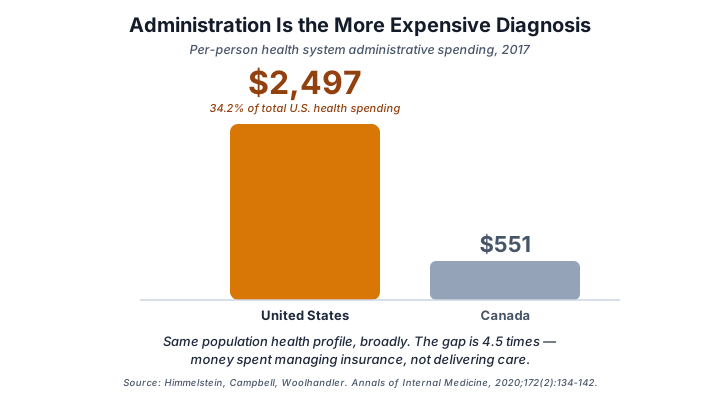
Where does that $2,497 per person actually go? Into exactly the kind of monthly fax-back-the-recertification work I am describing. Insurer billing departments, prior-authorization staff, denial-management staff, appeal-management staff, on the payer side. Practice billing departments, prior-authorization staff, denial-tracking staff, appeal-writing staff, on the provider side. Mirror images of each other, both funded by the patient.
The patient and the family see exactly none of this until something fails. And then they see all of it at once. The faxes. The portal logins that do not work. The phone tree that loops back to itself. The “we never received that” while the fax confirmation prints from the machine in the next room. The appeal deadline buried in a letter that arrived on day six of a fourteen-day window.
I have sent monthly recertification forms for ESRD patients to plans that knew, with mathematical certainty, that the patient still had ESRD. The reason is not that the plan needed the information. The reason is that requiring the information transfers cost from the plan to the clinic, and a fraction of those forms will fail to come back in time, and that fraction is denial-eligible, and a fraction of those denials will not be appealed, and that fraction is margin.
It is a tyranny of paper. It is funded by you.
8. The eight minutes and ten dollars
Let me bring this in from dialysis to my own private practice work, because the same machinery operates in mental health and the parity that does not exist there is one of the more honest tells of how this system actually values different parts of the body.
In outpatient psychotherapy, the two main billing codes for individual sessions are 90834 and 90837. 90834 is a thirty-eight to fifty-two minute session. 90837 is a fifty-three minute or longer session. The difference between them in real clinical practice is roughly eight minutes. That is it. Eight minutes.
The reimbursement difference between 90834 and 90837, depending on the payer, runs around ten dollars per session. Sometimes more. Sometimes less. Eight minutes, ten dollars.
This sounds trivial until you do the math at scale. A clinician seeing twenty-five clients per week, fifty weeks per year, who bills 90837 instead of 90834 for the bulk of those sessions, generates roughly twelve thousand dollars more per year. Same clinician. Same client base. Eight more minutes per session.
Insurers know this. They audit clinicians who bill 90837 at high rates. The American Psychological Association has had to publish guidance for clinicians on how to defend 90837 billing against payer audits. Plans send letters. They request documentation. They threaten clawbacks. The pressure to downcode to 90834 is constant and structural.
The reimbursement variance between platforms is its own data point. I have seen the per-session reimbursement at therapy platforms like Alma run roughly twenty-five dollars below what insurance companies pay directly. The insurer is not the only stakeholder taking a margin. The intermediary that exists to ease credentialing and billing also takes a cut. Every layer between the clinician and the federal benefit shaves something off.
This is not specific to mental health. But mental health is where you can see the squeeze most clearly because the units of work are small, the documentation requirements are heavy, and the reimbursement is already low.
9. The parity that isn’t
Mental health parity is the law. The Mental Health Parity and Addiction Equity Act of 2008 requires plans that cover behavioral health to do so at a level of access, cost-sharing, and treatment limits comparable to medical and surgical benefits. Easy to write. Hard to enforce.
The Department of Labor’s 2024 MHPAEA Report to Congress, released January 17, 2025, documented widespread non-compliance with the parity rules. The report identified six priority enforcement areas — including network composition, prior-authorization standards, and out-of-network reimbursement — and reported that 7.6 million participants benefited from corrections obtained through enforcement against approximately 72,000 plans.11
7.6 million is a lot of people. It is also a fraction of the total denominator. The size of that enforcement footprint is a way of telling you how much non-compliance was sitting there to be found.
If you have ever tried to find an in-network psychiatrist on a Medicare Advantage plan, you already know what the data is describing. The directory says yes. The phone calls say no. The phone calls say “not accepting new patients.” “Not in network anymore.” “Out on leave.” “Retired.” “Wrong number.” The directory is wrong on purpose. A plan with an inadequate behavioral health network and an accurate directory has a marketing problem. A plan with an inadequate behavioral health network and an inaccurate directory has cover.
Parity in law without parity in practice is just a lie wearing a statute number.
10. The price-outcome scandal
We pay more than any other developed country and get less for it. I want to put real numbers on this because the abstraction lets people argue with it.
The Commonwealth Fund’s 2024 Mirror, Mirror report ranked the United States last out of ten high-income countries on overall health system performance — last on access to care, last on health outcomes, last on equity, despite spending nearly twice the OECD average per capita.12 We are not getting more. We are getting less, and paying double for it.
CDC’s National Center for Health Statistics put US life expectancy at 78.4 years in 2023, with a partial recovery to 79.0 years in 2024 after the pandemic decline.13 The OECD-comparable country average was 82.7 years in the same period. We are more than four years behind comparable peers. Four years of life, on average, foregone — not because the technology is missing, but because the system that distributes it is broken.
A 2024 JAMA Health Forum analysis (Huckfeldt et al.) compared post-acute care intensity for Medicare Advantage versus traditional Medicare beneficiaries and found that MA enrollees received less intensive post-acute care than otherwise-similar traditional Medicare patients with the same conditions.14 Less rehab. Shorter stays. Less home health. The data does not say MA produces equivalent outcomes through efficiency. It says MA produces less care and pockets the difference.
This is the scandal at the center. We are spending more than any peer country and we are dying earlier than any peer country, and a meaningful share of the spread between what we pay and what we get is being captured by an insurance layer that exists to ration the care we already paid for.
Original description: Comparison chart showing US per-capita health spending of 13,432 dollars versus OECD average of 6,510 dollars, alongside US life expectancy of 78.4 years versus OECD average of 82.7 years
Two-times the spend. Four-and-a-third years less life. Last out of ten on system performance.
11. The overpayment, on the other side of the same coin
While managed Medicare is denying care to patients, it is also overcharging the federal government for the patients it covers.
The Medicare Payment Advisory Commission — MedPAC, the federal agency that advises Congress on Medicare spending — published its March 2025 Report to Congress estimating that Medicare Advantage payments will total approximately $84 billion more in 2025 than what the same beneficiaries would cost under traditional Medicare.15 Across 2023 and 2024 combined, MedPAC estimated more than $150 billion in excess MA spending relative to traditional Medicare.15
The excess is driven primarily by two mechanisms. First, MA insurers code their enrollees as sicker than they actually are — the so-called “risk score gaming,” where chart reviews and home health risk assessments add diagnoses to the record that increase the per-member federal payment without changing the care delivered. Second, the quality-bonus structure pays more to plans that hit star ratings, and plans optimize their measured performance more aggressively than their actual care delivery.
Hold those two facts side by side. The same insurers that are denying acute rehab to a man who has been in a hospital for five months are also collecting eighty-four billion dollars a year more from CMS than the same patients would cost under traditional Medicare. Denied care on one side. Padded payment on the other. Both flowing through the same balance sheet.
If you tried to write satire about American healthcare, you could not improve on this.
Original description: Stack chart showing 84 billion dollars excess Medicare Advantage spending in 2025, plus 83 billion in 2023 and 67 billion in 2024, totaling 234 billion across three years
Per Medicare Advantage member, per year, the federal government pays $2,329 more than the same person would cost under traditional Medicare. Multiply by 33 million enrollees.
12. Late-life downward mobility
This is the part that should keep retirees up at night.
You can do everything right. You can save. You can retire with a pension or a 401(k) that looked solid at sixty-five. You can pick the Medicare Advantage plan with good star ratings, the dental, the gym membership, the lower premium. You can move to Florida for the no-state-income-tax thing. You can convince yourself the math works.
And then somebody you love spends five months in a hospital. Or you do.
The Employee Benefit Research Institute’s 2024 analysis estimated that a 65-year-old couple with average prescription drug expenses, both enrolled in Medigap, would need approximately $351,000 saved to have a 90 percent chance of covering health expenses in retirement. The high-end estimate — couples with heavy prescription drug needs — pushed that number to $428,000 just for healthcare savings alone, separate from the rest of retirement.16 That is the line item that does not show up on the cocktail-party math.
For couples on Medicare Advantage with median drug expenses, EBRI’s targets were lower — around $98,000 for a man and $116,000 for a woman to hit the same 90 percent confidence — but that lower number assumes the MA plan delivers what the brochure says. The first time the network gap, the prior-authorization denials, or the out-of-network specialist costs hit, the actual out-of-pocket exposure can blow past the EBRI target in a single hospitalization.
Long-term care is where the line snaps. Genworth’s 2024 Cost of Care Survey put the national median annual cost of a semi-private nursing home room at $111,325, up seven percent year over year. A private room: $127,750.17 Medicare does not cover long-term custodial nursing home care. Not Medicare Advantage, not traditional Medicare, not any of it. To get nursing home coverage you have to spend down to Medicaid eligibility, which in most states means burning through your assets first. A retired couple with $400,000 in savings and one spouse needing two years in a nursing home can be dead-broke before that two years is up.
AARP’s 2023 caregiver research found that family caregivers spent an average of $7,242 out of their own pockets per year, equivalent to roughly twenty-six percent of caregiver income.18 That is on top of foregone work hours and the savings that do not get accumulated because somebody is on the phone with a prior-authorization line at 2 PM on a Wednesday.
You can be a have one decade and a have-not the next. The system is engineered to make that possible. It happens to people who did everything right. It will keep happening because the structure of managed Medicare is the structure that makes it happen.
13. The trust collapse
There is a cultural data point that does not show up in MedPAC’s tables but should.
Public confidence in the American medical system is at a multi-decade low. Gallup’s December 2024 healthcare poll found that 54 percent of Americans say healthcare in this country has “major problems,” another 16 percent say the system is “in a state of crisis,” and the share of Americans rating healthcare quality as “good” or “excellent” hit the lowest point in Gallup’s twenty-four-year trend.19 Trust in doctors has fallen fourteen points since 2021. Trust in the medical system as an institution is in free-fall.
You can read that as polling noise or you can read it as a warning. Watch what people do with their stories. Watch the social media reaction every time a denial story goes viral. Watch the comments. The country is watching what its insurance system does to people and the country has stopped pretending the insurance system is doing right by them.
This matters for clinicians and for healthcare leaders specifically because trust is the substrate on which every clinical interaction sits. When patients do not trust the system, they delay seeking care. They drop medications. They skip follow-ups. They show up at the ED at the point they should have shown up at the primary-care office two weeks earlier. Every public-trust point that erodes shows up downstream as worse outcomes for the next patient who walks through the door.
The trust collapse is not free-floating. It is data. It is the system’s report card from its own customers.
14. The caregiver tax
The story I started with — the hospital, the wall, the discharge planning — is a caregiving story, and caregiving has its own brutal data set.
A 2025 umbrella review of meta-analyses on informal caregivers found a median prevalence of clinically significant depression around 33 percent, anxiety around 35 percent, and overall caregiver burden around 49 percent.20 Roughly one in three caregivers screens positive for depression at any given time. One in three for anxiety. Half feel under sustained burden.
These are the people the system has off-loaded its administrative work to. They are taking the time off, making the calls, coordinating the discharge, fighting the denials, finding the in-network home health agency, monitoring the medications, handling the post-discharge transportation, calling the insurance company again because the previous representative said they would call back and didn’t, calling again, calling again.
The son in this story is one of these people. So is everyone else in that waiting room, and the families up and down that hospital floor. The hospital can engage with us. The insurance company has set up a system that systematically does not. The mismatch is itself the source of the burden.
If you want to know why caregivers are anxious, do not look first to clinical depression as a category. Look at the structure they are caregiving inside of. The structure is producing the affect. Mental health treatment for caregivers is necessary and good and I refer for it constantly. The deeper move is to fix the structure that is generating the patients.
The cost is not only psychological. AARP’s Valuing the Invaluable 2023 report estimated the economic value of unpaid family caregiving in the United States at approximately $600 billion in 2021 — 38 million caregivers contributing an average of 18 hours per week of care, valued at $16.59 per hour.21 Other research from the RAND Corporation has estimated $522 billion in foregone wages annually from caregivers reducing work hours or leaving the workforce.22
We talk about a “trillion-dollar caregiving economy” as if it were a number on a report. It is your sister taking afternoons off. It is your aunt missing the promotion she would have gotten. It is you on hold from a hospital chair for an hour at a time, only for the call to drop the moment you ask for a manager. It is six hundred billion dollars of work the system has off-loaded onto families who are not on payroll for it, plus another five hundred and twenty-two billion in wages those families do not earn because of it. It is the largest invisible labor market in the country, and we have built our healthcare financing on the assumption that it will keep being free.
Original description: Bar chart showing 600 billion dollars in unpaid caregiving labor and 522 billion dollars in foregone wages, totaling 1.12 trillion dollars per year, larger than the entire 2024 Medicare budget
Larger than the US defense budget. Larger than all of Medicare. None of it is on a budget. All of it gets assumed.
15. What we can actually do
I am not going to wrap this with a list of policy bullet points pretending I have solved a problem the federal government has not solved. I am going to say what I have seen work.
First, the 2024 CMS Medicare Advantage Final Rule (CMS-4201-F) made some structural changes that matter. It requires MA plans to honor a 90-day continuity-of-care transition period when an enrollee switches plans mid-treatment, during which the new plan cannot require prior authorization for the active course of treatment. It limits the use of prior authorization to confirming diagnoses or medical necessity. It requires a Utilization Management Committee at every plan to review policies annually for consistency with traditional Medicare’s coverage decisions.23
The rule is not enough. It is a step. The denial-friction architecture I have described will outlive any single rulemaking cycle because the financial incentive for plans to deny is structural, not procedural.
Second, families need to know to appeal. KFF’s 2022 data — only 9.9 percent of denials appealed, and 83 percent of appeals overturned — is a five-alarm fire of an underutilized remedy.3 The single highest-impact thing a family member can do for a hospitalized loved one on Medicare Advantage is to learn the appeal process and use it. State Health Insurance Assistance Programs (SHIPs) are free. The Medicare Rights Center has clinicians and attorneys on staff. You do not have to do this alone and you do not have to be a lawyer to do it.
Third, providers can document defensively. Good hospitals already do this well. Smaller practices and outpatient clinics — including therapists in private practice — have to assume that 90837s will be audited, that ESRD recertifications will be lost, that prior authorization will be denied, and build documentation that survives the appeal. That is administrative cost the country is paying because the system makes it necessary. Until the structure changes, the documentation is the defense.
Fourth — and this is the part I keep coming back to as a clinician — name the system out loud. Patients and families experience the wall as a personal failure. They blame themselves for not knowing the rules. They blame the doctor for not pushing harder. They blame the hospital for not making it work. The wall is none of those things. The wall is the explicit design of the product they bought. Once you can name it, you can stop carrying it as a personal weight. You can start treating it like the policy artifact it is.
16. A human being, not a file number
The father in this story has been in his hospital bed for almost five months. His hospital has been a model of what patient engagement looks like when an institution actually cares about the people in its beds. The insurance company has been a wall — a documented, datafiable, structural wall that exists because the financial design of managed Medicare rewards it for being one.
This is the thing I want every reader to take away.
The hospital is not the problem. The doctors are not the problem. The nurses, the therapists, the case managers, the social workers — none of them are the problem. The problem is a financial architecture that took a federal benefit this man paid into for forty-plus years of working life and routed it through a private intermediary whose business model is to keep what it does not spend.
We are spending more per person on healthcare than any other country in the world.12 We are dying four years earlier than our peer countries.13 More than half of our Medicare population is enrolled in a product that, by federal audit, denies medically necessary care thirteen percent of the time when audited.2 The wealth-protective math we sold retirees on does not survive a single five-month hospitalization. The trust the public used to have in this system is in free-fall, and the data backs them up.
He is a human being who paid taxes for forty years to earn the Medicare benefit that is now being rationed by a company that pretends the rationing is care management. He is not a file number. None of these patients are file numbers. The system needs to be told, in language it understands, that we know what it is doing — and we are not going to keep paying for the privilege of being denied care.
If you are reading this with a parent in a hospital bed, or with your own retirement coming, or as a clinician inside the machine: you are not crazy. The wall is real. The data is on your side. And the answer to a system that treats people like file numbers starts with the people refusing to be filed.
References
Footnotes
-
KFF. Medicare Advantage in 2025: Enrollment Update and Key Trends. Kaiser Family Foundation, 2025. https://www.kff.org/medicare/issue-brief/medicare-advantage-in-2025-enrollment-update-and-key-trends/ ↩
-
Office of Inspector General, U.S. Department of Health and Human Services. Some Medicare Advantage Organization Denials of Prior Authorization Requests Raise Concerns About Beneficiary Access to Medically Necessary Care. OEI-09-18-00260. April 2022. https://oig.hhs.gov/oei/reports/OEI-09-18-00260.asp ↩ ↩2 ↩3
-
Biniek JF, Sroczynski N, Cubanski J, Neuman T. Use of Prior Authorization in Medicare Advantage Exceeded 46 Million Requests in 2022. KFF, August 2024. https://www.kff.org/medicare/issue-brief/use-of-prior-authorization-in-medicare-advantage-exceeded-46-million-requests-in-2022/ ↩ ↩2 ↩3 ↩4
-
Salerno S, Messana JM, et al. Mortality Among Medicare Beneficiaries with End-Stage Kidney Disease Comparing Medicare Advantage and Traditional Medicare. JAMA Network Open. 2024. https://jamanetwork.com/journals/jamanetworkopen ↩ ↩2
-
Ochieng N, Biniek JF, Freed M, Damico A, Neuman T. Medicare Advantage: How Robust Are Plans’ Physician Networks? KFF, October 2025. https://www.kff.org/medicare/issue-brief/medicare-advantage-how-robust-are-plans-physician-networks/ ↩ ↩2
-
U.S. Senate Finance Committee Majority Staff. Refusal of Recovery: How Medicare Advantage Insurers Have Denied Patients Access to Post-Acute Care. October 2024. https://www.finance.senate.gov/imo/media/doc/refusal_of_recoverypdf.pdf ↩
-
Ross C, Herman B. Denied by AI: How Medicare Advantage plans use algorithms to cut off care for seniors in need. STAT News, March 2023; ongoing investigation series. Class certification reporting and federal court ruling permitting class action against UnitedHealthcare/NaviHealth’s nH Predict algorithm to proceed, February 2025. https://www.statnews.com/2023/03/13/medicare-advantage-plans-denial-artificial-intelligence/ ↩ ↩2
-
Rucker P, Miller M, Armstrong D. How Cigna Saves Millions by Having Its Doctors Reject Claims Without Reading Them. ProPublica, March 25, 2023. https://www.propublica.org/article/cigna-pxdx-medical-health-insurance-rejection-claims ↩
-
U.S. Department of Justice, Civil Division. United States Files Complaint Against Three Large Medicare Advantage Insurers and Three Large Insurance Brokerages for Paying or Receiving Hundreds of Millions of Dollars in Illegal Kickbacks. Press release and Complaint-in-Intervention, May 1, 2025. CMS Final Rule on Broker Compensation (CY 2025), CMS-4205-F, April 2024; ruling vacating portions of CY 2025 broker compensation rule, U.S. District Court for the Eastern District of Texas, August 2025. https://www.justice.gov/opa/pr/united-states-files-complaint-against-three-large-medicare-advantage-insurers-and-three ↩ ↩2
-
Himmelstein DU, Campbell T, Woolhandler S. Health Care Administrative Costs in the United States and Canada, 2017. Annals of Internal Medicine. 2020;172(2):134-142. doi:10.7326/M19-2818. https://www.acpjournals.org/doi/10.7326/M19-2818 ↩
-
U.S. Department of Labor, Employee Benefits Security Administration. 2024 MHPAEA Report to Congress. January 17, 2025. https://www.dol.gov/sites/dolgov/files/EBSA/laws-and-regulations/laws/mental-health-parity/report-to-congress-2024-mhpaea.pdf ↩
-
Schneider EC, Shah A, Doty MM, et al. Mirror, Mirror 2024: A Portrait of the Failing U.S. Health System. The Commonwealth Fund, September 2024. https://www.commonwealthfund.org/publications/fund-reports/2024/sep/mirror-mirror-2024 ↩ ↩2
-
Arias E, Xu JQ. United States Life Tables, 2023. NCHS Data Brief No. 521. National Center for Health Statistics, December 2024. https://www.cdc.gov/nchs/products/databriefs/db521.htm ↩ ↩2
-
Huckfeldt PJ, Escarce JJ, Sood N, et al. Postacute Care for Medicare Advantage vs Traditional Medicare Beneficiaries. JAMA Health Forum. 2024. https://jamanetwork.com/journals/jama-health-forum ↩
-
Medicare Payment Advisory Commission. March 2025 Report to the Congress: Medicare Payment Policy. MedPAC, March 2025. https://www.medpac.gov/document/march-2025-report-to-the-congress-medicare-payment-policy/ ↩ ↩2
-
Fronstin P, VanDerhei J. Projected Savings Medicare Beneficiaries Need for Health Expenses Continued to Rise in 2024. EBRI Issue Brief No. 619, January 2025. https://www.ebri.org/content/projected-savings-medicare-beneficiaries-need-for-health-expenses-continued-to-rise-in-2024 ↩
-
Genworth Financial / CareScout. Cost of Care Survey 2024. April 2025. https://www.carescout.com/cost-of-care ↩
-
AARP Public Policy Institute. Family Caregivers and Out-of-Pocket Costs: 2021 Update. (2023 update analysis.) https://www.aarp.org/pri/topics/ltss/family-caregiving/family-caregivers-cost-survey.html ↩
-
Saad L. Americans’ Ratings of U.S. Healthcare Quality Slip to 24-Year Low. Gallup, December 2024. https://news.gallup.com/poll/654044/americans-ratings-healthcare-quality-slip-year-low.aspx ↩
-
Gérain P, Zech E. Prevalence of depression, anxiety, burden, burnout, and stress in informal caregivers: An umbrella review of meta-analyses. Journal of Affective Disorders Reports. 2025. doi:10.1016/j.jadr.2025.100785. https://www.sciencedirect.com/science/article/pii/S2950307825000785 ↩
-
Reinhard SC, Caldera S, Houser A, Choula RB. Valuing the Invaluable 2023 Update: Strengthening Supports for Family Caregivers. AARP Public Policy Institute, March 2023. https://www.aarp.org/pri/topics/ltss/family-caregiving/valuing-the-invaluable.html ↩
-
Skira MM. The Economic Burden of Family Caregiving: Time Use and Wages Lost. RAND Corporation working analyses, synthesizing prior estimates including the $522 billion annual foregone-wages figure for U.S. family caregivers. https://www.rand.org/topics/family-caregiving.html ↩
-
Centers for Medicare & Medicaid Services. Contract Year 2024 Policy and Technical Changes to the Medicare Advantage Program, Medicare Prescription Drug Benefit Program (Final Rule, CMS-4201-F). April 2023. https://www.cms.gov/newsroom/fact-sheets/2024-medicare-advantage-and-part-d-final-rule-cms-4201-f ↩
Frequently asked questions
- What is managed Medicare and how is it different from traditional Medicare?
- Managed Medicare — sold as Medicare Advantage (Part C) — is Medicare administered through a private insurance company instead of the federal government. The insurer collects a flat per-member payment from CMS and decides which providers, services, and procedures are covered. Traditional Medicare lets you see any provider that accepts Medicare; Medicare Advantage limits you to a network and adds prior-authorization gates.
- Do Medicare Advantage plans actually deny medically necessary care?
- A 2022 HHS Office of Inspector General audit found that 13 percent of Medicare Advantage prior-authorization denials would have been covered under traditional Medicare. A 2024 Senate Finance Committee staff report documented post-acute care denial patterns at the three largest MA insurers. KFF's analysis of CMS data found 3.4 million prior-authorization denials in 2022 alone.
- Why do family members end up so anxious about navigating the system?
- Family caregivers absorb the administrative burden the system off-loads — appeals, in-network searches, documentation, and the time pressure of hospital discharge. Meta-analyses show roughly one in three informal caregivers screens positive for depression and one in three for anxiety. The healthcare system itself becomes a stressor.
- Does the United States get better outcomes for spending more?
- No. The Commonwealth Fund's 2024 international comparison ranks the US last among ten high-income countries on health system performance despite spending nearly twice the OECD average per capita. CDC data put US life expectancy at 78.4 years in 2023, more than four years below the OECD-comparable average.