A peer-reviewed simulation study published in May 2026 puts hard federal numbers behind something clinicians and patients have been saying for years: there are not enough psychiatrists, the gap is growing fast, and the market is not going to fix it on its own.
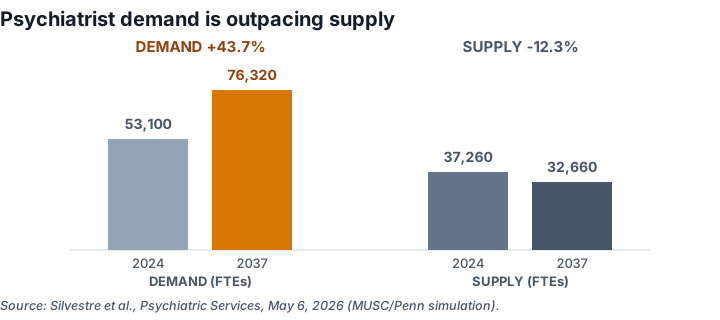
Quick answer: Researchers from the Medical University of South Carolina and the University of Pennsylvania published a workforce simulation in Psychiatric Services on May 6, 2026. Using the federal Health Workforce Simulation Model, they project that the supply of adult psychiatrists will fall 12.3% — from 37,260 full-time equivalents in 2024 to 32,660 by 2037 — while patient demand rises 43.7%, from 53,100 FTEs to 76,320. That is not a staffing gap. That is a structural collapse in slow motion. By 2037, the study projects 43 states will fall below adequate workforce coverage, up from 42 today.
What the Psychiatrist Shortage Study Found
The paper — “The Impending Psychiatrist Shortage: Projected Deficiencies in the U.S. Adult Psychiatry Workforce” — was published online May 6, 2026, in Psychiatric Services (DOI: 10.1176/appi.ps.20250467). The authors: Jason Silvestre, M.D., Sydney Seeger, M.S., Charles A. Reitman, M.D., and Benoit Dubé, M.D. They ran the federal government’s Health Workforce Simulation Model — the same methodology HRSA uses for national projections. This is not an advocacy estimate. It is a federal simulation tool applied to real workforce data.
The headline numbers: demand up 43.7%, supply down 12.3%, net adequacy approaching catastrophic by 2037.
The geographic picture is worse than the national aggregate. In 2024, the states with the lowest workforce adequacy were North Dakota, New Mexico, and Oklahoma. By 2037, the projected worst-off states are Idaho, Nevada, and Alaska. But the 43-state number is what matters strategically: this is not a rural-only problem or a flyover-state story. It is a national structural failure that happens to hit some states first.
I’ve watched this trajectory build for years. When I was directing behavioral health programs — substance abuse services, a forensic assertive community treatment team, disaster case management — the psychiatrist availability problem was already a daily operational constraint. What this study does is take what we experienced as anecdote and give it the weight of a federal projection with specific numbers and a hard timeline. That changes the policy conversation.
Why the Market Is Not Going to Fix This
The standard economic argument goes: if there is a shortage, prices rise, people enter the field, the gap closes. That logic does not apply here, and understanding why is the whole point.
Residency slots are federally capped. The number of Medicare-funded graduate medical education positions has been frozen at 1996 levels. Medical schools have graduated more doctors over the past two decades, but the training pipeline has not expanded to match. Only about 5% of residency slots are allocated to psychiatry. Congress added some new positions recently — the Consolidated Appropriations Act of 2023 designated at least 100 new spots for psychiatry — but those additions are marginal against the scale of the deficit. You cannot train more psychiatrists than residency slots allow, and the federal government controls that ceiling.
The existing workforce is aging out. More than 60% of active psychiatrists in the U.S. are 55 or older, according to AAMC data. That is not a workforce with growth ahead of it. That is a workforce with a retirement wave coming, and no comparable pipeline behind it. The 12.3% supply decline the MUSC study projects is not a risk scenario. It is essentially the mathematical consequence of this age distribution if nothing changes structurally.
Commercial insurance reimbursement has pushed a significant share of psychiatrists out of network. Within the same commercial health plan, behavioral health providers — including psychiatrists — are reimbursed at a fraction of what the same plan pays medical and surgical providers for equivalent services. That within-plan disparity is the documented parity violation at the center of every state enforcement action in 2025 and 2026. The result: 34% of behavioral health practitioners do not participate in insurance networks at all, per a 2024 Practitioner Pulse Survey. Of those out-of-network providers, nearly half were in-network at some point and left. The primary reasons: 82% cited insufficient reimbursement, 62% cited administrative burden, 52% cited payment delays and clawbacks.
Put those pieces together: the training pipeline is federally capped, the existing workforce is retiring, and the reimbursement structure has made commercial insurance participation economically untenable for a substantial share of the workforce. None of those forces respond to a demand signal. The market signal to enter psychiatry exists. The mechanisms that would normally respond to it are broken by design.
That is a structural failure, not a temporary imbalance.
Who Absorbs the Gap
Someone treats the people who cannot reach a psychiatrist. In practice, that someone is mostly primary care physicians, nurse practitioners, and licensed clinical social workers — providers who were not trained or resourced to deliver the level of psychiatric complexity the shortage demands.
I am one of the social workers who ends up in that position. Seeing clients for whom the only psychiatric care they have received was a prescription written by a PCP in the margins of a 20-minute appointment is not unusual. The PCP is not doing anything wrong. They are doing their best with a caseload that was never designed to absorb psychiatric complexity. The system is asking them to absorb it anyway, because there is no one else available.
HRSA projects that demand for behavioral health services overall will increase 49% through 2033 while workforce supply grows only 11%. The gap between those numbers gets filled informally, inefficiently, and often inadequately — by whoever is available, not by whoever is best suited. Telehealth has improved geographic reach, and expanded NP scope-of-practice has added some capacity. These are real partial solutions. But they do not solve the complex psychopharmacology problem. They redistribute some lower-acuity volume. The shortage at the top of the acuity pyramid — treatment-resistant cases, complex medication management, co-occurring severe psychiatric and medical conditions — remains unaddressed.
What This Means for Employers
Mental health benefits are now a standard feature of competitive compensation packages. Most large employers offer them. HR teams promote them at open enrollment. But a benefit that cannot connect to a provider is not a benefit. It is a promise the healthcare system cannot keep.
The median wait time for a new patient psychiatric appointment in the U.S. is 67 days for in-person visits and 43 days for telepsychiatry. Only 18.5% of psychiatrists are accepting new patients. More than half of psychiatrists contacted in recent survey research reported they were not taking new patients at all.
Put those numbers next to an employee who is finally willing to get help — and is now looking at a two-month wait, or no available appointment at all. The benefit exists on paper. The care does not exist in practice.
For employers who genuinely want to move the needle on workforce mental health, the psychiatrist shortage changes the calculus on plan design. Coverage adequacy and access adequacy are not the same thing. A plan can have excellent coverage on paper and zero actual access in practice if the network is structurally inadequate. The MUSC projections mean that access adequacy will get harder to achieve every year through 2037 under a status-quo scenario. Employers who are not asking pointed questions about their network’s real access will find out the hard way.
What an Actual Fix Requires
The MUSC researchers name the levers: expand Medicare-funded residency positions, increase incentive programs for practicing in underserved states, expand loan forgiveness, reform interstate telehealth licensing, and increase psychiatrist participation in public insurance networks.
Those are the right levers. None of them are market-driven. All of them require sustained policy action at the federal and state level.
The APA has been advocating on these fronts for years with incremental results. What this study adds is urgency and specificity. A federal simulation tool projecting 43 states below adequacy by 2037, with demand up 43.7% and supply down 12.3%, is harder to dismiss than clinical impression. It gives advocates, legislators, and health systems a concrete number to argue from.
What I know from behavioral health work since 2015 is that this system has never self-corrected on a problem of this scale. The financial structure that suppresses psychiatrist supply is the same structure that suppresses access to all behavioral health care. It does not respond to demand signals the way a functional market would. It responds to organized, sustained policy pressure — or it does not respond at all.
The study gives that pressure a sharper argument. Whether it gets used is a different question.
FAQ
What exactly did the MUSC study find?
Published in Psychiatric Services on May 6, 2026, “The Impending Psychiatrist Shortage: Projected Deficiencies in the U.S. Adult Psychiatry Workforce” used the federal Health Workforce Simulation Model to project that adult psychiatrist supply will fall 12.3% — from 37,260 to 32,660 full-time equivalents — while patient demand rises 43.7%, from 53,100 to 76,320 FTEs, between 2024 and 2037. By 2037, 43 states are projected to have inadequate psychiatric workforce coverage.
Why isn’t the psychiatrist shortage fixing itself?
Three structural barriers prevent market self-correction: federally capped residency slots (frozen near 1996 levels) limit how many psychiatrists can be trained regardless of demand; the existing workforce is aging, with over 60% of psychiatrists older than 55; and commercial insurance reimbursement rates have pushed 34% of behavioral health providers out of insurance networks entirely. These are policy failures, not market inefficiencies.
How long are people waiting to see a psychiatrist right now?
Recent data shows median wait times of 67 days for in-person psychiatric appointments and 43 days for telepsychiatry. Only 18.5% of psychiatrists are currently accepting new patients. More than half of psychiatrists contacted in survey research reported they were not taking new patients — the most common stated reason for unavailability.
What would actually fix the psychiatrist shortage?
The MUSC researchers identify the key levers: expanding Medicare-funded graduate medical education positions, increasing loan forgiveness and incentives for underserved-area practice, reforming interstate telehealth licensing, and increasing psychiatrist participation in public insurance networks. All of these require sustained legislative and regulatory action. The shortage is a structural failure and requires structural solutions — not market adjustment.
Sources
- The Impending Psychiatrist Shortage: Projected Deficiencies in the U.S. Adult Psychiatry Workforce — Silvestre et al., Psychiatric Services, published online May 6, 2026; DOI: 10.1176/appi.ps.20250467
- MUSC Led Study Finds Adult Psychiatry Shortage Likely to Get Worse as Need Grows — Medical University of South Carolina news release, June 25, 2026
- New Study Projects a Massive Shortage of Adult Psychiatrists in the United States — PsyPost, June 2026
- Health Workforce Projections — HRSA Bureau of Health Workforce; 49% behavioral health demand increase through 2033; adult psychiatrist shortage projections through 2036
- Physician Workforce Projections — AAMC; 60%+ of active psychiatrists age 55 or older
- Low Availability, Long Wait Times, and High Geographic Disparity of Psychiatric Outpatient Care in the US — Psychiatric Services / ScienceDirect; 67-day median in-person wait; 18.5% accepting new patients
- How Insurance Woes Are Impacting Mental Health Care — American Psychological Association; 34% out-of-network; reimbursement and administrative burden data
Disclaimer
Disclaimer
This article is for educational and informational purposes only. It does not constitute medical, clinical, legal, or therapeutic advice, and reading it does not create a therapist-client relationship with Matthew Sexton, LCSW or Mental Wealth Solutions, Inc. Although the author is a licensed clinical social worker, the content in this article is not clinical assessment, diagnosis, or treatment.
The workforce projections and statistics cited here reflect peer-reviewed research and publicly available federal data as of the publication date. Workforce conditions change, and individual regional and specialty markets vary significantly. Consult current HRSA and professional association resources for the most up-to-date workforce data in your area.
If you are in immediate emotional crisis, you can reach the 988 Suicide & Crisis Lifeline by calling or texting 988 (US). If you are experiencing domestic violence or are in physical danger, contact the National Domestic Violence Hotline at 1-800-799-7233 or visit thehotline.org. In a life-threatening emergency, call 911.
Want to discuss this for your program?
Book a 30-min conversation. We'll walk you through deployment, the BAA, and what your rollout looks like in production.
Book a 30-min conversation