AI Is Replacing Licensed Clinicians in Mental Health Triage
Becker's Behavioral Health: 25.2% of Americans need behavioral health care in 2026. Kaiser is replacing licensed clinicians with unlicensed, AI-scripted triage.
From the earlier archive. This article’s original writing is retained and has not been fact-checked as part of our current review. Product references may reflect an earlier version; see current solutions for today’s status.
In April 2026, NPR reported that Kaiser Permanente has been reassigning licensed clinical social workers away from behavioral health triage — replacing them with unlicensed operators following an AI-generated script. The framing in coverage has been careful: “AI-assisted,” “workforce optimization,” “streamlined intake.” The nurses and social workers who used to hold those triage calls have a different word for it.
I’ve done triage in forensic ACT settings, disaster case management, and inpatient behavioral health across 13 years of practice. Let me tell you what actually happens during a triage call — and why removing the licensed clinician from that conversation is not a workflow improvement. It’s a safety event waiting to be classified.
The Access Crisis Is Real — and Being Used as Cover
Let’s start with the actual problem. Behavioral health demand is not a projection anymore. Becker’s Behavioral Health puts the 2026 estimate at 25.2% of Americans needing services — roughly 84 million people. The licensed clinician supply hasn’t grown proportionally. Rural areas are especially starved. Wait times at community mental health centers stretch six to twelve weeks. The gap between need and access is documented, severe, and not improving fast enough.
That’s a real crisis. And it creates an opening for a compelling false solution: if we don’t have enough licensed clinicians, maybe we can use AI to cover more ground with fewer of them.
The logic sounds defensible. It falls apart the moment you examine what triage actually requires.
Triage Is Not a Routing Task
Here is what administrators, hospital CEOs, and technology vendors seem to consistently misunderstand: behavioral health triage is not a decision tree. It is a clinical judgment call that happens inside a conversation, in real time, with a person who may be in crisis — and who may not be telling you the full story.
A licensed clinician doing triage is not running down a checklist. They are:
- Listening for what the patient is not saying — the pauses, the hedging, the practiced-sounding answers that don’t quite fit the affect behind them
- Assessing suicidality and homicidality through graduated, relationship-building questions — not binary yes/no prompts
- Recognizing when a presenting complaint (“I’ve been feeling anxious”) is covering for something more acute (“I haven’t slept in four days and I’ve been thinking about driving off the bridge”)
- Making a level-of-care determination that has direct legal and clinical implications
An unlicensed operator following an AI script can do none of those things. They can follow the script. What they cannot do is recognize when the script’s outputs are wrong — because that recognition requires the clinical training the script was built to replace.
This is not a technology limitation that future models will solve. It is a knowledge boundary. You cannot encode 13 years of clinical judgment, earned through direct patient contact in forensic settings and disaster response, into a prompt. The prompt can only detect what it was trained to detect. The clinician detects what they weren’t expecting to detect.
What the AI Gets Wrong at the Margin
The patients who are easiest to triage correctly don’t need highly trained clinicians to triage them. Someone presenting with moderate generalized anxiety, stable housing, no history of SI, and an intact support system will get routed correctly by almost any process. The script will work fine.
The patients who are hardest to triage correctly are the ones at highest risk of catastrophic outcomes. The person minimizing because they’ve been hospitalized before and don’t want to go back. The veteran who gives trained, rehearsed answers because they’ve learned what triggers an involuntary hold. The person in early-stage psychosis who sounds perfectly coherent but whose responses to lateral questions reveal significant disorganization. The survivor who answers “no” to suicidality questions because they’ve already made their plan and have moved past ambivalence.
These are the patients at the margin. And at the margin is exactly where AI scripts — and unlicensed operators following them — will fail. The misses won’t always be visible in the data. Some patients will decompensate at home. Some will appear in ED records weeks later. Some will appear in obituaries.
The cost of those misses doesn’t show up in this quarter’s payroll savings. It shows up later. That is precisely why the behavioral economics literature on temporal discounting is relevant here: systems are chronically prone to choosing near-term cost reduction over long-term safety when the bad outcome is both uncertain and delayed. It’s not malice. It’s a well-documented cognitive failure that institutional structures replicate at scale.
Equity Is Not an Afterthought Here
There is a pattern that holds across virtually every healthcare efficiency measure introduced in the last two decades: underserved populations absorb the worst outcomes. This is not speculative — it is documented in the literature on managed care cost controls, prior authorization requirements, and discharge planning protocols. When a system optimizes for throughput, it optimizes for the average patient. The average patient is not the one most at risk.
Behavioral health AI triage rollouts will follow the same pattern. Where will unlicensed AI-scripted operators be deployed? At the highest-volume call centers — which are disproportionately serving Medicaid populations, rural communities, and patients who lack the resources to seek care elsewhere. Private-pay patients and those with commercial insurance will retain access to licensed clinicians in more controlled intake environments. The gap between those populations — in terms of safety, quality of triage, and likelihood of receiving appropriate level-of-care placement — will widen.
This is the equity dimension that is almost entirely absent from the current AI in behavioral health conversation. The technology is being evaluated on cost efficiency and clinician-hours-per-interaction. It is not being evaluated on whether the patients most likely to fall through are the ones who already have the fewest safety nets.
What Responsible AI-Augmented Mental Health Triage Actually Looks Like
I want to be precise about this, because the alternative to reckless AI deployment is not no AI. The behavioral health access crisis is real and the status quo is not acceptable. The solution is to scale licensed clinicians — not replace them.
There is a model that works. It looks like this:
-
AI-assisted pre-screening: A structured, validated screening tool collects presenting symptoms, crisis indicators, history of prior treatment, and initial risk stratification. This is something AI does well. It’s faster than intake paperwork, more consistent than an unlicensed operator’s memory, and creates a structured record that the clinician receives before the conversation begins.
-
Licensed clinician review: A licensed clinical social worker, counselor, or psychiatric clinician reviews the AI-generated risk summary and conducts the triage conversation with that context already loaded. They are not starting from scratch — but they are making the clinical judgment call. They are reading the gaps between the AI’s outputs and what the patient is actually presenting. They are doing the part that requires licensure.
-
Documented, defensible level-of-care determination: The clinician’s determination — not the algorithm’s output — is what drives placement, referral, and follow-up. The AI is a decision support tool, not a decision maker.
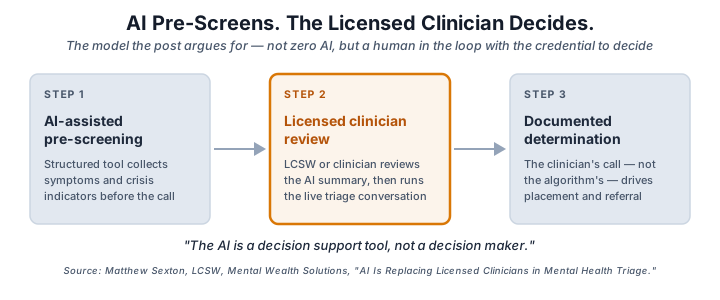
This is the model I’ve built TransplantCheck and VeteranCheck around. The AI handles systematic screening and risk flagging. A licensed clinician reviews the results and makes the clinical determination. The AI does not triage. It pre-triages — and then hands off to a human being with the credential to make the call.
This approach is more expensive than replacing the licensed clinician with an unlicensed operator. It is also safer, more legally defensible, and — critically — it is scalable without sacrificing clinical integrity. You can increase patient volume by improving how efficiently the licensed clinician’s time is used. You cannot increase patient volume by removing the licensed clinician from the loop without accepting consequences that haven’t appeared in your data yet.
What This Means for the Field
The Kaiser Permanente story is not an isolated case. The American Academy of Arts and Sciences’ Winter 2026 bulletin on AI and mental health care notes that we are in a period where “the field’s enthusiasm for AI-enabled efficiency outpaces the evidence base for its safety.” Healthcare IT News describes mental health AI as “breaking through to core operations in 2026.” The American Psychological Association has clarified — correctly — that AI is not replacing licensed practitioners in therapy. What nobody has said clearly enough is that the same protection needs to apply to triage.
NASW, state behavioral health licensing boards, and CMS all have regulatory standing here. The licensing framework for clinical social workers exists precisely because these judgment calls require documented training, supervised practice hours, and ongoing accountability. When a healthcare system replaces a licensed clinician with an unlicensed operator following an AI script, they are not just cutting costs. They are making an unilateral determination that clinical licensure doesn’t matter for triage — which is a position the law, the ethics codes, and thirteen years of direct practice tell me is wrong.
If you are a healthcare administrator reading this: the liability exposure from a triage miss by an unlicensed AI-scripted operator is not hypothetical. It is a when, not an if. The question is which patient it happens to and whether it happens before or after you’ve been served.
If you are a policymaker: the behavioral health workforce crisis requires investment in expanding the licensed clinician pipeline — through loan forgiveness, pay parity, supervision infrastructure, and reimbursement reform. It does not require legislative cover for replacing licensed judgment with scripted throughput.
If you are a patient: you have the right to ask who is triaging you, whether they are licensed, and what clinical authority backs their recommendation. Those questions are worth asking.
The access gap in behavioral health is real and urgent. Addressing it requires intelligent systems, efficient workflows, and tools that let licensed clinicians do more. It does not require removing licensed clinicians from the decisions that require them most.
Matthew Sexton, LCSW is a clinical social worker with 13 years of experience in forensic ACT, disaster case management, substance abuse treatment, and behavioral health administration. He is the President of Mental Wealth Solutions, Inc. and the developer of TransplantCheck and VeteranCheck — platforms that use AI-assisted screening paired with licensed clinical review to support high-risk patient populations. Follow on X/Twitter: @MattSextonLCSW.