Behavioral Health Workforce Attrition Is a Death Spiral
HRSA projects a 114,000 behavioral health worker shortage by 2037. Turnover is outpacing new entrants — training more clinicians won't fix why they burn out.
From the earlier archive. This article’s original writing is retained and has not been fact-checked as part of our current review. Product references may reflect an earlier version; see current solutions for today’s status.
There’s a number that gets cited in every behavioral health workforce conversation right now: HRSA projects a shortage of more than 114,000 addiction counselors and behavioral health workers by 2037. It shows up in grant applications, congressional testimony, conference presentations, and workforce development proposals. It’s real. It’s alarming. And the way we’re responding to it is almost entirely wrong.
The response, almost universally, is: we need more people entering the pipeline.
More training slots. More loan forgiveness programs. More J-1 visa waivers for underserved areas. More partnerships with graduate schools. More internship pathways. More recruitment.
All of that matters. None of it addresses the actual problem.
The actual problem is that behavioral health is currently losing clinicians faster than it produces them. Attrition has outpaced new entrants. We are not experiencing a shortage. We are experiencing a spiral — and the policy conversation is treating it like a tap that needs to be turned up, when the bucket underneath it has a hole.
What the Data Actually Shows
HRSA’s 2026 workforce projections are often read as a supply problem: not enough people choosing behavioral health careers. But the underlying data tells a different story.
Turnover rates in behavioral health settings run between 30% and 50% annually at many community mental health centers and substance use programs. The National Council for Mental Wellbeing’s 2026 workforce report documents that organizations are cycling through clinical staff at a pace that makes caseload stability structurally impossible. Clients experience multiple provider transitions in a single year. Supervisors spend a growing share of their time onboarding and offboarding rather than building clinical capacity.
The SAMHSA grant terminations that rippled through early 2026 — briefly rescinded but revealing of a larger funding fragility — removed infrastructure that many organizations depended on to fund supervision, training, and clinical support roles. The proposed Medicaid cuts via H.R. 1 (CBO scoring: 11.8 million people losing coverage) would further compress funding for the community-based behavioral health settings where the attrition crisis is most acute. These are not separate problems. They compound each other.
When funding shrinks, organizations cut supervision and administrative support first. When supervision quality drops, newer clinicians don’t receive the training and oversight that builds retention. When clinicians burn out and leave, supervisors absorb more direct caseload. When supervisors are overloaded, their capacity to retain the next generation collapses. The spiral accelerates.
Training more people to enter this environment does not stop the spiral. It feeds it.
The Behavioral Health Workforce Misdiagnosis
The language we use matters. “Workforce shortage” frames the problem as insufficient supply entering the system. It points toward recruitment, education pipeline expansion, and immigration policy as the solutions.
“Retention failure” frames the problem as the system itself burning through its own workers. It points toward organizational design, supervision infrastructure, caseload management, documentation burden reduction, and working conditions as the solutions.
These require different interventions. They require different accountability structures. And they point to different parties as responsible for the fix.
The “shortage” frame is politically easier. It allows administrators, funders, and policymakers to point outward — at graduate schools, at the talent pool, at the economy. The “retention failure” frame points inward. It asks what is happening inside behavioral health organizations that makes experienced clinicians leave.
I have spent thirteen years across thirteen clinical settings — forensic ACT teams, substance abuse programs, disaster case management, community mental health, dialysis social work. I have been a floor-level clinician in programs that were bleeding staff. I have been a supervisor trying to stabilize a team that lost three people in one quarter. I have been a director rebuilding a program from structural failure.
Here is what I know from that: clinicians do not primarily leave for salary. Salary matters, but it is rarely the deciding factor for exit.
They leave for caseloads that are not survivable. They leave for documentation systems that consume four hours of administrative work for every one hour of clinical contact. They leave for supervision that is evaluative rather than developmental. They leave for organizations where the implicit message is that their sustainability as a person is their own problem. They leave when they do not see a career path that does not require them to slowly disappear.
None of those problems are solved by a new cohort of students entering the field.
What Clinicians Actually Say When They Leave
Exit interview data from behavioral health organizations — when organizations bother to collect it — consistently identifies several drivers that have nothing to do with pay:
Documentation burden. EHR systems designed for billing optimization rather than clinical workflow impose enormous time costs on clinicians. A clinician carrying a caseload of 30 active clients in a Medicaid-funded program may spend 30-40% of their working hours on documentation that does not serve clinical decision-making. That is not sustainable over years.
Supervision quality and ratio. Supervision in behavioral health is chronically underfunded. When caseloads are high and headcount is short, supervision becomes a check-in rather than a developmental relationship. New clinicians who need structured reflective supervision — especially those working with high-acuity populations — do not get it. They either find their own peer support structures or they leave.
Caseload composition and intensity. High-acuity caseloads without adequate support are not just hard — they are clinically dangerous. Organizations that do not manage caseload composition set up their clinicians to fail.
Moral injury. This is underappreciated. Clinicians in underfunded community settings are regularly asked to do more with less in ways that violate their professional ethics. When a clinician knows that a client needs an inpatient level of care and cannot access it, and that situation repeats across a caseload, week after week, year after year — that is not burnout. That is moral injury. The distinction matters because the treatment is different.
Licensure pathway opacity. Many clinicians in community settings are working toward clinical licensure (LCSW, LCPC, LMFT) but receive no organizational support for that process. They find their own supervisors, pay out of pocket for supervision hours, and manage the licensing board requirements without institutional support. Organizations that invest in licensure pathways retain clinicians significantly longer.
What Retention-First Strategy Actually Looks Like
A retention-first workforce strategy does not begin with a wellness committee or an employee appreciation week. Those are not retention strategies. They are morale gestures.
Retention-first means treating clinician sustainability as a system design problem, not an individual resilience problem.
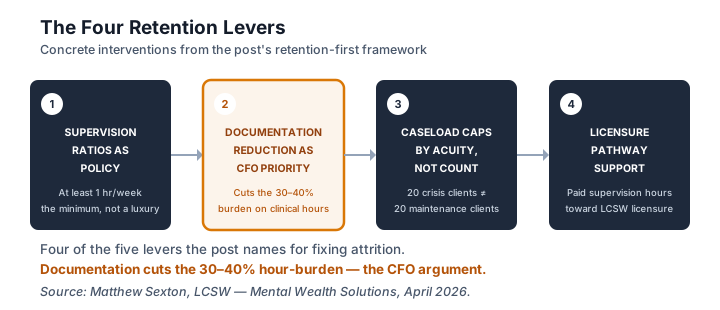
Supervision ratios as policy, not aspiration. Every clinician carrying a Medicaid-funded caseload should have access to at least one hour of individual clinical supervision per week, plus peer review. That is not luxury — it is the minimum standard to practice safely with high-acuity populations. Organizations that cannot fund that ratio should adjust their caseload capacity, not their supervision frequency.
Documentation reduction as a CFO priority. Every hour a licensed clinician spends on documentation that does not improve clinical outcomes is an hour the organization paid for and wasted. Documentation optimization — smarter EHR configuration, AI-assisted progress notes, structured templates that reduce click burden — is a financial efficiency intervention, not a perk. Organizations that treat it this way get better retention and better margin.
Caseload caps that reflect acuity, not just count. A caseload of 20 clients in crisis stabilization is not the same as a caseload of 20 clients in long-term maintenance. Organizations that cap by headcount but ignore acuity distribution are setting clinicians up for compounding overload.
Institutional licensure support. Paying for clinical supervision hours toward LCSW or equivalent licensure, providing internal supervisors who can sign off on hours, building the licensure pathway into the organizational onboarding structure — this is cheap relative to the cost of turnover, and it creates a retention incentive that compounds over years.
Exit interview infrastructure. Most behavioral health organizations do not systematically collect and analyze exit interview data. They therefore cannot identify systemic retention risks. If you do not know why people leave, you cannot fix it. This is a data problem before it is an intervention problem.
The Competitive Moat Nobody Is Talking About
Here is the organizational strategy argument: behavioral health is about to experience a talent environment where organizations that have solved retention will have a structural competitive advantage over those that have not.
The organizations that figure out retention now — that build the supervision infrastructure, that reduce documentation burden, that create real licensure pathways — will be the ones that can recruit selectively when the shortage deepens. They will have stable, experienced clinical teams when competitors are cycling through new graduates. They will have better outcomes data, which drives referral volume from systems that care about quality.
This is not a values argument, though the values are clear. This is a strategic argument. Retention is the lowest-cost, highest-ROI workforce intervention that exists in behavioral health right now. The organizations that treat it as such will outlast the ones that don’t.
A Note on Workforce Load Reduction
One underutilized lever in the retention conversation is technology that reduces the non-clinical burden on clinicians — not AI therapy replacing clinical judgment, but tools that remove administrative friction from clinical workflows.
In transplant and chronic illness settings, social workers are often responsible for complex care coordination documentation, eligibility navigation, and referral tracking that is time-consuming but not clinically complex. Systems that streamline that documentation load — that let a social worker complete a care coordination note in three minutes rather than twenty — extend clinical capacity without adding headcount.
That kind of load reduction matters for retention. A clinician who ends the day having done clinical work — rather than documentation work — is a clinician who comes back.
The Diagnosis Matters
The behavioral health workforce crisis will not be solved by pipeline investment alone. It will require retention-first organizational strategy at scale: supervision investment, documentation reduction, caseload management, licensure support, and the cultural shift from treating attrition as an individual failure to treating it as a system signal.
The shortage is real. The spiral is real. Treating them as the same problem, requiring the same intervention, is the misdiagnosis that will cost us the next decade.
The clinicians we need in 2037 are largely already in the field. The question is whether the organizations they work for are designed to keep them there.
Matthew Sexton, LCSW is the founder of Mental Wealth Solutions, Inc. and has worked across 13 clinical settings over 13 years including forensic ACT, substance abuse treatment, disaster case management, and community mental health. He builds technology and platforms to close the gap between the care people need and the care they can access.
If your organization is looking for tools that reduce non-clinical documentation burden on your social work and care coordination staff, visit transplantcheck.org to learn how teams in transplant and chronic illness settings are reclaiming clinical time.
Disclaimer: This article is written for informational and educational purposes only. The content reflects the professional perspective and clinical experience of Matthew Sexton, LCSW and does not constitute clinical advice, organizational consulting, or legal guidance. Workforce strategies discussed are general in nature and should be evaluated in the context of your organization’s specific environment, regulatory requirements, and workforce composition. Nothing in this article creates a clinician-client or consulting relationship.