Every few months, someone in a leadership position tells me they’re “just a little burnt out” and that they’re planning to take a long weekend to reset. Sometimes it works. More often, they’re back in my office six weeks later wondering why nothing changed.
Burnout doesn’t respond to rest the way exhaustion does. You can sleep twelve hours and still wake up dreading the day. You can take a week off and return to the same job feeling exactly as hollow as when you left. That’s not a willpower failure. That’s what burnout actually is — and misunderstanding it is exactly why most interventions miss.
It’s Not Just Tiredness
The clinical definition of burnout has three components, and only one of them is fatigue.
The World Health Organization’s ICD-11 (2019) classifies burnout as an “occupational phenomenon” — not a medical condition, but a syndrome with three distinct dimensions:
- Emotional exhaustion — the depletion of emotional resources; feeling like you have nothing left to give
- Depersonalization (also called cynicism) — psychological distancing from your work, your patients, your clients, or your colleagues; viewing them as problems rather than people
- Reduced sense of personal accomplishment — the feeling that your efforts aren’t mattering, that the work you’re doing doesn’t add up to anything
Fatigue is just one layer. The cynicism and the loss of meaning are what distinguish burnout from regular tired. And they’re what make “get more sleep” such an incomplete answer.
Researchers Christina Maslach and Michael Leiter — who spent decades studying burnout across professions — have consistently found that burnout isn’t caused by working too many hours. It’s caused by chronic mismatches between a person and their work environment: mismatches in workload, yes, but also in control, reward, community, fairness, and values.
That last one — values — is where burnout often starts for the people I work with. A social worker who got into the field to help people, who now spends most of her day entering data. A therapist who chose private practice for autonomy, now navigating six-week prior authorization delays for every client. A nurse who loves the work but can’t make rent on what it pays. The fatigue comes later. The mismatch is what opens the door.
Who’s Getting Burned Out (And Why the Numbers Are Worse Than Reported)
Burnout is widespread, and the data consistently underestimates it — because people underreport, because organizations don’t measure it accurately, and because a significant portion of burned-out workers simply leave before anyone counts them.
A few benchmarks:
- A 2023 Gallup report found that 43% of U.S. employees sometimes or very often feel burned out, with the highest rates in healthcare, education, and social services
- The American Nurses Association has reported that 50% of nurses are experiencing symptoms of burnout post-pandemic — a number that predates COVID and has only worsened
- SAMHSA data consistently shows behavioral health clinicians as among the highest-risk professions for secondary traumatic stress and compassion fatigue, which often co-occur with or precede burnout
- For healthcare workers broadly, the estimated cost of burnout — in turnover, decreased productivity, and medical errors — exceeds $4.6 billion annually (National Academy of Medicine, 2019)
The people who stay quiet about burnout are often the highest performers. They’re not flagging it. They’re white-knuckling it through the week and wondering why they can’t remember why they chose this work in the first place.
The Part Nobody Talks About: When Burnout Becomes a Clinical Problem
Most burnout doesn’t require clinical treatment. It requires systemic change — restructured workload, better management, clearer meaning, fairer conditions. That’s an organizational problem, not a personal one.
But burnout that goes unaddressed long enough can become something else. Prolonged burnout is associated with:
- Major depressive disorder — the depersonalization and anhedonia of burnout can shift into a full clinical picture with biological underpinning
- Generalized anxiety disorder — particularly in the hypervigilance and rumination that develops when someone feels chronically out of control at work
- Substance use — both as a coping mechanism and as a consequence of sleep disruption and dysregulated stress response systems
- Physical health effects — elevated cortisol over time has documented effects on cardiovascular health, immune function, and sleep architecture
The line between “I’m really burned out” and “I think I’m depressed” isn’t always obvious — and it matters for treatment planning. If you’re treating clinical depression as if it were a vacation deficit, you’re going to keep getting it wrong.
One of the practical tools I’ve found valuable for catching this shift early is some form of regular emotional tracking — not journaling, not mandatory therapy, not a weekly check-in that takes forty minutes. Something low-friction. Something that creates a baseline over time so that patterns become visible before they become crises.
What Actually Helps (For You, and For Your Organization)
Let’s separate the individual from the organizational — because they require different interventions, and conflating them is part of what keeps burnout unresolved.
For You
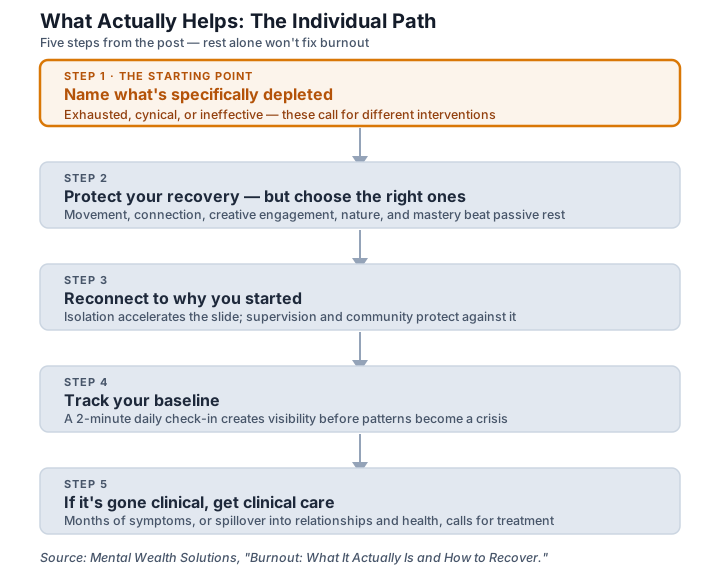
1. Name what specifically is depleted. Burnout isn’t one thing. Before you can address it, you need to know whether you’re primarily exhausted, primarily cynical, or primarily feeling ineffective. These call for different interventions. Exhaustion points toward recovery time and boundary-setting. Cynicism points toward meaning and community. Loss of efficacy points toward skill-building and visible outcomes.
2. Protect your recovery behaviors — but choose the right ones. Not all rest is equally restorative. Passive activities (scrolling, binge-watching) don’t restore depleted emotional resources the way active recovery does. Evidence-based options that consistently outperform general relaxation: physical movement, genuine social connection, creative engagement, time in nature, and experiences that generate mastery or progress.
3. Reconnect to why you started. This sounds like a platitude, but it’s a real clinical intervention. Burnout erodes meaning. Intentionally revisiting your original motivations — in conversation, in writing, in mentorship — can counteract the depersonalization that accumulates over time. For clinicians especially: supervision, peer consultation, and community are protective. Isolation accelerates the slide.
4. Track your baseline. Most people don’t know they’re burned out until they’re deep in it. A simple daily check-in practice — not elaborate journaling, just a 2-minute emotional rating — creates visibility. Patterns emerge over time. Early warning signs become visible. That’s different from reactive crisis management.
5. If it’s gone clinical, get clinical care. If you’ve had burnout symptoms for more than a few months, if it’s affecting your personal relationships, your physical health, or your identity outside of work — talk to a mental health professional. Burnout that has crossed into depression or anxiety disorder responds to treatment. Continuing to white-knuckle it without support is not resilience. It’s just delayed.
For Organizations
Burnout is primarily a structural problem. Individual interventions — yoga classes, mindfulness apps, employee assistance programs — do not fix broken workloads, toxic management, or chronic understaffing. The research on this is consistent: wellness perks without systemic change produce temporary relief at best.
What actually moves the needle at the organizational level:
Meaningful workload control. Employees who have some autonomy over how and when they do their work have consistently lower burnout rates. This doesn’t mean no accountability. It means not micromanaging the process.
Visible equity. Burnout is not distributed equally. Employees who feel that recognition, workload, and opportunity are unfairly distributed burn out faster and leave sooner. Fairness in process — even more than outcome — is protective.
Community. Teams with strong peer relationships are more resilient to high-stress conditions. This isn’t ping-pong tables. It’s psychological safety, shared purpose, and trust. It takes time to build and it’s easy to damage.
Measurement. You can’t manage what you don’t measure. Most organizations don’t have a valid, ongoing measure of workforce emotional health. Annual engagement surveys miss the slow burn. High performers leave quietly, and nobody saw it coming.
Tools that enable consistent, low-friction emotional check-ins — not as surveillance, but as an early warning system — give organizations visibility into team health before it becomes a turnover event.
The Honest Frame
Burnout is not a character flaw. It is not fixed by motivation speeches or mindfulness retreats or “just pushing through.” It’s a real, measurable syndrome with real, documented consequences — and the people most likely to minimize it are the same ones most likely to have it.
You don’t have to feel this way. And your organization doesn’t have to lose its best people to find out something was wrong.
Matthew Sexton, LCSW, is the founder of Mental Wealth Solutions and a licensed clinical social worker with experience across community mental health, forensic, and healthcare settings.
If you’re looking for a way to track your emotional baseline without the overhead of journaling or therapy — VibeCheck.luxury is the between-session companion for therapists and their clients — a clinician-built daily check-in for people who don’t love talking about their feelings.
If this named something you're living with —
You don't have to figure it out from articles. Matthew Sexton, LCSW, NATC sees adults in therapy at his separate private practice (telehealth · NY · ME · DE · FL). Or take this piece to your own therapist — it's written to be shared.
Visit the practice