Burnout, Depression, or Exhaustion? How to Tell Them Apart
In one study, up to 90% of burned-out workers met criteria for depression. Exhaustion answers to rest, burnout is job-shaped, depression follows everywhere.
From the earlier archive. This article’s original writing is retained and has not been fact-checked as part of our current review. Product references may reflect an earlier version; see current solutions for today’s status.
The short version: ordinary exhaustion answers to rest, burnout is job-shaped, and depression follows you everywhere. The names matter because the treatments differ, and the overlap is bigger than almost anyone assumes. In one study, up to 90% of workers identified as burned out also met criteria for a provisional diagnosis of depression, according to a review by Bianchi, Schonfeld, and Laurent in Clinical Psychology Review (2015). Getting the label right is the difference between booking time off, changing your job, and treating an illness. This article is about telling the three apart. Recovery is its own subject, and it is covered here.
What burnout is on paper
Burnout has an official definition, and the definition contains the sorting tool most people miss. The World Health Organization’s ICD-11 (2019) classifies burnout as an occupational phenomenon: “a syndrome conceptualized as resulting from chronic workplace stress that has not been successfully managed.” It names three dimensions: feelings of energy depletion or exhaustion; increased mental distance from one’s job, or feelings of negativism or cynicism related to one’s job; and reduced professional efficacy.
Two details in that definition do real work. First, the WHO declined to classify burnout as a medical condition. It is a description of a syndrome, and the syndrome’s named cause is the workplace, which puts the first repair on the workplace rather than on your character. Second, and more useful for self-sorting: “Burn-out refers specifically to phenomena in the occupational context and should not be applied to describe experiences in other areas of life.” Burnout, by definition, is job-shaped. Hold onto that sentence. It carries the rest of this article.
The rest test: burnout or ordinary exhaustion
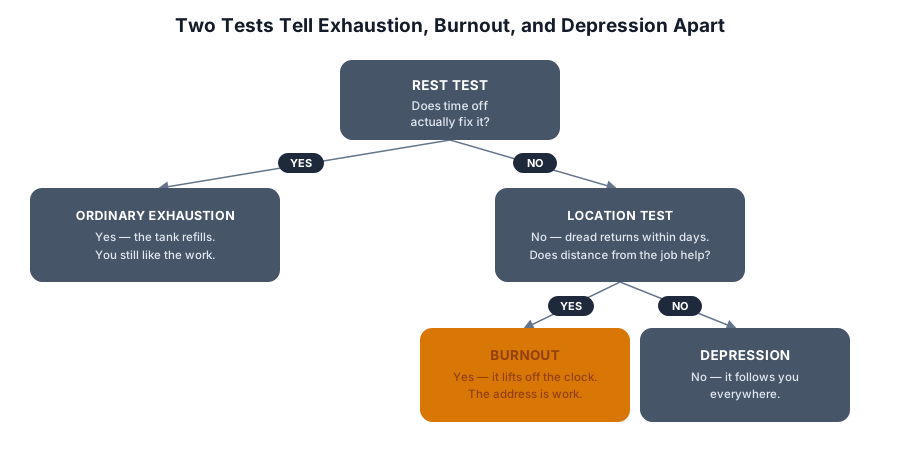
Ordinary exhaustion is load-shaped. You produced more output than your recovery could cover: a brutal quarter, a newborn, a move, tax season. Its defining feature is that rest actually works. A protected weekend or a real vacation refills the tank, and, crucially, you still like the work. You are tired the way a runner is tired.
Burnout fails the rest test in a specific way. Sleep repairs the body, so the physical fatigue lifts. Then you make contact with the job again, and the dread and distance return within days, sometimes hours. Rest treats the exhaustion dimension and leaves the other two, the cynicism and the sense of futility, untouched. If a genuine break made you feel recovered until roughly the moment you re-entered the building, the label you want is burnout, and another vacation is the wrong prescription.
The time course helps too. Exhaustion tracks a known event and eases as the event recedes. Burnout accumulates across months of the same mismatch, and it deepens even in weeks when the workload happens to be light.
The location test: burnout or depression
Burnout stays close to its cause, at least at first. Off the clock, on vacation, in the corners of life the job cannot reach, your capacity for pleasure and connection still works. The dinner with friends is still good. The hobby still pulls. The bitterness has an address, and the address is work.
Depression is pervasive. It does not check your calendar. Anhedonia, the flattening of pleasure, spreads to food, music, people, everything. The self-criticism generalizes: at work it says you are bad at your job, and everywhere else it says you are bad at being a person. Sleep and appetite shift. Hopelessness stops being about this quarter and starts being about the future as such. Depression is also common enough that “it’s probably just work” is a real gamble: 8.3% of U.S. adults, 21 million people, had at least one major depressive episode in 2021, per the National Institute of Mental Health’s summary of national survey data.
Three questions do most of the sorting. What happens on vacation? Burnout lifts, at least partly; depression packs a bag and comes along. Does anything, anywhere, still feel good? In burnout, usually yes; in depression, increasingly no. Where does the blame point? Burnout tends to blame the situation; depression blames the self.
Where the line blurs
Honesty requires saying that the line is contested inside the research itself. The 90% figure at the top of this article comes from a study of 67 workers with burnout, and it is one of several findings like it. An earlier Finnish study found that about 53% of participants with severe burnout had a depressive disorder (Ahola et al., 2005, reported in the same review). Bianchi and colleagues call the distinction between burnout and depression “conceptually fragile.” Some researchers think severe burnout may be depression wearing work clothes.
For you, the practical reading is this: the longer burnout runs, the more it behaves like depression, and the less reliable self-sorting becomes. The tests above work best early.
There is also a social trap built into the vocabulary. “Burned out” is a label you can say at a dinner party. It blames the job, and everyone nods. “Depressed” still carries stigma, so people ride the burnout label long past the point where it fits. The friendlier word can cost you the correct treatment, and that cost lands on you, because the system never built an easy on-ramp for saying the harder word out loud.
When each one needs a professional
Ordinary exhaustion mostly needs logistics: protected rest and a lighter load. Give it two or three weeks of genuinely adequate sleep and reduced demand. If nothing moves, stop calling it exhaustion.
Burnout needs conditions to change, because it is, by definition, a response to conditions. A professional becomes important when it is severe, when it has run longer than a few months, or when you can no longer tell whether you are looking at burnout at all. Given the overlap numbers above, that uncertainty is the norm rather than the exception, and assessment is exactly what clinicians are for.
Depression needs treatment, and treatment works. See a professional promptly if low mood and flattened pleasure are showing up across your whole life for more than two weeks; if sleep, appetite, or concentration have shifted; if the self-blame has generalized beyond work; or if you are having thoughts of death or of not wanting to be here. That last one is an immediate flag, whatever the label turns out to be.
You do not have to arrive with the right answer. Sorting exhaustion from burnout from depression is assessment, and assessment is the clinician’s job. Showing up with “I don’t know which one this is” is a complete and honest presenting problem.
FAQ
Is burnout an official medical diagnosis? No. The World Health Organization’s ICD-11 classifies burnout as an occupational phenomenon and states explicitly that it is not a medical condition. That says nothing about how real it feels. It does change the pathway: burnout points first at working conditions, while depression is a treatable medical condition with established care.
Can burnout turn into depression? The overlap research suggests the two run together far more often than they run separately. Up to 90% of burned-out workers in one study, and 53% of severe-burnout participants in another, met criteria for depression. Long-running burnout looks more and more like depression over time. If your symptoms have spread beyond work, treat that as a signal to get assessed.
How do I know if I’m burned out or depressed? Use the location test as a first pass: burnout organizes around the job and eases away from it, while depression follows you into the rest of your life. Then hold the result loosely, because the two conditions co-occur, and self-assessment is least reliable exactly when mood is low. A licensed clinician can sort it, and both conditions respond better the earlier they are named.
Sources
World Health Organization, “Burn-out an ‘occupational phenomenon’: International Classification of Diseases” (2019), https://www.who.int/standards/classifications/frequently-asked-questions/burn-out-an-occupational-phenomenon — supports the ICD-11 definition, the three dimensions, the statement that burnout is not classified as a medical condition, and the occupational-context-only scope. Bianchi, R., Schonfeld, I. S., & Laurent, E. (2015). Burnout–depression overlap: A review. Clinical Psychology Review, 36, 28–41, https://pubmed.ncbi.nlm.nih.gov/25638755/ — supports the finding that up to 90% of individuals with burnout (n=67, Bianchi et al., 2014) met criteria for a provisional diagnosis of depression, that about 53% of participants with severe burnout (n=78, Ahola et al., 2005) presented a depressive disorder, and the “conceptually fragile” characterization. National Institute of Mental Health, Major Depression statistics (2021 National Survey on Drug Use and Health), https://www.nimh.nih.gov/health/statistics/major-depression — supports 21.0 million U.S. adults (8.3%) with at least one major depressive episode in 2021. Figures current as of July 2026.
Disclaimer
This article is for educational and informational purposes only. It does not constitute medical, clinical, legal, or therapeutic advice, and reading it does not create a therapist-client relationship with Matthew Sexton, LCSW or Mental Wealth Solutions, Inc. Although the author is a licensed clinical social worker, the content in this article is not clinical assessment, diagnosis, or treatment.
The patterns, concepts, and frameworks described here reflect published research and general clinical observations. Individual experiences vary, and what is described here may not match every reader’s situation. If you are working through the concerns described in this article, please consult a licensed mental health professional who can assess your specific circumstances.
If you are in immediate emotional crisis, you can reach the 988 Suicide & Crisis Lifeline by calling or texting 988 (US). If you are experiencing domestic violence or are in physical danger, contact the National Domestic Violence Hotline at 1-800-799-7233 or visit thehotline.org. In a life-threatening emergency, call 911.
Frequently asked questions
- Is burnout an official medical diagnosis?
- No. The World Health Organization's ICD-11 classifies burnout as an occupational phenomenon and states explicitly that it is not a medical condition. That says nothing about how real it feels. It does change the pathway: burnout points first at working conditions, while depression is a treatable medical condition with established care.
- Can burnout turn into depression?
- The overlap research suggests the two run together far more often than they run separately. Up to 90% of burned-out workers in one study, and 53% of severe-burnout participants in another, met criteria for depression. Long-running burnout looks more and more like depression over time. If your symptoms have spread beyond work, treat that as a signal to get assessed.
- How do I know if I'm burned out or depressed?
- Use the location test as a first pass: burnout organizes around the job and eases away from it, while depression follows you into the rest of your life. Then hold the result loosely, because the two conditions co-occur, and self-assessment is least reliable exactly when mood is low. A licensed clinician can sort it, and both conditions respond better the earlier they are named.