I want to start with a confession that has nothing to do with a cult.
In June, for the first time in 53 years, the New York Knicks won the NBA championship, and for a few days the whole city was one organism — strangers hugging on the subway, grown adults crying at a bar, a little bit of chaos in the streets. And watching the footage, the part that stuck with me wasn’t the celebration. It was that not one second of it made me stop and think, what is wrong with us? Because deep down I already knew. We human beings have this genuinely wild thing about us: get enough of us pointed in the same direction, and we’ll throw our values, our judgment, and sometimes our ethics right out the window — and it won’t even feel strange while we’re doing it.
That instinct built every community you’ve ever loved. It’s also the exact thing a cult hijacks. And the machinery that runs a cult turns out to be the same machinery that runs a “we’re a family here” job, a church that closes ranks, a political movement, a group chat that turns on someone. Cult or no cult — we’ve all already done a version of this. So let’s take the mystery out of it, because understanding the machinery is how you keep it from running you.
Quick answer: A “cult” isn’t defined by weird beliefs — it’s defined by control. A high-control group uses four levers (behavior, information, thought, and emotional control) to quietly override your ability to think and choose for yourself. The same levers show up at toxic jobs, in high-control religion, and in political tribalism. None of it requires a villain in a robe; it requires a structure, a leader who benefits, and ordinary people whose deepest need — to belong — gets turned against them. The good news: once you can name the machinery, you can feel it switch on.
The machinery of cult control, in plain language
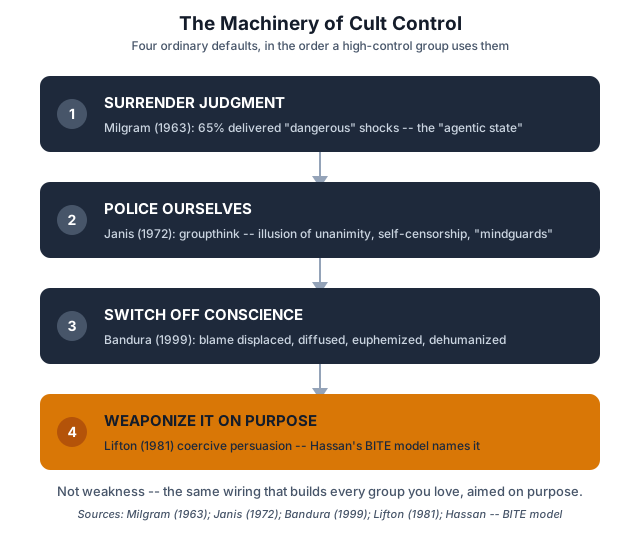
Scientists have been taking this apart for decades, and the mechanisms are unnervingly consistent.
We surrender our judgment to authority further than we’d ever admit. In Stanley Milgram’s famous obedience experiments, 65% of ordinary people delivered what they believed were dangerous shocks to a stranger, simply because a man in a lab coat told them to — slipping, Milgram argued, into an “agentic state” where they no longer felt like the author of their own actions.
We police ourselves. The psychologist Irving Janis studied how smart teams talk themselves into disasters and named it groupthink: the illusion of unanimity, self-censorship (you swallow the doubt so you don’t rock the boat), and “mindguards” who shield the group from inconvenient facts. Nobody has to enforce the line. We do it for them.
We switch off our own conscience. Albert Bandura mapped the mental moves — moral disengagement — that let decent people act against their values without the guilt catching up: displacing responsibility onto the leader, diffusing it across the group, sanitizing harm with euphemism, dehumanizing whoever’s on the receiving end.
And a high-control group weaponizes all of it on purpose. The psychiatrist Robert Jay Lifton catalogued the classic tools of coercive persuasion — milieu control, loading the language, the demand for purity — and the modern shorthand is Steven Hassan’s BITE model: Behavior, Information, Thought, and Emotional control. When several of those run at once — your time and money managed, your outside sources discredited, a black-and-white worldview, fear and guilt doing the enforcement — that’s the line between a strong community and a controlling one. As the scholars put it, what makes a group cultic isn’t its beliefs; it’s “unethically manipulative techniques of persuasion and control.”
You can believe almost anything and still be free. The only questions that matter are: can you question it, and can you leave?
Now watch the same machinery run in the four places it quietly shapes the most lives.
At work: when “we’re a family” turns into a cage
Almost everyone has been in the job that called itself a family — and it was great, right up until the moment someone needed the family to have their back. High-control dynamics hide at work because we have flattering words for all of them: devotion is “culture,” overwork is “hustle,” never unplugging is “commitment.”
There’s even a name for the category. Business scholar Dave Arnott wrote a book called Corporate Cults and named three ingredients that turn a strong company into a controlling one: devotion, a charismatic leader, and separation from your outside life. You can watch it in the famous flameouts — WeWork’s founder-as-prophet and mandatory “Summer Camp,” or Theranos, where Elizabeth Holmes was convicted of fraud and ex-employees described a culture of secrecy, surveillance, and fear held together by a founder mythology no one could question.
The most intimate version arrives in your DMs: the multi-level-marketing “opportunity,” which experts call a “commercial cult” because it runs the same recruitment and control tactics. The receipts are regulatory — Herbalife settled with the FTC for $200 million and had to reward selling over recruiting — and the income reality is brutal: an AARP-commissioned study found roughly 47% of MLM participants lose money.
Even structured networking draws the comparison. Groups like BNI are legitimate and many members find real value — no court or expert has ever called BNI a cult — but its own founder addresses the perception head-on with “it’s not a cult, it’s a culture.” Look at the structure: one seat per profession, tracked attendance with a removal rule, and a monthly scorecard grading referrals given and visitors brought. When you’re scored on referrals given, your incentive quietly rotates from “send my client to the best person” to “send my client to the person in the room.” That’s a closed loop — the commercial cousin of information control.
And the cost of a truly high-control workplace isn’t a bad review; it’s your body. A joint WHO/ILO study linked working 55+ hours a week to an estimated 745,000 deaths in a single year from stroke and heart disease. Burnout isn’t a sign you’re weak. Often it’s a sign the environment was built to extract from you faster than any human can recover.
In faith: when devotion gets pointed at a person
Let me be clear before anyone gets the wrong idea: faith is not the problem, and this isn’t an anti-religion argument. Healthy religious community is one of the most protective, life-saving things in a person’s world. The difference between that and spiritual abuse isn’t the beliefs. It’s what happens when you doubt, question, or want to leave.
Every tool of control has a sacred version, which is what makes it so hard to name from the inside — it all sounds holy. Lifton’s markers map almost perfectly: milieu control (who you can talk to, what you can read), the demand for purity (you’re never clean enough), and a charismatic leader who gradually becomes an object of worship — the pastor, guru, or prophet whose word quietly outranks the scripture he claims to serve. Healthy faith points past the leader to the principle; a high-control group points past the principle to the leader.
Some of it is on the public record. In 2009 a French court convicted the Church of Scientology of organized fraud, a conviction upheld in 2013; former members have documented policies like “disconnection,” which severs families. (Scientology denies these accounts and is recognized as a religion in the U.S. — which is exactly why the useful question is about the mechanism, not the label.)
But the most consequential religious abuse is often not a fringe group — it’s a mainstream institution protecting itself. A 2003 Suffolk County grand jury found that the Diocese of Rockville Centre had concealed decades of clergy abuse, concluding officials used “deception and intimidation” to keep victims silent; the Diocese later established a ~$323 million settlement for more than 600 survivors. Psychologist Jennifer Freyd has a precise name for that second wound: institutional betrayal — the harm an institution does when it protects itself instead of the people who depended on it.
Leaving a high-control faith is uniquely hard, because you’re not just losing a building — you’re losing a cosmology, often your whole social world, and, you’ve been taught, your soul. Clinicians describe a recognizable aftermath; Dr. Marlene Winell named it “religious trauma” (a clinical description, not a formal diagnosis), and it overlaps heavily with the complex trauma that follows any prolonged coercive control.
In politics: the most socially acceptable groupthink there is
This is where I’ll be careful: what follows is not about left versus right, and it endorses no party. The pattern isn’t partisan — it shows up wherever there’s a tribe, a leader, and a shared enemy, which in politics is everywhere. That’s the whole point.
Politics is a near-perfect host for the machinery. Us versus them isn’t a bug of political tribalism — it’s the product. Groupthink runs wide open (fittingly, Janis built the concept studying political fiascoes). Moral disengagement takes a seductive form: the other side is so dangerous that anything we do to stop them is justified. And identity fusion means that when “I’m a [party]” becomes who you are, criticism of the party lands like an attack on your soul.
Two New York examples, deliberately from opposite parties, because it’s not a team sport. An independent investigation for the New York Attorney General found that Governor Andrew Cuomo’s administration had a “culture… filled with fear and intimidation” and “secrecy, loyalty to the Governor, and fear” — what former staffers called “the Cuomo Way,” people who would “fall on the sword” and stay silent out of fear of retaliation. (Cuomo has categorically denied the allegations and was never criminally convicted; the AG report is a civil finding, not a criminal verdict.) And on the other side, the federal corruption cases around the Nassau County Republican machine put a cooperating witness on the stand describing “the Oyster Bay way,” where getting investigated was “a rite of passage” — corruption so normalized it stopped feeling like anything. Same machinery, both teams: loyalty, fear, silence.
And there’s a new machine the old bosses never dreamed of — your feed. The algorithm doesn’t care about your politics; it cares about keeping you scrolling, and nothing holds a human like tribal outrage. So it shows you the most infuriating version of the other side and the most flattering version of your own. That’s information control, automated and personalized, running all day. The result is an echo chamber you built one tap at a time that feels exactly like being well-informed.
The tell that tips political passion into something cult-shaped is simple: no failure is ever anyone’s fault. In a healthy group, someone owns it. In a cult-like one, every failure gets redirected — sabotage, fake news, a test of the faithful — and the group never looks in the mirror. You don’t have to abandon your convictions to stay free of that. You have to keep the one thing every high-control system wants to take: your ability to see the actual human across the table, separate from the team they’re on. This is the version quietly wrecking families — the estranged parent and child, the holiday table that got smaller every year — and that grief is real.
The reckoning: bad people, or swept-up people?
Which leaves the hardest question. The people who got swept up and did real harm — who recruited, enabled, covered up — are they bad people? And do we owe them a second chance?
The science is almost insulting in how consistently it answers the first part. Our intuition says I would never. Milgram, Bandura, and sociologist Kathleen Blee — who found that people usually “stumble into” extremist groups through ordinary social ties, with the extremism hardening after they belong — all say the same thing: the group makes the monster, one small compromise at a time, and it could do it to far more of us than we’d like to believe.
But diminished agency is not erased agency. The law keeps mapping the miserable middle for us: the “brainwashing defense” mostly fails in court, and manipulation tends to show up as a lighter sentence, not an acquittal — the coercion is real, and you’re still responsible. One more line matters, though: not everyone in the room is equally guilty. The architect who built the trap is a different moral animal than the person who fell into it. Compassion for the follower shouldn’t soften how we see the leader.
And the people are real. Leslie Van Houten, paroled in 2023 after five decades, said of the Manson murders she took part in at nineteen: “I have spent most of my life trying to find ways to live with it.” That’s not the sentence of a monster; it’s a person who did a monstrous thing inside a machine built to make her, and then spent a lifetime reckoning with the fact that she let it. The capacity to do terrible things in a group and the capacity to become someone who can’t live with having done them exist in the same human being.
So how does anyone come back? Not by being defeated in an argument. Across story after story, what breaks the spell is unexpected kindness from the very people you were taught to hate — the strangers who were patient with Megan Phelps-Roper until she couldn’t hold the caricature, the classmate who kept inviting a young white nationalist to Shabbat dinner. Our instinct is to shun and write off. The evidence says the door out is held open by someone who refused to.
If the swept-up person was you — if you recruited a friend, stayed silent while someone was hurt, went along — that pain has a name: moral injury, the wound of doing or failing to stop something that violated your own values. The healing turns on one distinction psychologist June Tangney’s research draws cleanly: the difference between guilt (“I did a bad thing”), which points toward repair, and shame (“I am a bad thing”), which just points at the exits. The whole task is holding both truths at once — “I did real harm” and “I was really manipulated” — without collapsing into either. It’s hard, specific, doable work, and people don’t just survive it; many grow through it.
Do we owe them a second chance? Not automatically, and not never. It’s earned, and the thing that earns it is reckoning — the difference between the person who owns it and the person who just rebrands, deploying “I was a victim too” to dodge accountability instead of to explain it. Grace for the person doing the work; boundaries for the one who isn’t. Compassion and consequences aren’t opposites.
Where this leaves us
Five settings, one point: this machinery is not “them.” It’s us. It runs on the best things about being human — our need to belong, to believe, to be part of something — and it can catch almost anyone who’s lonely or frightened or hungry for meaning at the wrong moment. Understanding it isn’t about learning to sneer at the people who got caught. It’s about three things: recognizing the machinery when it comes for you, forgiving yourself precisely and honestly if it already did, and extending grace to others wisely — open-hearted, but not a sucker.
At Mental Wealth Solutions, the whole mission is to make talking about this stuff normal — because the one thing every high-control situation needs to survive is your silence. Naming the machinery, out loud, to someone who isn’t in it, is the single most powerful move there is. It’s also, not coincidentally, the entire engine of every support room and every good therapy hour that’s ever worked: a bunch of people realizing oh — we’re all in the same boat. The moment it’s said, it loses most of its grip.
Written by Matthew Sexton, LCSW. This article is for educational purposes only; it is not medical, clinical, or legal advice, and it is not a substitute for care from a qualified professional. Individuals and organizations named are discussed on the basis of public court records, official investigative findings, and published reporting; where matters are contested or unproven, that is noted, and denials are included. If you’re in crisis, call or text the 988 Suicide & Crisis Lifeline; for domestic violence, the National Domestic Violence Hotline is 1-800-799-7233.
Sources
- Milgram, S. (1963). “Behavioral Study of Obedience.” J. Abnormal & Social Psychology. https://www.columbia.edu/cu/psychology/terrace/w1001/readings/milgram.pdf
- Janis, I. L. (1972). Victims of Groupthink. Overview: https://www.britannica.com/science/groupthink
- Bandura, A. (1999). “Moral Disengagement in the Perpetration of Inhumanities.” Pers. & Soc. Psych. Review. https://journals.sagepub.com/doi/10.1207/s15327957pspr0303_3
- Lifton, R. J. (1981). “Cult Formation.” Harvard Mental Health Letter. https://www.culteducation.com/brainwashing1.html
- Hassan, S. — The BITE Model. https://freedomofmind.com/cult-mind-control/bite-model/
- Arnott, D. (1999). Corporate Cults. https://archive.org/details/corporatecultsin00arno
- “Elizabeth Holmes sentenced.” NPR, 2022. https://www.npr.org/2022/11/18/1137606060/elizabeth-holmes-sentenced-11-years-prison
- FTC — Herbalife $200M settlement (2016). https://www.ftc.gov/news-events/news/press-releases/2016/07/herbalife-will-restructure-its-multi-level-marketing-operations-pay-200-million-consumer-redress
- AARP Foundation — MLM income study. https://www.aarp.org/work/job-search/advice-for-job-seekers-tempted-by-multilevel-marketing-offers/
- WHO/ILO (2021) — long working hours and mortality. https://www.who.int/news/item/17-05-2021-long-working-hours-increasing-deaths-from-heart-disease-and-stroke-who-ilo
- France high court upholds Scientology fraud conviction (2013). https://www.jurist.org/news/2013/10/france-high-court-upholds-scientology-fraud-conviction/
- Suffolk County Grand Jury Report (2003). https://www.bishop-accountability.org/reports/2003_02_10_SuffolkGrandJury/06_Suffolk_Conclusions.pdf
- Diocese of Rockville Centre $323M settlement (2024). https://evangelist.org/news/2024/sep/30/diocese-of-rockville-centre-reaches-323-million-bankruptcy-settlement-over-abuse-claims/
- Freyd, J. J. — Institutional Betrayal. https://dynamic.uoregon.edu/jjf/institutionalbetrayal/
- Winell, M. (2011). “Religious Trauma Syndrome.” CBT Today. https://journeyfree.org/wp-content/uploads/RTS-article-in-CBT-Today.pdf
- NY Attorney General — Cuomo investigation (2021). https://ag.ny.gov/press-release/2021/independent-investigators-find-governor-cuomo-sexually-harassed-multiple-women
- “‘It’s the Cuomo Way.’” Gothamist, 2021. https://gothamist.com/news/its-the-cuomo-way-former-staffers-describe-toxic-workplace-under-governors-relentless-thumb
- “Fred Mei describes ‘the Oyster Bay way.’” News 12. https://westchester.news12.com/fred-mei-returns-to-stand-to-describe-oyster-bay-way-37975952
- Blee, K. (2002). Inside Organized Racism. https://www.ucpress.edu/books/inside-organized-racism/paper
- United States v. Fishman (1990). https://law.justia.com/cases/federal/district-courts/FSupp/743/713/2593631/
- “Leslie Van Houten released on parole.” NPR, 2023. https://www.npr.org/2023/07/12/1187225790/leslie-van-houten-manson-murder-freed-prison-parole
- VA National Center for PTSD — Moral Injury. https://www.ptsd.va.gov/professional/treat/cooccurring/moral_injury.asp
- Tangney, J. P., et al. (2007). “Moral emotions and moral behavior.” Annual Review of Psychology. https://pmc.ncbi.nlm.nih.gov/articles/PMC3083636/
- Phelps-Roper, M. — TED (2017). https://www.ted.com/talks/megan_phelps_roper_i_grew_up_in_the_westboro_baptist_church_here_s_why_i_left
- “How A Rising Star Of White Nationalism Broke Free.” NPR, 2018. https://www.npr.org/2018/09/24/651052970/how-a-rising-star-of-white-nationalism-broke-free-from-the-movement
Frequently asked questions.
- What is the difference between a cult and a high-control group?
- Mostly branding. 'Cult' is a loaded, contested word; 'high-control group' names the thing that actually matters — a group that uses behavior, information, thought, and emotional control (Steven Hassan's BITE model) to override your independent judgment. What defines it isn't strange beliefs; it's whether you can question the group and leave it without losing your family, your identity, and your sense of safety.
- Does being susceptible to a cult mean I'm weak or gullible?
- No. Research on obedience (Milgram), groupthink (Janis), and radicalization (Blee) all points the same way: ordinary, intelligent, well-meaning people are susceptible under the right conditions. People usually get pulled in through normal needs — belonging, meaning, love — and the extreme commitment hardens after they're in, not before. Susceptibility is about being human, not about being weak.
- Can a workplace really be a cult?
- A demanding job isn't a cult. It crosses the line when the same control tactics show up: your time, money, and outside relationships get managed; questions get you branded 'not a team player'; your identity fuses with the company; and leaving is treated as betrayal. A strong culture asks for your best work; a controlling one asks for your self.
- If someone was manipulated into doing harm, are they still responsible?
- Both can be true. Coercion reduces culpability without erasing it — it's mitigation, not a blank exemption. Courts have generally rejected 'brainwashing' as a full defense while still recognizing manipulation as real, often reflected in a lighter sentence rather than an acquittal. The honest frame is: reduced agency, not erased agency. Not villains, not blameless.
- How do people actually leave cults or high-control groups?
- Usually gradually, not in a single moment — and often because of sustained, unexpected kindness from people they were taught to distrust, which makes an us-versus-them worldview harder to hold. Leaving physically ('disengagement') and changing one's beliefs ('deradicalization') are two separate steps, and the second is slower.
- Can therapy help after leaving a high-control group?
- Yes — especially trauma-informed therapy that understands coercion. It can help with the anxiety, grief, and identity confusion that follow, and with the specific wound of 'moral injury' — guilt and shame over things you did or went along with — by helping you hold 'I did real harm' and 'I was really manipulated' at the same time, without collapsing into either one.
If this named something you're living with —
You don't have to figure it out from articles. Matthew Sexton, LCSW, NATC sees adults in therapy at his separate private practice (telehealth · NY · ME · DE · FL). Or take this piece to your own therapist — it's written to be shared.
Visit the practice