When Networking Groups Become Dark Triad Hunting Grounds
Why professional networking groups produce trust as a function of attendance — and why that structure has been exploited by serial offenders, financial predators, and cult leaders for decades.
From the earlier archive. This article’s original writing is retained and has not been fact-checked as part of our current review. Product references may reflect an earlier version; see current solutions for today’s status.
In the summer of 2023, the architect arrested for the Gilgo Beach murders left a voicemail for his client, the head of Bohemia Industrial Investors LLC, that opened with a familiar phrase: “Hey John, this is Rex, your architect, from the BNI group” (Vidal, 2023, in Newsweek). Rex Heuermann had been a member of Business Network International for thirteen years. He attended chapter meetings every Wednesday morning at 8am on Long Island, exchanged referrals, sat through testimonials, and let the structure of mutual professional endorsement do what it was designed to do — produce the appearance of trust between strangers through repeated, low-friction exposure. The structure worked exactly as advertised. The man it was producing trust around was a different problem. This piece is about that gap. The Dark Triad — narcissism, Machiavellianism, and psychopathy — describes a constellation of antagonistic personality traits that load on a common factor of callous social manipulation (Paulhus & Williams, 2002). Networking groups are designed to short-circuit the slow, friction-rich social audit that ordinary trust requires. Those two facts produce a predictable selection problem. The piece walks through who has used networking groups for cover or victim access, and what about the structure of these groups makes them vulnerable to capture in the first place.
What is the Dark Triad — and why does it matter for networking?
The Dark Triad construct was introduced by Paulhus and Williams (2002), in Journal of Research in Personality, as a way to describe three subclinical personality styles that consistently co-occur and consistently predict callous, exploitative, antagonistic behavior in non-forensic populations. Narcissism is the grandiosity-and-entitlement style first operationalized as a personality trait by Raskin and Hall in the late 1970s. Machiavellianism is the strategic, manipulative, ends-justify-means style described by Christie and Geis (1970) in Studies in Machiavellianism. Psychopathy, in the subclinical sense, is the callousness-and-low-empathy style indexed by instruments like the Self-Report Psychopathy Scale and, in clinical and forensic populations, by Hare’s (2003) Psychopathy Checklist–Revised. Buckels, Jones, and Paulhus (2013), in Psychological Science, expanded the construct to a Dark Tetrad by adding everyday sadism — taking pleasure in the suffering of others — as an empirically distinct fourth element.
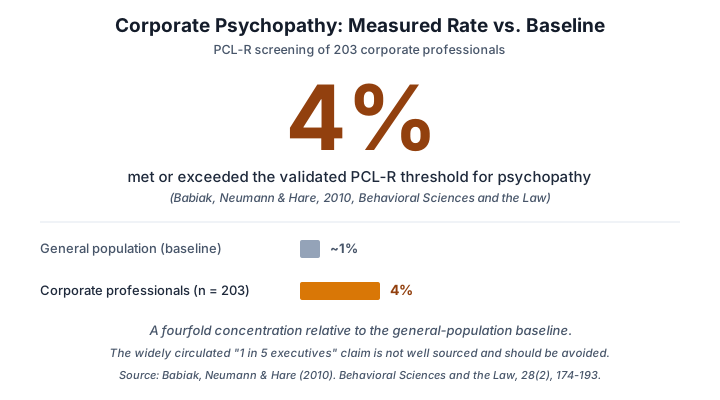
The reason the Dark Triad matters specifically for networking is the trait-environment fit. PCL-R Factor 1 captures what Hare (2003) called the interpersonal-affective core of psychopathy: superficial charm, grandiose self-worth, pathological lying, manipulativeness, shallow affect, lack of remorse. That cluster maps almost perfectly onto the skill set a professional networking format rewards — the polished elevator pitch, the curated success story, the warm handshake without the actual longitudinal data behind it. Babiak, Neumann, and Hare (2010), in Behavioral Sciences and the Law, screened 203 corporate professionals using the PCL-R and found that 4 percent met or exceeded the research threshold for psychopathy, compared with the roughly 1 percent base rate in the general population. (The widely repeated “1 in 5 corporate executives are psychopaths” claim circulates without solid sourcing and should not be used; the 4 percent figure, anchored to a validated instrument, is the one to remember.) A networking group is, in effect, a trait-amplification environment. It rewards the surface behaviors antagonistic personalities produce well and rarely audits the underlying conduct those behaviors are concealing. That is not a moral claim about any individual member. It is a structural claim about what the format selects for.
Rex Heuermann and BNI: a murderer hiding in the Givers Gain economy
The Heuermann case is the cleanest contemporary example of the trust-by-attendance problem. The voicemail Heuermann left his client opened with “Hey John, this is Rex, your architect, from the BNI group” (Vidal, 2023, in Newsweek; corroborated by Fox News and Daily Voice coverage of the same recording). The framing matters. Heuermann did not introduce himself by his license number, his portfolio, or even his firm name. He led with the social credential of BNI membership, because in the local commercial-real-estate ecosystem on Long Island, that credential did real work. RH Consultants, Heuermann’s firm, listed clients including Target, Foot Locker, Catholic Charities, and American Airlines (CBS News, 2023). The professional facade was ratified by the networking group, and the networking group was ratified by the professional facade, and the loop produced a level of community trust that neither would have produced alone.
What was running underneath the facade is now a matter of court record. The Suffolk County District Attorney’s bail application filed in mid-2024 documented thousands of violent and sadistic search queries, burner phones used to contact victims, and a years-long pattern of behavior consistent with predatory planning (People v. Heuermann, Suffolk County Court bail application, 2024). In April 2026, PBS NewsHour and other outlets reported that Heuermann had pleaded guilty to seven counts of murder. Thirteen years of unimpeded BNI attendance — every Wednesday at 8am — is the structural fact worth sitting with.
BNI’s central organizing concept is “Givers Gain” — a reciprocity ethic borrowed almost directly from the persuasion literature (Cialdini, 1984/2006). Members are expected to bring qualified referrals to one another every week. Attendance is mandatory, with most chapters limiting members to a small number of absences per year before expulsion. Each profession is represented by exactly one member per chapter, which makes leaving costly. Weekly testimonials are part of the format. The cumulative effect of that structure is that trust is produced as a function of attendance and reciprocity rather than as a function of investigation. The structure does not interrogate the person. It produces trust as a side effect of showing up. Heuermann showed up.
The pattern is old: Gacy, Rader, Bundy, and the civic-network disguise
The Heuermann case is contemporary, but the pattern of an antagonistic personality using a civic or professional network as legitimacy infrastructure is decades old. Three pre-internet cases anchor the point.
John Wayne Gacy and the Jaycees. In Springfield, Illinois, Gacy served as Vice President of the local Junior Chamber of Commerce — the Jaycees — and was named the chapter’s Outstanding Vice President in 1967 (A&E Biography, n.d.; AllThatsInteresting, 2023). He used the Jaycees recruiting pipeline to access young men for what would later become the first wave of victims of his sexual assaults and murders. After his 1968 sodomy conviction in Iowa, he organized a Jaycees chapter inside the Anamosa State Penitentiary. The networking format survived the conviction. That detail tells you something about how durable the format is as a piece of personal infrastructure.
Dennis Rader and the church council. Rader, who confessed to ten murders as the BTK killer, served as a compliance officer in his municipality, a Cub Scout leader, and the elected president of his Lutheran church council (NBC News, 2005; Britannica, 2024). Rader coined his own term, “cubing,” to describe the deliberate compartmentalization between his civic identity and his predator identity. The civic network was the cube. Membership in respected community structures was not a side effect of his life — it was a load-bearing part of the camouflage.
Ted Bundy and the helping professions. Bundy worked alongside Ann Rule on the Seattle suicide-prevention crisis line in the early 1970s, before the murders began (Rule, 1980, The Stranger Beside Me). He volunteered for Governor Dan Evans’s 1972 reelection campaign and worked out of the Rockefeller campaign office in Seattle. He was preparing for law school. The political and helping-profession networks were both used as legitimacy infrastructure, and they functioned the way networks are designed to function — as character references that did not require the work of actually verifying character.
The common thread across these three cases is not that civic networks attract predators in any unusual concentration. It is that civic networks are designed to signal trustworthiness, not to test it. The signal can be acquired. The test rarely happens. That asymmetry is a feature, not a bug — fast trust is the point — and it is exactly the affordance an antagonistic personality is best positioned to use.
Affinity, philanthropy, and boardroom networks: Madoff, Epstein, Holmes
Move up the social ladder and the same structural logic plays out at higher dollar values. Three cases illustrate.
Bernie Madoff and the Palm Beach Country Club. Madoff’s $65 billion Ponzi scheme was, in structural terms, an affinity fraud — a category the FBI defines as fraud in which the perpetrator is, or credibly poses as, a member of the targeted group (FBI Internet Crime Complaint Center, n.d.). Madoff was a member in good standing of Palm Beach Country Club and used overlapping Jewish philanthropic networks to cultivate investors. His victims included Hadassah, the Elie Wiesel Foundation for Humanity, and Steven Spielberg’s Wunderkinder Foundation (NPR, 2008; Haaretz, 2008). The State of Utah, where LDS-network affinity fraud has cost an estimated $1.4 billion, is the structural cousin of the Palm Beach case (Utah Division of Securities, public reporting). In both, network membership did the heavy lifting that ordinary due diligence usually does.
Jeffrey Epstein and Edge.org. Epstein donated approximately $638,000 to John Brockman’s Edge Foundation, making him the largest single donor on record (Aldhous, 2019, in BuzzFeed News). In return, he received introductions to Seth Lloyd at MIT, Lisa Randall at Harvard, and access to the 2011 “billionaires’ dinner” attended by Jeff Bezos, Sergey Brin, and Elon Musk. As Scientific American noted in 2019, the science philanthropy was reputation-laundering rather than research support — a network purchase, not a research investment. The network amplified him. The network did not investigate him.
Elizabeth Holmes and the Stanford-Shultz board. Holmes’s rise was, in John Carreyrou’s (2018) telling in Bad Blood, almost entirely a network artifact. Channing Robertson, a Stanford engineering professor, opened the venture capital pipeline. George Shultz, the former Secretary of State, brought Henry Kissinger, William Perry, Jim Mattis, and Gary Roughead onto the Theranos board — none of whom had the scientific credentials to evaluate a blood-testing platform. TED talks and Davos panels handled the public-facing credentialing spectacle. The network substituted for expertise, by design, until a single Wall Street Journal investigation undid the substitution.
The shared mechanism in all three is what Janis (1982), in Groupthink, identified as the symptoms of cohesive in-group decision-making: illusions of unanimity, mindguards who suppress dissent, direct pressure on doubters, and a shared illusion of invulnerability. Network membership functions as a trust shortcut, and the shortcut is most active in exactly the moments when scrutiny is most needed.
When the network is the front: NXIVM, Effective Altruism, Larry Ray
In some cases the networking apparatus is not the cover for the predation — it is the predation.
NXIVM and the Executive Success Programs. Keith Raniere built NXIVM as a corporate-coaching organization with more than 16,000 self-reported participants (CNBC, 2021). The Executive Success Programs front used invitation-only structures, advanced-tier pricing, and the corporate language of self-development to wrap what the federal indictment in the Eastern District of New York (United States v. Raniere, 2018) described as a sex-trafficking pyramid. Raniere is now serving 120 years. The networking format — invitation, scarcity, advanced membership, leader veneration — was the predation mechanism, not its disguise.
Sam Bankman-Fried and Effective Altruism. TIME (2022) and the Washington Post (2022) documented that EA leadership were warned about Bankman-Fried’s behavior as early as 2018, and that EA-affiliated organizations took more than $36 million from the FTX Future Fund anyway. Bankman-Fried became the second-largest individual donor to Democratic political campaigns in the 2022 cycle. His EA membership functioned as a trust signal that suppressed normal due diligence by journalists, regulators, and counterparties for years. The point is not that EA produced FTX. The point is that EA membership produced trust that should have been earned by financial transparency and was not.
Larry Ray and the Sarah Lawrence parent network. In 2010, Ray moved into his daughter’s college dormitory at Sarah Lawrence and used his legitimacy as a parent of a current student to build a coercive control group around a small set of her roommates over more than a decade (Schwartz, 2019, New York Magazine; Hulu, Stolen Youth, 2023). He was convicted on fifteen federal counts. The “parent of a student” identity was not incidental; it was the network credential that permitted the access. Predatory access is rarely random. It is almost always credentialed.
Networking groups as cult-like institutions: BITE, groupthink, and Givers Gain
Move from individual cases to the structure itself, and the analytic frame shifts. Several research traditions converge on the conclusion that high-control networking formats share more with cult-like institutions than the people inside them are usually comfortable acknowledging.
Janis (1982) on groupthink. Janis’s eight symptoms — illusion of invulnerability, collective rationalization, belief in the group’s inherent morality, stereotyping of out-groups, direct pressure on dissenters, self-censorship, illusion of unanimity, and the appearance of “mindguards” — map cleanly onto the social architecture of a high-attendance, high-reciprocity professional network. Mandatory testimonials suppress negative information; the absence cap turns dissent into a financial event; the per-profession exclusivity turns leaving into a referral-network amputation. The fact that BNI’s official site has historically maintained a FAQ page titled some version of “Is BNI a cult?” is itself diagnostic of the question the format raises.
Hassan’s BITE model. Steven Hassan (1988/2015), a former cult member turned licensed mental health counselor, formalized the BITE model — Behavioral, Information, Thought, and Emotional control — as a non-pejorative way to describe the spectrum of high-control group dynamics. Behavioral control shows up in mandatory attendance and dress codes. Information control shows up when “Givers Gain” or “abundance mindset” ideology is promoted to the exclusion of any critical evaluation of the group itself. Thought control shows up in thought-stopping mantras and the framing of skepticism as scarcity-mindset failure. Emotional control shows up in the threat of expulsion and the social cost of raising concerns about a member. None of these axes are unique to networking groups. All of them are present, in measurable degree, in the high-control end of the networking-group spectrum.
Lifton’s eight criteria of thought reform. Robert Jay Lifton (1961), in Thought Reform and the Psychology of Totalism, identified eight criteria that distinguish high-control groups from ordinary social organizations: milieu control, mystical manipulation, demand for purity, confession, sacred science, loading the language, doctrine over person, and dispensing of existence. The professional networking format scores measurably on at least five. Milieu control shows up in the closed-chapter format and the limit on critique permitted in members-only forums. Loading the language shows up as the proprietary vocabulary — Givers Gain, abundance mindset, power team — that flags in-group identity and converts ordinary skepticism into a category error. Doctrine over person shows up in the elevation of attendance metrics and referral counts above any consideration of actual professional fit. Sacred science is the founder’s framework — and every major networking organization has one — being treated as reasoned-from-evidence when it is in fact reasoned-from-charisma. Demand for purity shows up in the membership discipline. Lifton developed the framework from interviews with survivors of Chinese revolutionary thought-reform programs, but the structural overlap with high-control commercial organizations has been documented in the cult-recovery literature for half a century (Singer, 1995; Lalich, 2004; Hassan, 2015; Galanter, 1989).
Singer and Lalich on the commercial-cult adjacency. Margaret Singer (1995), in Cults in Our Midst, devoted an entire chapter to what she termed “commercial and self-improvement cults” — high-control organizations whose actual product is the structure itself rather than a religious or political ideology. Janja Lalich (2004), in Bounded Choice, formalized this as the bounded-choice framework: members within a high-control structure make choices that are rational given the constraints the structure imposes, but those choices are not free in the ordinary sense. Mandatory attendance, exclusivity rules, and exit penalties together produce bounded-choice conditions in which the member rationally continues to participate even when the participation no longer produces a positive return. The relevance to professional networking is direct. The format produces bounded-choice conditions whether the founder intended them to or not.
Galanter on the relief effect. Marc Galanter (1989), in Cults: Faith, Healing, and Coercion, identified what he called the “relief effect” — measurable nervous-system regulation members experience when they comply with group expectations and the matching dysregulation when they violate them. The relief-effect mechanism is one of the reasons high-control formats remain sticky even after members consciously recognize the format as harmful. The clinical implication is that survivor recovery is, in part, a re-regulation problem and not solely a cognitive-correction problem. That distinction shapes the treatment plan.
Cialdini’s six persuasion principles, structurally amplified. Cialdini (1984/2006), in Influence, identified six levers of persuasion: reciprocity, commitment and consistency, social proof, liking, authority, and scarcity. The networking-group format concentrates all six by design. Reciprocity is the explicit “Givers Gain” ethic. Commitment and consistency are produced by weekly attendance and public testimonial. Social proof is the testimonial culture itself. Liking is the structured socialization. Authority is the invited-speaker slot and the chapter-leadership hierarchy. Scarcity is the one-member-per-profession rule. Every principle Cialdini identified as ethically dangerous when concentrated is, in the networking-group format, concentrated by design. That is not an indictment of any individual chapter; it is an observation about the structural envelope.
MLM as the extreme case. Robert FitzPatrick (2020), in Ponzinomics, and Amanda Montell (2021), in Cultish, document how multi-level marketing structures take the persuasion-amplification logic to its end state. Jon Taylor’s analysis for the Federal Trade Commission documented loss rates approaching 99 percent across the MLM sector. The recruitment mechanism, however, is not coercion in the dramatic sense. It is affinity recruitment — leveraging existing personal relationships, often within tight-knit religious or community networks — to extract participation. The networking apparatus is the predation mechanism.
WeWork and the Cult of We. Brown and Farrell (2021), in The Cult of We, document how Adam Neumann sold belonging as the actual product of WeWork at a peak valuation of $47 billion. The cult-of-personality structure was not a marketing layer on top of a coworking business; it was the business. Networking-as-product is the extreme case of the structural logic and the cleanest demonstration that the format and the substance can become indistinguishable.
Putnam (2000) and the structural context. Bowling Alone documents the sustained decline of organic civic association in the United States since the 1960s. Bowling leagues, fraternal lodges, neighborhood political clubs, and church-based mutual aid all eroded over decades. The vacuum was real, and fee-based, intentional, professional networking organizations filled it. The format manufactures trust at scale, and it does so without the longitudinal accountability that organic community used to supply. That is the macro context for the rest of this piece.
Jonestown and the affinity-recruitment template
The 918-person mass casualty event at Peoples Temple in Jonestown, Guyana, on November 18, 1978, was the largest single-day loss of American civilian life prior to September 11, 2001 (Reiterman & Jacobs, 1982; Layton, 1998). It is also the most studied case of how a high-control group recruits, retains, and ultimately captures the autonomous decision-making of educated adults — the same demographic professional networking groups recruit from. The structural parallels with high-control commercial formats are precise enough to be worth listing.
Jim Jones built Peoples Temple in the 1950s as an integrated congregation in Indianapolis and later moved it to Northern California, where it grew to a self-reported peak membership of approximately 20,000 (Reiterman & Jacobs, 1982). The recruitment pathway was affinity-based. Civil-rights activists, social workers, university students, and progressive clergy were brought in through existing personal networks. Jones held public office on the San Francisco Housing Authority. Peoples Temple registered voters, ran a free medical clinic, and provided meals — the same kind of civic-credential infrastructure that, in the Heuermann case at BNI and the Gacy case at the Jaycees, produced legitimacy that did real work concealing what was happening inside the membership. The civic-credential mechanism is not unique to religious groups. It is the structural input that every high-control format requires.
The internal architecture used five mechanisms that map onto the high-control end of the networking-group spectrum. Mandatory attendance at increasingly long meetings produced the sleep deprivation and time scarcity that Hassan (2015) identifies as the precondition for behavioral compliance. Public confession — testimonial culture, with stakes — produced the kompromat that made leaving structurally expensive. Loading the language (“Father,” “the Cause,” “revolutionary suicide”) closed off the ordinary vocabulary of dissent. Doctrine over person elevated the group’s stated mission above any individual member’s reasoned objection. Dispensing of existence — Lifton’s (1961) eighth criterion, the framing of leaving as betrayal — was implemented through the Ukiah apartment-complex isolation in California and the agricultural-project isolation in Guyana (Robbins & Anthony, 1995).
The relevant analytic point is not that Peoples Temple and Business Network International are equivalent — they obviously are not, and the comparison is one of degree, not category. The relevant point is that the mechanisms high-control groups use to produce member loyalty are well documented, are not unique to religious or political contexts, and appear in attenuated form anywhere a group is structured to produce trust as a function of attendance and reciprocity rather than as a function of independent verification. The differences between Jonestown and a high-control professional networking chapter are stakes and intent. The structural mechanisms — mandatory attendance, in-group vocabulary, exclusivity-by-category, sacred-founder doctrine, expulsion penalty — are the same. That is the argument Singer (1995) and Lalich (2004) made about commercial-cult adjacencies in Cults in Our Midst and Bounded Choice, respectively, and it is the argument the cult-recovery literature has been making for forty years.
The clinical implication for survivors of high-control commercial structures is direct. The shame, derealization, and self-blame that appear after a person extracts themselves from one of these structures are not personal failures of judgment. They are the predicted output of the social architecture they were embedded in. Naming the architecture is part of the clinical work. Galanter (1989) called the nervous-system response that follows accurate naming the “relief effect” — measurable arousal regulation that allows the cognitive-recovery work to proceed. That sequencing is why so much of trauma-informed work with cult-adjacent survivors begins with structural psychoeducation rather than with cognitive restructuring.
NXIVM, Allison Mack, and the corporate-coaching front
The NXIVM case is the cleanest contemporary American example of a cult that wore an executive-coaching face. Keith Raniere founded NXIVM in 1998 as a corporate self-development organization, branded around an “Executive Success Programs” curriculum and marketed through invitation-only multi-tier pricing (United States v. Raniere, 2018, Eastern District of New York; Oxenberg, 2018; HBO, The Vow, 2020). Self-reported lifetime participation exceeded 16,000 (CNBC, 2021). The professional-development packaging produced exactly the kind of credentialed legitimacy that suppresses skepticism — endorsements solicited from public figures, Forbes coverage of Raniere as a candidate for “world’s smartest man,” and celebrity recruits including the Bronfman heirs (Sara and Clare) and Smallville actor Allison Mack.
The DOS subgroup — “Dominus Obsequious Sororium,” reportedly translated as “Master Over the Slave Women” — was a master-slave hierarchy operating inside the larger NXIVM membership. Recruits were required to provide “collateral” — naked photographs, financial confessions, statements implicating family members — before they were told what they were joining (Meier, 2017, New York Times; Schwartz, 2019, New York Magazine). Once inside, members were branded with Raniere’s initials in a ritual using a cauterizing pen (Meier, 2017; HBO, The Vow, 2020). Mack pleaded guilty in April 2019 to racketeering and racketeering conspiracy charges arising from her role as a master-tier DOS recruiter and was sentenced in June 2021 to three years in federal prison (United States v. Mack, EDNY indictment, 2018; sentencing record, June 2021). Raniere was convicted in June 2019 on all seven counts at trial and is serving 120 years.
The recruitment funnel is the structurally instructive part. New recruits encountered NXIVM through Executive Success Programs as a corporate-coaching weekend. The pricing structure was tiered, with higher tiers conferring sash-color status. The group used the same six Cialdini (1984/2006) levers identified earlier in this piece: reciprocity (the “gift” of the founder’s wisdom), commitment and consistency (escalating tier purchases), social proof (celebrity members displayed on the membership roster), liking (love-bombing during initial weekends), authority (Raniere’s personally engineered “smartest man alive” PR campaign), and scarcity (invitation-only advanced tiers). The packaging was the corporate-coaching format. The substance was what the federal indictment described.
The Allison Mack arc is structurally instructive on the recruitment side. Mack was a working actor at the time of recruitment, with Smallville cultural capital, an agent, and a public profile. She was recruited through existing acting-industry networks — Kristin Kreuk, also of Smallville, was an earlier recruit, though Kreuk left before DOS was formed. Mack’s role as a master-tier recruiter targeted other women with public profiles and the same kind of cultural capital. The recruitment pyramid replicated upward through entertainment-network affinity. This is the same pattern Madoff used through Jewish philanthropic networks, Larry Ray used through Sarah Lawrence parent identity, and Sam Bankman-Fried used through Effective Altruism academic networks. A credentialed founder uses an in-group identity to recruit through existing personal-network channels, and the recruitment is ratified at every step by the credential rather than by any independent test of conduct (FBI ICCC, n.d.; TIME, 2022).
The “corporate coaching” framing is the part that should make professional networking organizations uncomfortable. NXIVM was structurally indistinguishable from any other invitation-only multi-tier business-development organization until the indictment surfaced what was happening at the inner tiers. The structural envelope did not provide a warning. The structural envelope was the camouflage. That is the precise problem the rest of this piece has been describing.
BNI versus independent professional practice: a structural comparison
To make the structural argument concrete, it is useful to compare a high-control networking format directly against the alternative — independent professional practice with organic, friction-rich referral relationships. The comparison below is drawn from BITE-model dimensions (Hassan, 2015), the cult-recovery literature (Singer, 1995; Lalich, 2004; Galanter, 1989), and BNI’s publicly stated chapter rules.
| Dimension | High-control networking format (e.g., BNI) | Independent professional practice |
|---|---|---|
| Attendance | Mandatory; absence cap (often 3 in 6 months) enforced by financial penalty or expulsion | Voluntary; relationships maintained when professionally useful |
| Membership exclusivity | One member per profession per chapter; leaving = referral-network amputation | Open; multiple peers in the same specialty are standard |
| Trust mechanism | Produced by attendance + reciprocity + testimonial; substitutes for independent verification | Produced by longitudinal track record; survives interpersonal tension |
| Vocabulary | Proprietary (Givers Gain, power team, abundance mindset); flags in-group identity | Standard professional discourse; no doctrinal vocabulary |
| Founder authority | Charismatic; founder’s framework treated as “sacred science” (Lifton, 1961) | Decentralized; no single doctrinal authority |
| Dissent tolerance | Low; raising concerns about a member carries social and financial cost | High; peer review and second opinions are standard |
| Exit cost | High; leaving costs referrals, social standing, and category re-entry rights | Low; relationships persist when format ends |
| Audit mechanism for member conduct | None; trust ratified by attendance | Continuous; produced through case-by-case professional encounters |
| Bounded-choice profile (Lalich, 2004) | Active; structural constraints produce in-format rationality | Inactive; member retains independent decision criteria |
Table 1. Structural comparison drawn from Hassan (2015), Lifton (1961), Singer (1995), Lalich (2004), Galanter (1989), and BNI’s publicly stated chapter rules.
The point of the table is not that one column is always good and one column is always bad. It is that the design choices in the high-control column produce a set of in-group dynamics — accelerated trust, suppressed dissent, costly exit — that are well documented in the cult-recovery literature as the precondition for member capture. An independent practitioner who builds referral relationships organically pays a real cost in pipeline velocity. The cost they avoid paying is the structural envelope that has produced the cases this article has cataloged.
The clinical implication is not that practitioners should avoid all networking. It is that the choice of networking format is a clinical-risk decision that should be made deliberately, not by default. A high-control format with good people in it can produce real value. A high-control format with one antagonistic member in it can produce the kind of harm — financial, reputational, sometimes physical — that takes years to repair. The format does not select the people. The format selects the behaviors the people produce inside it. That is the structural fact this entire piece has been arguing for.
Why charm beats track record in networking selection
Babiak and Hare (2006), in Snakes in Suits, proposed a five-phase model of how individuals high in psychopathic traits move through organizations: entry, assessment, manipulation, confrontation, and ascension. A networking event is, in their framework, optimized for the first two phases. It compresses entry and assessment into a single ninety-second pitch, with no track record visible. Babiak, Neumann, and Hare (2010), in their corporate sample, found that participants meeting research thresholds for psychopathy were rated positively on charisma and negatively on actual job performance — and were promoted anyway. The performance discount did not show up in the selection.
The downstream research is consistent. Spurk, Keller, and Hirschi (2016), in Social Psychological and Personality Science, found that Machiavellianism predicts attainment of leadership positions and higher salary across a representative German employee sample. Mathieu, Neumann, Babiak, and Hare (2015), in Assessment, found that PCL-R Factor 1 traits — the interpersonal-affective core — predict abusive supervision and lower employee well-being. Lilienfeld, Watts, and Smith (2015), in Current Directions in Psychological Science, described the construct of “successful psychopathy” — the fearless-dominance subset of traits that predicts income, status, and political achievement without the criminal presentation that the public imagination still associates with the word. The networking format does not produce these outcomes. It selects for the same traits the research already showed produce the harm.
What clinicians and survivors should watch for
For clinicians treating survivors of network-based predation, the structural red flags live at the level of the group, not the individual member. The following inventory is adapted from the BITE model (Hassan, 1988/2015), the FTC’s analyses of high-control commercial structures, and the cult-recovery literature (Singer, 1995; Lalich, 2004):
- Mandatory attendance enforced by financial penalty or social cost
- Quotas that produce performative referral behavior over honest professional judgment
- Expulsion or social cost for raising substantive concerns about another member
- Testimonial culture that systematically suppresses negative information
- One-member-per-category exclusivity that makes leaving structurally expensive
- A charismatic founder figure whose teachings are not subject to peer review or independent audit
- Initiation rituals — paid retreats, weekend immersions, “advanced” tiers behind escalating price points
- Sustained pressure to recruit one’s existing personal social network into the structure
When a client presents with confusion, shame, or self-blame after a financial loss, a coercive relationship, or a professional betrayal that originated inside one of these structures, the confusion is structural, not personal. Boddy (2014), in the Journal of Business Ethics, found that approximately 1 percent of the workforce — those scoring high on corporate-psychopathy measures — accounts for 26 to 35 percent of reported workplace bullying. The asymmetry is real. The survivor’s perception is calibrated. The clinical work is to help the survivor distinguish between the trustworthy-looking format and the conduct of the individual the format produced trust around. Those are separate questions and they deserve separate answers.
Frequently Asked Questions
Are networking groups inherently harmful? No. Most professional networking groups are run in good faith, deliver genuine referral value, and house no one more dangerous than the median small-business owner. The argument here is structural, not categorical. The same persuasion levers that make networking groups effective at producing fast trust between strangers also make them poorly suited to detecting members whose conduct outside the room is dangerous. The risk is not the format itself. It is the absence of independent audit mechanisms inside the format.
How do I tell a healthy professional network from a high-control one? Look at the inventory above. Healthy networks tolerate dissent, do not penalize absence financially, do not require recruitment of your personal social network, and survive the loss of any single charismatic founder figure. High-control networks fail one or more of those tests. The Hassan BITE model and the cult-recovery literature offer a more granular framework for clinicians and survivors who want to do this work formally.
What does the research say about how often Dark Triad individuals are in leadership networks? Babiak, Neumann, and Hare (2010) found that 4 percent of corporate professionals in their sample met the research threshold for psychopathy on the PCL-R, against a roughly 1 percent base rate in the general population — a fourfold concentration. Spurk and colleagues (2016) found that Machiavellianism predicts leadership-position attainment in representative samples. The widely circulated “1 in 5 executives” claim is not well sourced and should be avoided. The 4 percent figure is.
If I think I was harmed by someone I met through a networking group, where do I start? Start with documentation rather than confrontation. Save communications, financial records, and witnesses. Consult an attorney before engaging the perpetrator directly. If the harm involved coercive control, financial exploitation by a fiduciary, or sexual abuse, those have separate legal pipelines and separate clinical sequelae. The clinical work and the legal work proceed in parallel, not in sequence. A trauma-informed clinician familiar with antagonistic personality dynamics is the right starting point for the clinical side.
Is “groupthink” a clinical term? No. Groupthink is a social-psychology construct introduced by Irving Janis in 1972 and elaborated in his 1982 book of the same name. It describes a pattern of decision-making in cohesive in-groups, not a diagnosable condition. The reason it appears in clinical conversation is that survivors of high-control group dynamics often present with symptoms — derealization, self-blame, distorted threat assessment — that are best explained by the social architecture they were embedded in, rather than by an individual cognitive distortion. Naming the structure is part of the clinical work.
If you want to do this work with someone who treats network-based predation and antagonistic personality dynamics as structural rather than as personal failure, book a free consultation.
Matthew Sexton, LCSW is a licensed clinical social worker with over a decade of experience treating survivors of narcissistic abuse and complex trauma. He has directed clinical programs across thirteen settings, including substance abuse treatment, forensic assertive community treatment, and disaster case management. He founded Mental Wealth Solutions to help survivors rebuild their nervous system, reclaim their sovereignty, and do the real work of recovery in a setting that respects the physiological reality of what they have been through.
Disclaimer
This article is for educational and informational purposes only. It does not constitute medical, clinical, legal, or therapeutic advice, and reading it does not create a therapist-client relationship with Matthew Sexton, LCSW or Mental Wealth Solutions, Inc.. Although the author is a licensed clinical social worker, the content in this article is not clinical assessment, diagnosis, or treatment.
The patterns, concepts, and recovery frameworks described here reflect clinical research and general observations across trauma recovery and personality research. Individual experiences vary, and what is described here may not match every reader’s situation. If you are working through the aftermath of network-based predation, coercive control, or abuse by someone with antagonistic personality traits, please consult a licensed mental health professional who can assess your specific circumstances.
If you are in immediate emotional crisis, you can reach the 988 Suicide & Crisis Lifeline by calling or texting 988 (US). If you are experiencing domestic violence or are in physical danger, contact the National Domestic Violence Hotline at 1-800-799-7233 or visit thehotline.org. In a life-threatening emergency, call 911.
References
Aldhous, P. (2019, September 26). Jeffrey Epstein bankrolled a controversial scientific salon and a “billionaires’ dinner.” BuzzFeed News.
Babiak, P., & Hare, R. D. (2006). Snakes in Suits: When Psychopaths Go to Work. HarperCollins.
Babiak, P., Neumann, C. S., & Hare, R. D. (2010). Corporate psychopathy: Talking the walk. Behavioral Sciences and the Law, 28(2), 174–193.
Boddy, C. R. (2014). Corporate psychopaths, conflict, employee affective well-being and counterproductive work behaviour. Journal of Business Ethics, 121(1), 107–121.
Brown, E., & Farrell, M. (2021). The Cult of We: WeWork, Adam Neumann, and the Great Startup Delusion. Crown.
Buckels, E. E., Jones, D. N., & Paulhus, D. L. (2013). Behavioral confirmation of everyday sadism. Psychological Science, 24(11), 2201–2209.
Carreyrou, J. (2018). Bad Blood: Secrets and Lies in a Silicon Valley Startup. Knopf.
CBS News. (2023, July 14). Rex Heuermann’s clients: Suspected Long Island serial killer worked with major retailers and brands.
Christie, R., & Geis, F. L. (1970). Studies in Machiavellianism. Academic Press.
Cialdini, R. B. (2006). Influence: The Psychology of Persuasion (Rev. ed.). Harper Business. (Original work published 1984)
CNBC. (2021, October 19). Inside NXIVM, the secretive group that ensnared celebrities and ended in a sex-trafficking conviction.
Encyclopædia Britannica. (2024). Dennis Rader: BTK killer.
Federal Bureau of Investigation, Internet Crime Complaint Center. (n.d.). Affinity fraud. Retrieved from FBI.gov.
FitzPatrick, R. L. (2020). Ponzinomics: The Untold Story of Multi-Level Marketing. FitzPatrick Management.
Galanter, M. (1989). Cults: Faith, Healing, and Coercion. Oxford University Press.
Hare, R. D. (2003). Manual for the Hare Psychopathy Checklist–Revised (2nd ed.). Multi-Health Systems.
Hassan, S. (2015). Combating Cult Mind Control: The #1 Best-Selling Guide to Protection, Rescue, and Recovery from Destructive Cults (3rd ed.). Freedom of Mind Press. (Original work published 1988)
HBO. (2020). The Vow [Documentary series, Seasons 1–2]. Home Box Office.
Janis, I. L. (1982). Groupthink: Psychological Studies of Policy Decisions and Fiascoes (2nd ed.). Houghton Mifflin.
Lalich, J. (2004). Bounded Choice: True Believers and Charismatic Cults. University of California Press.
Layton, D. (1998). Seductive Poison: A Jonestown Survivor’s Story of Life and Death in the Peoples Temple. Anchor.
Lifton, R. J. (1961). Thought Reform and the Psychology of Totalism: A Study of “Brainwashing” in China. W. W. Norton.
Lilienfeld, S. O., Watts, A. L., & Smith, S. F. (2015). Successful psychopathy: A scientific status report. Current Directions in Psychological Science, 24(4), 298–303.
Mathieu, C., Neumann, C. S., Babiak, P., & Hare, R. D. (2015). Corporate psychopathy and the full-range leadership model. Assessment, 22(3), 267–278.
Meier, B. (2017, October 17). Inside a secretive group where women are branded. The New York Times.
Montell, A. (2021). Cultish: The Language of Fanaticism. Harper Wave.
NBC News. (2005, August 18). BTK suspect’s church, scout ties stun community.
NPR. (2008, December 16). Madoff’s victims include Jewish charities, foundations.
Oxenberg, C. (2018). Captive: A Mother’s Crusade to Save Her Daughter from a Terrifying Cult. Gallery Books.
Paulhus, D. L., & Williams, K. M. (2002). The Dark Triad of personality: Narcissism, Machiavellianism, and psychopathy. Journal of Research in Personality, 36(6), 556–563.
PBS NewsHour. (2026, April). Rex Heuermann pleads guilty in Gilgo Beach murders.
People v. Heuermann. (2024). Suffolk County Court, bail application, June 2024.
Putnam, R. D. (2000). Bowling Alone: The Collapse and Revival of American Community. Simon & Schuster.
Reiterman, T., & Jacobs, J. (1982). Raven: The Untold Story of the Rev. Jim Jones and His People. E. P. Dutton.
Robbins, T., & Anthony, D. (1995). Sects and violence: Antecedents to the Jonestown massacre. In S. A. Wright (Ed.), Armageddon in Waco: Critical Perspectives on the Branch Davidian Conflict (pp. 236–259). University of Chicago Press.
Rule, A. (1980). The Stranger Beside Me. W. W. Norton.
Schwartz, E. (2019, April 28). The stolen kids of Sarah Lawrence. New York Magazine.
Scientific American. (2019, August 19). Jeffrey Epstein and the power of networks.
Singer, M. T. (1995). Cults in Our Midst: The Hidden Menace in Our Everyday Lives. Jossey-Bass.
Spurk, D., Keller, A. C., & Hirschi, A. (2016). Do bad guys get ahead or fall behind? Relationships of the Dark Triad of personality with objective and subjective career success. Social Psychological and Personality Science, 7(2), 113–121.
TIME. (2022, December 17). Inside Effective Altruism, where the far future counts a lot more than the present.
United States v. Mack. (2018). Eastern District of New York, federal indictment; sentencing record, June 2021.
United States v. Raniere. (2018). Eastern District of New York, federal indictment.
Vidal, J. (2023, July). Voicemail from Rex Heuermann to client, reported in Newsweek; corroborated in Fox News and Daily Voice coverage.
Washington Post. (2022, December 14). FTX collapse and the Effective Altruism movement.