You’ve been in therapy for two years. Your therapist is competent, kind, and trained in EMDR. You’ve processed the assault, the accident, the loss. And yet—you still feel fundamentally broken. You still don’t trust yourself. You still dissociate when someone raises their voice. You still feel ashamed of things that weren’t your fault.
It’s not because you’re broken. It’s because your therapist might be treating PTSD when you actually have Complex PTSD (C-PTSD)—and those are two different animals.
What Is Complex PTSD, and Why It’s Not “Just PTSD Plus”
Complex PTSD is not PTSD with extra symptoms piled on top. It’s a distinct injury of the nervous system that emerges from prolonged, repeated trauma—usually in relational contexts where someone with power repeatedly harmed you.
The canonical cases:
- Childhood abuse or severe neglect
- Domestic violence spanning years
- Combat in repeated deployments
- Captivity or torture
- Systematic institutional abuse
- Medical trauma intersecting with other traumas
A single car accident? That’s PTSD. Three years of your partner telling you you’re worthless, controlling who you see, periodic rage and violence? That’s Complex PTSD. The difference is not semantic. It’s neurobiological.
When trauma repeats—especially in relationships where you were supposed to be safe—it doesn’t just burn one hot memory into your brain. It rewires how you understand yourself, how you read danger, how you regulate emotion, and whether you believe you deserve safety. The window of trauma widens. The window of tolerance shrinks.1
The Core Features That Single-Trauma Frameworks Miss
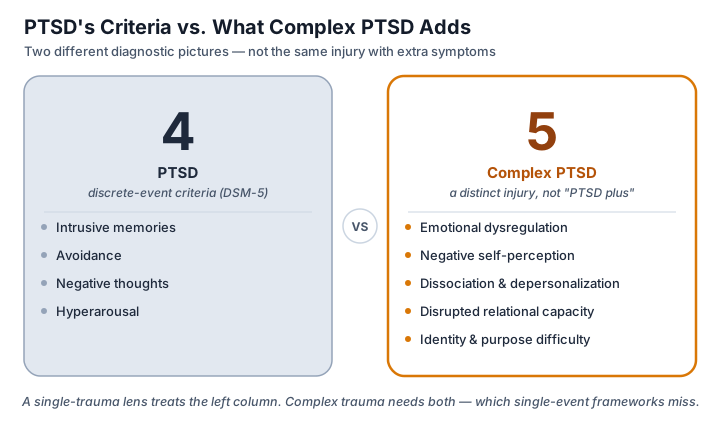
Standard PTSD looks like this: intrusive memories, avoidance, negative thoughts, hyperarousal. The diagnostic criteria, established by the DSM-5, fit a discrete event model. One clear thing happened. You have a flashback to that thing. You avoid reminders of that thing.
Complex PTSD adds dimensions that radically change treatment:
1. Emotional Dysregulation Not just anxiety or anger—but the inability to modulate emotion across the entire spectrum. Your nervous system has lost the ability to recognize when you’re safe. You oscillate between numb and flooded. A slight criticism feels like a death threat because your threat-detection system has been recalibrated by years of unpredictable harm.
2. Negative Self-Perception Shame is not optional with C-PTSD. It’s foundational. When the harm came from someone who was supposed to protect you—a parent, partner, authority figure—the mind often internalizes blame. “I wasn’t good enough.” “I deserved it.” “I’m fundamentally flawed.” This is not cognitive distortion in the usual sense; it’s a learnable fact from your lived experience. The therapist who counters shame with logic (“That’s not true!”) misses why the brain encoded it in the first place.
3. Dissociation and Depersonalization When you’re beaten down for years, your mind finds an exit. You leave your body. You watch yourself from outside. Time gaps appear. You develop what researchers call “structural dissociation”—not just dissociative episodes, but fundamental fragmentation of identity and memory.2 This is adaptive in a context of ongoing threat. It becomes maladaptive when the threat ends and you can’t find your way back into your body.
4. Disrupted Relational Capacity Single-trauma survivors often recover relational function quickly: you were safe, then you were hurt, then you were safe again. But if your harm came from the people closest to you, your brain learned a different lesson: “The people I need are dangerous.” Trust becomes a physiological impossibility, not a cognitive choice. You may find yourself drawn to people who recreate the trauma dynamic because it’s neurologically familiar.
5. Difficulty with Identity and Purpose After years of someone else defining you—your worth, your reality, your thoughts—you may struggle to know who you actually are. Therapy that assumes you have a stable self waiting to be “freed” misses the fact that you may need to build a self from the ground up.
What the 2025-2026 Research Actually Shows
For years, Complex PTSD lived in a liminal space—clinically observable, but not officially in the DSM-5 (though the ICD-11, used globally, includes it). That meant less research funding, less specialized training, and thousands of people being treated as if they had standard PTSD when they didn’t.
That’s starting to change.
The efficacy evidence: A 2025 meta-analysis published in Journal of Affective Disorders examined psychotherapy outcomes across multiple interventions for C-PTSD in adults with complex trauma exposure.3 The results were clear: multicomponent, phase-based approaches work. When researchers looked at intensive treatment programs that combined prolonged exposure, EMDR, psychoeducation, and physical activity, they found that 60% of participants no longer met diagnostic criteria for C-PTSD after treatment, with improvements holding stable at 28-month follow-up.4
That’s real recovery, not management.
The sequence matters finding: A 2025 study that compared treatment sequences found something counterintuitive: patients who received Prolonged Exposure first, followed by EMDR, showed significantly greater symptom reduction than those who received either treatment alone or in reverse order.5 This suggests that stabilization work (PE’s structured processing) followed by more titrated, resource-orienting work (EMDR) creates optimal conditions for healing. But it also means the sequence is not interchangeable.
The dissociation accommodation: For clients with significant dissociative symptoms, both EMDR and PE can work, but they require modifications. EMDR’s titrated, resource-oriented approach often feels safer for dissociation-heavy presentations because it doesn’t demand sustained present-moment awareness in the same way PE does.1 The evidence suggests clinicians should match the intervention to the nervous system’s current capacity, not force the client into the treatment modality.
The Neurobiology: Why This Matters
You can’t understand C-PTSD without understanding what trauma does to the brain.
Bessel van der Kolk’s decades of research have shown that when trauma happens—especially repeated trauma in childhood—it doesn’t just create bad memories. It recalibrates the entire threat-detection system.6 The amygdala becomes hyperactive. The prefrontal cortex (the thinking, deciding part) goes offline. The default mode network fragments. Your window of tolerance—the band of arousal where you can think, regulate, and act—shrinks.
With single-event trauma, you can often restore window capacity quickly: it was there before, the event narrowed it, and safety work widens it again.
With Complex PTSD, many people never had a stable window of tolerance in the first place. It was never built. Your nervous system learned early that the world was chaotic, that people hurt you unpredictably, that you couldn’t trust your own perceptions. Building a functional window of tolerance is not recovery—it’s development. You’re not going back to who you were. You’re growing into who you can be.
This is why somatic work—yoga, breathwork, physical anchoring—is not optional in C-PTSD treatment. It’s not a nice add-on to talk therapy. It’s the language your nervous system actually speaks.6 When you regulate your body, you regulate your brain. When you practice safety in your body, you teach your nervous system that presence is possible.
The Treatment Frame That Actually Works
If you have Complex PTSD, here’s what you need to know about treatment:
Phase 1: Stabilization and Capacity Building This is not the time to process traumatic memories. This is the time to teach your nervous system what safety feels like again. It includes:
- Psychoeducation about trauma and your specific presentation
- Emotion regulation skills (not to suppress, but to modulate)
- Grounding and resourcing techniques
- Building the therapeutic relationship (this is harder than it sounds—your nervous system was trained by relationships to be unsafe)
- Possibly medication to reduce hyperarousal
This phase can last weeks to months. It’s not therapy being slow. It’s therapy being smart.
Phase 2: Memory Processing and Integration Once your window of tolerance is wider and your nervous system has learned what stability feels like, you process. The evidence supports EMDR and/or Prolonged Exposure, often in combination. The goal is not to forget—it’s to move the memory from a present-tense threat to a historical fact. “This happened. It was terrible. I survived. I am not in danger now.”
This phase is intense. It requires a therapist who can track your capacity in real time—who knows when to push and when to stabilize.
Phase 3: Integration and Reconnection Processing memories is not the end. You need to rebuild yourself—your identity, your relationships, your sense of agency. This phase often includes:
- Relational repair and trust-building work
- Values clarification and meaning-making
- Reconnecting with the body and pleasure
- Building a sustainable, autonomous life
The Alliance Matters More Than the Modality
Here’s something the research doesn’t always emphasize: the therapeutic relationship itself is part of the treatment mechanism for C-PTSD.
Your nervous system learned to be unsafe around people. The therapy relationship is the place where you re-learn that people can be predictable, boundaried, and non-exploitative. If your therapist dismisses your dissociation as “avoidance,” or pushes you to process before you’re ready, or misses the relational patterns you’re recreating—you won’t heal. You’ll retraumatize.
This is not your fault. But it is your responsibility to find someone who understands C-PTSD specifically.
The Hard Truths
Complex PTSD treatment is not fast. A solid phase-based approach takes 6 months to 2+ years, depending on severity and complexity. That’s not because you’re broken or resistant. It’s because you’re building something from the ground up: a nervous system that knows safety, a self that isn’t built entirely around surviving someone else’s harm, a capacity to trust that was stolen from you.
You may have setbacks. Anniversaries of trauma, new relationships, transitions—these can open old wounds. That’s not failure. That’s the non-linear nature of integration.
And here’s the most important part: you will likely need to grieve. Not just the trauma itself, but the self you had to become to survive it. The hypervigilance that kept you alive isn’t useful now. The shame that made you compliance possible needs to die. The identity built entirely around avoiding harm needs to be released. That grief is part of healing.
Your Path Forward
If you’re reading this and recognizing yourself—if single-trauma therapy didn’t work, if you’re still trapped in dysregulation and dissociation and shame despite years of work—you don’t have a therapy failure. You have a diagnosis mismatch.
Find a clinician trained specifically in Complex PTSD. Ask about their experience with dissociation, shame-based identity work, and phase-based treatment. Ask if they use evidence-based multimodal approaches. Ask if they understand that recovery is not just symptom reduction—it’s the gradual restoration of a life that feels yours.
The research from 2025-2026 is clear: C-PTSD responds to proper treatment. Not overnight. Not perfectly. But genuinely. You can rewire your nervous system. You can build a window of tolerance. You can learn what safety feels like again.
References
Footnotes
-
Frontiers in Psychology (2026). “Psychotherapy for complex post-traumatic stress disorder: efficacy and therapeutic factors.” https://www.frontiersin.org/journals/psychology/articles/10.3389/fpsyg.2026.1684921/full ↩ ↩2
-
PMC National Center for Biotechnology Information (2025). “PTSD and complex PTSD, current treatments and debates: a review of reviews.” https://pmc.ncbi.nlm.nih.gov/articles/PMC12466117/ ↩
-
ScienceDirect (2025). “Efficacy of psychological interventions for complex post-traumatic stress disorder in adults exposed to complex traumas: A meta-analysis of randomized controlled trials.” Journal of Affective Disorders. https://www.sciencedirect.com/science/article/abs/pii/S0165032725005026 ↩
-
Taylor & Francis Online (2025). “8-day intensive treatment programme for PTSD and complex PTSD vs treatment as usual: a clinical trial.” https://www.tandfonline.com/doi/full/10.1080/20008066.2025.2553422 ↩
-
ScienceDirect. “Sequence matters: Combining Prolonged Exposure and EMDR therapy for PTSD.” https://www.sciencedirect.com/science/article/pii/S0165178120300469 ↩
-
Van der Kolk, B. (2014). The Body Keeps the Score: Brain, Mind, and Body in the Healing of Trauma. Penguin. Research on neurobiology of trauma and somatic approaches updated through 2025 clinical practice. ↩ ↩2
Frequently asked questions.
- Is Complex PTSD different from regular PTSD?
- Yes. Regular PTSD typically follows a single traumatic event; Complex PTSD (C-PTSD) emerges from prolonged, repeated trauma—often in interpersonal contexts like abuse, neglect, or captivity. C-PTSD affects self-perception, emotional regulation, dissociation, and relational patterns in ways that standard PTSD treatments often miss.
- Can I treat Complex PTSD with the same therapy I'd use for regular PTSD?
- Not reliably. While EMDR and Prolonged Exposure have solid evidence for both, C-PTSD requires phase-based treatment—typically starting with stabilization and safety, then processing, then integration. Jumping straight to trauma processing without building capacity often re-traumatizes people.
- What does the research say about combined EMDR and Prolonged Exposure?
- Recent 2025 research shows that combining both therapies—Prolonged Exposure first, then EMDR—produces significantly greater symptom reduction than either alone. Patients also report preferring this sequence and rating it as more helpful.
- How do I know if I have Complex PTSD instead of regular PTSD?
- Ask yourself: Did your trauma happen across years (not days or weeks)? Was it interpersonal—abuse, neglect, captivity, ongoing violence? Do you struggle with emotional flashbacks, feeling detached from your own life, or deep shame about what happened? If yes, you likely have C-PTSD, and you need a clinician who understands that.
- How long does Complex PTSD treatment take?
- It varies, but phase-based approaches typically span 6 months to 2+ years. A 2025 intensive treatment study showed that 60% of participants no longer met C-PTSD criteria after focused treatment, with improvements holding at 28-month follow-up. The work is real, the timeline is honest, and recovery is possible.
If this named something you're living with —
You don't have to figure it out from articles. Matthew Sexton, LCSW, NATC sees adults in therapy at his separate private practice (telehealth · NY · ME · DE · FL). Or take this piece to your own therapist — it's written to be shared.
Visit the practice