What to Expect in Your First Therapy Session
In one classic study, half of therapy patients improved within eight sessions and 75 percent within six months. A first session itself: paperwork, questions, a plan.
From the earlier archive. This article’s original writing is retained and has not been fact-checked as part of our current review. Product references may reflect an earlier version; see current solutions for today’s status.
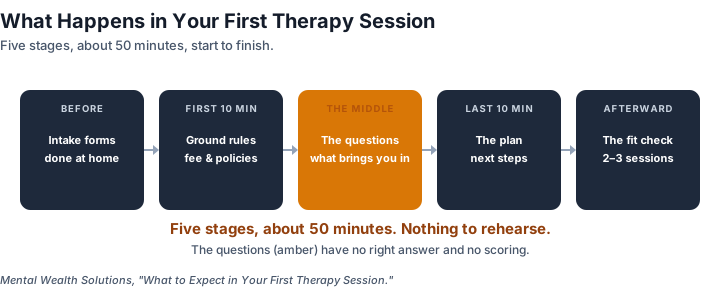
A first therapy session is a structured conversation, usually about 50 minutes long: a little paperwork, a series of questions about what brought you in, and a short talk about what happens next. Nobody puts you on a couch, and nobody makes you relive your worst day in week one. The odds are also better than your nerves are telling you. In one classic study cited by the American Psychological Association, half of psychotherapy patients improved within eight sessions, and 75 percent improved within six months. What follows is the whole appointment, laid out step by step, so nothing in that room catches you off guard.
The week before your first therapy session: booking was the hard part
If getting this appointment felt like a part-time job, that was the system, and it is behind you now. In the American Psychological Association’s December 2025 survey of 1,742 practicing psychologists, 46 percent reported having no openings for new patients. The calls, the waitlists, the “not accepting new clients” voicemails: that gauntlet is real, and you got through it. Everything from here is easier than the phone calls were.
Most practices send intake forms before the first visit: contact details, insurance information if you are using it, a short health history, and consent paperwork. Fill them out at home if you can. It saves session time for the actual conversation, and it is easier to remember your medication names at your kitchen table than in a waiting room.
One thing you do not need to prepare: a speech. You do not need your problems organized into bullet points or a theory about where they came from. Sorting through the pile together is the therapist’s job, and the first session is built for exactly that.
The first ten minutes: ground rules
The session opens like an ordinary introduction. The therapist tells you a little about how they work, checks the paperwork, and covers logistics: the fee, the cancellation policy, scheduling. If any of it is unclear, ask on the spot. Money questions are normal here, and how a therapist handles them tells you something about how they will handle everything else.
Then comes the part worth listening to closely: confidentiality. What you say in therapy stays private, with a few specific exceptions the therapist is required to explain. The standard ones are serious risk of harm to yourself or someone else, suspected abuse or neglect of a child or a dependent adult, and a court order. A good therapist walks you through these limits before you share anything deep, so you can make informed choices about what you say. If yours skips this, ask about it directly.
The middle: the questions
At some point the therapist asks a version of “What brings you in?” There is no right answer and no scoring. You can start with the thing keeping you up at night, the relationship that fell apart, or a vague sense that something is off and has been for a while. Some people arrive with a specific problem. Plenty arrive with “I honestly don’t know where to start.” Both are workable starting points, and a therapist can build from either one.
Expect some history questions next: how you have been sleeping, changes in appetite or energy, alcohol and substance use, medications, past experience with therapy, and some family background. This part can feel like a medical intake because it partly is one. The purpose is context, so the therapist understands the terrain before making any suggestions about it.
You control the depth the entire time. If a question touches something you are not ready to open, say so. “I’d rather not get into that today” is a complete sentence. A competent therapist hears it as useful information, marks the spot, and moves on without pressure.
Your only job in the room
Show up and be roughly honest. That is the entire job description.
You can stumble over words, contradict yourself, lose your train of thought, sit in silence, or cry. All of it is standard. The tissues are within reach of your chair for a reason. You do not need to be articulate, insightful, or composed, because the polished version of you is not the one who needs the help.
And remember that evaluation runs both directions. While the therapist is learning about you, you are learning about them: how they listen, whether their questions land, whether you can imagine being honest in this room. That assessment of yours is a legitimate part of the process, and it matters for what comes after.
The last ten minutes: the plan
A first session usually closes with logistics for what comes next. The therapist may suggest a schedule, and weekly sessions are a common starting rhythm because momentum builds faster with shorter gaps. They should also sketch how they work: what approach they use, and roughly how it applies to what you described.
Before you leave, three questions are worth asking if they have not been answered already:
- What approach would you use for what I described, and why?
- How will we know whether this is helping?
- How do scheduling and between-session messages work?
You are allowed to leave without committing to anything. A first session is a trial run for both people in the room, and treating it that way is healthy, common practice.
Afterward: the strange-feelings window
People walk out of first sessions relieved, wrung out, lighter, heavier, energized, or several of those at once. All of it is normal. You spent an hour handling material you may have been carefully not touching for years, and your system needs a day or two to settle. Give it that time before you judge the experience.
Then run a simple fit check over the next two or three sessions. Did you feel heard? Could you imagine telling this person something hard? A working relationship with your therapist is one of the best-documented predictors of whether therapy helps, so the fit question deserves real weight. If the answer keeps coming back no, switching therapists is normal and common, and a decent clinician will offer referrals rather than take offense. Finding the right person matters more than staying loyal to the first name that had an opening.
The step you have already taken, deciding to go, is the one most people postpone for years. The rest of it really is just two people in a room, figuring out what is going on and what to do about it.
FAQ
What should I say at the start of a first therapy session? Whatever is true. “I’ve been anxious for months and it’s getting worse” works. So does “I don’t know how to describe it, things just feel off.” Therapists are trained to take a rough starting point and ask the questions that give it shape. You do not need a prepared speech, a diagnosis, or an organized story. Arriving is the whole assignment.
Do I have to talk about my childhood in the first session? No. A therapist will usually ask some background questions for context, including about family, but you control the depth. “I’m not ready to get into that today” is a complete sentence, and a competent therapist will respect it without pushing. The first session is for building enough safety to do harder work later, when you choose to.
What if I cry in my first therapy session? Then you cry. It is one of the most common things that happens in a therapy office, which is why the tissues sit within arm’s reach of your chair. Crying usually means the conversation touched something real, and no therapist will think less of you for it. You will not be the first person to cry in that room that week.
Sources
- American Psychological Association, “Understanding psychotherapy and how it works” (accessed July 2026). https://www.apa.org/topics/psychotherapy/understanding — in one classic study, half of psychotherapy patients improved after eight sessions and 75 percent improved after six months.
- American Psychological Association, 2025 Practitioner Pulse Survey (n=1,742), December 2025. https://www.apa.org/pubs/reports/practitioner/2025/full-report.pdf — 46 percent of psychologists reported no openings for new patients.
Figures current as of July 2026.
Disclaimer
This article is for educational and informational purposes only. It does not constitute medical, clinical, legal, or therapeutic advice, and reading it does not create a therapist-client relationship with Matthew Sexton, LCSW or Mental Wealth Solutions, Inc. Although the author is a licensed clinical social worker, the content in this article is not clinical assessment, diagnosis, or treatment.
The patterns, concepts, and frameworks described here reflect published research and general clinical observations. Individual experiences vary, and what is described here may not match every reader’s situation. If you are working through the concerns described in this article, please consult a licensed mental health professional who can assess your specific circumstances.
If you are in immediate emotional crisis, you can reach the 988 Suicide & Crisis Lifeline by calling or texting 988 (US). If you are experiencing domestic violence or are in physical danger, contact the National Domestic Violence Hotline at 1-800-799-7233 or visit thehotline.org. In a life-threatening emergency, call 911.
Frequently asked questions
- What should I say at the start of a first therapy session?
- Whatever is true. 'I've been anxious for months and it's getting worse' works. So does 'I don't know how to describe it, things just feel off.' Therapists are trained to take a rough starting point and ask the questions that give it shape. You do not need a prepared speech, a diagnosis, or an organized story. Arriving is the whole assignment.
- Do I have to talk about my childhood in the first session?
- No. A therapist will usually ask some background questions for context, including about family, but you control the depth. 'I'm not ready to get into that today' is a complete sentence, and a competent therapist will respect it without pushing. The first session is for building enough safety to do harder work later, when you choose to.
- What if I cry in my first therapy session?
- Then you cry. It is one of the most common things that happens in a therapy office, which is why the tissues sit within arm's reach of your chair. Crying usually means the conversation touched something real, and no therapist will think less of you for it. You will not be the first person to cry in that room that week.