As of December 2025, 137 million Americans — 40% of the entire U.S. population — live in a federally designated Mental Health Professional Shortage Area (HPSA). That figure comes from HRSA’s Bureau of Health Workforce, and it is not a rounding error. It grew by 15 million people in a single year, up from roughly 122 million in December 2024. The number of designated shortage areas jumped from 6,418 to 6,807 in the same period. (HRSA Bureau of Health Workforce, State of the Behavioral Health Workforce 2025, December 2025)
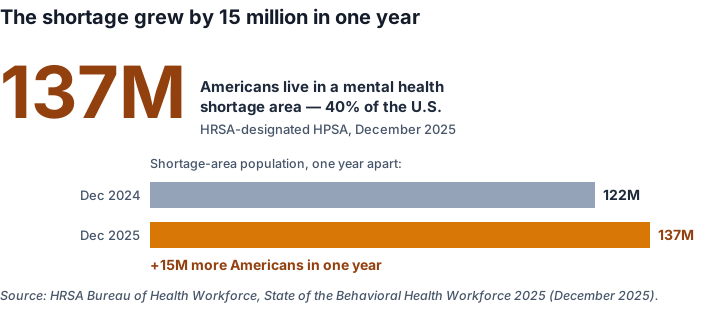
Quick answer: Nearly half the country cannot reliably access a mental health provider, and the shortage grew by 15 million people in one year — not because the crisis appeared, but because the system responsible for producing and keeping clinicians failed them out of the profession.
Key Takeaways
- 137 million Americans — 40% of the country — live in a mental health provider shortage area as of December 2025, up 15 million from the prior year (HRSA, December 2025)
- Only 26.4% of workforce need is being met in those shortage areas as of April 2026
- 93% of behavioral health workers report burnout; 48% are considering leaving
- The shortage is manufactured, not natural: commercial insurer underpayment drives clinicians out, which shrinks the workforce, which grows the shortage
- HRSA projects shortfalls of nearly 100,000 psychologists and 100,000 mental health counselors by 2038
What does “mental health desert” actually mean?
A Mental Health Professional Shortage Area is a federal designation. HRSA grants it when a geographic area, population group, or facility cannot access a sufficient supply of mental health professionals. The threshold is one provider per 30,000 people, or one per 20,000 in areas with elevated need.
When 40% of the country falls into that category, the designation stops being a local administrative label and becomes a description of how the country has structured mental health access. Or failed to.
As of April 2026, HRSA’s Designated HPSA Quarterly Report estimated that only 26.4% of the mental health workforce need in those areas is being met nationally. (HRSA Designated HPSA Quarterly Report, April 2026) That means even in places that have been formally identified as having a shortage — places where the government has said, on the record, that there are not enough providers — roughly three-quarters of the need goes unmet. That is not a gap at the margins. It is the primary condition.
Citation capsule: As of April 1, 2026, HRSA’s Quarterly HPSA Report shows only 26.4% of mental health workforce need is being met in federally designated shortage areas. This figure covers 137 million Americans in 6,807 shortage areas as of December 2025 — a 389-area increase in one year. (HRSA, April 2026)
Nearly half of adults with a mental illness aren’t getting care
The 137 million figure is about geography — where providers are. It doesn’t count the people in other areas who can’t afford care, can’t get an appointment, or stopped trying. The treatment gap is bigger.
SAMHSA’s 2024 National Survey on Drug Use and Health found that 61.5 million adults — 23.4% of the U.S. adult population — experienced any mental illness in the past year. Of those, 48% received no mental health treatment at all. (SAMHSA National Survey on Drug Use and Health 2024, 2025)
Nearly one in four American adults is carrying something diagnosable. Half of them got nothing.
Some of that gap is financial. Some is stigma. A lot of it is that the provider isn’t there, or they don’t take the plan, or the first available appointment is three months out and the person in crisis isn’t going to hold that calendar slot. We have a tendency to explain this away as a “help-seeking problem.” But when the help isn’t reachable, not seeking it is rational, not pathological.
How does a shortage grow by 15 million people in one year?
I’ve been a clinician long enough to watch colleagues leave private practice not because they burned out on the clinical work, but because the business conditions made staying impossible. The reimbursement math stopped working. The prior authorizations multiplied. The emotional overhead of fighting for services stayed constant while the pay for providing them eroded. That is the mechanism behind the 15 million.
The shortage did not grow because demand exploded overnight. It grew because the workforce is contracting while the population is not.
A 2024 National Council for Mental Wellbeing survey of 750 behavioral health workers, conducted by Harris Poll, found 93% reported burnout and 48% said they were considering leaving for other employment. (National Council for Mental Wellbeing “Help Wanted” survey, June 2024) Nearly half the existing workforce is looking at the exit. The people who remain are covering more ground. The people who leave are not being replaced at the same rate.
This is the pipeline running backward.
Citation capsule: 93% of behavioral health workers report burnout and 48% are considering leaving the profession entirely, according to a June 2024 National Council for Mental Wellbeing survey of 750 workers conducted by Harris Poll. When the workforce that exists is considering exit at that rate, the shortage cannot shrink. (National Council for Mental Wellbeing, June 2024)
The mental health provider shortage is manufactured, not natural
Here is the argument I think needs to be made more clearly, because the “shortage” framing lets the actual cause disappear into abstraction.
Mental health clinicians don’t appear and then randomly leave. They leave because the economics were designed by commercial insurance companies to make staying untenable. Commercial insurers pay mental health clinicians substantially less than they pay medical and surgical providers inside the same plans — a parity violation that has been enforced in 43 states by the Kennedy Forum’s analysis of the four largest commercial insurers published in April 2026. The result is a profession where the reimbursement rate doesn’t cover the overhead of a private practice, which means clinicians either go out of network (making them unreachable for people who depend on insurance), join agency settings with heavy caseloads, or leave the field.
When 43 out of 44 states reported a behavioral health workforce shortage in a 2024 NCSL survey, the natural question is: what do all 43 of those states have in common? (NCSL Behavioral Health Workforce Shortages report, June 2024) The commercial insurance infrastructure that decides what a therapy session is worth is the same in all of them.
This is not to say the shortage would vanish if payers fixed reimbursement tomorrow. The pipeline damage is real and structural. HRSA projects a shortfall of roughly 99,840 psychologists and 99,780 mental health counselors by 2038, alongside gaps of 77,050 addiction counselors and 36,780 adult psychiatrists. (HRSA Bureau of Health Workforce 2025, 2025) Those numbers reflect decades of underinvestment, not just last year’s insurance contracts.
But the frame matters. A “shortage” sounds like a natural scarcity, like a drought or a geographic constraint. What we have is a commercially manufactured scarcity, where the entity profiting from coverage decisions structured those decisions in a way that made the covered services unreachable. That is a different problem, and it has a different set of solutions.
What can actually change this?
Pew Charitable Trusts published a state-by-state analysis in April 2026 identifying concrete policy levers: workforce needs assessments, financial incentives for clinicians to practice in shortage areas, and pipeline programs to grow the supply of licensed providers. (Pew Charitable Trusts, April 16, 2026) These are not radical interventions. They are the basic infrastructure a functioning system would already have.
The distribution problem is as important as the headcount problem. The workforce that exists is not located where it is needed most. Rural counties, low-income urban neighborhoods, and communities with high Medicaid reliance carry a disproportionate share of the shortage burden. Adding providers to undersupplied areas is different from adding providers overall, and the two require different policy instruments.
On the payer side, the enforcement of existing mental health parity law is the most direct lever. States like Connecticut and Pennsylvania have recently taken enforcement action against commercial insurers for parity violations. Georgia identified approximately $25 million in violations in a 2026 review. Fines create consequences. Consequences change the reimbursement calculus. And changing the reimbursement calculus is the only thing that changes whether a clinician can afford to stay in the profession.
We are not going to build our way out of a 15-million-person increase in one year without addressing why the providers who exist are leaving. That is the part that tends to get dropped from the policy conversation, because it requires naming commercial insurers as a causal factor, and that is a less comfortable argument than adding more residency slots.
FAQ
How many Americans live in a mental health provider shortage area in 2026? 137 million Americans — 40% of the U.S. population — lived in a federally designated Mental Health Professional Shortage Area as of December 2025, according to HRSA. That figure grew by 15 million people in a single year. As of April 2026, only 26.4% of the mental health workforce need in those areas is being met.
What is causing the mental health provider shortage? The shortage is not a natural disaster. Commercial insurers pay mental health clinicians significantly less than medical and surgical providers in the same plan. That reimbursement gap makes private practice financially untenable, which feeds burnout: 93% of behavioral health workers report burnout and 48% are considering leaving the field, per a 2024 National Council for Mental Wellbeing survey. Fewer clinicians staying in the field means more shortage areas.
Which states have the worst mental health provider shortages? The shortage is nearly universal. A 2024 NCSL survey found 43 out of 44 states reported a behavioral health workforce shortage. The distribution is uneven within states, with rural areas and low-income communities carrying a disproportionate share of the gap. A 2026 Pew analysis confirmed the workforce is not distributed to match where need is highest.
How many mental health providers does the U.S. need by 2038? HRSA projects shortfalls of roughly 99,840 psychologists, 99,780 mental health counselors, 77,050 addiction counselors, and 36,780 adult psychiatrists by 2038. These gaps reflect decades of structural underinvestment, driven in large part by a reimbursement environment that has long made behavioral health an economically punishing field to practice in.
Sources
- HRSA Bureau of Health Workforce, State of the Behavioral Health Workforce 2025 — 137M / 40% / +15M / +389 shortage areas; workforce projections through 2038. December 2025.
- HRSA, Designated HPSA Quarterly Report — 26.4% of need met in shortage areas. Data as of April 1, 2026.
- SAMHSA, 2024 National Survey on Drug Use and Health — 61.5M adults with any mental illness; 48% treatment gap. Published 2025 (reporting 2024 data).
- National Council for Mental Wellbeing, “Help Wanted” survey (Harris Poll, n=750) — 93% burnout; 48% considering leaving. June 2024.
- Pew Charitable Trusts, State Policies Can Help Address the Mental Health Care Workforce Shortages — state policy levers; uneven workforce distribution. April 16, 2026.
- NCSL, Behavioral Health Workforce Shortages — 43 of 44 states reporting shortage. June 2024.
Figures current as of June 2026.
Disclaimer
This article is for educational and informational purposes only. It does not constitute medical, clinical, legal, or therapeutic advice, and reading it does not create a therapist-client relationship with Matthew Sexton, LCSW or Mental Wealth Solutions, Inc. Although the author is a licensed clinical social worker, the content in this article is not clinical assessment, diagnosis, or treatment.
The workforce data, shortage designations, and projections described in this article are drawn from federal agency reports, peer-reviewed analysis, and national surveys. They represent estimates and point-in-time snapshots that may change as HRSA updates its designation criteria, survey methods improve, or policy conditions shift. Access to mental health services in any specific location depends on many local factors not reflected in national figures. If you are trying to find a mental health provider, your state’s mental health authority, SAMHSA’s treatment locator at findtreatment.gov, or a licensed clinician in your area is the appropriate starting point — not this article.
If you are in immediate emotional crisis, you can reach the 988 Suicide & Crisis Lifeline by calling or texting 988 (US). If you are experiencing domestic violence or are in physical danger, contact the National Domestic Violence Hotline at 1-800-799-7233 or visit thehotline.org. In a life-threatening emergency, call 911.
Frequently asked questions.
- How many Americans live in a mental health provider shortage area in 2026?
- 137 million Americans — 40% of the U.S. population — lived in a federally designated Mental Health Professional Shortage Area as of December 2025, according to HRSA. That figure grew by 15 million people in a single year, up from roughly 122 million in December 2024. As of April 2026, only 26.4% of the mental health workforce need in those areas is being met.
- What is causing the mental health provider shortage?
- The shortage is not a natural disaster. Commercial insurers pay mental health clinicians significantly less than medical and surgical providers in the same plan, a parity violation that makes private practice financially untenable for many. That underpayment feeds burnout: 93% of behavioral health workers report burnout and 48% are considering leaving the field entirely, according to a 2024 National Council for Mental Wellbeing survey. Fewer clinicians entering and staying in the field means more designated shortage areas.
- Which states have the worst mental health provider shortages?
- The shortage is nearly universal. A 2024 NCSL survey found 43 out of 44 states reported a behavioral health workforce shortage. The distribution is uneven within states too — rural areas, low-income urban neighborhoods, and communities of color carry a disproportionate share of the gap. A 2026 Pew Charitable Trusts analysis confirmed that the workforce is not distributed in a way that matches where need is highest.
- How many mental health providers does the U.S. need by 2038?
- HRSA projects shortfalls of roughly 99,840 psychologists, 99,780 mental health counselors, 77,050 addiction counselors, and 36,780 adult psychiatrists by 2038. These are not small gaps at the margin. They represent a structural collapse in the pipeline — driven largely by a field where the business conditions have been hostile long enough that the people who would have entered it chose not to.
Want to discuss this for your program?
Book a 30-min conversation. We'll walk you through deployment, the BAA, and what your rollout looks like in production.
Book a 30-min conversation