Signs You Need Therapy, Not Just Self-Help
People wait a median of 11 years between a problem starting and treatment. Self-help does real work, but here's the honest line where it stops being enough.
From the earlier archive. This article’s original writing is retained and has not been fact-checked as part of our current review. Product references may reflect an earlier version; see current solutions for today’s status.
Self-help handles a real share of mental health problems, and the sign you need more was never about effort. It shows up as a specific pattern: you know exactly what to do, and you still cannot do it. The stakes of reading that pattern late are higher than most people guess. People wait a median of 11 years between the first onset of a mental disorder and their first contact with treatment, according to National Comorbidity Survey data published in Health Services Research (2004). Much of that decade gets spent trying harder with tools that were never built for the job. This post draws the line honestly: what self-help genuinely does well, the signs your situation has crossed into clinician territory, and why crossing sooner beats crossing later.
What self-help actually does well
Start with credit where the research gives it. Books, structured workbooks, and well-built programs teach real skills: how anxiety behaves, how to interrupt a thought spiral, how to build a routine that supports sleep. For many people with milder symptoms, that is enough to move the needle.
The strongest version is what researchers call guided self-help: a structured workbook or online program plus brief, regular check-ins with a professional. A meta-analysis in Psychological Medicine (2010) compared it head-to-head with face-to-face psychotherapy for depression and anxiety across 21 randomized trials with 810 participants. The difference in outcomes was effectively zero (d = -0.02). Two honest caveats travel with that finding. The reviewers flagged the limited quality of many included studies. And “guided” is the load-bearing word: a human was checking in on every one of those participants. The fully solo version, the book on the nightstand and the app streak, has the weakest evidence, and it is the version most people are actually running at 11 p.m.
So self-help counts. The question is whether your problem is still in its weight class.
The signs you need therapy
These are the patterns I see most often when someone has been white-knuckling it alone past the point where alone works.
You know what to do and still cannot do it
You can name your attachment style, recite the breathing exercise, and explain your triggers with footnotes. Under real load, the old pattern runs anyway. This is the clearest sign of all, and it means information has already solved the part information can solve. What remains lives in your nervous system and your relationships, and it changes through practice with feedback, which requires another person in the loop.
The same wall shows up in every context
New job, same burnout. New partner, same fight by month four. You have swapped the external circumstances more than once, and the internal experience keeps its shape. When a pattern survives every change of scenery, the pattern is the thing to work on, and a general-audience book cannot see yours. A clinician can, because spotting it across the details of your specific life is the trade.
Your coping has started charging interest
The glass of wine that took the edge off now takes the evening. The alone time that restored you has quietly become isolation. The detachment that got you through a hard stretch now sits between you and everyone you love. When a strategy starts generating its own damage, the goal shifts from finding a better strategy to understanding what the strategy was protecting you from, and that is clinical work.
Basic functioning is slipping
Sleep, meals, deadlines, showering, answering texts. When the load-bearing routines of your life start dropping, and the trend has held for a couple of weeks or more, that is your signal, whatever the cause turns out to be. Functioning is the honest gauge precisely because it does not care how well you can explain yourself.
You feel flat instead of bad
No crisis, nothing technically wrong, and no color in any of it. Going through the motions of a life rather than living one. This one hides because it does not look dramatic enough to act on, and most self-help is written for people who feel actively bad rather than persistently nothing. Emotional flatness is real clinical territory and it responds to treatment.
The safety sign
If you are having thoughts of suicide or of harming yourself, the self-help question is already answered, today. Call or text 988. That line exists for exactly this moment, and using it is the competent move.
Why capable people stay too long on the self-help side
Because the front door to therapy is heavy, and it was built that way by economics rather than by accident. Private-pay therapy averaged $159 a session while insurance paid therapists about $111 for the same hour, per a Heard survey of more than 3,000 therapists reported by Behavioral Health Business (April 2025). Math like that pushes clinicians away from insurance entirely: 38 percent of psychologists now accept no insurance at all, per the American Psychological Association’s December 2025 Practitioner Pulse Survey. The result is cash prices on one side and thin networks with waitlists on the other.
Seen against that backdrop, the years people spend on the self-help side stop looking like denial. Working with what is on the shelf is a rational response to a system that made the alternative expensive and slow. The 11-year figure at the top of this post is mostly a story about that system. Just be clear-eyed about the trade: the door being heavy is a reason the wait happens, and it is never evidence you belong outside.
If cost is the wall, there are footholds. Sliding-scale fees adjust to income, and many therapists reserve slots for them. University training clinics offer supervised care at reduced rates. Insurance plans can be pushed for out-of-network reimbursement. None of it is as easy as it should be. All of it beats year eight of the same workbook.
Use both, in the right order
Therapy and self-help stack well. The books build vocabulary and skills between sessions, and the sessions supply the piece no book carries: a trained person who can see your blind spots, in real time, and hand the pattern back to you. Think of workout videos and a physical therapist. The videos stay useful after the knee injury. They stop being sufficient.
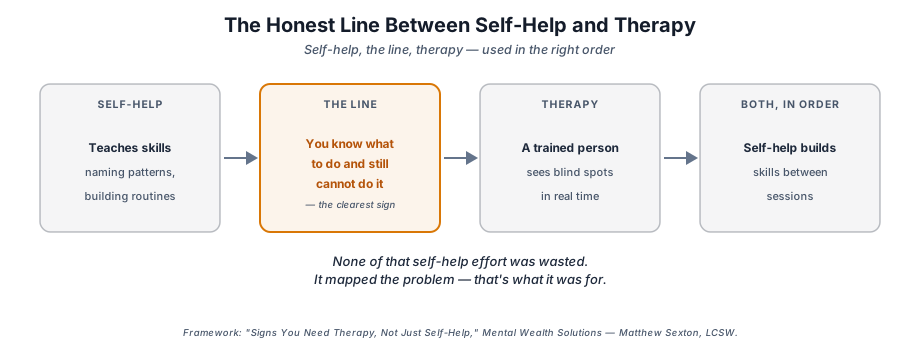
And none of this marks your effort as wasted. The years of reading and practicing mapped the problem well enough to show it deserves specialist attention, which is exactly what that work was for. If you are ready to look at the next step, here is exactly what a first session looks like, beat by beat.
FAQ
Is guided self-help as effective as therapy? For mild to moderate depression and anxiety, it can be. A meta-analysis in Psychological Medicine (2010) covering 21 randomized trials with 810 participants found no significant difference in outcomes between guided self-help and face-to-face psychotherapy, though the reviewers cautioned that many included studies were of limited quality. The word “guided” matters: those programs included regular check-ins with a professional. Fully solo self-help has weaker evidence, and problems that are severe, worsening, or involve safety belong with a clinician.
How long should I try self-help before starting therapy? No trial has produced an official number, so treat this as a working rule rather than research: if you have put in several weeks of honest effort and nothing is moving, or if any sign on the functioning list applies (sleep, work, relationships, or basic care slipping), book the appointment. And if you are having thoughts of suicide or self-harm, skip the waiting period entirely and call or text 988 today.
What if I can’t afford therapy? Ask prospective therapists about sliding-scale fees, which adjust to your income. University training clinics offer supervised therapy at reduced rates. If you have insurance, ask your plan for a list of in-network therapists who are actually accepting new clients, and ask about out-of-network reimbursement. While you work those options, a guided self-help program with professional check-ins is a research-supported way to make progress rather than a consolation prize.
Sources
- Wang P.S., Berglund P.A., Olfson M., Kessler R.C., “Delays in Initial Treatment Contact After First Onset of a Mental Disorder,” Health Services Research, 2004 (National Comorbidity Survey data). https://pmc.ncbi.nlm.nih.gov/articles/PMC1361014/ — median of 11 years between onset of the first mental disorder and first treatment contact.
- Cuijpers P., Donker T., van Straten A., Li J., Andersson G., “Is guided self-help as effective as face-to-face psychotherapy for depression and anxiety disorders?” Psychological Medicine, 2010. https://www.ncbi.nlm.nih.gov/books/NBK80507/ — 21 randomized trials, 810 participants, no significant difference in overall effect size (d = -0.02, 95% CI -0.20 to 0.15); authors noted the limited quality of most included studies.
- Behavioral Health Business, “Despite the Rise in Therapist Income, Reimbursement Woes Continue,” April 7, 2025, covering Heard’s survey of more than 3,000 therapists. https://bhbusiness.com/2025/04/07/despite-the-rise-in-therapist-income-reimbursement-woes-continue/ — average $111 per session from insurance versus $159 private pay.
- American Psychological Association, 2025 Practitioner Pulse Survey (n=1,742), December 2025. https://www.apa.org/pubs/reports/practitioner/2025/full-report.pdf — 38 percent of psychologists accept no insurance.
Figures current as of July 2026.
Disclaimer
This article is for educational and informational purposes only. It does not constitute medical, clinical, legal, or therapeutic advice, and reading it does not create a therapist-client relationship with Matthew Sexton, LCSW or Mental Wealth Solutions, Inc. Although the author is a licensed clinical social worker, the content in this article is not clinical assessment, diagnosis, or treatment.
The patterns, concepts, and frameworks described here reflect published research and general clinical observations. Individual experiences vary, and what is described here may not match every reader’s situation. If you are working through the concerns described in this article, please consult a licensed mental health professional who can assess your specific circumstances.
If you are in immediate emotional crisis, you can reach the 988 Suicide & Crisis Lifeline by calling or texting 988 (US). If you are experiencing domestic violence or are in physical danger, contact the National Domestic Violence Hotline at 1-800-799-7233 or visit thehotline.org. In a life-threatening emergency, call 911.
Frequently asked questions
- Is guided self-help as effective as therapy?
- For mild to moderate depression and anxiety, it can be. A meta-analysis in Psychological Medicine (2010) covering 21 randomized trials with 810 participants found no significant difference in outcomes between guided self-help and face-to-face psychotherapy, though the reviewers cautioned that many included studies were of limited quality. The word 'guided' matters: those programs included regular check-ins with a professional. Fully solo self-help has weaker evidence, and problems that are severe, worsening, or involve safety belong with a clinician.
- How long should I try self-help before starting therapy?
- No trial has produced an official number, so treat this as a working rule rather than research: if you have put in several weeks of honest effort and nothing is moving, or if any sign on the functioning list applies (sleep, work, relationships, or basic care slipping), book the appointment. And if you are having thoughts of suicide or self-harm, skip the waiting period entirely and call or text 988 today.
- What if I can't afford therapy?
- Ask prospective therapists about sliding-scale fees, which adjust to your income. University training clinics offer supervised therapy at reduced rates. If you have insurance, ask your plan for a list of in-network therapists who are actually accepting new clients, and ask about out-of-network reimbursement. While you work those options, a guided self-help program with professional check-ins is a research-supported way to make progress rather than a consolation prize.