The most dangerous sentence in a clinical interview is not “I want to hurt myself.” Clinicians are trained for that one. We have screens, escalation paths, safety plans. We know what to do when someone names a crisis out loud.
The most dangerous sentence is “I’m fine.” Especially when it is said quickly, smoothly, and on time. Especially when the person saying it is still showing up to work, still answering email, still hitting their numbers. Especially when nothing on the dashboard is flashing red.
Spring Health released its 2026 Workplace Mental Health Report on April 9. The headline finding is that forty percent of burned-out employees report being physically present but mentally checked out. HR leaders, asked to estimate, put silent burnout at thirty percent of their workforce. Nearly two-thirds of organizations saw mental-health leaves of absence rise over the past year. About one in six saw those leaves spike by twenty-five percent or more. And eighty-nine percent of HR leaders still believe their existing mental-health benefits give them a competitive advantage.
Those last two numbers do not belong in the same paragraph unless something is broken. Either the benefits are working, in which case leaves should not be spiking, or the benefits are not catching what is actually happening, in which case the competitive-advantage story is being told to the wrong audience using the wrong instrument. The Spring Health data, read honestly, says the second one.
This essay is about what silent burnout is, why every metric currently used to detect it is built to miss it, and what changes — at the level of the consulting room and at the level of the HR dashboard — when you accept that “I’m fine” is not reassurance. It is the symptom.
What silent burnout actually is
Burnout, as Christina Maslach defined it across forty years of research, has three dimensions: emotional exhaustion, depersonalization, and reduced sense of personal accomplishment. The original literature assumed all three would show up at once and visibly — the helping professional who snaps at a client, the nurse who stops making eye contact, the teacher whose lesson plans get thinner each month.
Silent burnout is what happens when the first dimension — exhaustion — runs ahead of the other two, and the person compensates. They are running on empty. They know they are running on empty. They also know that admitting it costs something they cannot afford to lose. So they keep producing. They keep performing engagement. They keep answering “fine” because the alternative is a conversation they do not have time, energy, or institutional safety to have.
The behavioral signature is muted on purpose. Output stays inside the acceptable range. Tone in meetings stays inside the acceptable range. The person you would expect to notice — the manager, the partner, the colleague who shares the standup — is being given exactly the data they expect to see. Then, abruptly, the person takes a leave. Or quits. Or has the breakdown they have been postponing for months.
Spring Health’s number — forty percent of burned-out employees physically present, mentally checked out — is not a measure of laziness. It is a measure of a specific compensatory pattern under chronic stress, and it has a long clinical lineage. In trauma literature it overlaps with what Bessel van der Kolk and others have called functional freeze — the dorsal-vagal version of immobility, in which a person continues to operate while affectively offline. In occupational psychology it overlaps with presenteeism — being at work but not productive — though silent burnout is the more accurate frame because it foregrounds the internal state, not just the output curve.
In the consulting room, it looks like this. The person comes in on time. They answer questions in complete sentences. They report that things are “fine,” “manageable,” “a lot but okay.” If you ask them what they did over the weekend, they cannot remember. If you ask them to name three things they enjoyed in the past month, the pause is long. If you ask them when they last slept through the night, they smile, look up, and say something like “what year is it.” That smile is the diagnostic moment. They are not being flippant. They are showing you, with affect, that the question has touched something the words are not allowed to touch.
Why your metrics are designed to miss it
The instruments most organizations rely on to gauge workforce mental health were built for visible distress, not silent compensation. Each of them, by design, returns a clean signal exactly when you should be most worried.
Engagement surveys. A person in silent burnout is, by definition, performing engagement. They have learned which Likert anchors to pick. They have learned which open-text answers do not trigger follow-up. The survey is a self-report instrument, and self-report from someone whose entire compensatory strategy is appearing fine will return appearing fine. The instrument is doing what it was built to do; the input is contaminated.
EAP utilization rates. I have written at length about why EAP utilization sits at three to six percent and why that is a design problem, not a motivation problem. Silent burnout makes the access architecture worse, not better. The same person who cannot bring themselves to say “I am not okay” out loud to their partner is not going to navigate an eight-step phone tree to say it to a stranger.
Productivity dashboards. Output stays in the acceptable range until the day it stops entirely. There is no early-warning gradient. The dashboard looks identical on the day before a leave of absence as it looked six months earlier.
Manager check-ins. A weekly one-on-one in which the manager asks “how are you doing?” gets the answer the institution has trained the employee to give. If the manager has not been trained to hear the second-order signal — the speed of the answer, the smile that does not reach the eyes, the deflection back to a project update — the meeting becomes another data point that says everything is fine.
Absenteeism counts. Silent burnout produces presenteeism, not absenteeism. By the time it converts to absence, it converts hard. The leap from zero sick days to a multi-week mental-health leave is the signature pattern. There is no gentle slope.
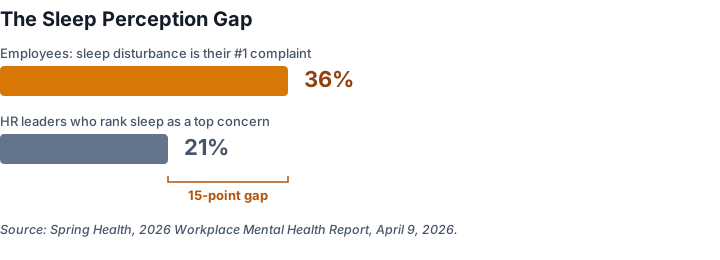
Spring Health’s report exposes the gap precisely. Sleep disturbance — the single largest mental-health complaint employees report, at thirty-six percent — is recognized as a top concern by only twenty-one percent of HR leaders. That is a fifteen-point perception gap on what is probably the most predictive early indicator of silent burnout in the literature. The signal is right there. The instruments are not reading it.
The clinical picture, two ways
Read by an HR leader and read by a clinician, silent burnout describes the same person from two different chairs. Both readings need to coexist.
From the HR chair, the question is: what does the population look like and what does the system owe it. The 2026 numbers are unambiguous. If one in six organizations saw leaves spike twenty-five percent or more, and if HR’s own estimate is that thirty percent of the workforce is in silent burnout, then any benefit design that requires the employee to identify themselves as struggling and initiate contact is going to fail at scale. The compensatory pattern is the barrier. You cannot solve it with a better landing page.
From the clinical chair, the question is: what is this person actually experiencing and what does it cost them to keep performing. The honest answer is: it costs the part of them that used to enjoy things. Anhedonia is the quiet companion of silent burnout, and it shows up earlier than most clinicians look for it. Loss of curiosity. Loss of the small pleasures — the morning coffee they used to taste, the song that used to land, the friend they used to want to call. Sleep architecture goes first; pleasure goes second; performance goes last. By the time performance breaks, the other two have been gone for months.
Both readings converge on the same intervention principle: the system, not the individual, needs to do the work of noticing. Asking a silent-burnout patient to “advocate for themselves” or “set boundaries” is asking the symptom to fix itself.
What actually moves the number
A clinician’s prescription and an HR leader’s intervention plan will use different vocabulary, but they end up at the same five practices.
Stop asking “how are you?” as a yes/no. Ask “what is the hardest thing about your week right now?” The first question gets fine. The second gets a sentence. The shift is small, the cost is zero, and it is the single highest-yield change a manager or a therapist can make.
Measure sleep, not mood. Self-report on sleep — hours, continuity, restorativeness — is a far better leading indicator than self-report on mood, because the compensatory mask does not extend to sleep. People who would never say “I am struggling” will report, factually, that they have not slept through the night in a month. The Spring Health perception gap on sleep is the single biggest underused diagnostic resource in workforce mental health.
Reduce the friction cost of admission. The reason silent burnout stays silent is that the cost of breaking the silence is higher than the cost of maintaining it. Every reduction in that cost — anonymous screens, opt-out (not opt-in) outreach, a single human contact who is not in the chain of command — moves the curve. Behavioral economists call this channel factors: small situational changes that gate large behavior changes. They are the actual lever, not the awareness campaign.
Train second-order listening. Managers, partners, and clinicians can be taught to hear the data that lives outside the words — answer latency, affect-text mismatch, the joke that lands a beat too fast. None of this requires a clinical license. It does require deciding that the absence of complaint is information, not reassurance.
Stop treating leaves of absence as failures. A mental-health leave is, in most cases, the system finally working — the safety valve opening before the engine seizes. The organizations seeing leaves spike are not seeing their benefits fail; they are seeing them succeed late. The correct response is to ask what would have made the leave unnecessary three months earlier, not to drive the number back down.
The line under all of it
When I trained as a clinician, I was taught to take seriously what the patient says. I still believe that. But twenty years of practice — across substance-abuse programs, a forensic assertive community treatment team, disaster case management, and now private psychotherapy — has added a second instruction underneath the first. Take seriously what the patient cannot say. The smoothness of a too-quick “fine” is data. The unbroken engagement score on a team that just lost two people to leave is data. The silence is data.
The 2026 Spring Health report is the first major workforce dataset I have seen that names the pattern directly. Silent burnout is real, it is measurable, and the instruments built to measure it are built wrong. The work in front of HR leaders, clinicians, partners, and managers is the same work: learn to read the absence as a signal, and stop letting “I’m fine” close the conversation.
The person in front of you is not lying. They are protecting a part of themselves they do not yet trust you to see. The job is to make that trust cheap enough that they spend it.
If this named something you're living with —
You don't have to figure it out from articles. Matthew Sexton, LCSW, NATC sees adults in therapy at his separate private practice (telehealth · NY · ME · DE · FL). Or take this piece to your own therapist — it's written to be shared.
Visit the practice