Why Your EAP Has a 3% Utilization Problem
EAPs cost employers thousands per employee annually — yet 94–97% of that investment sits untouched. The problem isn't that employees don't want help. It's that the system wasn't designed for how human brains actually work.
From the earlier archive. This article’s original writing is retained and has not been fact-checked as part of our current review. Product references may reflect an earlier version; see current solutions for today’s status.
Your organization invested in an Employee Assistance Program. You announced it at open enrollment. You put the number in the handbook, maybe even on a flyer in the break room.
And then nobody used it.
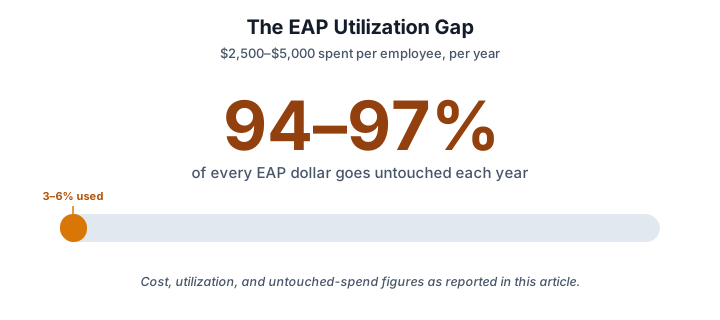
The average EAP utilization rate in the United States hovers between 3 and 6 percent of eligible employees annually. These programs can cost employers anywhere from $2,500 to $5,000 per employee per year, depending on the plan. That means somewhere between 94 and 97 cents of every mental health dollar your organization spends on EAPs goes untouched.
If your first instinct is “employees just don’t prioritize their mental health,” behavioral science says you’re wrong — and the research backs that up.
This Is Not a Motivation Problem
According to SAMHSA’s National Survey on Drug Use and Health, approximately 1 in 5 American adults experiences a mental health condition in any given year. That’s not a population that doesn’t want support. That’s a population with unmet need at scale.
The demand is real. The problem is the access architecture.
When I was directing behavioral health programs — including substance abuse programs, a forensic assertive community treatment team, and disaster case management programs — I watched this pattern play out constantly. People in genuine distress who wanted help, who had taken the significant step of admitting they needed help, who somehow still didn’t make it to a first appointment. Not because they changed their minds. Because the system asked too much of them at exactly the wrong moment.
That’s not a motivation failure. That’s a design failure.
The Behavioral Science Explanation
Behavioral economists have been documenting the gap between intention and action for decades. The mechanisms are well-understood. What’s surprising is how rarely they’re applied to healthcare access design.
Present bias is the tendency to overvalue immediate costs relative to future benefits. When someone is struggling and considers calling their EAP, the cost is immediate and concrete: find the number, make the call, navigate the phone tree, explain yourself to a stranger, potentially be put on hold. The benefit — feeling meaningfully better — is weeks away and abstract. Present bias predicts, reliably, that people will delay. And delay becomes dropout.
Friction cascades compound the problem. Research in behavioral health consistently shows that each additional step between an intention and an action reduces follow-through rates. Count the steps in a typical EAP onboarding: locate the number in your benefits portal, call the number (often during business hours), navigate an automated system, reach a coordinator, explain your situation, receive a provider list, select a provider from dozens of names with no differentiating information, call that provider, check their availability, schedule an appointment, wait — sometimes two to four weeks — then actually show up emotionally ready to engage.
Eight or more steps. Each one is a dropout point. A 2024 study in Science Advances looking at large-scale behavioral health nudge interventions found statistically significant causal effects on care-seeking behavior simply from reducing friction and adding structured prompts — without changing the underlying service at all.
Loss aversion fires in a direction people don’t expect. The classic framing is that losses hurt more than equivalent gains feel good. In the EAP context, the perceived loss isn’t money — it’s social standing, privacy, and professional reputation. Employees weigh the concrete risk of being seen as struggling (even if only in their own mind) against the abstract benefit of support. Loss aversion predicts they’ll choose inaction to avoid the perceived downside, even when the rational calculus favors seeking help.
Choice overload closes the loop. Behavioral economists Barry Schwartz and Sheena Iyengar have documented extensively that presenting people with too many options doesn’t empower them — it paralyzes them. “Here’s a list of 200 in-network providers. Pick one.” That’s not care navigation. That’s outsourced decision-making to the person least equipped, in that moment, to make it.
What Actually Moves the Needle
The good news is that the behavioral science also tells us what works. And it’s not more awareness campaigns.
Default enrollment over opt-in structures is one of the most reliably documented behavioral interventions in the literature. The Commonwealth Fund has highlighted behavioral economics applications in population health — and default enrollment is consistently near the top. When the baseline is “you’re enrolled and can opt out” instead of “you need to opt in,” utilization rises dramatically. This applies to EAPs, workplace wellness programs, and initial assessments alike.
Pre-scheduled touchpoints replace self-initiated contact. The research is clear: the hardest behavioral ask is the first self-initiated action. A pre-scheduled 10-minute check-in with a care coordinator — already on someone’s calendar, requiring only that they show up — is a fundamentally different behavioral challenge than asking someone in distress to initiate contact on their own.
Brief digital assessments as the entry point eliminate the phone-call barrier entirely. A 3-question validated screening tool, completable in under two minutes, with automated triage, reaches people who would never pick up the phone. Frontiers in Public Health published research in 2026 documenting nudge-based approaches to health policy that consistently show digital, low-friction first touches outperform phone-based intake for initial engagement.
Social proof anchors. Anonymized, aggregated outcome data — “87% of employees who completed an initial check-in reported feeling meaningfully better within four sessions” — reduces loss aversion by making the expected positive outcome more concrete than the feared stigma.
Embedded pathways in existing workflows remove the “I have to go find this” barrier. If a check-in prompt appears inside Slack, inside an HR portal, inside the onboarding workflow — it meets people where they already are instead of asking them to leave their existing context.
The Commitment Device Gap
Here’s what most EAP reforms still miss: the commitment device problem.
Behavioral economists define commitment devices as mechanisms that help people follow through on future intentions they hold today. They work because they remove the need for willpower at the moment of action — the decision is already made.
Traditional EAPs have no commitment device. The appointment is optional. The follow-up is optional. The path from initial contact to sustained engagement is entirely self-directed, at every step, by someone who may be in significant distress. That structure is optimized for people who need the least support — not the people who need it most.
Behavioral health platforms that build commitment devices into their architecture — automatically scheduled follow-ups, brief check-ins that trigger care escalation, structured pathways that don’t require re-initiation each session — close this gap. The person doesn’t have to decide again. The system holds the structure.
This isn’t paternalistic. It’s just how human motivation actually works, and designing for it is a basic act of respect for the people you’re trying to serve.
What This Means for 2026
The “Beyond EAPs” movement that’s gained significant traction in HR and benefits circles in 2026 is, at its core, about this. It’s not about abandoning investment in employee mental health. It’s about acknowledging that the legacy EAP model was designed by actuaries, not behavioral scientists — and that the gap between “we offer mental health support” and “our employees actually access mental health support” is an architectural problem with architectural solutions.
Organizations that get this right aren’t just seeing better utilization numbers. They’re seeing earlier identification of high-risk individuals, reduced absenteeism, and measurably lower downstream costs in medical claims — because getting someone into care before a crisis is dramatically less expensive than managing the aftermath of one.
The research supports a 3- to 5-fold increase in utilization for programs that integrate behavioral design principles compared to traditional EAP models. That’s not marginal improvement. That’s a different category of outcome.
For clinicians and healthcare organizations building the next generation of care access tools, the question isn’t whether behavioral science applies to your platform. It’s whether you’ve designed your onboarding, your intake, and your engagement pathways with the same rigor you’d apply to a clinical protocol.
If you haven’t, that’s where the 94% is going.
Building behavioral health infrastructure for your practice or organization? VibeCheck.luxury was built with exactly these principles — low-friction intake, structured touchpoints, and care pathways designed for how people actually behave under stress. Visit vibecheck.luxury to see how it works.
The information in this post is for educational and informational purposes only and does not constitute clinical advice, diagnosis, or treatment. For mental health concerns, please consult a licensed mental health professional.