
More than 8 in 10 employers — 83% — say they want to use AI to help their workers navigate mental health benefits. The employees those employers are trying to reach? Only 24% of them actually use it today, according to Prudential’s June 2026 Benefits & Beyond study of 3,096 employees and 760 employers. And workers are twice as likely as their employers to say the reason is simple: they don’t trust AI.
That gap — employers betting on a tool, workers choosing not to pick it up — is the defining tension in workplace mental health right now. Not whether AI should be in benefits. Whether employees will ever believe it’s safe enough to use when the stakes are their mental health data.
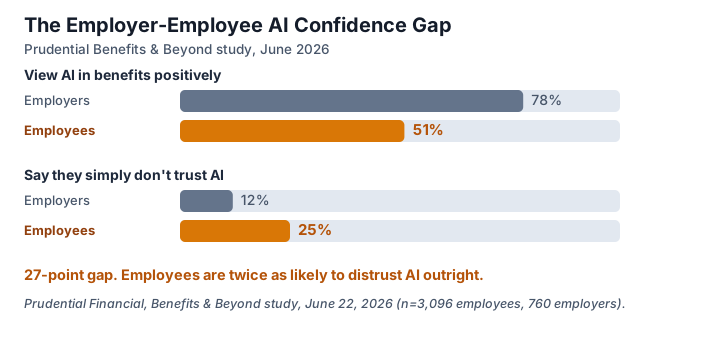
Quick answer: Employers are deploying AI tools to make mental health benefits easier to navigate, but the Prudential 2026 data shows a 27-point confidence gap between employers (78% view AI positively) and employees (51%). Workers are twice as likely to cite outright distrust of AI — 25% vs. 12% of employers — and privacy concerns top the barrier list. The AI is there. The people it’s supposed to help are staying away.
The number every HR director should read twice
Prudential’s Benefits & Beyond study, released June 22, 2026, surveyed 3,096 full-time U.S. employees and 760 employers — a sample large enough to take seriously. The headline is that 83% of employers are interested in using AI for benefits navigation, a figure that tracks with the broader sprint to deploy AI tools across every HR function.
The other number is the one that should give employers pause: only 24% of employees currently use AI for benefits purposes. Another 58% say they would use it in principle — meaning there’s a stated openness that the actual product experience isn’t matching.
What’s keeping the other 42% back? The study is direct. Employees cite privacy and security (52%), concerns about inaccuracy (49%), moral and ethical reservations (36%), and 25% who say they simply don’t trust AI — full stop. Employers, by contrast, put only 12% in that last category. Double the distrust, same HR system, same tools.
The confidence gap runs 27 points wide. While 78% of employers view AI positively, only 51% of employees agree. Employers are buying something employees are being asked to trust with their health information, arriving at that ask before they’ve solved the foundational question: what makes you think they’ll use it?
This is a mental health problem specifically, not a general AI problem
AI skepticism across HR uses — expense reports, scheduling, training — is one thing. AI tools deployed in the mental health lane carry different stakes, and employees seem to know it.
When someone uses an AI benefits navigator to figure out their vision plan, the cost of a data exposure is annoying. When they use it to navigate mental health coverage — disclosing they’ve been struggling, searching for an in-network therapist, finding out what their plan covers for substance use treatment — the data is a different category. A mental health disclosure in the wrong hands is not just an inconvenience. It can affect employment status, professional licensing, life insurance underwriting. The concern isn’t irrational. It’s structural.
The employer-side stack makes this harder, not easier. Platforms like Lyra Health and Spring Health are serious products at the clinical matching and care delivery layer. But they’re sold to HR departments, integrated with HR systems, and paid for by the same organization that evaluates your performance and controls your income. The data-separation architecture may be sound on the back end. Whether employees believe that is a different question, and the Prudential numbers suggest they mostly don’t.
In the Prudential data, 65% of employees say they’re comfortable with their employer managing personal data for general benefits purposes. That number likely shifts when the topic moves from dental claims to depression disclosures. Workers are running a different mental calculation when what’s at stake is their mind rather than their medical plan, and the utilization numbers reflect it.
The AI was supposed to close the mental health benefits access gap. It may be widening it.
The pitch for AI in benefits is reasonable on paper. Employee Assistance Programs run at a stubborn 3 to 6 percent annual utilization rate. Benefits navigation is genuinely confusing. AI can make it faster, more personalized, and available at 2 a.m. when someone can’t sleep and finally works up the nerve to check whether therapy is covered. That’s a real problem being addressed by a real tool.
But the people who were already least likely to use mental health benefits — because of stigma, because of the intake process designed for the wrong kind of person, because the in-network roster is weeks out — are now being asked to trust that same system with something more sensitive. The Prudential data says they’re declining.
Modern Health’s 2026 workplace survey found that only 33% of employees strongly agree their employer values their mental health, down from 41% in 2025. That 8-point drop happened in a single year, during the same period employer spending on mental health benefits increased. More money spent, less trust earned. The AI layer being added on top isn’t being received as a fix. It’s being received as more of the same — a benefit announced and purchased, landing somewhere between noise and anxiety.
The utilization pattern for AI tools is already echoing the old EAP problem. 83% of employers interested; 24% of employees actually using it. We’ve seen this before. The benefit arrives. The access architecture stays broken. The 76% who should be reaching for help keep not reaching.
What the clinical data says about the tools being deployed
The employee distrust isn’t only about data privacy. There’s a second concern that deserves more attention: whether the AI tools being deployed into mental health benefits are actually ready for mental health use.
In May 2026, Fortune reported that leading AI models struggle to detect indirect mental health risk signals — the subtle framing of hopelessness across a conversation, eating and withdrawal patterns that build gradually, beliefs that intensify over time. These are exactly the patterns a trained clinician catches in a session. The models handle direct statements. The rest is harder.
A 2026 American Psychological Association survey of more than 1,200 licensed psychologists found that 94% say AI chatbots cannot handle mental health conditions with the nuance the work requires. 36% had patients who had become dependent on a chatbot. 15% reported patients who developed delusional beliefs after extended AI chatbot use. These aren’t fringe cases from consumer apps people downloaded on their own. These are working licensed clinicians describing what they’re seeing in their clinical rooms — many of them serving clients whose employer-paid benefits fund access to platforms with AI built in.
When an employee declines to use the AI mental health navigation tool their company purchased, they may be making exactly the calculation the clinical evidence supports. The AI wasn’t cleared for this work the way a clinical tool gets cleared. It was deployed because it was available, scalable, and inexpensive — which is not the same credential.
Who benefits from low engagement
The mental health benefits AI market is worth examining as a market. Lyra Health carries a valuation around $5.85 billion. Spring Health is at approximately $3.3 billion. The dominant business model is employer-paid B2B: an HR department contracts with the platform, employees access services at no cost, and the vendor grows through enterprise contracts renewed annually.
That contract structure creates a particular accountability problem. The platform gets paid whether or not employees engage. If utilization hovers at the same 3 to 6 percent that plagued traditional EAPs, the employer absorbs the gap and the vendor isn’t penalized. The AI interface is new; the accountability problem it was supposed to solve is not.
The clinical AI vendors building this responsibly — with human-in-the-loop oversight, risk scaffolding, and licensed clinician accountability at meaningful decision points — are doing something genuinely different. But the broader market is moving fast, and not every tool that lands in a 2027 benefits package is built to that standard. Employees, who cannot audit the architecture they’re being asked to trust, are making a reasonable choice when they approach the whole category with caution.
Commercial insurers set the ceiling here too. The Kennedy Forum’s April 2026 Mental Health Parity Index found that Aetna, BlueCross BlueShield, Cigna, and UnitedHealthcare pay clinicians less for outpatient mental health care than for comparable medical care in all 43 states examined. That underpayment narrows the in-network therapist pool, which is part of why employers turned to digital platforms in the first place. The AI-navigation layer is a patch on a problem created upstream — by payer reimbursement decisions that have nothing to do with what the employee actually needs.
What would actually close this gap
The Prudential study points in three directions: transparency about data use, education to help employees feel informed, and keeping humans at the center of the technology. That framework is right and also incomplete.
Telling employees their data is safe is not the same as designing a system where it visibly is. The gap closes when employees can see — in plain language, on the front end of any tool — who can access what they disclose, under what conditions, and with what safeguards. Not buried in a terms-of-service document written for legal compliance. In language someone can absorb when they’re struggling at midnight.
The human-in-the-loop piece matters more than any other. AI that triages, matches, and navigates — with a licensed clinician available and accountable at each significant decision point — is a fundamentally different product than AI that replaces the clinician. Employees choosing not to engage may be distinguishing between those two things even if they can’t name the distinction. They’re right to.
Employers looking at their 2027 benefits packages need to ask a different first question. Not “what AI does this platform offer?” but “why would my employees trust this with information they can’t take back?” The answer to that question is where the utilization gap either closes or doesn’t. Covered is still not the same as cared for. Adding a chatbot to the front door doesn’t change that arithmetic unless the door is one workers actually feel safe walking through.
FAQ
Why don’t employees use employer AI mental health tools? According to Prudential’s June 2026 Benefits & Beyond study (n=3,096 employees), only 24% of employees currently use AI for benefits navigation despite 83% of employers wanting to offer it. Top barriers: privacy and security concerns (52% of employees), distrust of AI accuracy (49%), and a general lack of trust — employees are twice as likely as employers to say they simply don’t trust AI (25% vs. 12%).
What is the employer-employee AI trust gap in mental health benefits? The Prudential 2026 Benefits & Beyond study found a 27-point gap in how employers and employees view AI: 78% of employers view AI positively vs. 51% of employees. When it comes to outright distrust, 25% of employees say they simply don’t trust AI, compared to 12% of employers. The tools are being bought for workers who mostly won’t use them.
Are AI mental health chatbots safe for use in employer benefits programs? The clinical research raises serious concerns. A May 2026 Fortune report found leading AI models struggle to detect indirect mental health risk signals. A 2026 APA survey of 1,200+ licensed psychologists found 94% say AI chatbots cannot handle mental health conditions with the nuance the work requires, and 36% had patients who became dependent on a chatbot.
What drives employees to distrust AI with their health data? Privacy tops the list — 52% of employees cite privacy and security as an AI concern vs. 49% of employers. When the tool is paid for by your employer and integrated into your HR system, the data boundary isn’t obvious. Mental health disclosures carry real stakes — employment decisions, professional licensing, insurance underwriting — and employees make a reasonable calculation about what happens when that information moves.
Sources
-
Prudential Financial, Employers Embrace AI for Benefits — Employees Remain Cautious — Benefits & Beyond study, June 22, 2026 (n=3,096 employees, 760 employers): 83% employer AI interest, 24% employee current use, 25% vs. 12% distrust, 78% vs. 51% positive view, 52% employee privacy concern.
-
American Psychological Association, Patients Are Bringing AI to Therapy — 2026 Chatbots and Mental Health Survey (n=1,200+ licensed psychologists): 94% say chatbots can’t handle MH with needed nuance, 36% had patients dependent on a chatbot, 15% reported patients with delusional beliefs from chatbot use.
-
Fortune, AI chatbots are becoming mental health tools before they are ready (May 12, 2026) — Leading AI models struggle to detect indirect mental health risk signals; harmful responses often subtle even when surface-level language sounds supportive.
-
Modern Health Workplace Mental Health Report (May 8, 2026), via Fair Play Talks — 33% of employees strongly agree their employer values their mental health, down from 41% in 2025.
-
The Kennedy Forum Mental Health Parity Index, via AHA News (April 16, 2026) — Aetna, BlueCross BlueShield, Cigna, and UnitedHealthcare pay less for outpatient mental health than medical/surgical care in all 43 states examined.
-
Taylor Benefits Insurance, EAP Utilization at 5%: How to Fix It Before Renewal — traditional EAPs median utilization 5.5%; modern digital-first alternatives achieve 40%+ engagement.
-
Mental Wealth Solutions, Why Your EAP Has a 3% Utilization Problem (April 2026) — access architecture as the root cause of underutilization.
Disclaimer
This article is for educational and informational purposes only. It does not constitute medical, clinical, legal, or therapeutic advice, and reading it does not create a therapist-client relationship with Matthew Sexton, LCSW or Mental Wealth Solutions, Inc. Although the author is a licensed clinical social worker, the content in this article is not clinical assessment, diagnosis, or treatment.
Survey findings, AI platform capabilities, benefits utilization rates, and the regulatory environment for AI in health and HR contexts vary by employer, vendor, and over time. The studies cited reflect data collected through early to mid-2026 and may not reflect conditions at the time you read this. Nothing here is a substitute for a qualified HR or benefits professional’s assessment of a specific program, vendor, or employee population. Organizations and circumstances differ, and what is described here may not match your situation.
If you are in immediate emotional crisis, you can reach the 988 Suicide & Crisis Lifeline by calling or texting 988 (US). If you are experiencing domestic violence or are in physical danger, contact the National Domestic Violence Hotline at 1-800-799-7233 or visit thehotline.org. In a life-threatening emergency, call 911.
Frequently asked questions.
- Why don't employees use employer AI mental health tools?
- According to Prudential's June 2026 Benefits & Beyond study (n=3,096 employees), only 24% of employees currently use AI for benefits navigation despite 83% of employers wanting to offer it. The top barriers are privacy and security concerns (52% of employees), distrust of AI accuracy (49%), and a general lack of trust in AI — employees are twice as likely as employers to say they simply don't trust it (25% vs. 12%).
- What is the employer-employee AI trust gap in mental health benefits?
- The Prudential 2026 Benefits & Beyond study found a 27-point gap in how employers and employees view AI: 78% of employers view AI positively vs. 51% of employees. When it comes to distrust specifically, 25% of employees say they simply don't trust AI, compared to 12% of employers. That gap is the core problem: employers are purchasing AI mental health tools that the workers they're designed to serve won't touch.
- Are AI mental health chatbots safe for use in employer benefits programs?
- The clinical research raises serious questions. A May 2026 Fortune report found that leading AI models struggle to detect indirect mental health risk signals — suicidal ideation framed through subtle hopelessness, disordered eating patterns, beliefs that gradually become more extreme. A 2026 APA survey of 1,200+ licensed psychologists found that 94% say AI chatbots cannot handle mental health conditions with the nuance the work requires.
- What drives employees to distrust AI with their health data?
- Privacy tops the list — 52% of employees cite privacy and security as an AI concern, compared to 49% of employers. When the tool is paid for by your employer and integrated into your HR system, the data boundary is not self-evident. Workers make a reasonable calculation: mental health disclosures carry real stakes — employment, professional licensing, insurance underwriting — and that data is not like an expense report.
Want to discuss this for your program?
Book a 30-min conversation. We'll walk you through deployment, the BAA, and what your rollout looks like in production.
Book a 30-min conversation