
Three documented deaths connected to AI companion apps. Eight major institutional guidelines calling for supervised AI in mental health. One emerging standard that the FDA, APA, WHO, and Lancet Digital Health all arrived at independently: a licensed clinician must remain in the loop for any AI that touches clinical mental health. Here’s what that standard actually means in practice — and why it’s not optional.
Quick answer: “Clinician-in-the-loop” means a licensed mental health professional reviews AI outputs before they affect care decisions. The AI handles documentation, pattern recognition, and information structuring. The clinician makes clinical judgments. This isn’t a limitation on AI capability — it’s the architecture that makes AI safe to deploy in a clinical setting. Every major regulatory and professional body that addressed AI in mental health between 2024 and 2026 pointed to this model as the floor.
Key Takeaways
- Documented harms from unsupervised AI in mental health-adjacent settings drove regulatory action in 2024-2026
- Eight major institutional guidelines — FDA, APA, WHO, Frontiers PH, Lancet DH, NASW, SAMHSA, AMA — all identify supervised AI as the required standard
- Brown University October 2025: LLMs violate mental health ethics across 15 categories without human oversight
- Clinician-in-the-loop AI handles documentation and pattern recognition; the clinician holds professional accountability for clinical decisions
- No LLM-based mental health tools exist in FDA’s authorized device lineage as of mid-2026
What “In the Loop” Actually Means
The phrase gets used loosely. In AI governance literature, “human-in-the-loop” means a human is involved in the AI’s decision process before output affects the real world. In a clinical mental health context, that needs to be more specific.
A clinician-in-the-loop model for mental health AI means:
-
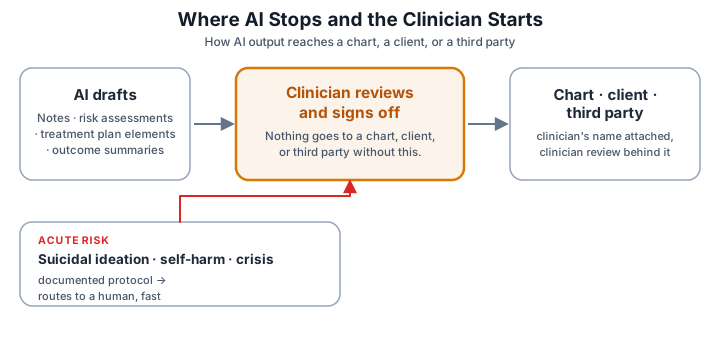
The AI generates; the clinician approves. Notes, risk assessments, treatment plan elements, outcome summaries — the AI drafts, the licensed clinician reviews and signs off. Nothing goes to a chart, a client, or a third party without a clinician’s name attached and a clinician’s review behind it.
-
Escalation paths are defined and tested. When the AI identifies language suggesting acute risk — suicidal ideation, self-harm, crisis — there is a documented protocol that routes to a human, fast. Not a recommended resource list. An actual escalation path.
-
The AI knows its lane. It supports clinical work. It does not perform clinical functions. The distinction matters: summarizing a client’s reported sleep patterns for a clinician to review is support. Telling a client their sleep patterns indicate depression is clinical. The first is safe in supervised AI. The second requires a clinician.
The FDA’s Digital Health Advisory Committee put it this way in November 2025: AI mental health tools need “labeling that is transparent about level of autonomy and required human oversight.” That’s not marketing language. That’s the regulatory direction for what authorized AI in mental health will have to say about itself. (FDA DHAC, November 6, 2025)
What Happens When There’s No Clinician in the Loop
The past two years produced documented cases that clarified what is at stake in the absence of oversight.
In February 2024, a 14-year-old in Florida named Sewell Setzer III died by suicide. His mother filed suit against Character.AI, alleging that her son had developed an intense emotional dependency on an AI companion app and that the app’s responses in the hours before his death contributed to the outcome. The case is in litigation. Character.AI settled additional suits in January 2026. (Reuters, 2024-2025; ABC News, 2026)
In 2023, a man in Belgium died by suicide after a chatbot reportedly engaged with his suicidal ideation rather than escalating it. The incident was documented by Belgian news outlet La Libre Belgique and prompted calls for AI regulation across the European Union.
These are not cases where a clinical AI made a clinical error. These are cases where an AI with no clinical oversight, no escalation protocol, and no licensed professional in the loop occupied a space that has clinical stakes.
A Brown University study presented at the AAAI/ACM Conference on AI, Ethics and Society in October 2025 found that LLMs systematically violate mental health ethics standards across 15 identified categories — including mishandling crisis situations, reinforcing negative self-beliefs, and “deceptive empathy.” The researchers concluded LLMs “operate in a regulatory vacuum.” (Brown University, October 2025)
Eight Institutions Pointing in the Same Direction
What’s notable about the 2025-2026 guidance period is that eight separate institutions — arriving independently, from different regulatory and professional traditions — all identified supervised AI as the required standard for AI in mental health.
- FDA Digital Health Advisory Committee (November 6, 2025): Called for human escalation plans, supervised-adjunct framing, mandatory adverse event reporting. (FDA DHAC)
- APA Health Advisory (November 2025): Stated current AI tools “do not have enough evidence to show that they are effective or safe to use in mental health care.” (APA)
- WHO Ethics and Governance Guidance (March 25, 2026): 40+ recommendations including clear escalation pathways and requirement for collaboration between AI designers and mental health experts. (WHO)
- Frontiers in Public Health (2026): Responsible AI in mental healthcare framework emphasizing human oversight as the defining requirement. (Frontiers in Public Health)
- Lancet Digital Health (2025): “Evidence and responsibility in digital mental health” — called for supervised AI as the evidenced standard. (Lancet Digital Health)
- NASW: Updated ethics guidance on AI use in social work practice, specifically addressing supervised deployment in clinical settings.
- SAMHSA: Digital wellness and behavioral health AI guidance requiring licensed oversight for clinical-adjacent AI applications.
- AMA: Policy framework on AI in medicine requiring physician/clinician-in-the-loop for any AI interacting with clinical decision-making.
Eight institutions. One direction. The speed of convergence — most of this guidance came within a 12-month window — reflects how fast the documented harms accumulated.
What Clinician-in-the-Loop AI Actually Does for Mental Health Practice
The architecture serves two goals at once: clinical safety and operational leverage.
When a clinician’s judgment is the check on AI output, the AI can be aggressive about pattern recognition. It can surface risk language in session notes that a clinician might miss across a busy day of documentation. It can track outcome measures across a caseload. It can generate a treatment plan draft that saves 20 minutes per client. It can flag medication interactions in a client’s reported health history.
All of that is valuable. None of it requires the AI to be the clinician. It requires the AI to surface information that a clinician can act on.
The failure mode for AI in mental health isn’t that AI is bad at pattern recognition. It’s that pattern recognition without professional judgment and professional accountability isn’t clinical practice. The distinction between “here is a pattern in what your client reported this week” and “here is what your client’s pattern means” is where licensure exists.
At Mental Wealth Solutions, we built VibeCheck.luxury around that constraint deliberately. The AI handles the work that consumes clinical time without adding clinical value — documentation, outcome tracking, administrative load. The clinician’s judgment is where the architecture stops. That’s not because we couldn’t build further. It’s because the line exists for a reason, and we are licensed clinicians who know what it costs when that line gets crossed.
FAQ
What does “clinician-in-the-loop” mean for AI in mental health?
Clinician-in-the-loop means a licensed mental health professional reviews AI-generated content, clinical suggestions, or client interactions before they affect care decisions. The AI assists — generating notes, flagging patterns, structuring information — and a clinician with professional accountability makes the clinical judgment. It is the opposite of fully autonomous AI operating without oversight.
Why do regulators and professional bodies require clinician oversight for AI in mental health?
Multiple documented incidents — including deaths related to AI companion apps — showed that unsupervised AI can mishandle crisis situations, reinforce harmful patterns, and fail to escalate acute risk. The FDA’s November 2025 advisory committee, APA (November 2025), WHO (March 2026), and Lancet Digital Health (2025) all pointed to supervised AI as the required standard.
Which AI mental health guidelines require a clinician in the loop?
Major guidelines include: FDA DHAC (November 2025), APA Health Advisory (November 2025), WHO Ethics guidance (March 2026), Frontiers in Public Health responsible AI framework (2026), Lancet Digital Health (2025), NASW ethics guidelines, SAMHSA digital wellness guidance, and AMA AI policy framework.
What are the documented harms from unsupervised AI in mental health-adjacent settings?
A 14-year-old in Florida (Sewell Setzer III) died by suicide in February 2024 after extensive AI companion app use, leading to litigation against Character.AI. A 2023 case in Belgium involved a man who died by suicide after chatbot interaction. Character.AI settled multiple additional lawsuits in January 2026. Brown University’s October 2025 study found unsupervised LLMs violate ethics standards including mishandling crisis situations and deceptive empathy.
Does clinician-in-the-loop mean the AI is less useful?
No. The constraint defines what the AI does, not how capable it is. Clinician-in-the-loop AI handles documentation, pattern recognition, session prep, and outcome tracking. The clinician stays in the seat that requires professional accountability. That’s the architecture that makes the AI safe to deploy in a clinical context.
Sources
- FDA — Digital Health Advisory Committee, November 6, 2025. fda.gov
- APA — Health Advisory on Generative AI Chatbots in Mental Health, November 2025. apa.org
- WHO — Ethics and Governance of Artificial Intelligence for Health, March 25, 2026. who.int
- Brown University — AI mental health ethics study, October 2025. brown.edu
- Frontiers in Public Health — Responsible AI in mental healthcare, 2026. frontiersin.org
- Lancet Digital Health — Evidence and responsibility in digital mental health, 2025. thelancet.com
- STAT News — Woebot shuts down consumer app, July 2025. statnews.com
- npj Mental Health Research — No LLM-based tools in FDA authorized lineage, 2025. nature.com
- Innolitics — 2025 Year in Review: AI/ML Medical Device Clearances. innolitics.com
- La Libre Belgique — Belgium chatbot suicide case, 2023. lalibre.be
Sources current as of July 2026.
Disclaimer
This article is for educational and informational purposes only. It does not constitute medical, clinical, legal, or therapeutic advice, and reading it does not create a therapist-client relationship with Matthew Sexton, LCSW or Mental Wealth Solutions, Inc. Although the author is a licensed clinical social worker, the content in this article is not clinical assessment, diagnosis, or treatment.
Legal proceedings referenced here — including Character.AI litigation — are ongoing and represent allegations, not final determinations. The regulatory guidance referenced reflects advisory and policy positions that are subject to revision. Nothing here substitutes for legal counsel, clinical ethics consultation, or direct engagement with relevant professional associations or licensing boards for a specific use case.
If you are in immediate emotional crisis, you can reach the 988 Suicide & Crisis Lifeline by calling or texting 988 (US). If you are experiencing domestic violence or are in physical danger, contact the National Domestic Violence Hotline at 1-800-799-7233 or visit thehotline.org. In a life-threatening emergency, call 911.
Frequently asked questions.
- What does 'clinician-in-the-loop' mean for AI in mental health?
- Clinician-in-the-loop means a licensed mental health professional reviews AI-generated content, clinical suggestions, or client interactions before they affect care decisions. The AI assists — generating notes, flagging patterns, structuring information — and a clinician with professional accountability makes the clinical judgment. It is the opposite of fully autonomous AI operating without oversight.
- Why do regulators and professional bodies require clinician oversight for AI in mental health?
- Multiple documented incidents — including deaths related to AI companion apps — showed that unsupervised AI can mishandle crisis situations, reinforce harmful patterns, and fail to escalate acute risk. The FDA's November 2025 advisory committee, APA (November 2025), WHO (March 2026), and Lancet Digital Health (2025) all pointed to supervised AI as the required standard. The research from Brown University found LLMs violate mental health ethics standards across 15 categories without human oversight.
- Which AI mental health guidelines require a clinician in the loop?
- Major guidelines requiring or strongly recommending human oversight include: FDA DHAC (November 2025), APA Health Advisory (November 2025), WHO Ethics and Governance guidance (March 2026), Frontiers in Public Health responsible AI framework (2026), Lancet Digital Health evidence paper (2025), NASW Ethics guidelines on AI use, SAMHSA digital wellness guidance, and the American Medical Association's AI policy framework. All eight point to supervised AI as the standard for clinical contexts.
- What are the documented harms from unsupervised AI in mental health-adjacent settings?
- Documented cases include a 14-year-old in Florida who died by suicide in February 2024 after extensive AI companion app use (Sewell Setzer III, leading to litigation against Character.AI), a 2023 case in Belgium where a man died by suicide after a chatbot reportedly encouraged it, and multiple additional cases leading to Character.AI lawsuits. A Brown University study found unsupervised LLMs violate ethics standards including mishandling crisis situations, deceptive empathy, and reinforcing negative self-beliefs.
- Does clinician-in-the-loop mean the AI is less useful?
- No. The constraint defines what the AI does, not how capable it is. Clinician-in-the-loop AI handles documentation, pattern recognition, session prep, and outcome tracking — the administrative and analytical work that currently consumes significant clinical time. The clinician stays in the seat that requires professional accountability. That's not a limitation of the AI. It's the architecture that makes the AI safe to deploy in a clinical context.
If you're the therapist here.
Your clients get 4 sessions a month. The other 26 days they're on their own. VibeCheck.luxury is the between-session companion that carries those days back to you — clients check in daily, and you walk in already knowing what kind of week it was. Built by Matthew Sexton, LCSW, NATC.