Quick answer: Patients are mostly okay with an AI scribe writing the note. They are not okay with a for-profit company keeping their health data: only 25.4% would share it with for-profits, versus 80.2% with research groups, in an npj Digital Medicine review of 117,905 people across 52 studies (August 2025). So the real fight is governance: who holds the recording, and whose rules it follows.
An AI scribe is software that listens to a visit and writes the clinical note. In mental health, that visit is the most private hour of a person’s week. And the research shows two things at once. Patients accept the scribe itself at high rates. The same patients refuse to hand their health data to for-profit companies. Both findings are true, and they point at the same conclusion. The problem was never the microphone. The problem is who owns what the microphone hears, and who wrote the rules for it. I want that hour protected, and I want the tool too. Those two wishes only clash when nobody writes the rules.
Do patients actually mind the AI scribe?
Mostly, no. UC Davis Health asked 1,893 patients how they felt about ambient AI documentation before switching it on. Ambient just means the tool listens in the background during the visit. In that survey, published in JMIR Medical Informatics (November 2025), 48% of patients felt favorable about it, 33% were neutral, and only 19% were unfavorable.
The tool seems to make visits better, too. A March 2026 Perspective in npj Digital Medicine cites deployment data from the Permanente Medical Group: 84% of clinicians felt ambient scribes had a positive impact on visit interactions, and 56% of patients reported a positive impact on visit quality. That tracks with common sense. A clinician who is not typing can look you in the eye. I have written before about how the EHR turned clinicians into unpaid transcriptionists. Any tool that hands that hour back to the humans in the room is doing something real.
But the UC Davis survey carried a warning inside it. Among patient comments, 15% raised privacy and security fears, like the recordings being hacked. Another 13% reported negative feelings about being recorded at all. Read those findings together and the shape gets clear. Patients said yes to the scribe. They did not say yes to whatever happens to the audio after the session ends.
Why won’t people share their data with the companies?
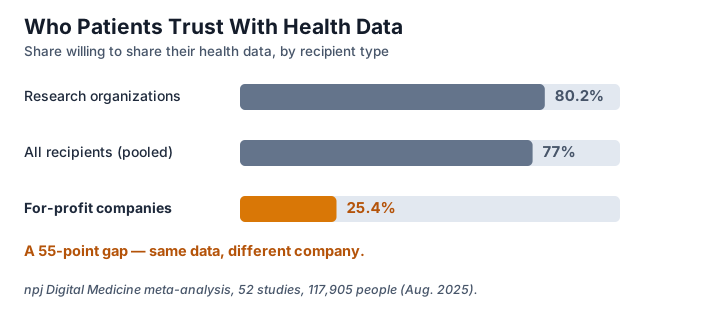
Because trust follows whoever holds the data, not the tool that collects it. An npj Digital Medicine meta-analysis, which is a study that pools many studies, combined 52 of them, covering 117,905 people (August 2025). Overall, 77% of people were willing to share their health data. When the recipient was a research organization, willingness reached 80.2%. When the recipient was a for-profit company, it collapsed to 25.4%. It fell lowest of all when a for-profit wanted the data for commercial purposes. The review called privacy, consent, and transparency “paramount,” a formal way of saying these conditions mattered most.
That is a 55-point drop, and nothing about the data changed. Only the name on the server did.
Worth being precise here: no single study measured both sides of this. The scribe-comfort numbers come from one hospital survey. The vendor-trust numbers come from a separate pooled review of 52 studies. Put them side by side, though, and the pattern is hard to miss. One shows patients open to AI documentation. The other shows patients refusing to hand health data to for-profit vendors. An AI scribe in a therapy session is both things at once: a useful tool, and a raw audio feed of someone’s most private hour, flowing to a company they have never met.
The behavioral science here is simple. People share when they can trust the holder. They hold back when they cannot see the holder’s incentives. That 25.4% can look like fear of new technology. I read it as an accurate read of the incentives.
Where did the money go in 2025?
Straight into the scribe layer. Rock Health’s year-end report (January 2026) counted $14.2 billion raised by US digital health startups in 2025, up 35% from $10.5 billion in 2024. AI-enabled companies captured 54% of that money, up from 37% the year before. And the single most-funded space was workflow: clinical and non-clinical workflow companies, the record-and-write-and-file layer, took 39% of all the dollars.
One example tells the story. Abridge, an AI scribe maker, closed back-to-back mega rounds within months in 2025 and doubled its valuation to $5.3 billion, per the same Rock Health report.
I want to be careful with the frame. Wellness apps did not lose this race. Infrastructure simply took the top of the stack. The tools that record, transcribe, and file grabbed the largest share of the money, so they will spread fast, into medical offices and therapy rooms alike, long before most patients think to ask what the rules are.
Money sets the pace. Law is supposed to set the boundaries. So let’s check on the law.
Who is writing the AI scribe governance rules? Almost nobody.
Researchers in the Division of Digital Psychiatry at Beth Israel Deaconess Medical Center ran a 50-state review, published in JMIR Mental Health (October 2025). They screened 793 state bills that touched AI. Only 143 could even potentially affect mental health AI. Only 28 explicitly mentioned mental health. And just 20 were enacted, across 11 states. The authors flagged “notable gaps in privacy protections for sensitive mental health data.” In plain terms, most US states have no enacted law governing AI in mental health at all. Eleven states is not a system of rules. It is a patchwork with holes in it.
The clinical literature says the same thing from the inside. The March 2026 npj Digital Medicine Perspective on scaling ambient scribes puts it bluntly: “governance of these data streams is often unspecified.” No shared standard for how long raw audio gets kept. None for when transcripts get deleted. None for who can access them. The same paper notes “ongoing uncertainty” about how scribes should even be classified under current regulatory frameworks. It also warns that automatic recording “may not always be appropriate” for sensitive topics such as substance use.
Now think about what gets said in a therapy session. Substance use. Suicidal thoughts. Abuse. Money shame. The things a person says out loud in one room, to one person, and nowhere else. In mental health, there is no non-sensitive part of the transcript.
States did draw one clear line recently: AI cannot be the therapist. Good. That fight has rules now. The scribe-data fight mostly does not. So the tool that records the session spreads on venture timelines, while the rules for its data crawl on legislative ones.
What should you ask before you say yes?
You do not need a law degree for this. You need five questions:
- Who keeps the raw audio, and for how long? “Indefinitely” is an answer. It is just a bad one.
- Can I say no for one session, or one topic, and keep my care? Consent should work like a light switch you can flip any session.
- Will my words train the vendor’s models? If the answer takes more than one sentence, the answer is yes.
- Who can open my transcript, and who checks? Access logs exist. Ask whether anyone reads them.
- If the data leaks, who answers for it? Ask for a name. “A department” does not count.
A trustworthy vendor answers all five in plain words. A vendor with something to protect answers with a link to a terms-of-service page. People do not need to read the code. They need to see the rules, and a person accountable to them.
And notice who is not the enemy here. Your therapist did not build the data pipeline. They got sold a scribe by the same system that sold them the EHR, the billing portal, and the rest of the paperwork machine. Most clinicians want exactly what you want: the note done and the hour protected, with data someone actually governs. That is why I keep arguing that the tools that help most are built by people who have carried a caseload. It shaped how we approached VibeCheck.luxury, where the clinician reviews and owns every note; the team’s guide to scribe consent and whose note it is walks through the clinician side of that promise.
Here is where I land. The scribe is fine. I would rather my therapist look at me than at a keyboard, and the survey data says most patients feel the same. But being covered on paper isn’t the same as being cared for in the room, and being recorded isn’t the same as being protected. That 25.4% comes from a public that read the room correctly. Nobody needs to smash the tool. We need rules worth trusting: clear retention limits, real consent, named accountability, and clinicians who own the note. So ask who built your scribe. Then ask whose rules it follows. If nobody can answer, the silence is your answer.
FAQ
What is an AI mental health scribe? An AI scribe is software that listens during a clinical visit and drafts the note. In deployment data cited by npj Digital Medicine (March 2026), 84% of clinicians felt ambient scribes improved visit interactions. The clinician still reviews and signs the note. The open question is what happens to the audio and transcript afterward.
Do patients trust AI scribes? Mostly yes for the tool, less so for the data holder. In a UC Davis survey of 1,893 patients (JMIR Medical Informatics, November 2025), 48% were favorable and only 19% unfavorable. But an npj Digital Medicine meta-analysis (August 2025) found just 25.4% of people willing to share health data with for-profit companies, versus 80.2% with research groups.
Are there laws governing AI scribes in mental health? Very few. A 50-state review in JMIR Mental Health (October 2025) screened 793 AI bills and found only 20 enacted laws across 11 states, with just 28 bills explicitly mentioning mental health. The authors flagged notable gaps in privacy protections for sensitive mental health data, so most states have no enacted rules today.
Can I say no to an AI scribe in therapy? Yes. Consent belongs to you, session by session. Researchers writing in npj Digital Medicine (March 2026) warn that automatic recording “may not always be appropriate” for sensitive topics such as substance use. A good practice will let you decline, pause the tool for a hard topic, and continue your care without any penalty.
Sources
- Worldwide willingness to share health data high but privacy, consent and transparency paramount, npj Digital Medicine, meta-analysis of 52 studies and 117,905 participants (August 2025). The 25.4% for-profit versus 80.2% research-organization willingness figures, and the 77% pooled figure.
- Patient Attitudes Toward Ambient Voice Technology: Preimplementation Patient Survey in an Academic Medical Center, JMIR Medical Informatics, via PubMed Central (November 2025). The UC Davis figures: 48% favorable, 33% neutral, 19% unfavorable, 15% privacy concerns, 13% negative feelings about recording.
- 2025 Year-End Digital Health Funding Overview: A Tale of Two Markets, Rock Health (January 2026). The $14.2 billion total, the 54% AI-enabled share, the 39% workflow share, and the Abridge $5.3 billion valuation.
- Governing AI in Mental Health: 50-State Legislative Review, JMIR Mental Health, Division of Digital Psychiatry, Beth Israel Deaconess Medical Center (October 2025). The 793 bills screened, 28 explicit mental health mentions, and 20 enacted laws across 11 states.
- Barriers and opportunities of scaling ambient AI scribes for clinical documentation across diverse healthcare settings, npj Digital Medicine Perspective (March 2026). The governance quotes and the Permanente Medical Group figures (84% of clinicians, 56% of patients).
Disclaimer
This article is for educational and informational purposes only. It does not constitute medical, clinical, legal, or therapeutic advice, and reading it does not create a therapist-client relationship with Matthew Sexton, LCSW or Mental Wealth Solutions, Inc. Although the author is a licensed clinical social worker, the content in this article is not clinical assessment, diagnosis, or treatment.
AI documentation tools, vendor data practices, and the state laws that govern them vary by product, by state, and over time, and may change after this article is published. The survey and funding figures described here reflect groups and markets, not any single practice or reader, and your situation may differ. Nothing here is a substitute for reviewing a specific tool’s consent form and data terms with your clinician, your compliance team, or qualified counsel.
If you are in immediate emotional crisis, you can reach the 988 Suicide & Crisis Lifeline by calling or texting 988 (US). If you are experiencing domestic violence or are in physical danger, contact the National Domestic Violence Hotline at 1-800-799-7233 or visit thehotline.org. In a life-threatening emergency, call 911.
Frequently asked questions.
- What is an AI mental health scribe?
- An AI scribe is software that listens during a clinical visit and drafts the note. In deployment data cited by npj Digital Medicine (March 2026), 84% of clinicians felt ambient scribes improved visit interactions. The clinician still reviews and signs the note. The open question is what happens to the audio and transcript afterward.
- Do patients trust AI scribes?
- Mostly yes for the tool, less so for the data holder. In a UC Davis survey of 1,893 patients (JMIR Medical Informatics, November 2025), 48% were favorable and only 19% unfavorable. But an npj Digital Medicine meta-analysis (August 2025) found just 25.4% of people willing to share health data with for-profit companies, versus 80.2% with research groups.
- Are there laws governing AI scribes in mental health?
- Very few. A 50-state review in JMIR Mental Health (October 2025) screened 793 AI bills and found only 20 enacted laws across 11 states, with just 28 bills explicitly mentioning mental health. The authors flagged notable gaps in privacy protections for sensitive mental health data, so most states have no enacted rules today.
- Can I say no to an AI scribe in therapy?
- Yes. Consent belongs to you, session by session. Researchers writing in npj Digital Medicine (March 2026) warn that automatic recording may not always be appropriate for sensitive topics such as substance use. A good practice will let you decline, pause the tool for a hard topic, and continue your care without any penalty.
If you're the therapist here.
Your clients get 4 sessions a month. The other 26 days they're on their own. VibeCheck.luxury is the between-session companion that carries those days back to you — clients check in daily, and you walk in already knowing what kind of week it was. Built by Matthew Sexton, LCSW, NATC.