
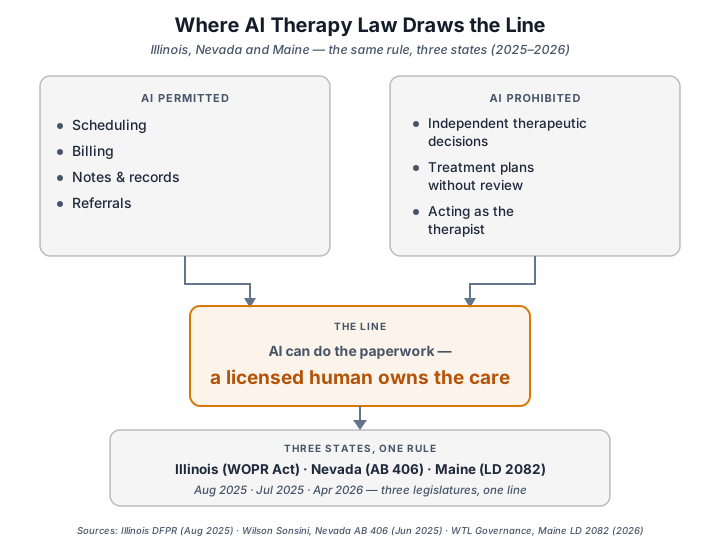
In 2025 and 2026, statehouses across the country answered a question the mental health field had been circling for years: can an AI be your therapist? The answer they wrote into law is no — and the line they drew is almost word-for-word the one clinicians have been asking for. Illinois, Nevada, and Maine all enacted nearly identical statutes that let AI handle the paperwork while requiring a licensed human to own the care. Illinois made it law first as a full statute in August 2025; Nevada’s took effect that July; Maine’s was signed in April 2026. Read side by side, they say the same thing.
Quick answer: As of 2026, a growing list of states bars AI from being the therapist but explicitly permits it as the therapist’s assistant. The legal line is human accountability — AI can schedule, bill, draft notes, and surface referrals, but a licensed professional must make and own the clinical decisions. That is not a compromise the field resented. It is the standard responsible tools were already built to.
What the AI therapy state laws actually say
Strip away the bill numbers and the statutes rhyme.
Illinois passed the Wellness and Oversight for Psychological Resources Act — the WOPR Act, Public Act 104-0054 — and signed it on August 1, 2025. It forbids AI from making independent therapeutic decisions, generating treatment plans without licensed review, or communicating directly with a client in a therapeutic role. Violations run up to $10,000 each. But the same law spells out what AI is allowed to do: manage scheduling, process billing, and — with the client’s written consent — prepare and maintain notes and records, run ambient documentation, analyze anonymized data, and identify referrals for the client’s use. Paperwork, yes. The session itself, no.
Nevada got there a few weeks earlier. AB 406, signed June 5, 2025 and effective July 1, prohibits AI systems from providing professional mental or behavioral healthcare and from claiming they can. It also bars a chatbot from calling itself a therapist or a provider. Licensed clinicians can still use AI — but for administrative support, not for the care itself. Penalties reach $15,000 per incident.
Maine closed the same loop in 2026. LD 2082, signed April 13, prohibits offering therapy through internet-based AI unless a licensed professional provides it, and explicitly bans using AI to independently make therapeutic decisions or generate treatment plans without direct human oversight. The permitted column reads like the other two: scheduling, billing, record-keeping.
Three states, three legislatures, one line. AI assists; the clinician decides.
Not every state drew the line the same way
The headline version — “states are banning AI therapy” — is close but not exact, and the differences matter.
Utah moved first, in May 2025, but it didn’t ban anything. It built a disclosure-first framework: a mental health chatbot has to tell you clearly that it’s AI at first contact, when you come back after a week away, and any time you ask. That’s transparency, not prohibition.
Idaho and Nebraska took a third route in April 2026, both passing a Conversational AI Safety Act. These require any public-facing chatbot to disclose that it’s AI, to run crisis-response protocols that detect expressions of suicidal ideation and refer users to hotlines, and to never represent themselves as a provider of professional mental health care. They take effect in July 2027.
So the real picture isn’t a single national ban. It’s a patchwork — and a fast-moving one. Across 2025, lawmakers in 47 states introduced more than 250 bills regulating AI in healthcare, with dozens signed into law, according to a December 2025 analysis from Becker’s Hospital Review. In just the first quarter of 2026, 36 states introduced over 70 more bills aimed at AI chatbots, most of them centered on disclosure, according to Holland & Knight. A 50-state legislative review published in JMIR Mental Health in October 2025 found the same themes surfacing again and again: professional oversight, harm prevention, patient autonomy, and data governance.
Different mechanisms, one underlying instinct. Keep a licensed human accountable for the care.
The danger was never a therapist using a tool
It’s worth being precise about what these laws are reacting to, because it isn’t clinicians.
The problem that put this on legislative agendas was a different one: platforms marketing a bot, on its own, as a stand-in for treatment. A person in distress opens an app, talks to something that sounds like a counselor, and there is no licensed professional anywhere in the loop — nobody assessing risk, nobody catching a crisis, nobody responsible if it goes wrong. After several high-profile cases drew regulator attention, that was the model lawmakers moved to shut down.
The federal posture is reading the same way. On November 6, 2025, the FDA’s Digital Health Advisory Committee met to weigh how it might regulate a hypothetical prescription large-language-model therapy chatbot for adults with major depression. The committee surfaced exactly the concerns you’d expect from people who take this seriously — automation bias, the risk of missing suicidal ideation, the unknowns of long-term use. As of that meeting, the FDA had not authorized a single generative-AI device for any clinical mental health purpose. It is moving carefully, on purpose.
The World Health Organization landed in the same place from a wider angle. Its March 25, 2026 guidance on large multi-modal models in health offers more than 40 recommendations, and a recurring one is the warning against automation bias — against professionals and patients improperly handing difficult choices to a model. WHO’s frame is that governments set the standards and that oversight should be proportionate to risk. Mental health, where a wrong call can cost a life, sits at the high-risk end.
None of this is anti-AI. It’s anti-unaccountable-AI. There is a difference, and the laws are built on it.
This is the standard responsible tools were already built to
Here’s the part that should reassure clinicians rather than alarm them: the line the law just drew is the line good tools were already drawing for themselves.
There’s a useful distinction underneath all of this — between autonomous AI and governed AI. Autonomous AI makes the call itself, with no licensed human responsible for it. That’s the model the statutes prohibit, and rightly. Governed AI keeps a clinician in the loop: the AI drafts the note, summarizes the intake, surfaces the relevant history, flags the pattern — and the licensed professional reviews it, decides, and signs. The work speeds up. The accountability doesn’t move.
That’s not a workaround invented to satisfy a new rule. It’s the only posture that was ever defensible. A tool built by people who have carried a caseload starts from the assumption that the clinician is the one responsible, because that’s how the work actually goes. The AI exists to give the clinician back the hours that documentation and admin quietly eat — the time that’s supposed to go to patients but gets spent on paperwork instead. It never sits in the chair across from the client.
When a tool is designed that way from the start — assistive, governed, with the human accountable for the care and the data handled under executed business-associate agreements rather than scraped into a model — a law requiring exactly that arrangement isn’t a constraint. It’s a tailwind. The companies scrambling in 2026 are the ones who sold autonomy. The ones who built for the clinician were already aligned with the spirit of these laws before the ink was dry.
That’s the quieter story inside the headlines. The states didn’t pick a side against AI in mental health. They picked the side of the licensed human — and that was always the right side to be on.
FAQ
Is AI therapy legal in 2026? AI can support therapy but cannot legally be the therapist in a growing number of states. Illinois (Public Act 104-0054, August 2025), Nevada (AB 406, effective July 2025), and Maine (LD 2082, signed April 2026) bar AI from independently providing therapy, making therapeutic decisions, or generating treatment plans. All three permit AI for administrative and supplementary support — scheduling, billing, note-taking, identifying referrals — as long as a licensed professional owns the clinical decisions.
Which states have banned AI therapy? Illinois, Nevada, and Maine have enacted the strongest restrictions, prohibiting AI from acting as a therapist while allowing it for behind-the-scenes support. Utah took a lighter path with a disclosure-first framework (effective May 2025) rather than a ban. Idaho and Nebraska passed Conversational AI Safety Acts in April 2026 requiring crisis protocols and barring chatbots from claiming to provide professional care. Across 2025, lawmakers in 47 states introduced more than 250 healthcare-AI bills.
Can a licensed therapist use AI in their practice? Yes — every one of the new laws was written to permit it. The Illinois WOPR Act allows AI for administrative tasks like scheduling and billing, and for supplementary support like preparing notes, ambient documentation, and identifying referrals, provided the licensed clinician reviews the output and stays responsible for the care. The line is between AI assisting a clinician and AI replacing one.
What is the difference between governed AI and autonomous AI in mental health? Autonomous AI makes clinical decisions on its own, with no licensed human accountable — the model the new laws prohibit. Governed AI keeps a licensed clinician in the loop: the AI drafts, summarizes, or surfaces information, and the human reviews, decides, and signs. The 2026 state laws, the FDA’s November 2025 advisory review, and the WHO’s March 2026 guidance all point to the same standard — keep a human accountable for the care.
Sources
Illinois Department of Financial and Professional Regulation, Gov. Pritzker Signs Legislation Prohibiting AI Therapy in Illinois (August 2025) — the WOPR Act / Public Act 104-0054, $10,000 penalty. Holland & Knight, New Illinois Law Restricts Use of AI in Mental Health Therapy (August 2025) — prohibited vs. permitted uses, supplementary-support language. Wilson Sonsini, Nevada Passes Law Limiting AI Use for Mental and Behavioral Healthcare (June 2025) — AB 406, signed June 5, 2025, effective July 1, $15,000 penalty. WTL Governance, Maine Passes Law Restricting AI Use in Mental Health Therapy (2026) — LD 2082, signed April 13, 2026. KFF Health News, Illinois Becomes Third State To Ban AI Use For Mental Health Care, Therapy (August 2025) — Utah/Nevada/Illinois sequence; Utah’s disclosure-first approach. Orrick, 2026 State Chatbot Laws: Key Provisions and Regulatory Trends (April 2026) — Idaho SB 1297 / Nebraska LB 525 Conversational AI Safety Acts, effective July 2027. STAT News, FDA digital advisers confront risks of therapy chatbots (November 2025) — November 6, 2025 Digital Health Advisory Committee meeting; no GenAI mental health device authorized. World Health Organization, Ethics and governance of artificial intelligence for health: Guidance on large multi-modal models (guidance dated 25 March 2026) — 40+ recommendations, automation-bias warning, government standard-setting, risk-proportionate oversight. Becker’s Hospital Review, 47 states introduced healthcare AI bills in 2025 (December 2025). Governing AI in Mental Health: 50-State Legislative Review, JMIR Mental Health (October 31, 2025). Figures current as of June 2026.
Disclaimer
This article is for educational and informational purposes only. It does not constitute medical, clinical, legal, or therapeutic advice, and reading it does not create a therapist-client relationship with Matthew Sexton, LCSW or Mental Wealth Solutions, Inc.. Although the author is a licensed clinical social worker, the content in this article is not clinical assessment, diagnosis, or treatment.
State laws governing the use of artificial intelligence in mental health care are new, vary by state, and are changing quickly; statutes, effective dates, permitted uses, and penalties described here may be amended or interpreted differently after this article is published. Nothing here is legal advice or a substitute for confirming a specific requirement with the relevant state licensing board, your compliance team, or qualified counsel. Jurisdictions and circumstances differ, and what is described here may not match your situation.
If you are in immediate emotional crisis, you can reach the 988 Suicide & Crisis Lifeline by calling or texting 988 (US). If you are experiencing domestic violence or are in physical danger, contact the National Domestic Violence Hotline at 1-800-799-7233 or visit thehotline.org. In a life-threatening emergency, call 911.
Frequently asked questions.
- Is AI therapy legal in 2026?
- AI can support therapy but cannot legally be the therapist in a growing number of states. Illinois (Public Act 104-0054, August 2025), Nevada (AB 406, effective July 2025), and Maine (LD 2082, signed April 2026) now bar AI from independently providing therapy, making therapeutic decisions, or generating treatment plans. All three explicitly permit AI for administrative and supplementary support — scheduling, billing, note-taking, and identifying referrals — as long as a licensed professional owns the clinical decisions.
- Which states have banned AI therapy?
- Illinois, Nevada, and Maine have enacted the strongest restrictions, prohibiting AI from acting as a therapist while allowing it for behind-the-scenes support. Utah took a lighter path with a disclosure-first framework (effective May 2025) rather than a ban. Idaho and Nebraska passed Conversational AI Safety Acts in April 2026 requiring crisis protocols and barring chatbots from claiming to provide professional mental health care. Across 2025, lawmakers in 47 states introduced more than 250 healthcare-AI bills.
- Can a licensed therapist use AI in their practice?
- Yes. Every one of the new state laws was written to permit it. The Illinois WOPR Act, for example, allows AI for administrative tasks like scheduling and billing, and for supplementary support like preparing notes, ambient documentation (medical scribing), and identifying referrals — provided the licensed clinician reviews the output and remains responsible for the care. The line is between AI assisting a clinician and AI replacing one.
- What is the difference between governed AI and autonomous AI in mental health?
- Autonomous AI makes clinical decisions on its own, with no licensed human accountable for them — the model the new laws prohibit. Governed AI keeps a licensed clinician in the loop: the AI drafts, summarizes, or surfaces information, and the human reviews, decides, and signs. The 2026 laws, the FDA's November 2025 advisory review, and the World Health Organization's March 2026 guidance all point to the same standard — keep a human accountable for the care.
If you're the therapist here.
Your clients get 4 sessions a month. The other 26 days they're on their own. VibeCheck.luxury is the between-session companion that carries those days back to you — clients check in daily, and you walk in already knowing what kind of week it was. Built by Matthew Sexton, LCSW, NATC.