There are more than 10,000 mental health apps available right now. Odds are you’ve downloaded at least one. And odds are also good that it didn’t quite deliver what you were hoping for.
You’re not doing it wrong. The app probably is.
As a licensed clinical social worker, I’ve spent years watching the intersection of technology and mental health — the real promise, the real pitfalls, and the places where the two blur in ways that can genuinely hurt people. What’s happening in 2026 is a turning point: the research is catching up to the hype, states are starting to regulate, and a clearer picture is emerging of what mental health technology can and can’t do for you.
Let me break it down.
The AI Mental Health Apps Explosion
The numbers are staggering. The mental health app market is expected to exceed $17 billion globally by 2027. Venture capital poured into mental health tech companies throughout the early 2020s, and the post-pandemic period accelerated adoption dramatically. Employers started offering apps as part of benefits packages. Insurers started recommending them. Therapist waitlists stretched to months, and apps positioned themselves as the interim solution.
The pitch made sense on the surface: access mental health support anytime, anywhere, at a fraction of the cost of traditional therapy. No appointment needed. No insurance required. Just download and start.
But something wasn’t adding up for a lot of users — and clinicians like me were seeing it in our offices.
What They Actually Get Right
I want to be fair here, because some of what mental health apps do well is genuinely valuable — and worth using intentionally.
Habit tracking and accountability. The best apps help you build consistent routines: sleep logs, mood check-ins, gratitude journals, breathing exercises. When a person is between therapy sessions, having a daily touchpoint matters. Consistency is one of the strongest predictors of behavioral change, and apps lower the friction to showing up every day.
Psychoeducation. Apps can deliver evidence-based information about anxiety, depression, PTSD, and coping skills in accessible, non-stigmatizing formats. For someone who isn’t sure whether what they’re experiencing is “serious enough” to seek help, a well-designed app can normalize the conversation and lower the barrier to care.
Mood trend data. Tracking how you feel over time — and being able to see patterns — is clinically useful. It’s something I ask clients to do anyway. An app that captures this data consistently and presents it visually can actually support therapy, not just substitute for it.
Between-session support. For people already in therapy, apps can reinforce what’s happening in sessions — provide coping tools, guided exercises, reflection prompts. This is where the technology genuinely shines: as a support layer, not the primary care layer.
The keyword there is layer.
What They Get Catastrophically Wrong
Here’s where I have to be direct with you, because some of what’s happening in this space is a genuine problem.
Misrepresenting scope. The most dangerous thing an app can do is let you believe it’s providing clinical care when it isn’t. Several states — Nevada, Illinois, and Utah, as of 2025–2026 — have enacted laws specifically targeting AI wellness apps that misrepresent themselves as clinical services, with civil penalties up to $15,000 per violation. The fact that lawmakers felt this was necessary tells you how widespread the problem is.
No crisis escalation capacity. Clinical care has a safety net. If a client tells me they’re having suicidal thoughts, I don’t say “here’s a breathing exercise.” I assess lethality, I document, I involve support systems, I make referrals. An app has no such capacity. Some have crisis hotline numbers built in — which is better than nothing — but it’s not the same as clinical judgment in a moment that requires it.
Algorithmic responses to trauma. Trauma processing is one of the most delicate clinical skills in our field. It requires attunement, pacing, the ability to read a client in real time, and significant training. An algorithm — however sophisticated — cannot do this safely. Pushing trauma content without that clinical container can actually retraumatize people. I’ve seen it happen.
The illusion of being held. Therapeutic relationship is one of the most robust predictors of outcomes in mental health treatment. You can’t replicate that with a chatbot. When someone is in genuine distress and reaches for an app instead of a person, that substitution can delay the care they actually need.
The American Psychological Association said it plainly in November 2025: “Artificial intelligence, wellness apps alone cannot solve mental health.” Not a fringe position — the scientific establishment consensus.
The Hybrid Model That Actually Works
So where does that leave us? Not with a binary choice between “use apps” and “don’t use apps.” The APA’s emerging guidance — and what the research is increasingly pointing toward — is a hybrid model.
Here’s what that looks like in practice:
- AI and apps handle the daily layer: mood logging, habit building, between-session exercises, psychoeducation, peer community access
- Humans handle clinical judgment: assessment, diagnosis, trauma work, crisis intervention, medication management, therapeutic relationship
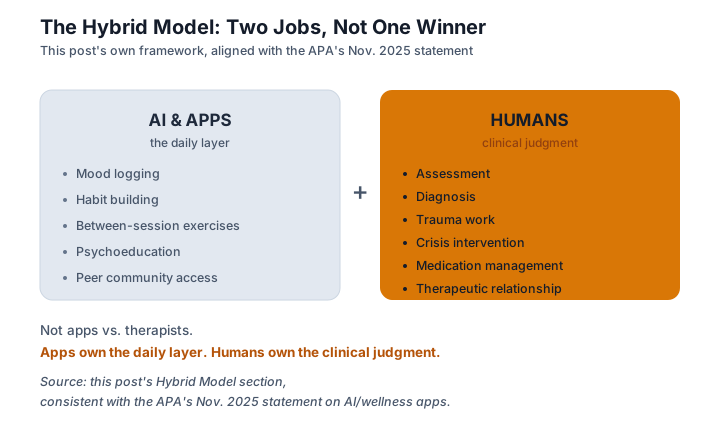
This isn’t a new concept in healthcare. We’ve used telehealth to extend clinical reach for years. We use apps to help people track blood sugar, blood pressure, and medication adherence — but no one suggests the app is replacing the endocrinologist. Mental health should work the same way.
The apps that are winning right now — the ones actually improving outcomes — are the ones built with this division of labor in mind. They don’t try to be everything. They’re honest about what they are: a daily support layer that complements clinical care, not a replacement for it.
What to Look for in an AI Wellness Tool
If you’re evaluating an app — for yourself, for your team, or as an HR director building out a benefits package — here’s what I’d look at:
1. Is it clinician-informed? Was the content and approach designed with licensed clinicians, not just UX designers and engineers? This matters. Evidence-based modalities like CBT, DBT, and ACT don’t accidentally end up in apps — they’re intentionally built in.
2. Is it clear about scope? The best apps are explicit: this is not therapy, this is not a crisis resource, this is daily support. If an app is vague or evasive about what it is and isn’t, that’s a red flag.
3. Does it have evidence-based modalities? Not “research-informed” as a marketing phrase — actual structured approaches backed by clinical literature. CBT-based mood tracking. ACT-based values exercises. Behavioral activation. These things work because decades of research says they work.
4. Does it escalate appropriately? Does the app know when to say “this is beyond my scope, please call this number or talk to a professional”? A good app has limits and respects them.
5. Who built it — and why? An app built by engineers for scale is different from an app built by clinicians who’ve actually sat across from clients in crisis. Background matters. Motivation matters.
For Organizations: This Is a Liability Question Too
If you’re an HR director or benefits manager reading this: the apps you offer your employees carry your organization’s implicit endorsement. With state regulation tightening and employee lawsuits around mental health benefit adequacy increasing, choosing clinician-designed tools with clear scope isn’t just good ethics — it’s risk management.
The behavioral economics principle at play here is default architecture: when you make a tool the default option, most employees will use it without evaluating it critically. Make sure the default is one worth defending.
Proactive screening, evidence-based tools, clear escalation pathways — this is the standard of care emerging for employer-sponsored mental health programs. The organizations building toward this now are ahead of where regulations are heading.
The Bottom Line
AI mental health apps are not inherently good or bad. They’re tools. Like any tool, their value depends entirely on using them for the right job.
The right job for an AI wellness app: daily check-ins, habit support, mood tracking, psychoeducation, between-session reinforcement.
The wrong job: crisis intervention, trauma processing, clinical diagnosis, replacing a therapeutic relationship.
The technology that’s going to matter in mental health over the next decade isn’t the technology that tries to replace clinicians. It’s the technology that makes the clinical side easier to access — and fills the daily gap between sessions in a way that’s actually grounded in how people heal.
Matthew Sexton is a licensed clinical social worker (LCSW) and President of Mental Wealth Solutions, Inc. He has directed clinical programs across 13 facilities and specializes in behavioral health access, chronic illness, and technology-informed care.
The VibeCheck.luxury EMR is currently in beta. Email [email protected] for more information.
If you're the therapist here.
Your clients get 4 sessions a month. The other 26 days they're on their own. VibeCheck.luxury is the between-session companion that carries those days back to you — clients check in daily, and you walk in already knowing what kind of week it was. Built by Matthew Sexton, LCSW, NATC.