Schizoid Personality Disorder: What Clinicians Miss
Schizoid personality disorder affects an estimated 3-5% of the population per DSM-5, yet remains one of the most misunderstood diagnoses in clinical practice.
From the earlier archive. This article’s original writing is retained and has not been fact-checked as part of our current review. Product references may reflect an earlier version; see current solutions for today’s status.
If you’ve ever sat across from a client who seems utterly indifferent to your warmth — who doesn’t want connection, doesn’t seem distressed by their isolation, and maybe genuinely can’t understand why you keep asking about their relationships — you may have encountered schizoid personality disorder (SPD).
And if your instinct was to push harder for engagement, you may have done exactly the wrong thing.
This is one of the most misunderstood diagnoses in clinical work. Not because it’s rare — it’s actually more common than we tend to think — but because it challenges a fundamental assumption most of us carry into the therapy room: that people want connection, and that connection is always the goal.
Let’s break that assumption down.
What Schizoid Personality Disorder Actually Is
Schizoid personality disorder is characterized by a persistent pattern of detachment from social relationships and a restricted range of emotional expression in interpersonal settings. To be clear, this is not shyness. It’s not depression. It’s not autism spectrum disorder, though there is overlap worth acknowledging.
People with SPD typically:
- Prefer solitary activities and genuinely find them satisfying
- Have little desire for or enjoyment of close relationships, including family
- Appear emotionally cold, detached, or flat to observers
- Are indifferent to praise or criticism
- May have a rich inner fantasy life that they rarely share
The key word here is genuinely. Unlike avoidant personality disorder — where people desperately want connection but fear rejection — individuals with schizoid PD often aren’t in significant distress about their isolation. That’s not denial. It’s their baseline.
According to DSM-5 diagnostic criteria, SPD is estimated to affect approximately 3–5% of the general population, though prevalence may be higher in clinical settings where co-occurring conditions bring people through the door.
Why Clinicians Keep Getting This Wrong
The most common clinical mistake is conflating schizoid PD with other presentations — particularly depression, autism, or avoidant PD — and then building treatment goals around increasing connection and social engagement.
That’s not always the wrong goal, but it’s the wrong starting point.
When a client with schizoid PD says “I don’t really want more friends,” they’re not articulating a symptom. They may be articulating a fact about who they are. Treating that statement as pathology to be overcome can rupture the therapeutic alliance immediately — and more importantly, it’s clinically inaccurate.
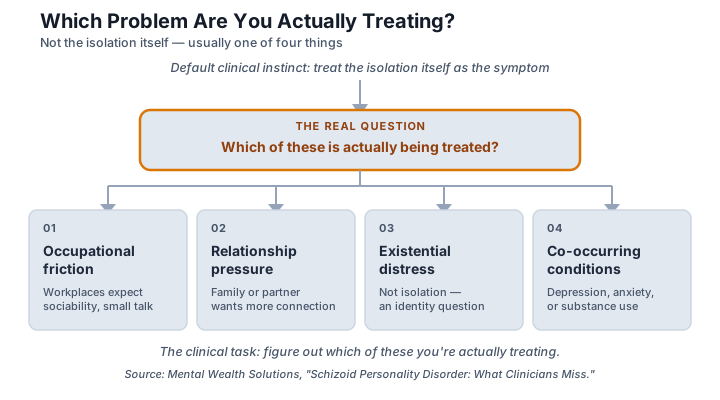
The actual presenting problems for people with SPD are more likely to be:
- Occupational friction — workplaces expect sociability, collaboration, small talk. SPD individuals may struggle to mask this over time.
- Relationship pressure from family or partners — someone in their life wants more, and the conflict brings them in.
- Existential distress — not about isolation, but about identity. The “am I broken?” question.
- Co-occurring conditions — depression, anxiety, or substance use may be what drives the referral, with SPD as the underlying architecture.
The clinical task is to understand which of these you’re actually treating.
What Helps (And It’s Not What You Think)
Treatment for schizoid PD doesn’t look like most personality disorder work. There’s no standard protocol the way there is for borderline PD (DBT) or antisocial PD. What tends to help is:
Respect the autonomy
If the client doesn’t want connection, stop making connection the goal. Build a treatment frame around their actual stated goals — occupational functioning, reducing family conflict, understanding themselves better. This isn’t colluding with pathology. It’s meeting people where they are.
Motivation for change often emerges after the client feels genuinely accepted as they are. Pushing before that point kills the work.
Use intellectual engagement, not emotional mirroring
Many individuals with SPD respond better to intellectual curiosity than empathic reflection. They’re often thoughtful, self-aware, and interested in understanding their own patterns — they just don’t process this emotionally. Lean into that. Ask about how they think, not how they feel.
Psychoeducation is underused with this population. Many clients find genuine relief in learning that what they experience has a name, is documented, and doesn’t mean they’re broken.
Individual work, almost always
Group therapy is rarely the right modality. The push for interpersonal engagement in group can be actively harmful for someone with SPD, and the premise of the work often conflicts with their values. If social skills are genuinely a target — usually for occupational reasons — highly structured, skill-based groups can work, but relational process groups typically don’t.
Watch your countertransference
Working with someone who seems indifferent to you is uncomfortable. Clinicians often either pull back and disengage, or double down and push for connection in ways that are more about the therapist’s discomfort than the client’s need.
Notice it. Supervise it. Don’t let it drive the treatment.
For Organizations: This Shows Up at Work, Too
This isn’t just a clinical conversation. If you’re a manager, HR director, or organizational leader, you may have employees or colleagues whose presentation maps onto this.
People with SPD can be exceptional contributors — especially in roles that require sustained independent focus, technical depth, or creative work without heavy collaboration requirements. They often produce high-quality output precisely because they’re not distracted by social dynamics.
Where organizations tend to lose them:
- Open office plans and forced collaboration cultures
- Performance reviews that rate “team player” behaviors as high-value metrics when the actual job doesn’t require them
- Employee engagement initiatives that feel coercive or performative
- Mandatory social events with no opt-out
None of this means accommodating poor performance. It means understanding that engagement doesn’t have one face. If someone consistently delivers excellent individual work, quietly, without socializing, that’s not a gap to fix — that’s a contribution to leverage.
Organizations that understand this retain talent that others burn out.
A Note on Differential Diagnosis
Clinicians working with schizoid PD presentations should explicitly consider:
Autism Spectrum Disorder — There is significant phenotypic overlap between SPD and ASD Level 1, particularly around social withdrawal and restricted affect. The distinction lies partly in the presence of repetitive behaviors, sensory sensitivities, and the underlying mechanism. ASD involves difficulty with social cognition. SPD typically involves disinterest in social engagement, with social cognition relatively intact.
Avoidant Personality Disorder — The key differential: desire. People with avoidant PD want connection and avoid it due to fear. People with SPD don’t want it, and largely don’t experience the approach-avoidance conflict.
Major Depression — Social withdrawal in MDD is ego-dystonic (the person misses connection and is distressed by the withdrawal). In SPD, it’s ego-syntonic. This matters for treatment targets.
Schizotypal PD — Both fall on what’s sometimes called the schizophrenia spectrum. Schizotypal PD involves odd beliefs, magical thinking, and perceptual distortions. Schizoid PD is more about flat affect and withdrawal without the cognitive distortions.
If you’re unsure, longitudinal history helps. SPD is stable, early-onset, and doesn’t fluctuate with mood episodes the way depressive withdrawal does.
The Bottom Line
Schizoid personality disorder asks clinicians and organizations alike to let go of the assumption that connection is always the right goal — that more warmth, more engagement, more togetherness is inherently healthier.
For people with SPD, the task is usually different. It’s about functioning effectively in a world that expects sociability, understanding themselves clearly, and reducing friction without being asked to become someone they’re not.
That’s legitimate therapeutic work. It just looks different than what we’re often trained for.
If you’re a client reading this: the fact that you prefer your own company isn’t a diagnosis that needs to be cured. How you function in the world, how you feel about yourself, how you navigate relationships that matter to you — those are worth exploring. You don’t have to want what everyone else wants.
Work With Someone Who Gets It
At Mental Wealth Solutions, Matthew Sexton, LCSW works with individuals navigating personality disorder diagnoses — both understanding them and working with them clinically. Whether you’re a client seeking clarity or a clinician looking for consultation, the work starts with accurate understanding.
This post is intended for educational purposes and does not constitute clinical advice or establish a therapeutic relationship. If you are experiencing a mental health crisis, please contact 988 (Suicide & Crisis Lifeline) or go to your nearest emergency room.