
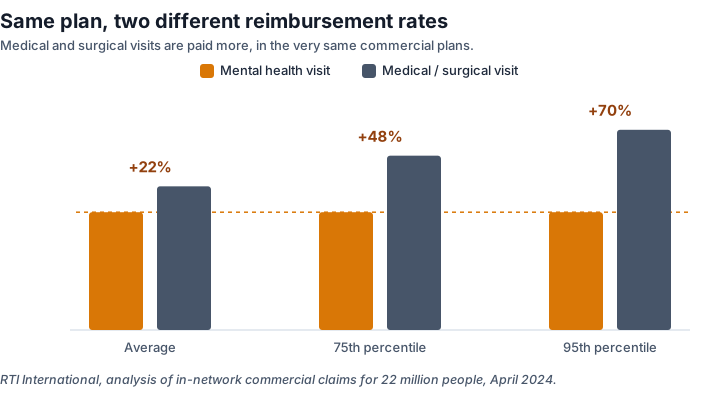
Quick answer: Commercial insurers pay mental health clinicians less than medical clinicians inside the same plan. The largest national claims study, covering 22 million commercially insured people, found in-network pay for medical and surgical office visits ran 22% higher on average than for mental health visits, and 70% higher at the top of the range (RTI International, April 2024). That low pay pushes therapists out of network, and that is when the real bills land on you.
Your insurance card makes a promise. It says your heart and your mind are both covered. The company behind the card does not pay for them the same way. When a clinician treats your body, the plan pays one rate. When a clinician treats your mind, the plan pays a lower one. Same plan. Same kind of office visit. Different money.
I am a licensed clinical social worker. I have watched this math from the inside for years. It explains something most people feel but cannot name. Your cardiologist has an open slot and takes your card. Your therapist has a waitlist, or does not take insurance at all. That is a pay gap doing its work, and it has been measured.
This post walks through the numbers behind that gap. All of them come from national studies and public reports, and every one is linked below. You do not need a policy degree to follow this. You just need to see two pay rates side by side.
The same card pays two different reimbursement rates
First, one plain word. “Reimbursement” is the money an insurer pays a provider for a visit. So when researchers compare mental health reimbursement rates vs medical surgical rates, they are asking one simple question. Does the plan pay a therapist the way it pays other doctors?
The answer is no. RTI International, a nonprofit research group, studied in-network claims from 22 million commercially insured people. It is the most recent national claims analysis of this question. Medical and surgical office visits paid 22% more, on average, than mental health office visits (RTI International, April 2024).
Think about what “in the same plan” means here. This is one company, one network, one benefits booklet. The only difference is which clinician the member went to see.
The gap grows at the high end. Line up all the payments from lowest to highest. At the 75th spot out of 100, the gap was 48%. At the 95th spot, it was 70% (RTI International, April 2024). Researchers call those spots percentiles. In plain terms, the better a plan pays its doctors, the worse the deal gets for its therapists.
One more finding made me put my coffee down. The same commercial plans paid physician assistants 19% more than psychiatrists, and 23% more than psychologists (RTI International, April 2024). A psychiatrist trains for more than a decade. A psychologist earns a doctorate. Both specialists earned less from these plans than a generalist with a master’s degree. Someone approved that rate sheet.
Is the gap still there in 2026?
Yes. In April 2026, The Kennedy Forum launched the Mental Health Parity Index, built with Third Horizon and other partners. It tracks the four largest commercial insurers: Aetna, BlueCross BlueShield, Cigna, and UnitedHealthcare. The result was blunt. All four paid less for outpatient mental health and addiction care than for outpatient physical health care, in every state, with payment gaps of 16% to 59% nationwide (The Kennedy Forum, April 2026).
“Outpatient” means regular visits, the kind where you walk in and walk out. No hospital stay. This is the care most of us mean when we say therapy.
Hospitals flagged the same numbers. AHA News, the American Hospital Association’s news service, reported lower payment for outpatient mental health and addiction treatment from those four insurers across all 43 states it analyzed for network gaps (AHA News, April 16, 2026).
So the deepest claims study we have points one way, and the newest index points the same way. The gap held from one dataset to the next. And the index will keep updating, in public. A one-time study can be waved off as old news, but a scoreboard that updates is harder to ignore.
I have written before about how insurers profit from this distance in The Business of Being Unwell. The short version: a plan saves money every time care looks covered on paper and stays hard to reach in practice.
Why does the low rate make your visit cost more?
Because the therapist who can actually see you is often outside your network. The same RTI study found commercially insured patients went out of network 3.5 times more often for behavioral health than for medical or surgical care. For psychiatrists, it was 8.9 times more often. For psychologists, 10.6 times (RTI International, April 2024).
Here is the chain, step by step:
- The insurer sets a low rate for therapy visits.
- Therapists cannot run a practice on that rate, so many leave the network or never join it.
- The directory still looks full. But lots of the names in it are not taking new clients.
- You need care now, so you see an out-of-network therapist and pay the full fee yourself.
- Your cardiologist stayed in network, because the plan pays medical specialists enough to stay. You pay your copay and go home.
That is the whole trick. Both visits count as covered. One costs you a copay. The other can cost the full fee, out of your own pocket, week after week.
Out of network usually also means a separate, higher deductible. A deductible is the amount you pay before the plan pays anything. Many people never reach the out-of-network one. So “we cover out-of-network care” often means the plan covers close to nothing, while the patient covers a weekly fee that adds up fast.
The access numbers match the payment numbers. The American Medical Association reported that in-network access to physical health clinicians runs 24% to 83% higher than access to mental health and addiction clinicians at those same four insurers. The gaps showed up in 43 states and in 7 out of 10 U.S. counties (AMA, April 2026).
This is a big part of why “just go to therapy” is broken advice for so many people. The advice assumes an open door. The rate sheet quietly closed it. If you have called ten therapists from your plan’s list and gotten ten voicemails, nothing is wrong with you. The list was thin before you started dialing.
Isn’t there a law against this?
There is. The Mental Health Parity and Addiction Equity Act became law in 2008. “Parity” means equal. The law says a health plan cannot treat mental health benefits worse than medical benefits. Not in dollar limits, and not in the fine print that decides who gets seen.
The government’s own referees say plans are failing that test. In January 2025, the Departments of Labor, Health and Human Services, and the Treasury sent their required report to Congress. It found that plans and insurers are “continuing to fall short” of the parity requirement (U.S. Department of Labor, January 17, 2025). That is the regulators’ own phrase, in their own report.
Then the tools got weaker. In 2024, regulators finished a stronger parity rule that required more proof from insurers. An employer and industry group, the ERISA Industry Committee, sued to block it. On May 15, 2025, the departments announced they would not enforce the 2024 rule while they reconsider it (APA Services, May 2025). The 2008 law itself still stands. But the newest enforcement tool is sitting on a shelf while the pay gap sits in the data. The blocked rule mostly asked insurers to prove parity with numbers, the same kind of numbers you have been reading in this post.
Some states are pushing anyway, with parity fines and audits of their own. I covered that wave, and how slowly the money actually moves, in The Parity Fines Are Real Now.
What can you actually do?
You cannot rewrite a rate sheet from your kitchen table. Neither can I. But the gap counts on people staying quiet and paying up, and you do not have to do either.
If you are a patient, three moves help:
- Call your plan when no in-network therapist can see you. Ask for a “network gap exception.” That is a request to cover an out-of-network therapist at your in-network cost.
- Keep notes. Write down who you called, the date, and what you were told. If you appeal later, that record does the heavy lifting.
- If your plan denies mental health care, appeal it, and use the word “parity” in the appeal. Plans track which members push back.
If you are an employer, you hold more power here than any patient does. You buy the plan. Ask your broker or carrier, in writing, how their behavioral health rates compare with their medical rates. Ask what share of your employees’ mental health claims went out of network last year. Mental health is a real cost line for employers now, and paying for a network that exists mostly on paper is the worst of both worlds. A carrier that pays therapists fairly will be glad to show you. A carrier that does not will send you a very long email that answers neither question.
My team and I sit on the clinician side of this fight too. Over on our VibeCheck.luxury blog, we broke down why commercial insurers pay therapists so little, from inside the practice. Same gap, seen from the other chair.
“Covered” was never the same as “cared for.” The 22% gap is where those two words split apart. For years the gap hid inside claims data nobody published. Now the numbers are public. A live index tracks it insurer by insurer, and federal regulators put “continuing to fall short” in writing. The gap survived because it was hard to see. It is not hard to see anymore.
FAQ
Do commercial insurers pay mental health clinicians less than medical clinicians? Yes, inside the very same plans. RTI International studied in-network claims from 22 million commercially insured people. Medical and surgical office visits paid 22% more on average than mental health visits. The gap was 48% at the 75th percentile of payments and 70% at the 95th (RTI International, April 2024).
Is the mental health payment gap still happening in 2026? Yes. The Kennedy Forum’s Mental Health Parity Index launched in April 2026. It found that Aetna, BlueCross BlueShield, Cigna, and UnitedHealthcare all paid less for outpatient mental health and addiction care than for outpatient physical health care, with payment gaps of 16% to 59% nationwide (The Kennedy Forum, April 2026).
Why is it so hard to find an in-network therapist? Low rates thin the network. Commercially insured patients went out of network 3.5 times more often for behavioral health than for medical or surgical care, 8.9 times more often for psychiatrists, and 10.6 times more often for psychologists (RTI International, April 2024). The AMA reports in-network access gaps of 24% to 83% at the four largest insurers (AMA, April 2026).
Isn’t mental health parity already the law? Yes. The federal parity law passed in 2008 and is still in force. But regulators told Congress in January 2025 that plans are “continuing to fall short” (U.S. Department of Labor, January 2025). And on May 15, 2025, the government said it would not enforce its stronger 2024 parity rule while it reconsiders it (APA Services, May 2025).
Sources
- RTI International, Behavioral Health Parity: Pervasive Disparities in Access to In-Network Care Continue (commissioned by the Bowman Family Foundation’s Mental Health Treatment and Research Institute), April 2024. rti.org
- The Kennedy Forum, Mental Health Parity Index launch release (with Third Horizon, the AMA, the American Psychological Foundation, and the Ballmer Group), April 14, 2026. globenewswire.com
- AHA News, Data highlights gaps in finding in-network mental health coverage, April 16, 2026. aha.org
- American Medical Association, New insurer data shows parity gaps in mental vs. physical health care, April 2026. ama-assn.org
- U.S. Departments of Labor, Health and Human Services, and the Treasury, 2024 MHPAEA Report to Congress press release, January 17, 2025. dol.gov
- APA Services, Departments announce nonenforcement of 2024 Mental Health Parity Rule, May 2025. apaservices.org
Figures current as of July 2026.
Disclaimer
This article is for educational and informational purposes only. It does not constitute medical, clinical, legal, or therapeutic advice, and reading it does not create a therapist-client relationship with Matthew Sexton, LCSW or Mental Wealth Solutions, Inc. Although the author is a licensed clinical social worker, the content in this article is not clinical assessment, diagnosis, or treatment.
Reimbursement rates, network rules, parity enforcement, and appeal rights vary by health plan, state, and over time, and may change after this article is published. The studies cited here describe national patterns, and your plan’s rates, network, and appeal process may differ. Nothing here is a substitute for confirming a specific benefit, rate, or deadline with your insurer, your benefits administrator, or qualified counsel. Plans and circumstances differ, and what is described here may not match your situation.
If you are in immediate emotional crisis, you can reach the 988 Suicide & Crisis Lifeline by calling or texting 988 (US). If you are experiencing domestic violence or are in physical danger, contact the National Domestic Violence Hotline at 1-800-799-7233 or visit thehotline.org. In a life-threatening emergency, call 911.
Frequently asked questions.
- Do commercial insurers pay mental health clinicians less than medical clinicians?
- Yes, inside the very same plans. RTI International studied in-network claims from 22 million commercially insured people. Medical and surgical office visits paid 22% more on average than mental health visits. The gap was 48% at the 75th percentile of payments and 70% at the 95th (RTI International, April 2024).
- Is the mental health payment gap still happening in 2026?
- Yes. The Kennedy Forum's Mental Health Parity Index launched in April 2026. It found that Aetna, BlueCross BlueShield, Cigna, and UnitedHealthcare all paid less for outpatient mental health and addiction care than for outpatient physical health care, with payment gaps of 16% to 59% nationwide.
- Why is it so hard to find an in-network therapist?
- Low rates thin the network. Commercially insured patients went out of network 3.5 times more often for behavioral health than for medical or surgical care, 8.9 times more often for psychiatrists, and 10.6 times more often for psychologists (RTI International, April 2024). The AMA reports in-network access gaps of 24% to 83% at the four largest insurers.
- Isn't mental health parity already the law?
- Yes. The federal parity law passed in 2008 and is still in force. But regulators told Congress in January 2025 that plans are 'continuing to fall short.' And on May 15, 2025, the government said it would not enforce its stronger 2024 parity rule while it reconsiders it (APA Services, May 2025).
Want to discuss this for your program?
Book a 30-min conversation. We'll walk you through deployment, the BAA, and what your rollout looks like in production.
Book a 30-min conversation