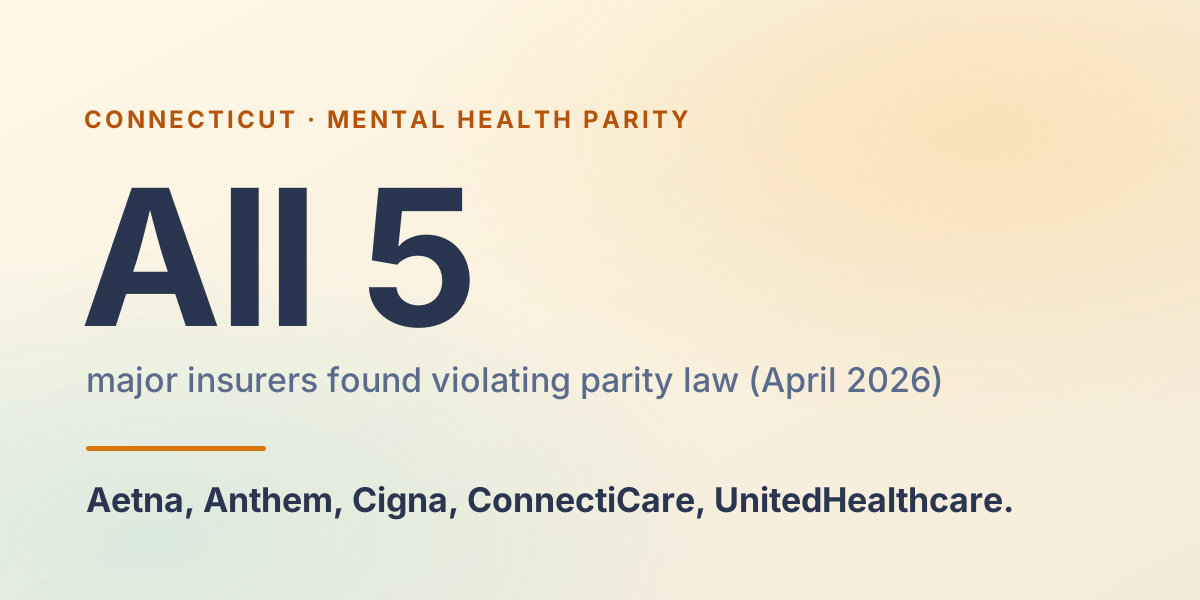
Connecticut’s insurance regulator did something no other state has done: it cited all five of its major commercial health insurers for the same category of mental health parity violation, in one report, on the same day. Aetna, Anthem, Cigna, ConnectiCare, and UnitedHealthcare all showed up in the Connecticut Insurance Department’s 2026 NQTL Annual Report, published April 15, 2026. Not one carrier passed.
Quick answer: In April 2026, Connecticut found all five of its major commercial insurers, Aetna, Anthem, Cigna, ConnectiCare, and UnitedHealthcare, violating mental health parity requirements. It’s not the largest parity action in the country. Georgia fined 22 insurers a combined nearly $25 million in January 2026, more money and more carriers than Connecticut’s action touches. What Connecticut did that Georgia didn’t: name every major carrier in its market for the same violation at once, instead of building the case insurer by insurer over two and a half years.
That distinction matters more than it sounds like it should. A big fine tells you one company got caught. A whole state’s carrier roster getting cited on the same day tells you the problem was never one bad actor. It was how the market operates.
All Five, Named at Once
Connecticut’s Insurance Department reviewed non-quantitative treatment limitations, the network and utilization rules insurers use to manage behavioral health care, for its five major commercial carriers. Every one of them failed. The department found the pattern repeated across Aetna, Anthem, Cigna, ConnectiCare, and UnitedHealthcare as of the April 15, 2026 report. (Connecticut Insurance Department, 2026)
NQTL is regulatory shorthand for the quieter side of a parity violation. It’s not a hard dollar cap that’s easy to spot. It’s the softer machinery: which providers count as in-network, how utilization gets reviewed, how long a new patient waits, how reimbursement is structured behind the scenes. The report found mental health and substance-use networks built thinner than medical networks across all five carriers, tied back to how those carriers pay behavioral health clinicians relative to everyone else on the same plan.
The state’s response was pointed. Attorney General William Tong called it “a sea change in mental health parity enforcement in Connecticut.” Comptroller Sean Scanlon said carriers “will, for the first time, be held accountable.” State Senator Matt Lesser put it more bluntly: “Outrageously, insurance companies failed to follow the law.” (Office of the State Comptroller, April 2026)
Those aren’t the words of officials citing a paperwork gap. They’re the words of officials who reviewed five companies and got five failures.
How Much Money Is Actually on the Table?
Connecticut’s 2025 parity law caps fines at $625,000 per insurer per year, which puts a theoretical ceiling around $3.1 million across all five carriers if every one is fined at the maximum. But as of this writing, the department has not disclosed the specific dollar amounts it’s actually levying against Aetna, Anthem, Cigna, ConnectiCare, or UnitedHealthcare. (Hartford Business Journal, April to May 2026)
That gap between “found in violation” and “paid a specific amount” is worth sitting with. It’s the same gap that showed up in Georgia, where investigative reporting found the state had collected none of its nearly $25 million in fines months after announcing them. (The Parity Fines Are Real Now: What Georgia’s $25M Crackdown Means, Mental Wealth Solutions, June 2026) A finding is a finding. A fine that’s actually collected is a separate and slower process, and Connecticut hasn’t gotten there publicly yet.
What Connecticut’s cap does, whether or not it hits, is put a repeatable number on the table every single year. Georgia’s fines were a one-time market-conduct settlement. Connecticut built a mechanism that can run again in 2027, against the same five names, if nothing changes.
Not the Biggest Fine, the Broadest Parity Indictment
Georgia fined 22 insurers a combined nearly $25 million in January 2026, the largest single-state parity crackdown by dollar amount to date. Oscar Health alone paid $10.2 million, Anthem BCBS Georgia $4.6 million, Kaiser $2.6 million. (Georgia OCI, January 12, 2026) Measured in dollars and in carrier count, Connecticut’s action is smaller.
Measured a different way, it isn’t. Georgia’s fines came out of 22 separate market-conduct exams, built over roughly two and a half years, one insurer at a time. Connecticut’s report named its entire major-carrier market, all five national commercial insurers a Connecticut resident is likely to actually be enrolled in, in a single simultaneous filing. Georgia proved that parity enforcement can eventually catch almost every insurer in a market. Connecticut proved something faster: that on a single audit date, none of a state’s major carriers were in compliance at once. That’s not a bigger number. It’s a harder thing to explain away as one bad company.
The Rate Gap Behind the Networks
The parity violation isn’t abstract. It traces to a specific pay gap inside the same insurance plan. Anthem paid master’s-level behavioral health clinicians roughly 75% of the Medicare rate used as the yardstick, while medical and surgical physicians in the same plan received roughly 115% of that same benchmark. (Connecticut Insurance Department, cited in Connecticut Public, April 27, 2026)
Cigna’s gap ran wider. Licensed clinical social workers were reimbursed at roughly 72% of that benchmark rate. Orthopedic surgeons, in the same Cigna plan, were reimbursed at roughly 159%. Same insurer, same rate table logic, more than double the pay for one specialty over the other. (Connecticut Insurance Department, April 2026)
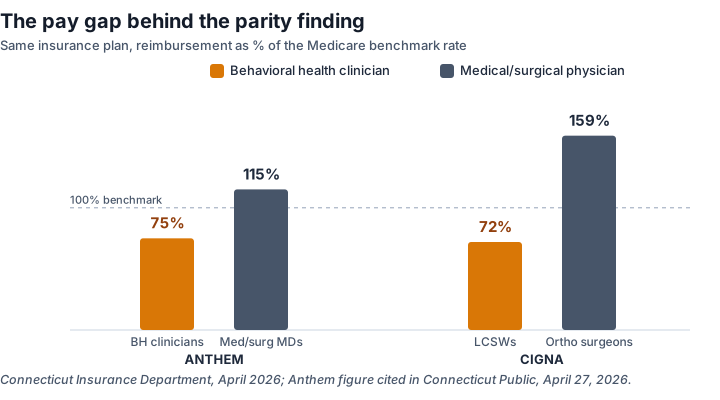
This is why the networks look full on paper and empty when you actually call. Pay a therapist a fraction of what you pay a surgeon, and a lot of therapists eventually stop taking that plan. The names stay listed. The line just gets longer for whoever’s still on it. We’ve written before about how that reimbursement gap plays out for the clinicians on the receiving end. (Why Your In-Network Therapist Costs More to See Than Your In-Network Cardiologist, Mental Wealth Solutions, July 2026)
What the Insurers Are Saying
The industry’s public response has been measured, not combative. The Connecticut Association of Health Plans said carriers were “in the process of understanding the department’s findings” and remained “committed to working collaboratively.” That’s the language of a group buying time, not one conceding fault. (Connecticut Public, April 27, 2026)
Two carriers pushed back on specifics. Aetna and Anthem both disputed whether case management, the process of reviewing and approving ongoing behavioral health treatment, should even count as a treatment limitation subject to parity review in the first place. The department rejected that argument and kept the finding. In our work with clinicians navigating these plans, case management review is exactly where a lot of authorized sessions quietly stop getting authorized. Calling it outside the scope of parity review would have been a convenient exemption.
What This Means If You’re Actually Trying to Use Your Benefits
None of this changes what a Connecticut resident experiences trying to book an appointment this month. A parity finding doesn’t shorten a waitlist by itself. What it does is put an official record behind something patients and clinicians have been saying for years: the thin network wasn’t an accident. Even a client who does land an in-network appointment often gets an hour a week, at most four sessions a month. The other 26 days are still theirs to get through, with or without a regulator’s report.
The practical value of this report is narrower and more useful than a headline number. It gives clinicians, employers, and patients a citable, state-sourced document to point to when a network looks adequate on paper and isn’t in practice. That’s not nothing. It’s also not care delivered.
What happens next is the real test. Does Connecticut publish actual dollar figures against these five names, or does this stay a finding with no invoice attached, the way Georgia’s fines sat uncollected months after they were announced? Watch that gap. It’s the one that decides whether 2026 was the year parity enforcement got teeth or just got louder.
FAQ
Which insurers did Connecticut cite for mental health parity violations in 2026? All five major commercial carriers doing business in the state: Aetna, Anthem, Cigna, ConnectiCare, and UnitedHealthcare. The Connecticut Insurance Department’s 2026 NQTL Annual Report, published April 15, 2026, found every one out of compliance. (Connecticut Insurance Department, April 2026)
How much money will Connecticut’s insurers actually pay? Unclear so far. State law caps fines at $625,000 per insurer per year, a theoretical ceiling near $3.1 million across the five, but the department hasn’t disclosed the actual amounts being levied against any carrier. (Hartford Business Journal, April to May 2026)
Is Connecticut’s action bigger than Georgia’s $25 million parity fine? Not in dollars. Georgia fined 22 insurers a combined nearly $25 million in January 2026, more carriers and more money. Connecticut’s action is broader in a different sense: it named its whole major-carrier market in one report instead of 22 separate exams over 2.5 years. (Georgia OCI, January 2026)
What specifically did Connecticut’s report find insurers doing wrong? Thinner mental health and substance-use networks than medical networks, tied to reimbursement, plus higher out-of-network utilization, tighter new-patient acceptance, and longer waits. Anthem paid behavioral clinicians about 75% of a benchmark rate versus 115% for medical/surgical physicians. (Connecticut Insurance Department, April 2026)
How are the insurers responding? The Connecticut Association of Health Plans said carriers were “in the process of understanding the department’s findings” and remained “committed to working collaboratively.” Aetna and Anthem disputed that case management counts as a parity-reviewable limitation, a dispute the department rejected. (Connecticut Public, April 27, 2026)
Sources
- Connecticut Insurance Department, 2026 NQTL Annual Report, all five major commercial carriers found in violation, April 15, 2026.
- Connecticut Public, “Insurance regulator finds all five major carriers out of compliance”, April 27, 2026; carrier reimbursement figures, CAHP statement, Aetna/Anthem case management dispute.
- Hartford Business Journal, Connecticut’s $625,000-per-insurer, per-year fine cap; no disclosed dollar totals, April to May 2026.
- InsuranceNewsNet, corroborating coverage of Connecticut’s 2025 parity law and fine structure, April to May 2026.
- Office of the State Comptroller, State of Connecticut, quotes from AG William Tong, Comptroller Sean Scanlon, and Sen. Matt Lesser, April 2026.
- Georgia Office of Commissioner of Insurance, 22 insurers fined nearly $25 million combined, finalized January 12, 2026.
- Mental Wealth Solutions, “The Parity Fines Are Real Now: What Georgia’s $25M Crackdown Means”, June 2026.
- Mental Wealth Solutions, “Why Your In-Network Therapist Costs More to See Than Your In-Network Cardiologist”, July 2026.
Figures current as of July 2026.
Disclaimer
This article is for educational and informational purposes only. It does not constitute medical, clinical, legal, or therapeutic advice, and reading it does not create a therapist-client relationship with Matthew Sexton, LCSW or Mental Wealth Solutions, Inc. Although the author is a licensed clinical social worker, the content in this article is not clinical assessment, diagnosis, or treatment.
Parity enforcement actions, fine amounts, and regulatory findings described here reflect Connecticut and Georgia state filings as reported through July 2026, and may change as departments issue further rulings, insurers appeal, or fines are collected or reduced. Nothing here is a substitute for confirming the current status of a specific enforcement action with the relevant state insurance department or qualified counsel. What a patient or clinician experiences with a specific plan may not match the patterns described here.
If you are in immediate emotional crisis, you can reach the 988 Suicide & Crisis Lifeline by calling or texting 988 (US). If you are experiencing domestic violence or are in physical danger, contact the National Domestic Violence Hotline at 1-800-799-7233 or visit thehotline.org. In a life-threatening emergency, call 911.
Frequently asked questions.
- Which insurers did Connecticut cite for mental health parity violations in 2026?
- All five major commercial carriers doing business in the state: Aetna, Anthem, Cigna, ConnectiCare, and UnitedHealthcare. The Connecticut Insurance Department's 2026 NQTL Annual Report, published April 15, 2026, found every one out of compliance with mental health parity requirements. (Connecticut Insurance Department, April 2026)
- How much money will Connecticut's insurers actually pay?
- Unclear so far. Connecticut's 2025 parity law caps fines at $625,000 per insurer per year, putting a theoretical ceiling around $3.1 million across the five carriers, but the department has not disclosed the actual dollar amounts being levied against any of them. (Hartford Business Journal, April to May 2026)
- Is Connecticut's action bigger than Georgia's $25 million parity fine?
- Not in dollars. Georgia fined 22 insurers a combined nearly $25 million in January 2026, more carriers and more money than Connecticut's action involves. Connecticut's is broader in a different way: it named its entire major-carrier market for the same violation in one simultaneous report, not 22 separate exams over 2.5 years. (Georgia OCI, January 2026; Connecticut Insurance Department, April 2026)
- What specifically did Connecticut's report find insurers doing wrong?
- Non-comparable mental health and substance-use networks tied to reimbursement, higher out-of-network utilization for behavioral health, tighter new-patient acceptance, and longer wait times than for medical and surgical care within the same plans. Anthem paid master's-level clinicians about 75% of Medicare rates while medical/surgical physicians received about 115%. (Connecticut Insurance Department, April 2026)
- How are the insurers responding to Connecticut's findings?
- The Connecticut Association of Health Plans said carriers were 'in the process of understanding the department's findings' and remained 'committed to working collaboratively.' Aetna and Anthem specifically disputed that case management qualifies as a treatment limitation subject to parity review, a dispute the department rejected. (Connecticut Public, April 27, 2026)
If you're the therapist here.
Your clients get 4 sessions a month. The other 26 days they're on their own. VibeCheck.luxury is the between-session companion that carries those days back to you — clients check in daily, and you walk in already knowing what kind of week it was. Built by Matthew Sexton, LCSW, NATC.