Quick answer: Insurers selling plans on HealthCare.gov denied 19% of in-network claims in 2024. That is about 85 million denials in a single year, per KFF (March 2026). Fewer than 1% of those denials were ever appealed. And nobody can tell you the exact mental health share, because insurers do not have to report it separately until 2027.
Eighty-five million. That is how many in-network claims came back marked “no” in 2024, out of roughly 451 million submitted to insurers selling plans on HealthCare.gov (KFF, March 2026). In-network means the doctor was already on your plan’s approved list. These were not surprise out-of-network bills. Nearly one claim in five was denied anyway.
I’m a licensed clinical social worker. I have sat with people on the day a denial letter lands, and I have watched what that one page does to a week. So this piece walks through the real numbers behind mental health insurance claim denials, and what happens when anyone checks the insurers’ work. Fair warning: the math looks bleak. The ending does not.
How often do insurers say no?
About one time in five. In 2024, insurers on HealthCare.gov received roughly 451 million in-network claims and denied about 85 million of them, a 19% denial rate (KFF, March 2026). And that is just the average. Company by company, denial rates ran from 3% all the way up to 36%. Same federal rules, wildly different answers.
Picture a waiting room with ten people in it. On average, two of them will have a bill bounce back denied this year, even though every one of them stayed inside the plan’s own network.
A quick word on words. A claim is the bill your doctor or therapist sends the insurer after your visit. A denial means the insurer refuses to pay it. When that happens, the cost lands on you, or the visit never happens at all.
Now the names. KFF broke out the biggest parent companies using 2023 data. Among companies that handled more than 5 million claims that year, UnitedHealth Group denied 33% of in-network claims. Only one company came in higher: Blue Cross Blue Shield of Alabama, at 35%. Elevance Health, the company behind Anthem plans, denied 23% (KFF, January 2025).
What about Aetna? Honest answer: I could not find one Aetna denial rate from a source I trust enough to print. Aetna’s parent company, CVS Health, sells marketplace plans like the others. But the public data will not hand you a clean, verified number for them. Sit with that for a second. You should be able to look this up. Mostly, you can’t.
One scope note. All of these figures cover plans people buy on HealthCare.gov, the individual marketplace. If your insurance comes through your job, your plan is not in this public data.
Why does saying “no” pay?
Because almost nobody fights back. Out of roughly 85 million denials in 2024, people filed 262,982 appeals. That is fewer than 1% (KFF, March 2026). And when people did appeal, the first review went back to the insurer itself, which stood by its own “no” 66% of the time.
Run that math from the insurer’s side. Every denied claim is a bill it may never have to pay. If 99 out of 100 denials go unchallenged, a “no” costs almost nothing to issue. And the first appeal gets judged by the same company that said no. The player is also the referee.
Once in a while, we get to see inside the machine. In March 2023, ProPublica published an investigation into a Cigna review tool called PXDX. Over two months in 2022, Cigna’s staff doctors used it to deny more than 300,000 requests for payment, spending an average of 1.2 seconds per case, without opening the patient files (ProPublica, March 2023). Yes, those numbers are older, from 2022 claims, and I am dating them on purpose. But hold onto the scale. 1.2 seconds is less time than it took you to read this sentence.
Behavioral science has a name for this kind of design: friction. Every extra form sheds a few more people. Every week on hold sheds a few more. And the people who drop out first are the ones with the least energy left to fight. In mental health, that is often the exact person the claim was for. A person in a depressive episode is being asked to out-stubborn a billing department. I have written before about how insurers weaponize prior authorization. Denial is the same play, run one step later.
What happens to mental health insurance claim denials
Here is the part that should bother you most: nobody outside the companies knows the true mental health denial rate. Insurers are not required to report mental health denials separately from other denials. Per KFF, marketplace insurers only begin splitting out behavioral health claims starting with plan year 2027 (KFF, March 2026). “Behavioral health” is the industry’s term for mental health and addiction care. So the one number this article is about does not exist in public yet. The scoreboard itself is missing.
There is a federal law that is supposed to prevent all of this. It is called the parity law, MHPAEA, and it has been on the books since 2008. Parity is a simple idea: a plan cannot treat mental health care more strictly than it treats medical care. Same plan, same rules, whether the problem is a knee or a mind.
The government checked. In March 2026, the Labor Department, HHS, and the Treasury released their 2025 parity report to Congress, covering enforcement from August 2023 through July 2025. It found plans still demanding more permission steps for mental health care than for similar medical care, and approving that care for shorter stretches. It counted 15 final findings of noncompliance, which is the government’s word for breaking the rules (DOL/HHS/Treasury, March 2026). States are adding fines of their own, a wave I covered in The Parity Fines Are Real Now.
The money side tilts the same way. RTI International studied commercial claims covering more than 22 million people, using 2019 to 2021 data published in April 2024. Patients went out of network 3.5 times more often to see mental health clinicians than medical ones. For psychiatrists, 8.9 times more often. For psychologists, 10.6 times. And in-network office visits paid about 22% more when the clinician was treating a body instead of a mind (RTI International, April 2024). RTI concluded that a therapist shortage cannot explain gaps that size.
Put it plainly. Your card says therapy is covered. But the plan pays therapists less than other clinicians in the very same plan, so therapists leave the network. Then you drive farther, pay cash, or give up. You can be fully insured and still find nobody in network with an open slot. The card in your wallet promises coverage, not an appointment.
What happens when neutral doctors check the work?
They side with the patient most of the time. In April 2026, JAMA Internal Medicine published a study of 51,394 external appeals in New York State, closed between May 2019 and December 2025. An external appeal means a neutral reviewer outside the insurance company takes a second look. Those reviewers overturned the insurer’s denial 46.7% of the time overall. For substance use care, 61.5%. For mental health care, 60.6%. Those were the two highest rates of any type of care (JAMA Internal Medicine, April 2026).
Now put the numbers side by side. When a neutral doctor re-checks a mental health denial in New York, the “no” fails the check about six times out of ten. Yet across the country, fewer than 1% of denials ever get appealed at all. Denials that would lose keep winning, because almost no one makes the insurer show its work. New York is just one state. It also happens to be a state where we can actually see the results.
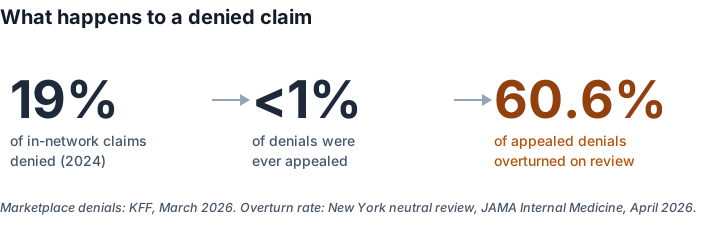
That asymmetry is the engine of the denial economy. A “no” stands unless you spend hours fighting it. The company wins by default, because pushing back costs you evenings and costs them a form letter.
What can you do with a “no”?
Treat the denial as a first offer. The numbers say it often is one. If your mental health claim gets denied, here is the short playbook:
- Get the reason in writing. Ask the plan to name the exact rule your claim supposedly failed. Vague letters melt under specific questions.
- File the internal appeal. It costs nothing. Fewer than 1% of people do it, and the whole model leans on that.
- If you lose, ask for external review. That is the neutral check outside the company. In New York, it overturned mental health denials 60.6% of the time.
- Save everything. Letters, dates, names, portal messages. Appeals are won on paper.
If you are a therapist reading this, your documentation is the lever. There is a working guide on what to document to win parity denials that gets into the weeds.
After years inside this system, here is my honest read. The denial economy runs on one quiet bet: that you are too tired to push back. The numbers above say the bet usually pays. They also say it falls apart the moment somebody checks the work. That is why I keep writing about the business of being unwell, and it is part of why we built VibeCheck.luxury, so support has a place to live between sessions instead of inside a review queue. Appeal the “no.” In the one state where neutral doctors kept score, the “no” was wrong most of the time.
FAQ
How often do insurers deny mental health insurance claims? Nobody outside the companies knows the exact rate yet. Insurers do not have to report mental health denials separately until plan year 2027 (KFF, March 2026). Overall, HealthCare.gov insurers denied 19% of in-network claims in 2024. And when New York’s neutral reviewers re-checked mental health denials, they overturned 60.6% of them (JAMA Internal Medicine, April 2026).
Which insurance company denies the most claims? Among HealthCare.gov parent companies with more than 5 million claims in 2023, UnitedHealth Group denied 33% of in-network claims, second only to Blue Cross Blue Shield of Alabama at 35%. Elevance Health, which runs Anthem plans, denied 23% (KFF, January 2025). Across all insurers in 2024, denial rates ranged from 3% to 36% (KFF, March 2026).
Is it worth appealing a denied mental health claim? Yes. Fewer than 1% of denied claims were appealed in 2024, and insurers upheld their own denials 66% of the time on internal review (KFF, March 2026). The picture changes at the neutral stage: New York’s external reviewers overturned 60.6% of mental health denials and 61.5% of substance use denials (JAMA Internal Medicine, April 2026).
Is it legal to deny mental health care more often than medical care? Federal parity law, known as MHPAEA, bars plans from treating mental health care more strictly than comparable medical care. Even so, the 2025 parity report to Congress, released March 2026, documented ongoing violations, including extra permission steps for mental health care, and counted 15 final findings of noncompliance (DOL/HHS/Treasury, March 2026).
Sources
- KFF, Claims Denials and Appeals in ACA Marketplace Plans in 2024, March 2026. kff.org
- KFF, HealthCare.gov Insurers Denied Nearly 1 in 5 In-Network Claims in 2023, January 2025. kff.org
- U.S. Departments of Labor, Health and Human Services, and the Treasury, 2025 MHPAEA Report to Congress, released March 3, 2026. dol.gov
- Bruch et al., research letter on New York State external appeals closed May 2019 to December 2025, JAMA Internal Medicine, April 2026. jamanetwork.com
- RTI International, study on network access disparities in mental health and SUD treatment, commissioned by the Mental Health Treatment and Research Institute (Bowman Family Foundation), April 2024. rti.org
- ProPublica, How Cigna Saves Millions by Having Its Doctors Reject Claims Without Reading Them, March 2023. propublica.org
Figures current as of July 2026.
Disclaimer
This article is for educational and informational purposes only. It does not constitute medical, clinical, legal, or therapeutic advice, and reading it does not create a therapist-client relationship with Matthew Sexton, LCSW or Mental Wealth Solutions, Inc. Although the author is a licensed clinical social worker, the content in this article is not clinical assessment, diagnosis, or treatment.
Claim denial rates, appeal rights, deadlines, and parity enforcement vary by health plan, state, and over time, and may change after this article is published. The figures here describe plans sold on HealthCare.gov and, for external appeals, New York State, so they may not describe your plan or your claim. Nothing here is a substitute for confirming a specific denial, deadline, or appeal step with your insurer, your benefits administrator, or qualified counsel.
If you are in immediate emotional crisis, you can reach the 988 Suicide & Crisis Lifeline by calling or texting 988 (US). If you are experiencing domestic violence or are in physical danger, contact the National Domestic Violence Hotline at 1-800-799-7233 or visit thehotline.org. In a life-threatening emergency, call 911.
Frequently asked questions.
- How often do insurers deny mental health insurance claims?
- Nobody outside the companies knows the exact rate yet. Insurers do not have to report mental health denials separately until plan year 2027, per KFF (March 2026). Overall, HealthCare.gov insurers denied 19% of in-network claims in 2024. When New York's neutral reviewers re-checked mental health denials, they overturned 60.6% of them (JAMA Internal Medicine, April 2026).
- Which insurance company denies the most claims?
- Among HealthCare.gov parent companies with more than 5 million claims in 2023, UnitedHealth Group denied 33% of in-network claims, second only to Blue Cross Blue Shield of Alabama at 35%. Elevance Health, which runs Anthem plans, denied 23% (KFF, January 2025). Across all insurers in 2024, denial rates ranged from 3% to 36% (KFF, March 2026).
- Is it worth appealing a denied mental health claim?
- Yes. Fewer than 1% of denied claims were appealed in 2024, and insurers upheld their own denials 66% of the time on internal review (KFF, March 2026). The picture changes at the neutral stage: New York's external reviewers overturned 60.6% of mental health denials and 61.5% of substance use denials (JAMA Internal Medicine, April 2026).
- Is it legal to deny mental health care more often than medical care?
- Federal parity law, known as MHPAEA, bars plans from treating mental health care more strictly than comparable medical care. Even so, the 2025 parity report to Congress, released March 2026, documented ongoing violations, including extra permission steps for mental health care, and counted 15 final findings of noncompliance.
Want to discuss this for your program?
Book a 30-min conversation. We'll walk you through deployment, the BAA, and what your rollout looks like in production.
Book a 30-min conversation