
For almost twenty years, mental health parity was a law without a bill attached. In 2026, the bills started arriving. On January 12, Georgia’s Office of Commissioner of Insurance announced nearly $25 million in fines against at least 11 insurers for violating mental-health parity rules. It was one of the largest parity enforcement actions any state had ever taken — and by the spring, according to local investigative reporting, the state had collected $0 of it.
That second number is the whole story in miniature. After a decade and a half of a federal law that almost nobody enforced, states have finally started swinging. The swings are landing. Whether they connect with anything that helps an actual patient is the question underneath the headlines.
Quick answer: In 2026, state insurance regulators began fining commercial insurers real money for mental-health parity violations — Georgia’s nearly $25 million in January, Pennsylvania’s $550,000 against Aetna in March, Connecticut finding all five of its commercial insurers in violation in April. It is the first time in years the parity law has carried real consequences. But the fines were written for paperwork failures, not for the people who were denied care, and the money is collected slowly if at all — so the enforcement era has begun without the access gap closing yet.
A law that sat on the shelf for fifteen years
The Mental Health Parity and Addiction Equity Act passed in 2008. Its promise was simple: a health plan can’t make it harder to get covered for therapy than to get covered for a knee replacement. No tighter limits, no stingier networks, no extra hoops for the mental-health side of the same card.
The promise and the practice drifted apart almost immediately. Parity is hard to police because the violations hide in the machinery — in how a network is built, how a claim is reviewed, how a reimbursement rate is set. None of that shows up on the front of an insurance card. For most of fifteen years, the law existed and the enforcement didn’t, and patients learned the difference the hard way: the plan said “covered,” and the appointment was nowhere to be found.
The federal government’s most recent attempt to put teeth in the law has itself stalled. A 2024 final rule meant to tighten parity enforcement is now on hold — in May 2025 the federal agencies that oversee it announced they would not enforce the new rule’s provisions while an industry lawsuit, brought by the ERISA Industry Committee, works through the courts. So at the exact moment federal enforcement paused, the states picked up the hammer. That timing is not a coincidence. It’s a handoff.
What the states did on mental health parity enforcement
Three 2026 actions show the shape of the new enforcement, and they’re worth taking one at a time, because the details matter more than the headline dollar figures.
Georgia. The Office of Commissioner of Insurance issued nearly $25 million in fines on January 12, 2026, against at least 11 insurers. The penalties grew out of market-conduct exams — the slow, document-heavy audits where regulators actually open the machinery and look. An earlier round of those exams, announced in August 2025, had documented more than 6,000 violations across the insurers it examined, with penalties set at $2,000 to $5,000 apiece. Secondary reporting put the largest January penalty on a single insurer at more than $10 million, with smaller multimillion-dollar fines against others. Then came the part that tells you where enforcement still stands: an open-records investigation by an Atlanta news team found that, months later, none of the roughly $25 million had been collected. Insurers can ask for hearings and file corrective-action plans, and a fine that’s been announced is not a fine that’s been paid.
Pennsylvania. In March 2026, the state’s Insurance Department fined Aetna $550,000 and ordered it to repay members and reprocess mishandled claims. The finding was specific: Aetna had applied more stringent review standards to certain behavioral-health claims — autism therapies and inpatient addiction treatment among them — than to comparable medical claims. That’s parity violation in its purest form. Same plan, two sets of rules, the stricter set reserved for the mental-health side.
Connecticut. In April 2026, the Connecticut Insurance Department reported that all five of the commercial insurers operating in the state were out of compliance with parity requirements. The regulator hasn’t finalized dollar amounts — under state law it can assess up to $625,000 per insurer per year, and the carriers get to submit corrective plans first. But the substance of the finding is the useful part. The report documented insurers paying behavioral clinicians markedly less than medical providers inside the same plans, along with thinner networks, longer waits, and lower rates of clinicians accepting new patients. One example described a plan reimbursing a licensed clinical social worker at a small fraction of what the same plan paid a surgeon for a comparable visit.
Three states, three different mechanisms, one pattern: regulators are finally auditing the parts of the system that don’t show on the card, and they’re writing the failures down in dollars.
The underpayment is the violation, not a side effect
It’s tempting to read network gaps and long waits as an unfortunate shortage — not enough therapists, too much demand, nobody’s fault. Some of that is real. But a meaningful share of the access problem isn’t a shortage. It’s a pay decision, and the pay decision is the parity violation.
The clearest 2026 evidence is the Kennedy Forum’s Mental Health Parity Index, released April 14. Looking at the four largest commercial plans, it found they pay 16% to 59% less for in-network mental-health and substance-use care than for physical-health care, with access disparities in all 43 states it examined. That’s not a regional quirk. It’s a structural choice made plan by plan, line by line.
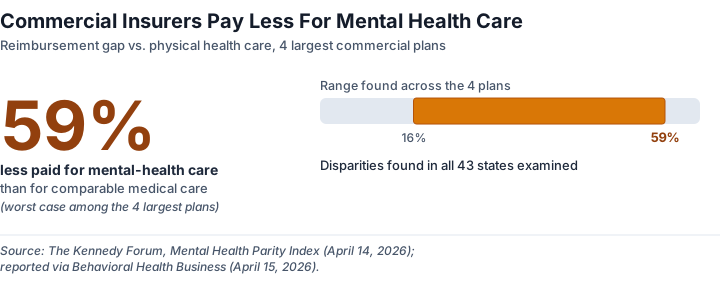
Here’s why that one decision cascades into a closed door. When a plan pays a licensed therapist a fraction of what it pays a medical specialist for a comparable visit, a lot of therapists do the rational thing and stop taking the plan. The network thins. The directory still lists names, but the names are booked solid, or retired, or no longer in-network at all — the “ghost network” problem regulators keep finding when they call down the list themselves. The patient holding the card was told they had coverage. What they actually had was a phone number and a wait.
This is the mechanism behind a number that has held for years: people go out-of-network for behavioral health far more often than for physical health — by one analysis of commercial claims, several times more often, with some specialties many times likelier to be out-of-network than their medical counterparts. That isn’t patients preferring to pay more. It’s patients discovering that “in-network” was a category with very little inside it.
Fines priced the paperwork, not the patient
Now the hard part, the part the celebratory coverage skips.
The fines are real and they matter, but look at how they were written. They were assessed per violation — per process failure, per inadequate network analysis, per claim handled under the wrong standard. They were not assessed per patient who couldn’t find a therapist, or per person who gave up after the fourth name on the list didn’t call back. The penalty attaches to the broken procedure, not to the human cost the procedure produced.
There’s a behavioral logic to that, and it isn’t all bad. Pricing the process failure is how you make compliance cheaper than violation, and regulators can only fine what they can document. You can audit a network-adequacy analysis far more cleanly than you can audit the diffuse misery of a thousand people who never got an appointment. So per-violation is enforceable in a way per-harm never could be. It’s a start.
But a start it remains, because the thing being deterred and the thing being suffered aren’t the same thing. A multimillion-dollar fine changes an insurer’s math on whether to fix a compliance document. It does nothing, on its own, to put a clinician in the chair across from the person who was turned away last March. And when the fine isn’t even collected for months — as in Georgia — the deterrent softens further. The signal still goes out: enforcement exists now, after years when it didn’t. That signal is worth something. It is just not the same as access.
What “covered” was supposed to mean
The gap this whole saga lives in is the oldest one in this field: the distance between covered and cared for. A card that says your mental health is covered, a directory that lists in-network therapists, a plan that passes the front-of-house test — all of it can be true while the appointment stays impossible to get. Covered was never the same as reachable. The 2026 fines are the first serious attempt to make insurers answer for that distance, and that’s genuine progress after a long silence.
It’s also why the people inside this system — the clinicians who left the panels, the patients who gave up at name number four — can’t wait for enforcement to finish closing the gap. Reducing the friction between a person in distress and the help they were promised is work that has to happen at the point of care, not just in a regulator’s filing cabinet. That’s the part of the problem we build for at Mental Wealth Solutions: tools like VibeCheck.luxury exist to put a clinician’s time and attention where the system keeps letting it leak out, so more of the care a plan paid for actually reaches the person who needs it. Enforcement can make the violation more expensive. Someone still has to make the care easier to reach.
For now, the honest read is this. The parity fines are real, which is new and which matters. They are also priced for the paperwork, collected slowly, and aimed at the procedure rather than the patient. A law finally has consequences. Whether it has reach is the thing the next two years will decide.
FAQ
What is mental health parity and why is it suddenly being enforced in 2026? Parity is the requirement that health plans cover mental-health and substance-use care no more restrictively than physical health care — federal law since 2008 under MHPAEA, but largely unenforced for most of that time. In 2026 states stepped in: Georgia issued nearly $25 million in fines in January, Pennsylvania fined Aetna $550,000 in March, and Connecticut found all five of its commercial insurers in violation in April.
How much did Georgia fine insurers for parity violations? Georgia’s Office of Commissioner of Insurance announced nearly $25 million on January 12, 2026, against at least 11 insurers, following market-conduct exams that documented thousands of violations. As of the spring, investigative reporting found none of the roughly $25 million had been collected — insurers can request hearings and file corrective-action plans, so an announced fine is not yet a paid one.
Why do commercial insurers underpay mental health clinicians? Because plan by plan they reimburse behavioral-health care below comparable medical care. The Kennedy Forum’s Mental Health Parity Index (April 14, 2026) found the four largest commercial plans pay 16% to 59% less for in-network mental-health and substance-use care than for physical health, with access gaps in all 43 states examined. Underpay therapists relative to surgeons in the same plan and many therapists leave the network — which is how a directory looks full but plays empty.
Will the 2026 parity fines actually help patients get care faster? Not right away. The fines prove enforcement exists, which is new and real. But they were written per process violation, not per patient harmed, and in Georgia the money hadn’t been collected months later. The fines raise the cost of ignoring the law; they don’t, by themselves, place a clinician in front of the person who was turned away. Closing that distance is the work that’s left.
Sources
Georgia Office of Commissioner of Insurance and Safety Fire, Commissioner King Issues Nearly $25 Million in Fines for Mental Health Parity (January 12, 2026) — nearly $25M against at least 11 insurers. Earlier exam wave: Commissioner King to Fine Insurers Over $20 Million for Mental Health Parity (August 15, 2025) — 6,000+ violations, $2,000–$5,000 per violation. “$0 collected” and per-insurer amounts: 11Alive Investigates, $25 million in fines, $0 collected (2026).
Pennsylvania Insurance Department, Shapiro Administration Protects Consumers, Fines Aetna for Violation of Mental Health Parity Laws (March 3, 2026) — $550,000 fine plus member repayment and claim reprocessing.
Connecticut Insurance Department 2026 NQTL Annual Report, as reported by Connecticut Public Radio (April 27, 2026) and The Connecticut Mirror (May 17, 2026) — all five commercial insurers found in violation; up to $625,000 per insurer per year; within-plan reimbursement disparities.
The Kennedy Forum, Mental Health Parity Index (launched April 14, 2026), and reporting via Behavioral Health Business (April 15, 2026) — 16%–59% lower payment for in-network mental-health/SUD care across the four largest commercial plans, access gaps in 43 states.
Out-of-network usage gap: RTI International commercial-claims analysis (2024), summarized by Behavioral Health Business — behavioral health several times likelier to be out-of-network than medical care.
Federal enforcement pause: U.S. Department of Labor, Statement Regarding Enforcement of the 2024 MHPAEA Final Rule (May 15, 2025) — non-enforcement of the 2024 final rule pending the ERISA Industry Committee litigation. Figures current as of June 2026.
Disclaimer
This article is for educational and informational purposes only. It does not constitute medical, clinical, legal, or therapeutic advice, and reading it does not create a therapist-client relationship with Matthew Sexton, LCSW or Mental Wealth Solutions, Inc.. Although the author is a licensed clinical social worker, the content in this article is not clinical assessment, diagnosis, or treatment.
Insurance regulations, parity enforcement actions, fine amounts, settlement terms, and the status of specific state and federal rules described here vary by jurisdiction and change over time, and may be revised, appealed, or superseded after this article is published. Nothing here is legal advice or a guarantee of how any particular plan, claim, appeal, or enforcement action will be handled. If a coverage decision affects you, confirm the current rules with your plan, your state insurance department, or qualified counsel rather than relying on this summary.
If you are in immediate emotional crisis, you can reach the 988 Suicide & Crisis Lifeline by calling or texting 988 (US). If you are experiencing domestic violence or are in physical danger, contact the National Domestic Violence Hotline at 1-800-799-7233 or visit thehotline.org. In a life-threatening emergency, call 911.
Frequently asked questions.
- What is mental health parity and why is it suddenly being enforced in 2026?
- Parity is the legal requirement that health plans cover mental health and substance-use care no more restrictively than they cover physical health care — it has been federal law since 2008 under MHPAEA. For most of that time it went largely unenforced. In 2026 that changed at the state level: Georgia issued nearly $25 million in parity fines in January 2026, Pennsylvania fined Aetna $550,000 in March 2026, and Connecticut's regulator found all five of its commercial insurers in violation in April 2026.
- How much did Georgia fine insurers for parity violations?
- Georgia's Office of Commissioner of Insurance announced nearly $25 million in fines on January 12, 2026, against at least 11 insurers. The penalties followed market-conduct exams that documented thousands of parity violations. As of the spring of 2026, investigative reporting found that none of the roughly $25 million had actually been collected — insurers can request hearings and submit corrective-action plans, so a fine announced is not the same as a fine paid.
- Why do commercial insurers underpay mental health clinicians?
- Because, in plan after plan, they reimburse behavioral-health care at a lower rate than comparable medical care. The Kennedy Forum's Mental Health Parity Index, released April 14, 2026, found the four largest commercial plans pay 16% to 59% less for in-network mental health and substance-use care than for physical health care, with access gaps in all 43 states examined. When a plan pays a licensed therapist a fraction of what it pays a surgeon, many therapists stop taking that plan — which is how a network looks full on paper and empty when you call.
- Will the 2026 parity fines actually help patients get care faster?
- Not immediately. The fines are a signal that enforcement exists, which is new and real. But the penalties were written per process violation, not per patient harmed, and at least in Georgia the money had not been collected months later. The fines change the cost of ignoring the law; they do not, by themselves, put a clinician in front of the person who was turned away. That gap is the work that is left.
If you're the therapist here.
Your clients get 4 sessions a month. The other 26 days they're on their own. VibeCheck.luxury is the between-session companion that carries those days back to you — clients check in daily, and you walk in already knowing what kind of week it was. Built by Matthew Sexton, LCSW, NATC.