
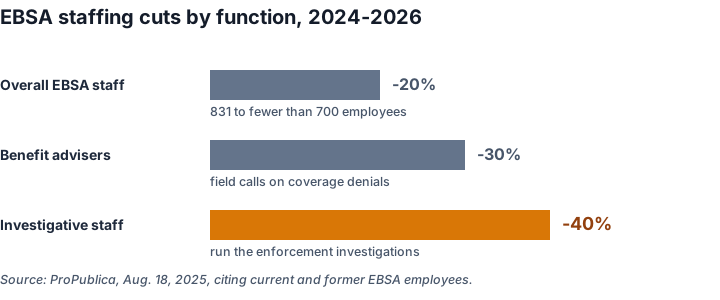
The federal agency responsible for enforcing mental health parity in most employer health plans — the Employee Benefits Security Administration, or EBSA — is heading into 2026 with roughly 136 million workers, retirees, and their families under its watch and fewer investigators to watch anything. Its workforce has dropped from 831 employees in 2024 to fewer than 700 in 2026, a roughly 20 percent reduction. The benefit advisers who field calls from people fighting coverage denials are down about 30 percent. The investigative staff that runs the actual probes is down nearly 40 percent, according to current and former employees who spoke to ProPublica.
At the same time, the Trump administration told a federal court it would not defend or enforce the strongest mental health parity standard ever written into federal regulation. That standard — the 2024 MHPAEA final rule — was the one requiring commercial health plans to actually measure whether they were treating mental health and substance use care differently from medical care, and to fix it if they were.
The rule is now in legal limbo. The enforcement staff is hollowed out. The people who depend on both are left with what they’ve always had: a law that says one thing and a system built to say it doesn’t apply to them.
Quick answer: The Trump administration suspended enforcement of the 2024 MHPAEA rule in May 2025 after siding with an industry lawsuit, and simultaneously oversaw a roughly 20 percent staffing cut at the agency that enforces parity for most employer-sponsored health plans. What reverts is not the law — MHPAEA still exists — but the data requirements and corrective-action standards that would have forced commercial insurers to prove they were following it.
What the 2024 mental health parity rule actually required
The Mental Health Parity and Addiction Equity Act has been federal law since 2008. It says commercial health plans cannot put more restrictive limits on mental health and substance use disorder benefits than on medical and surgical benefits in the same plan. The theory is clean. The practice has always been a different story.
The problem is something called a non-quantitative treatment limitation, or NQTL. These are the non-numerical restrictions that shape whether you can actually get care: prior authorization requirements, step-therapy protocols, network adequacy standards, criteria for what counts as “medically necessary.” A plan can have the same dollar limits for mental health and physical health and still make mental health four times harder to access through these design choices. MHPAEA requires that the rules governing mental health NQTLs be no more restrictive than the rules governing the same kind of medical care in the same plan. But writing that requirement into regulation and enforcing it are different acts.
The 2024 final rule, issued in September 2024 by the Departments of Labor, HHS, and Treasury, was the most concrete attempt yet to enforce the principle. It required health plans to:
- Collect actual outcomes data on how people access mental health and substance use care compared to medical care within the same plan
- Conduct a comparative analysis of their non-quantitative treatment limitations and document it rigorously
- Take corrective action when the data showed “material differences in access”
- Have a named plan fiduciary certify that a qualified party performed and documented the analysis
That last requirement was significant. It put a named person on the hook for whether the analysis was real, not just filed.
The rule was set to apply to plan years beginning on or after January 1, 2025, with remaining provisions phasing in January 1, 2026.
The lawsuit, the abeyance, and what the administration told the court
On January 17, 2025 — three days before Inauguration Day — the ERISA Industry Committee (ERIC), a lobbying group representing large employers, filed suit in the U.S. District Court for the District of Columbia. The case is ERISA Industry Committee v. Department of Health and Human Services et al. ERIC’s complaint challenged the 2024 rule under the Administrative Procedure Act, arguing the new requirements overstepped the statute.
On May 9, 2025, the Tri-Agencies — the Departments of Labor, HHS, and Treasury — filed a motion for abeyance in the lawsuit. On May 15, 2025, they issued a formal statement of non-enforcement. Then on March 30, 2026, the departments told the court they would not even defend the rule.
The administration’s position was explicit: it would not pursue enforcement actions against plans that failed to comply with any requirements that were new in the 2024 rule, as compared to the 2013 baseline, for the duration of the litigation plus an additional 18 months. The agencies also said they were considering “whether to issue a notice of proposed rulemaking rescinding or modifying the Final Rule.”
What this means in practice: the 2024 rule’s data requirements, outcomes analysis, corrective-action obligations, and fiduciary certification are all suspended. What remains technically in force is the 2013 rule’s version of comparative analysis standards — weaker, less prescriptive, and being enforced by an agency with far fewer resources than when those standards were written.
Some states moved quickly. Washington state enacted legislation requiring insurers to comply with the 2024 federal rule regardless of federal enforcement status. Arizona had begun updating its own parity standards to match the 2024 rule, then paused when the federal case went into abeyance. The Commonwealth Fund reported in 2026 that the federal retreat was actively discouraging state-level enforcement efforts, creating a patchwork where access to parity protections increasingly depends on geography.
The enforcement numbers, and what they’ve always looked like
I want to be direct about what enforcement of parity has actually looked like, because the rollback narrative only makes sense against the baseline.
EBSA has never had close to enough resources for this job. Before the recent cuts, the agency had roughly one investigator for every 13,900 health, retirement, and other benefit plans it regulated. The Department of Labor’s own Inspector General issued a report in February 2025 finding that EBSA’s ability to enforce NQTL parity requirements was already “diminished” — and that this increased the risk of plan participants paying out-of-pocket for mental health treatment that should have been covered, or not receiving it at all. The OIG also noted EBSA had requested additional enforcement authority in congressional budget submissions going back to 2016 and had never received it.
That was before the recent staffing reductions. The supplemental enforcement funding Congress had provided under the Consolidated Appropriations Act expired in December 2024 and was not renewed. Budget proposals for fiscal year 2027 called for cutting EBSA’s funding by another $10 million from 2026 enacted levels, which would bring total staffing to approximately 640 full-time positions.
ProPublica’s August 2025 investigation put a face on what these numbers mean. A Massachusetts family whose teenage daughter developed self-harm behaviors and severe anorexia during the pandemic: their insurer denied coverage for residential treatment. The family accumulated more than $80,000 in bills. It took a long battle and intervention from an EBSA investigator before the insurer agreed to repay most of the cost. That outcome depended on the family knowing to contact EBSA, finding a functioning pathway to file a complaint, and landing on an investigator with capacity to take the case. All three of those variables are now harder to rely on.
What commercial insurers still get to do while this plays out
The 2013 baseline that enforcement reverts to is not nothing. Plans are still required to perform a comparative analysis of their non-quantitative treatment limitations. But the 2013 standard does not require them to collect outcomes data or fix anything specific if the data shows disparities. It requires the analysis to exist; it does not prescribe what that analysis must show or what must follow from it.
I have written before about how commercial insurers have used prior authorization, network design, and medical-necessity criteria to limit behavioral health access while technically complying with parity rules on paper. The 2024 rule was specifically designed to close that gap — to require data that would make the paper-versus-reality divergence visible and legally actionable. Without that requirement, the gap stays invisible in the way it has always been most useful to the plans that benefit from it.
The Kennedy Forum’s Mental Health Parity Index, published in April 2026, found that the four largest commercial insurers — Aetna, BlueCross BlueShield, Cigna, and UnitedHealthcare — pay clinicians less for outpatient mental health care than for physical health care in every state examined, inside the same plans. That pay gap drives clinicians out of network. Clinicians out of network mean patients pay more or go without. That is the structural condition the 2024 rule was trying to reach, and the one that now has no federal mechanism forcing it into the light.
What this means for the people those plans cover
If you’re covered under an employer-sponsored health plan, your legal right to parity hasn’t changed. MHPAEA is still federal law. What has changed is whether anyone with the authority and resources to enforce that right is looking at your plan.
The American Psychological Association called the enforcement suspension a significant setback, describing it as the fruit of years of advocacy by the behavioral health community. The CEO Alliance on Mental Health — representing 15 major mental health organizations — wrote to Congress outlining the consequences of a weakened enforcement framework. None of that changes the math at EBSA.
I work with clinicians every day who are watching what happens when structural protections for their patients weaken. We already function in a system where being covered for mental health care and being able to access it are two entirely different things. The 2024 rule was, in my reading of it, the most serious attempt in 17 years to close that distance. Its suspension doesn’t change the law. It changes who has to prove it’s being followed — and right now, that question has no clear answer.
If you are in a plan that denies your mental health coverage and you believe that denial violates parity, you still have the right to file a complaint with EBSA. That process still exists. It will just take longer, with a smaller team, working under rules that require less from the insurers they’re investigating.
Being insured and being able to get an appointment are two different things. This year, the gap between them got a little more room to grow.
FAQ
What is the mental health parity rollback in 2026? In May 2025, the Trump administration announced it would not enforce the 2024 MHPAEA final rule — the strongest federal standard ever written for mental health coverage parity. The rule required health plans to collect and analyze outcomes data on how they restrict mental health and substance use care, and to fix material access gaps. The administration sided with an industry lawsuit and placed the rule in abeyance, reverting enforcement to the weaker 2013 standards while EBSA’s enforcement staff was cut by roughly 20 percent.
What did the 2024 MHPAEA rule actually require insurers to do? The 2024 rule required health plans to collect outcomes data and conduct a documented non-quantitative treatment limitation (NQTL) comparative analysis — comparing how they restrict mental health and substance use disorder benefits against how they restrict medical and surgical benefits in the same plan. If the analysis showed material differences in access, the plan had to take corrective action. A named fiduciary had to certify the analysis was done properly. The Trump administration suspended all of these new requirements while allowing the weaker 2013 baseline to remain technically in force.
Who enforces mental health parity rules, and what happened to that agency? The Employee Benefits Security Administration (EBSA), a Department of Labor agency, is the primary federal enforcer of MHPAEA for employer-sponsored plans. EBSA’s workforce dropped from 831 employees in 2024 to fewer than 700 by 2026, roughly a 20 percent cut. Within that, benefit advisers who help people challenging coverage denials are down about 30 percent, and investigative staff has shrunk by nearly 40 percent, according to current and former employees cited by ProPublica in August 2025.
Does mental health parity law still exist? What is still in effect? Yes, MHPAEA as a statute remains the law. The core principle — that mental health and substance use disorder benefits cannot be more restrictive than medical and surgical benefits — is still in force. What changed is that the stronger 2024 requirements around data collection, outcomes analysis, and fiduciary certification are not being enforced. Plans must still comply with the 2013 rule’s baseline comparative analysis standards, but those standards are less prescriptive and the agency enforcing them has far fewer resources than two years ago.
Sources
-
U.S. Department of Labor, EBSA. Statement regarding enforcement of the final rule on requirements related to the Mental Health Parity and Addiction Equity Act. Issued May 15, 2025.
-
ProPublica. Trump’s Rollback of Rules for Mental Health Coverage Could Lead More Americans to Go Without Care. August 18, 2025.
-
U.S. Department of Labor, Office of Inspector General. EBSA Faced Challenges Enforcing Compliance with Mental Health Parity Laws and Requirements. Report No. 09-25-001-12-001. February 19, 2025.
-
ERISA Industry Committee. ERIC Sues to Stop Recent Biden Administration Mental Health Regulations. January 17, 2025.
-
Commonwealth Fund / Georgetown University Center on Health Insurance Reforms. Behavioral Health Parity Takes Step Backward Under Trump Administration. 2026.
-
The Kennedy Forum. Mental Health Parity Index, as reported by AHA News (April 16, 2026).
-
American Psychological Association. Departments announce nonenforcement of 2024 Mental Health Parity Rule. May 2025.
Disclaimer
This article is for educational and informational purposes only. It does not constitute medical, clinical, legal, or therapeutic advice, and reading it does not create a therapist-client relationship with Matthew Sexton, LCSW or Mental Wealth Solutions, Inc.. Although the author is a licensed clinical social worker, the content in this article is not clinical assessment, diagnosis, or treatment.
MHPAEA enforcement, litigation timelines, and regulatory requirements vary by plan, state, and over time and may change after publication. The legal status of the 2024 MHPAEA final rule, including the ongoing litigation in ERISA Industry Committee v. Department of Health and Human Services et al., may evolve significantly after this article’s publication date. Nothing here is legal or benefits counsel; consult your attorney, benefits administrator, or compliance team for plan-specific guidance.
If you are in immediate emotional crisis, you can reach the 988 Suicide & Crisis Lifeline by calling or texting 988 (US). If you are experiencing domestic violence or are in physical danger, contact the National Domestic Violence Hotline at 1-800-799-7233 or visit thehotline.org. In a life-threatening emergency, call 911.
Frequently asked questions.
- What is the mental health parity rollback in 2026?
- In May 2025, the Trump administration announced it would not enforce the 2024 MHPAEA final rule — the strongest federal standard ever written for mental health coverage parity. The rule had required health plans to collect and analyze data on how they restrict mental health and substance use care compared to medical care, and to take corrective action when they found gaps. The administration sided with an industry lawsuit and placed the rule in abeyance, reverting enforcement to the looser 2013 standards while cutting EBSA's enforcement staff by roughly 20 percent.
- What did the 2024 MHPAEA rule actually require insurers to do?
- The 2024 rule required health plans to collect outcomes data on how they restrict mental health and substance use disorder benefits compared to medical and surgical benefits — a process called a non-quantitative treatment limitation (NQTL) comparative analysis. If the data showed material differences in access, the plan had to explain what it was doing to close those gaps. It also required a named plan fiduciary to certify the analysis was done correctly. The Trump administration suspended all of these new requirements while allowing the weaker 2013 baseline to remain technically in force.
- Who enforces mental health parity rules, and what happened to that agency?
- The Employee Benefits Security Administration (EBSA), a Department of Labor agency, is the primary federal enforcer of MHPAEA for employer-sponsored health plans. EBSA's workforce dropped from 831 employees in 2024 to fewer than 700 by 2026 — a roughly 20 percent cut. Inside that, benefit advisers who field calls from people challenging coverage denials are down about 30 percent, and investigative staff has shrunk by nearly 40 percent, according to current and former employees cited by ProPublica in August 2025.
- Does mental health parity law still exist? What is still in effect?
- Yes, MHPAEA as a statute is still the law. The core principle — that mental health and substance use disorder benefits cannot be more restrictive than medical and surgical benefits in the same plan — remains in force. What changed is that the stronger 2024 requirements around data collection, outcomes analysis, and fiduciary certification are not being enforced. Plans must still comply with the 2013 rule's baseline NQTL comparative analysis standards, but those standards are weaker and the agency enforcing them has far fewer resources than it did two years ago.
If you're the therapist here.
Your clients get 4 sessions a month. The other 26 days they're on their own. VibeCheck.luxury is the between-session companion that carries those days back to you — clients check in daily, and you walk in already knowing what kind of week it was. Built by Matthew Sexton, LCSW, NATC.