
If you have ever waited weeks to find out whether your insurance would cover a treatment your therapist already said you needed, you ran into prior authorization. It is the step where the insurance company gets to decide, after the clinician has decided, whether care actually happens.
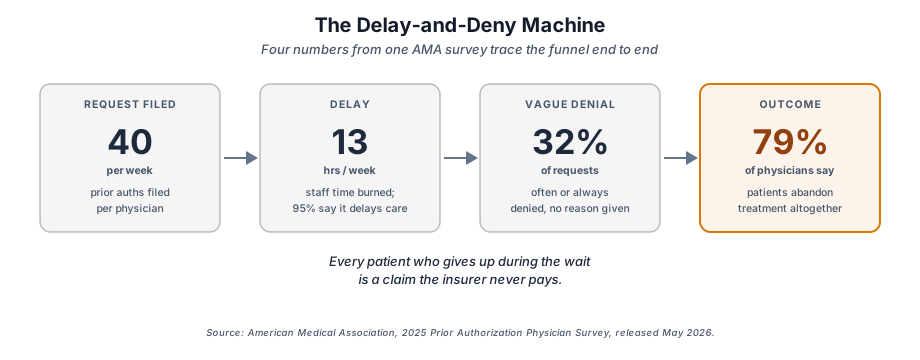
In the American Medical Association’s 2025 survey of physicians, released in May 2026, doctors reported filling out an average of 40 prior authorizations a week, and 79% said the process can push patients to abandon recommended treatment altogether (AMA, May 2026). That second number is the one I want you to sit with. Almost four in five doctors have watched a patient walk away from care they needed, not because the care was wrong, but because the paperwork wore them down first.
I have spent enough years inside this system to stop reading that as an accident. In mental health especially, prior authorization isn’t a clumsy safeguard that occasionally fails patients. It works exactly the way it is built to work. Here is how the machine runs, and why the gap between “covered” and “cared for” is the point, not the bug.
The delay-and-deny machine of prior authorization
Prior authorization is sold as a quality check: the insurer confirms a treatment is medically necessary before agreeing to pay. Put that way, it sounds reasonable. Then you look at what it actually does to a week.
That same AMA survey found prior authorization eats an average of 13 hours of physician and staff time every week, and two in five practices now employ someone whose entire job is processing these requests (AMA, May 2026). That is a person paid to talk to insurance companies instead of patients. In a solo or small therapy practice, there is no such person. There is just the clinician, after hours, on hold.
And the delay does real harm. 95% of physicians said prior authorization delays access to necessary care, and 94% said it adds to burnout (AMA, May 2026). For someone in a mental health crisis, “your treatment is under review” is not a neutral status. A week of waiting to start therapy or get a medication approved is a week where things can get worse. The delay is not incidental to the harm. The delay is part of how the cost gets shifted off the insurer’s books.
Because here is the quiet math: every patient who gives up during the wait is a claim the insurer never pays. The 79% who abandon treatment aren’t losing because their care was unjustified. They’re losing because the process outlasted them. That is not a system failing to deliver care. It is a system succeeding at not paying for it.
The vague no
The second tool is the denial that tells you nothing.
Anyone who has tried to appeal an insurance decision knows the form letter: does not meet medical necessity criteria. No specifics. No citation to which criterion, or why this patient’s documented need falls short. A vague no is not lazy. It is engineered. A denial you can’t understand is a denial you can’t easily fight, and a denial you can’t easily fight is one a tired person stops fighting.
In the AMA survey, nearly one in three physicians (32%) said their requests are often or always denied (AMA, May 2026). Stack that on the time cost and you can see the funnel: make the request slow, make the denial common, make the reason unclear, and a predictable share of people fall out at each step. The ones who fall out were never told no to their faces. They were just outlasted.
This lands harder in mental health than almost anywhere else, because the person being asked to mount a multi-week appeal is, by definition, someone already struggling. The system asks the most administrative effort from the people with the least capacity to give it, at the exact moment they have the least. That is not a design flaw. For the people who profit from the gap, that is the design.
Same plan, different math
Now the part that explains why so many good therapists don’t take insurance at all.
Within a single commercial health plan, insurers pay mental health clinicians less than they pay medical and surgical providers for comparable work. An RTI International analysis of commercial claims covering more than 22 million people, published in April 2024, found that in-network reimbursement for medical and surgical office visits ran about 22% higher on average than for behavioral health visits (RTI International, April 2024). Same insurer, same plan, and the rate moves depending on whether the provider is treating a body or a mind.
That gap has a consequence you can watch in the data. When reimbursement is low enough, clinicians can’t afford to stay in network, so they leave it. The same RTI analysis found patients went out of network 3.5 times more often for behavioral health than for medical or surgical care, 8.9 times more often to see a psychiatrist, and 10.6 times more often to see a psychologist (RTI International, April 2024). A directory full of in-network therapist names, most of whom can’t actually take you, is what an underpriced network looks like from the patient’s side. The card says you’re covered. The math says you’re on your own.
This is the violation behind the paperwork. The Mental Health Parity and Addiction Equity Act has required since 2008 that insurers cover mental health no more restrictively than physical health. Underpay the providers and bury the approvals in process, and you produce a plan that is parity on paper and a maze in practice.
When the system gets caught, slowly
The encouraging part is that regulators have started naming this out loud. The discouraging part is how slowly consequences move.
In May 2026, Connecticut fined all five of its major commercial insurers for mental-health parity violations (CT Mirror, May 2026). The detail underneath the fines is the one to hold onto: regulators documented insurers paying master’s-level behavioral-health clinicians a fraction of what they paid medical and surgical providers in the same plans. Not a market accident. A pattern, written into the rate sheets.
It isn’t one state. Pennsylvania fined Aetna $550,000 in March 2026 over parity violations tied to autism therapy and tighter review of opioid-use-disorder treatment (PA Insurance Department, March 2026). Georgia issued roughly $25 million in parity fines against 11 insurers in January 2026 — and as of this spring had collected $0, with every insurer appealing (11Alive Investigates, January 2026).
Read those together and you have the whole machine in miniature. The law exists. The violations are documented. The fines get issued. And the money sits, because for the insurer the appeal is cheaper than the care. The system isn’t broken. It is working precisely as designed, for someone other than the patient.
”Covered” was never the same as “cared for”
This is the deeper thing, and it is the reason I do the work I do.
The mental health system is very good at producing the appearance of access. A number on your insurance card. A directory full of names. A “your request is under review.” Each one lets someone say the system is working. None of them is the same as a person actually getting care.
The gap between those two things — covered and cared for — is not an accident the industry is racing to fix. Every prior authorization that delays a treatment, every denial vague enough to make someone quit, every behavioral-health rate set just low enough to thin the network, is a place where money stays with the insurer instead of going to care. For the company, the gap is the product.
I’m not telling you this to make you cynical. I’m telling you because naming how the system behaves is the first honest step toward not being quietly ground down by it. If you’re a person trying to get care, a vague denial is not the final word: you can ask in writing for the specific reason, and you can appeal. Knowing the process is built to outlast you is what helps you outlast it instead.
If you’re a clinician reading this, you already know. You’ve been on the hold line at 7 p.m. The reimbursement math is real and the paperwork is real, and none of it reflects the care you’re capable of giving once the insurance company is out of the room. The work — ours, and increasingly the work we’re building tools to do — is to close the distance between covered and cared for, because nobody profiting from that distance is going to close it for us.
FAQ
Why do insurance companies require prior authorization for mental health care? Officially, to confirm a treatment is medically necessary. In practice, prior authorization layers on delay and paperwork that causes a meaningful share of patients to give up before care begins. In the AMA’s 2025 physician survey, released May 2026, 79% of doctors said prior authorization can lead patients to abandon recommended treatment, and 95% said it delays necessary care. Every abandoned course of treatment is a claim the insurer never pays.
Do insurers pay mental health providers less than medical providers in the same plan? Yes. An RTI International analysis of commercial claims (April 2024) found in-network reimbursement for medical and surgical office visits averaged about 22% higher than for behavioral health visits. That gap thins behavioral-health networks, which is why patients went out of network 3.5 times more often for behavioral health than for medical care.
Is a vague denial something I can fight? Yes. You can request the specific reason for the denial in writing and file an appeal. A denial is designed to be discouraging, not final — many are overturned when challenged, and behavioral-health denials carry extra grounds for appeal under federal parity law if the insurer applied stricter criteria than it would to comparable medical care.
Are insurers actually being penalized for mental health parity violations? Increasingly, yes, but slowly. In 2026, Connecticut fined all five of its major commercial insurers, Pennsylvania fined Aetna $550,000, and Georgia issued roughly $25 million in fines against 11 insurers. As of this spring, Georgia had collected $0 while insurers appealed. The fines are real; collection lags.
Sources
- American Medical Association — 2025 Prior Authorization Physician Survey (reform pledge falls short with physicians), released May 13, 2026. ama-assn.org
- RTI International — Behavioral Health Parity: Pervasive Disparities in Access to In-Network Care Continue, April 2024. rti.org
- The Connecticut Mirror — Connecticut fined insurers for mental health parity violations, May 17, 2026. ctmirror.org
- Pennsylvania Insurance Department — Shapiro Administration fines Aetna for mental health parity violations, March 3, 2026. pa.gov
- 11Alive Investigates — $25 million in fines, $0 collected: Georgia mental health parity enforcement, January 2026. 11alive.com
Figures current as of June 2026.
Disclaimer
This article is for educational and informational purposes only. It does not constitute medical, clinical, legal, or therapeutic advice, and reading it does not create a therapist-client relationship with Matthew Sexton, LCSW or Mental Wealth Solutions, Inc.. Although the author is a licensed clinical social worker, the content in this article is not clinical assessment, diagnosis, or treatment.
Prior-authorization requirements, mental-health-parity enforcement, and insurer reimbursement and denial practices vary by health plan, state, and over time, and may change after this article is published. Nothing here is a substitute for confirming a specific requirement or appealing a specific decision with your insurer, your benefits administrator, or qualified counsel. Plans and circumstances differ, and what is described here may not match your situation.
If you are in immediate emotional crisis, you can reach the 988 Suicide & Crisis Lifeline by calling or texting 988 (US). If you are experiencing domestic violence or are in physical danger, contact the National Domestic Violence Hotline at 1-800-799-7233 or visit thehotline.org. In a life-threatening emergency, call 911.
Frequently asked questions.
- Why do insurance companies require prior authorization for mental health care?
- Officially, to confirm a treatment is medically necessary. In practice, prior authorization adds delay and paperwork that causes some patients to give up before care starts. In the AMA's 2025 survey of physicians, released May 2026, 79% said prior authorization can lead patients to abandon recommended treatment, and 95% said it delays necessary care. Every abandoned course of treatment is money the insurer keeps.
- Do insurers pay mental health providers less than medical providers?
- Yes, and within the same plan. An RTI International analysis of commercial claims (April 2024) found in-network reimbursement for medical and surgical office visits ran about 22% higher than for behavioral health visits. That gap pushes therapists out of network, so patients went out of network 3.5 times more often for behavioral health than for medical care.
- Are insurers being penalized for mental health parity violations?
- Increasingly, but slowly. In 2026, Connecticut fined all five of its major commercial insurers, Pennsylvania fined Aetna $550,000, and Georgia issued roughly $25 million in fines. As of this spring, Georgia had collected $0 while insurers appealed. The fines are real. Collection lags.
Want to discuss this for your program?
Book a 30-min conversation. We'll walk you through deployment, the BAA, and what your rollout looks like in production.
Book a 30-min conversation