
Someone you love is struggling, and the kind, obvious thing to say is: just go to therapy. Maybe you’ve said it. Maybe someone has said it to you.
I say a version of it myself. I believe in the work. But I’ve spent enough years inside this system to know that the advice quietly assumes something that, for most people, isn’t true: that there’s a door, and it opens, and a person on the other side is ready to help. As of March 2026, 137 million Americans, about 40% of the country, live in a place the federal government has formally designated a Mental Health Professional Shortage Area. “Just go to therapy” sends those people toward a door that, for a lot of them, isn’t there.
Quick answer: Therapy is hard to get in 2026 because the access system itself is the obstacle. A national workforce shortage, reimbursement rates that push clinicians off insurance panels, multi-week waitlists, and prior-authorization friction all sit between “I’ll go to therapy” and “I’m in the room.” Naming that architecture honestly is the first step toward not being quietly ground down by it.
The mental health workforce shortage is real, and it’s most of the country
Start with the simplest barrier: there aren’t enough clinicians, and they aren’t where the people are.
The Health Resources and Services Administration (HRSA) tracks this directly. As of its March 2026 data, those 137 million people in shortage areas have only about 26.4% of their mental health workforce need met, roughly a quarter. HRSA estimates it would take more than 6,200 additional practitioners just to lift the shortage designations, and it’s careful to call that a conservative floor, not the real number needed to make care feel available.
It’s not improving on its own. HRSA projects demand for behavioral health services will rise 49% through 2033, while the supply of providers grows only 11% over the same stretch. Demand pulling away from supply, year after year. So when someone in a rural county or an overloaded city neighborhood is told to “just go,” the honest answer is often that the nearest available clinician is booked, an hour away, or doesn’t exist yet.
This is the part that gets left out of the advice. We talk about therapy as a personal choice, like deciding to start running. But you can’t choose a provider who isn’t there.
Even when there’s a clinician, there may not be one who takes your insurance
Say you find a therapist nearby. The next wall is money, and it works differently than people assume.
The reimbursement math stops working, so therapists leave insurance behind. Greed has little to do with it. In the American Psychological Association’s 2024 Practitioner Pulse Survey (December 2024), 34% of practicing psychologists were not in-network with any insurance at all. The reason they named most often: low reimbursement rates (82%), followed by administrative hassle and unreliable payment. Nearly half of those who’d gone cash-pay had been on insurance panels before and walked away.
Psychiatry tells the same story further along. National data has shown psychiatrist acceptance of private insurance falling to around 55%, meaning a patient looking for a prescriber faces close to a coin-flip on whether a given doctor will even bill their plan. The downstream effect is exactly what you’d predict: the APA found patients are more than ten times as likely to go out-of-network for mental health care as for other specialty medical care.
So “covered” and “able to find a covered therapist” turn out to be very different things. You can be fully insured and still face a directory where the names who’d take your card are full, gone, or never existed.
Why clinicians keep leaving the insurance panels
It’s worth sitting with why the reimbursement math fails, because this is where the system shows its hand.
In May 2026, Connecticut’s regulators released findings after fining all five of its major commercial insurers for mental health parity violations. Parity, on the books since 2008, is the law requiring insurers to cover mental health the way they cover physical health. The numbers underneath the fines explain the whole exodus, and the cleanest way to see them is to compare what a single insurer pays its own providers. Regulators found Anthem reimbursing master’s-level behavioral health clinicians at a steep discount to what it paid medical and surgical providers in the same plan, a roughly 40-point gap. Cigna paid licensed clinical social workers less than half what it paid orthopedic surgeons. Same insurer, same plan, same network.
Read those side by side and the pattern is plain: the rate changed depending on whether a clinician was treating a body or a mind. That’s the parity violation in one line: a commercial insurer paying for the mind at a fraction of what it pays for the body, inside the same coverage a patient bought. A therapist running a small practice can’t absorb getting paid half of what a surgeon gets for the same hour of in-network work. So they go cash-pay, another name drops off the insurance panel, and the directory thins a little more. The shortage and the cost barrier aren’t separate problems. The pay gap feeds the access gap.
Then comes the waiting
Suppose you clear all of that: a clinician exists nearby who takes your insurance. You still have to get on the calendar.
The National Council for Mental Wellbeing has reported an average wait of about six weeks for behavioral health services. Among psychologists who keep waitlists, the APA found average waits of three months or longer, with many reporting their lists had only grown. For someone who finally worked up the nerve to ask for help, a six-week or three-month wait is frequently where the attempt ends. The distress eases or hardens, the motivation fades, and the appointment that was eight weeks out never happens.
And for the insured patient who does hang on, there can be one more gate: prior authorization. On a commercial or employer-sponsored plan (the coverage most working people actually have), your insurer can still require its own sign-off before treatment, on an open-ended timeline the insurer controls. The decision to start care belongs to you and your clinician; the permission slip belongs to the company holding the checkbook, and it isn’t in a hurry to hand it over.
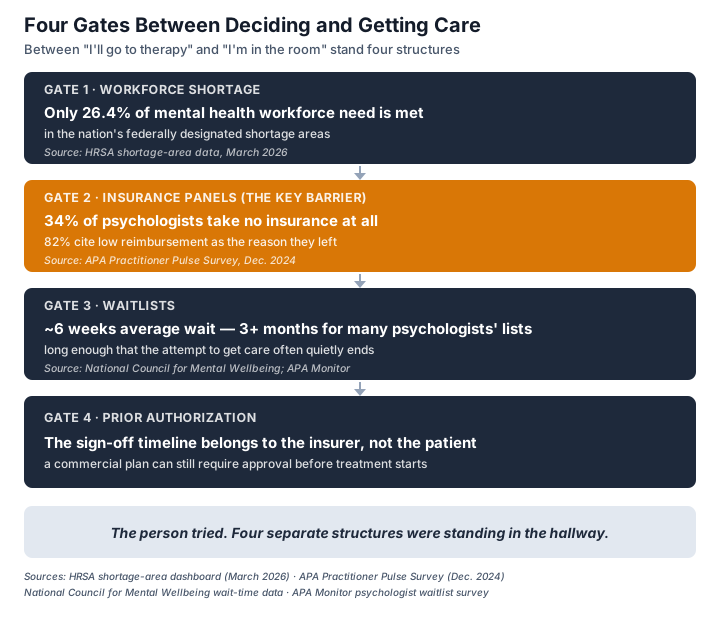
Workforce shortage. Reimbursement that drives clinicians off panels. Waitlists. A commercial insurer’s prior-auth sign-off on top. Stack those, and you see why “just go to therapy” so often goes nowhere. The person tried. Four separate structures were standing in the hallway.
This is architecture, and architecture can be rebuilt
I’d rather name this than soften it.
When we treat the access gap as a personal failing — they didn’t prioritize it, they gave up too easily — we hand the insurance companies a free pass and hand the patient a second weight to carry. The demand for care is real and documented. The barriers are structural. A shortage you can count, a within-plan pay gap a state regulator put in writing and fined commercial insurers over, a waitlist measured in months, a prior-auth sign-off the insurer controls. That is a design problem, and design problems have design solutions.
That’s the genuinely hopeful part. A willpower problem is a dead end; there’s nothing to fix but a person. An architecture problem is something you can rebuild. You can train and place clinicians where the shortage is. You can enforce parity until the reimbursement math stops punishing therapists for staying in-network. You can collapse the friction between deciding to get help and getting it. None of it is easy, but all of it is buildable — which is more than you can say for “try harder.”
So if you’ve been told to just go to therapy and run into a wall, the wall isn’t a verdict on you. It’s a map of where the work is. Making talking about mental health normal has to come with making getting mental health care possible — and the first honest move is to stop pretending the door already opens, and start naming exactly where it’s stuck. It’s the least cynical read available, because it points at something we can actually change.
Frequently asked questions
Why is therapy so hard to get in 2026? Because the access architecture wasn’t built to let most people through. As of March 2026, 137 million Americans, roughly 40% of the country, live in a Mental Health Professional Shortage Area, where only about 26.4% of workforce need is met. Add clinicians who’ve left insurance panels over low pay, six-week-plus waitlists, and prior-auth delays, and “just go” collides with a system stacked against entry.
How many therapists don’t take insurance? In the APA’s 2024 Practitioner Pulse Survey (December 2024), 34% of practicing psychologists were not in-network with any insurance; the top reason was low reimbursement (82%). Psychiatrist acceptance of private insurance had already fallen to roughly 55% nationally. When the reimbursement math fails, clinicians go cash-pay, and insured patients get pushed out-of-network.
How long is the average wait for a therapy appointment? The National Council for Mental Wellbeing has reported an average of about six weeks for behavioral health services, and the APA found average waits of three months or longer among psychologists who keep waitlists. For someone in distress, a wait that long is often where the attempt to get care quietly ends.
Is the mental health access problem the patient’s fault? No. The demand is real and well-documented; the barriers (workforce shortage, reimbursement that drives clinicians off panels, waitlists, prior-auth friction) are structural. Treating it as a willpower problem misreads the system and adds weight to the person already struggling. Naming the architecture is how you start fixing it.
Sources
Workforce shortage figures (137 million in shortage areas; ~40% of the population; ~6,200 additional practitioners needed; 26.4% of need met; demand +49%/supply +11% through 2033), HRSA data current as of March 31, 2026: HRSA Health Workforce Shortage Areas dashboard and KFF Mental Health Care HPSAs.
Insurance acceptance and reimbursement: APA, “How insurance woes are impacting mental health care”, citing the 2024 Practitioner Pulse Survey (December 17, 2024) — 34% of psychologists out-of-network, 82% citing low reimbursement, patients 10x more likely to go out-of-network. Psychiatrist private-insurance acceptance (~55%): JAMA Psychiatry / Acceptance of insurance by psychiatrists.
Within-plan parity reimbursement gap (commercial insurers paying master’s-level behavioral health clinicians a fraction of what they paid medical/surgical providers in the same plan — Anthem’s roughly 40-point behavioral-vs-med/surg gap; Cigna paying LCSWs less than half what it paid orthopedic surgeons; all five Connecticut commercial insurers fined, May 2026): CT Mirror (May 17, 2026) and CT Office of the State Comptroller statement.
Wait times (~6 weeks average; 3+ months for waitlisted psychologists): APA Monitor, mental health services wait times and NPR Health Shots, psychologist waitlist survey.
Figures current as of July 2026.
Disclaimer
This article is for educational and informational purposes only. It does not constitute medical, clinical, legal, or therapeutic advice, and reading it does not create a therapist-client relationship with Matthew Sexton, LCSW or Mental Wealth Solutions, Inc. Although the author is a licensed clinical social worker, the content in this article is not clinical assessment, diagnosis, or treatment.
The patterns, concepts, and frameworks described here reflect published research and general clinical observations. Individual experiences vary, and what is described here may not match every reader’s situation. If you are working through the concerns described in this article, please consult a licensed mental health professional who can assess your specific circumstances.
If you are in immediate emotional crisis, you can reach the 988 Suicide & Crisis Lifeline by calling or texting 988 (US). If you are experiencing domestic violence or are in physical danger, contact the National Domestic Violence Hotline at 1-800-799-7233 or visit thehotline.org. In a life-threatening emergency, call 911.
If this named something you're living with —
You don't have to figure it out from articles. Matthew Sexton, LCSW, NATC sees adults in therapy at his separate private practice (telehealth · NY · ME · DE · FL). Or take this piece to your own therapist — it's written to be shared.
Visit the practice