
In 2026, regulators in three different states fined commercial health insurers for the same thing: paying less for the mind than for the body.
The clearest evidence came out of Connecticut, where the insurance department moved to fine all five of the state’s largest commercial insurers for parity violations. Among the findings: insurers reimbursing master’s-level mental-health clinicians at a fraction of what they paid medical and surgical providers — in the same plans, for patients holding the same cards. The rate changed depending on whether the visit was for a body or a mind.
Quick answer: The mental health system isn’t broken in the way a flat tire is broken. It works — reliably, predictably, profitably — for the commercial insurers that run it. The thing most of us experience as failure (a denial, a six-week wait, a directory of names who aren’t taking patients) isn’t the system breaking down. It’s the system doing exactly what its incentives reward. The gap between “your care is covered” and “you can actually get your care” is not a defect Aetna or Cigna or UnitedHealthcare is hurrying to repair. For a shareholder-run insurer, that gap is the product.
I’ve spent enough years inside this system to say that without flinching. I don’t say it to make you cynical. I say it because naming how the machine actually behaves is the first honest step toward not being quietly ground down by it — and the first step toward building something that behaves differently.
”Covered” was never the same as “cared for”
Here’s the sleight of hand the whole industry runs on.
Commercial insurers are extraordinarily good at producing the appearance of access. A benefit on your insurance card. An EAP number in the employee handbook. A provider directory with hundreds of names. Every one of those lets a company point to a thing and say the coverage is working.
None of them is the same as a person sitting across from a clinician and getting better.
The distance between those two things has a shape. It’s the call you make to a directory where half the listed providers aren’t accepting patients. It’s the prior authorization that delays a treatment your clinician already said you needed. It’s the denial vague enough that you give up before you appeal. It’s the in-network therapist who left the network because the reimbursement didn’t cover the rent.
Each of those is a place where money that was nominally committed to your care quietly stays where it started — on the insurer’s balance sheet. Multiply it across millions of people and you can see the business model without anyone having to admit to it: the further apart “covered” and “cared for” drift, the more profitable the coverage becomes.
The gap is the product, not the bug
I want to be careful here, because this is the load-bearing idea.
When a system fails the same way over and over, in the same direction, to the same company’s advantage, that’s not a series of accidents. That’s a design. A truly broken process produces random errors — sometimes the patient wins, sometimes the insurer does. This one doesn’t break randomly. The friction almost always lands on the side of less care delivered and more money retained.
That’s the tell. The mental health gap behaves less like a pothole the city hasn’t gotten to and more like a tollbooth somebody built on purpose.
And the companies that built it aren’t villains twirling a mustache. They’re publicly traded insurers — Aetna, Cigna, UnitedHealthcare and its Optum arm, Anthem — answering to shareholders and doing the thing publicly traded companies are structured to do: minimize what goes out, maximize what stays. A claim denied is a cost avoided. A network kept narrow is a cost contained. A reimbursement rate held below the cost of practice is a clinician quietly priced out — which shrinks the network, which makes care harder to reach, which means fewer claims, which is, again, a cost avoided. The incentive runs in one direction the whole way down.
You can watch the design surface most clearly in the moments when an insurer gets caught.
When the mental health system gets caught, slowly
2026 turned out to be a year of mental health parity enforcement. Parity is the law — on the books federally since 2008 — that says insurers have to cover mental health and substance-use care the same way they cover physical health. The enforcement record this year tells you two things at once: the violations are real, and the consequences move at a crawl.
Start with Connecticut. In its 2026 review, the state moved to fine all five of its largest commercial insurers for parity violations, citing the reimbursement disparities above along with unequal out-of-network rates, denial patterns, and patient wait times. The state had recently raised its penalty ceiling to $625,000 per insurer per year — one of the stronger state parity regimes in the country.
It isn’t one state. In March 2026, Pennsylvania fined Aetna $550,000 for applying more stringent review standards to behavioral health than to medical care, among other violations — and ordered it to repay affected customers. Worth noting: Pennsylvania had already fined Aetna $190,000 for similar conduct back in 2019. The second fine suggests the first one didn’t change the math.
And in January 2026, Georgia’s insurance commissioner issued nearly $25 million in parity fines against 11 insurers. By this spring, according to an open-records request by a local investigative team, the state had collected $0, with insurers exercising their right to appeal. Read closely and the headline number deflates further: $25 million spread across 11 companies averages under $1 million each — for some of the largest insurers in the country.
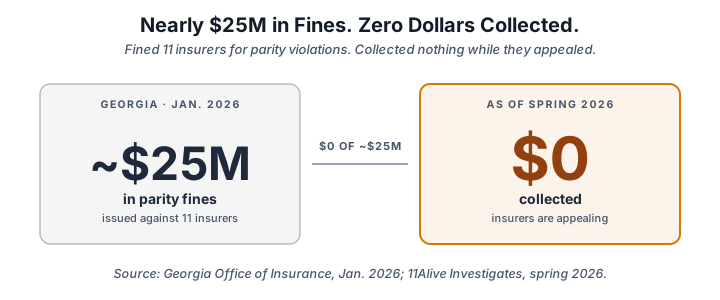
Put those three states side by side and you have the whole machine in one frame. The law exists. The violations are documented in detail. The fines get issued. And the money largely doesn’t move, because for a company that size, the appeal is cheaper than the care, and a sub-million-dollar penalty is cheaper than fixing the practice that produced it. The insurer isn’t failing to respond. It’s responding exactly as a rational profit-seeker would: treat the fine as a cost of doing business, and keep doing the business.
The disparity is written into the same plan
The thing that makes this so clean is that you don’t have to compare an insurer to anything outside itself to see the gap. You can hold a single plan in your hand and watch the number change.
That’s what the Connecticut findings expose. Inside one plan, from one insurer, the company reimburses a master’s-level therapist treating depression at one rate and a medical or surgical provider at a markedly higher one. Two providers, both in network, both billing the same insurer, separated only by whether the appointment was for a mind or a body. There’s no neutral benchmark involved and no government program in the picture — just the insurer’s own paperwork, paying less for mental health than for physical health, in writing.
That within-plan disparity is the parity violation in its purest form. It’s also the quiet engine of the access problem. Hold reimbursement for mental-health visits below the cost of running a practice and clinicians don’t stage a protest — they just stop taking the plan. The network thins. The directory keeps the names. And the patient, card in hand, discovers that “covered” and “available” were never the same word.
The part I’m plucky about
Here’s where I refuse to leave you in the basement, because cataloguing the machine isn’t the point — closing the gap is.
The encouraging thing about a problem that’s designed rather than random is that designs can be redesigned. A system optimized to keep the distance between covered and cared for is a system whose every weak point is now visible. We know where the friction lives. We know which incentives produce it. That’s not despair — that’s a map.
Some of the closing happens through policy, and it’s already starting: parity laws with real teeth, penalty ceilings high enough to outrun the “cost of doing business” calculation, transparency rules that drag denial rates into daylight. Make denial more expensive than care and the math that built the gap starts to invert. None of that is finished. All of it is moving.
The rest happens closer to the ground, and it’s the part I get to actually build. The reason prior authorization eats so much of a clinician’s week isn’t only the waiting — it’s that the whole apparatus still runs on fax machines and hold music, a therapist’s afternoon spent arguing with a payer instead of sitting with a patient. Give clinicians tools that hand that time back, and you’ve closed a sliver of the gap directly, without waiting for an insurer to grow a conscience it was never built to have.
That’s the throughline of everything we do at Mental Wealth Solutions, and it’s why our enemy is never the therapist and never the person seeking care. The enemy is the arrangement that profits from keeping them apart. We are, unapologetically, trying to make talking about mental health normal — and to be a little bit fun about it in a field that’s decided everything sucks. Plucky isn’t naïve. It’s a strategy. You don’t out-grind a machine built to grind you down; you build a different machine and make it more pleasant to use.
Commercial insurers spent 2026 collecting fines they won’t cash and reimbursing the mind below the body in their own plans. The arrangement still doesn’t have a conscience, because it was never designed to need one. The work — ours, and increasingly the work we’re building tools to do — is to close the distance between covered and cared for. The companies that profit from the gap aren’t going to close it for us. So we’re closing it ourselves, one less fax at a time.
Frequently asked questions
Is the mental health system actually broken, or is it working as designed? The evidence points to working as designed. In 2026, Connecticut moved to fine all five of its largest commercial insurers for paying master’s-level mental-health clinicians a fraction of what they paid medical and surgical providers in the same plans — same insurer, same plan. A system that pays less for the mind than the body, and keeps doing it across multiple states, isn’t malfunctioning. It’s responding rationally to an incentive: every dollar not spent on care stays with the payer.
Why is mental health care so hard to access even when you have insurance? Because “covered” and “cared for” are two different things. A number on your card, an EAP flyer, and a directory of names all let a commercial insurer say the coverage works. None of them puts a clinician in front of you. The friction between coverage and care — denials, narrow networks, low reimbursement that pushes clinicians out of network — is where committed money quietly stays with the insurer.
Are commercial insurers being penalized for parity violations in 2026? Yes, but slowly. Connecticut moved to fine all five of its largest commercial insurers, Pennsylvania fined Aetna $550,000, and Georgia issued nearly $25 million against 11 insurers. As of this spring, Georgia had collected $0 while insurers appealed. The fines are real; collection lags, and for a large insurer a single penalty can run under $1 million — often cheaper than changing the practice.
What would actually close the gap between covered and cared for? Three things working together: enforcement strong enough to make denial more expensive than care, reimbursement parity that keeps clinicians in network, and tools that give clinicians their time back instead of feeding the paperwork machine. Closing the real distance between covered and cared for is the ongoing work — and it’s the work we’re building toward.
Sources
Connecticut parity enforcement, reimbursement disparities (master’s-level mental-health vs. medical/surgical providers in the same plans), and $625,000/insurer/year cap: CT Mirror (May 2026), corroborated by Hartford Business Journal (2026) and DistilINFO (April 2026). Pennsylvania / Aetna $550,000 fine (and prior 2019 $190,000 fine): PA Insurance Department (March 2026) and The Philadelphia Inquirer (March 2026). Georgia ~$25 million in fines / $0 collected: Georgia Office of Insurance (January 2026) and 11Alive Investigates. Figures current as of June 2026.
Disclaimer
This article is for educational and informational purposes only. It does not constitute medical, clinical, legal, or therapeutic advice, and reading it does not create a therapist-client relationship with Matthew Sexton, LCSW or Mental Wealth Solutions, Inc.. Although the author is a licensed clinical social worker, the content in this article is not clinical assessment, diagnosis, or treatment.
Mental-health-parity enforcement, prior-authorization requirements, and insurer reimbursement rates vary by health plan, state, and over time, and may change after this article is published. Nothing here is a substitute for confirming a specific benefit, denial, or requirement with your insurer, your benefits administrator, or qualified counsel. Plans and circumstances differ, and what is described here may not match your situation.
If you are in immediate emotional crisis, you can reach the 988 Suicide & Crisis Lifeline by calling or texting 988 (US). If you are experiencing domestic violence or are in physical danger, contact the National Domestic Violence Hotline at 1-800-799-7233 or visit thehotline.org. In a life-threatening emergency, call 911.
Want to discuss this for your program?
Book a 30-min conversation. We'll walk you through deployment, the BAA, and what your rollout looks like in production.
Book a 30-min conversation