If your insurer is making mental health care harder to get than physical care, you file a parity complaint with whichever agency regulates your specific plan: the U.S. Department of Labor’s EBSA for private employer plans, CMS for public-employee and some individual-market plans, and your state insurance department for fully insured coverage. You have solid ground to stand on. The Kennedy Forum’s Mental Health Parity Index, released April 14, 2026, found the four largest commercial insurers pay mental health and substance-use clinicians 16% to 59% less than physical-health clinicians, with access gaps in 43 states and patients in 7 of 10 counties struggling to find an in-network mental health clinician.
Quick answer: To file a mental health parity complaint, first identify who regulates your plan (self-funded employer plan = Department of Labor / EBSA; non-federal governmental plan = CMS; fully insured employer or individual-market plan = your state insurance department, with CMS stepping in only in the few states that do not enforce parity themselves), gather your denial letter and plan documents, and submit the complaint to that agency by phone or online. EBSA’s line is 1-866-444-3272 (askebsa.dol.gov); CMS routes parity complaints through the No Surprises Help Desk at 1-800-985-3059; state departments are listed in the NAIC directory. You can appeal the denial and file the complaint at the same time.
What mental health parity actually requires
The Mental Health Parity and Addiction Equity Act (MHPAEA) has been federal law since 2008. In plain terms: a health plan cannot make it harder to get covered for mental health and substance-use care than for comparable medical or surgical care. Same copays. Same visit limits. Same prior-authorization rules. Same standard for what counts as “medically necessary.”
The violations rarely show up as an obvious dollar cap. They hide in what regulators call non-quantitative treatment limitations, or NQTLs: how a network is built, how claims get reviewed, how “medical necessity” gets defined, how much a plan pays a therapist versus a surgeon. A plan can look identical on the front of the card and still make the mental health side harder to use through these design choices. That is the machinery this whole complaint process exists to open up. If you want the fuller picture of how insurers do it, we cover the tactics in how insurers weaponize prior authorization and the reimbursement gap that pushes clinicians out of network.
Signs your insurer may be violating parity
You do not need to prove the violation before you file. You need a reasonable belief, and these are the patterns that support one:
- Ghost networks. The directory lists in-network therapists, but the names are booked solid, retired, or no longer taking your plan. You call ten and reach none. Thin behavioral-health networks are a documented parity problem, covered in network adequacy rules for 2026.
- Prior authorization only on the mental health side. Your plan requires pre-approval for therapy or inpatient addiction treatment but not for comparable medical care.
- Repeated “not medically necessary” denials for care your clinician recommends, especially for residential or intensive outpatient treatment.
- Lower reimbursement that drives your therapist out of network, so you pay out of pocket for care the plan claims to cover. See how the largest insurers set behavioral-health denial rates.
- Step-therapy or “fail first” rules applied to mental health medication or treatment that are stricter than the medical side.
Any one of these is worth a complaint. The pattern across a plan is what regulators are actually looking for.
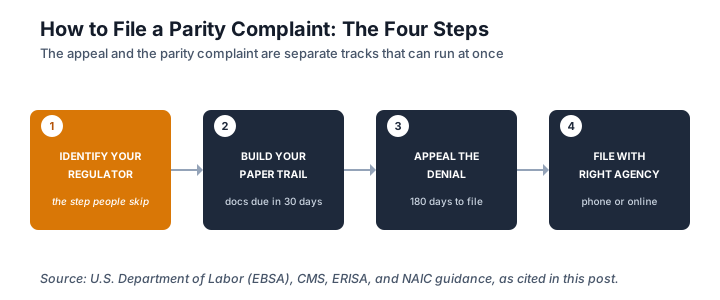
Step 1: Figure out who regulates your plan
This is the step people skip, and it is the one that decides whether your complaint lands on the right desk. Three buckets:
- Private employer plan (self-funded). If your employer funds claims directly, the plan is governed by federal ERISA law and enforced by the Department of Labor’s EBSA, not your state. Self-funded plans are exempt from state parity laws, so the state insurance department cannot help you here.
- Fully insured plan or individual-market coverage. If an insurance company bears the risk, your state insurance department regulates the insurer. This is also where most marketplace and individually purchased plans go.
- State or local government employee plan. These “non-federal governmental plans” are enforced by CMS in all states.
How to tell which you have: ask HR, or read your Summary Plan Description. If the employer bears the financial risk, it is self-funded; if an issuer does, it is fully insured. A fully insured plan’s ID card often references your state department of insurance. When you genuinely cannot tell, the No Surprises Help Desk (1-800-985-3059) will take the complaint and route it to the correct agency.
Step 2: Build your paper trail before you file
A parity complaint is stronger with documents attached. Gather:
- The denial. Your denial letter and Explanation of Benefits (EOB), which state the reason and cite the plan rule used.
- Your plan documents. Under ERISA, a plan administrator must provide the SPD and the instruments the plan operates under within 30 days of a written request, or a court can impose a penalty of up to $110 per day starting on day 31. Put your request in writing and keep a copy.
- The medical-necessity criteria and the comparative analysis. The Consolidated Appropriations Act, 2021 requires plans to perform and document a comparative analysis of the NQTLs they apply to mental health benefits, and to make it available on request. The Department of Labor publishes a model request form for the exact criteria a plan used to limit your care. Requesting it forces the plan to show its reasoning.
- Your own record. Dates you called, names in the directory that were unreachable, what your clinician recommended, what you paid out of pocket.
You do not need every item to file. Start the complaint with what you have and add the rest as it arrives.
Step 3: Appeal the denial (this runs alongside the complaint)
If a specific claim was denied, appeal it. The appeal and the parity complaint are separate tracks and you can run them at once.
- Internal appeal: file with your insurer within 180 days of the denial notice.
- External review: if the internal appeal fails, request an independent external review within four months of the final denial. A standard external review is decided within 45 days; an expedited one within 72 hours when the situation is urgent. Since 2022, mental health parity disputes are explicitly eligible for external review.
The denial letter must tell you how to request both. If it does not, that omission is itself worth reporting.
Step 4: File the complaint with the right agency
Here are the exact channels. Use the one that matches your plan from Step 1.
Private employer plans → Department of Labor (EBSA)
File online at askebsa.dol.gov or call 1-866-444-3272. A free EBSA benefits advisor reviews your case, and you can expect a status report roughly every 30 days. If your complaint cannot be resolved informally, it can be referred to enforcement staff. EBSA is the primary federal enforcer of parity for employer-sponsored plans.
Public-employee and individual-market plans → CMS
Contact CMS at 1-877-267-2323 or [email protected] for public-sector plans and individual coverage. CMS also accepts parity complaints through the No Surprises Help Desk at 1-800-985-3059 and an online consumer complaint form. CMS enforces the federal parity law directly over insurers only in the few states that are not enforcing it themselves (for parity, that recent list has been Texas and Wyoming); it always enforces parity for state and local government employee plans, in every state.
Fully insured and marketplace plans → your state insurance department
Find your state’s department through the NAIC directory at content.naic.org/state-insurance-departments. Many states have their own parity laws that are stronger than the federal floor, and the state regulates the insurer directly. If your state runs a Consumer Assistance Program, it can help you assemble and file the complaint.
Not sure which applies? File through the No Surprises Help Desk. It is built to route parity complaints to the correct federal or state agency.
What to expect after you file
Be honest with yourself about the timeline. A complaint is the start of a process, not a switch that flips your coverage back on. EBSA sends status updates about every 30 days and works many cases toward an informal resolution before any formal enforcement.
It also helps to know the ground you are filing on. In 2026 the federal picture got harder: the strongest federal parity rule, finalized in 2024, is on hold after an industry lawsuit, and the Trump administration paused its enforcement while EBSA lost staff. None of that repealed your right to file. And states have moved into the gap. Georgia issued nearly $25 million in parity fines in January 2026, and Connecticut cited all five of its major commercial insurers in April 2026, part of a wider state enforcement wave. Regulators act on documented patterns. Your complaint is one of the documents.
The distance between being covered and being cared for is where these violations live. Filing is how you make that distance visible to the one office with the authority to close it.
FAQ
Who do I file a mental health parity complaint with? It depends on who regulates your plan. Private employer plan: the Department of Labor’s EBSA (askebsa.dol.gov or 1-866-444-3272). State or local government employee plan, or individual coverage where CMS enforces directly: CMS at 1-877-267-2323, or the No Surprises Help Desk at 1-800-985-3059. Fully insured or marketplace plan in most states: your state insurance department, listed in the NAIC directory. When in doubt, file through the No Surprises Help Desk and it will route you.
How do I know if my health plan is self-funded or fully insured? Ask HR or read your Summary Plan Description. If your employer pays claims directly, it is self-funded and regulated federally by the Department of Labor. If an insurance company bears the risk, it is fully insured and your state insurance department has jurisdiction over the insurer. Plan type decides which agency handles the complaint, so confirm it first.
Can I request the documents that prove a parity violation? Yes. ERISA requires the plan administrator to give you plan documents within 30 days of a written request, with a possible court penalty of up to $110 per day for failure. The Consolidated Appropriations Act, 2021 requires plans to document a comparative analysis of the non-quantitative treatment limitations they apply to mental health benefits and provide it on request. The Department of Labor publishes a model form for requesting the criteria a plan used to limit your care.
Do I have to appeal the denial before I file a complaint? No. They are separate tracks and you can pursue both at once. You generally have 180 days from a denial to file an internal appeal, and four months after a final internal denial to request an external review. Mental health parity disputes have been eligible for external review since 2022.
Is filing worth it in 2026 when federal enforcement was rolled back? Yes. The 2024 federal rule is on hold and EBSA has fewer investigators, but MHPAEA is still law and your right to file is unchanged. Complaints create the record regulators act on, and states are enforcing: Georgia issued nearly $25 million in fines in January 2026, and Connecticut cited all five of its major commercial carriers in April 2026.
Sources
The Kennedy Forum, Mental Health Parity Index, released April 14, 2026: the four largest commercial insurers pay 16% to 59% less for mental health and substance-use care than for physical health care; access gaps in 43 states; patients in 7 of 10 counties face difficulty finding in-network mental health clinicians.
U.S. Department of Labor, EBSA, Understanding Your Mental Health and Substance Use Disorder Benefits and Ask EBSA: how to contact a benefits advisor (askebsa.dol.gov, 1-866-444-3272), 30-day status reports, and referral to enforcement. Model disclosure request: Request Form for Health Plan Treatment Limitation information.
Centers for Medicare & Medicaid Services, The Mental Health Parity and Addiction Equity Act (MHPAEA): CMS jurisdiction over non-federal governmental plans in all states and over issuers in states not substantially enforcing; contact 1-877-267-2323 and [email protected]. Direct-enforcement states (Texas and Wyoming for MHPAEA in FY2023): U.S. Department of Labor / CMS, FY 2023 MHPAEA Enforcement Fact Sheet.
CMS, Call the No Surprises Help Desk: 1-800-985-3059 accepts mental health parity complaints and routes them to the correct federal or state agency; online consumer complaint form available.
National Association of Insurance Commissioners, State Insurance Department directory: how to find and contact your state regulator for fully insured and individual-market complaints.
Consolidated Appropriations Act, 2021 NQTL comparative analysis requirement, as summarized by CMS: plans must perform, document, and make available on request a comparative analysis of the NQTLs applied to mental health and substance-use benefits (effective February 10, 2021).
ERISA plan-document right: ERISA §104(b)(4) and §502(c), as summarized by practitioner guidance (e.g., Newfront): plan administrator must furnish requested plan documents within 30 days; court penalty of up to $110 per day for failure, beginning day 31.
Appeal rights: HealthCare.gov, Internal appeals and External review: 180-day internal appeal window, four-month external review request window, 45-day standard and 72-hour expedited decisions; mental health parity disputes eligible for external review since 2022.
State enforcement in 2026: Georgia Office of Commissioner of Insurance, nearly $25 million in parity fines (January 12, 2026); Connecticut Insurance Department 2026 NQTL Annual Report, via Connecticut Public (April 27, 2026). Federal enforcement pause: U.S. Department of Labor, Statement Regarding Enforcement of the 2024 MHPAEA Final Rule (May 15, 2025).
Figures current as of July 2026.
Disclaimer
This article is for educational and informational purposes only. It does not constitute medical, clinical, legal, or financial advice, and reading it does not create a therapist-client relationship with Matthew Sexton, LCSW or Mental Wealth Solutions, Inc. Although the author is a licensed clinical social worker, the content in this article is not clinical assessment, diagnosis, or treatment.
The statistics, policy details, and market patterns described here reflect published sources and are accurate as of their stated publication dates. Conditions change; verify current figures against the linked sources before relying on them. For decisions about your specific situation, consult the relevant professional, licensing board, or qualified legal or financial counsel.
If you are in immediate emotional crisis, you can reach the 988 Suicide & Crisis Lifeline by calling or texting 988 (US). If you are experiencing domestic violence or are in physical danger, contact the National Domestic Violence Hotline at 1-800-799-7233 or visit thehotline.org. In a life-threatening emergency, call 911.
Frequently asked questions.
- Who do I file a mental health parity complaint with?
- It depends on who regulates your plan. For a private employer's health plan, file with the U.S. Department of Labor's Employee Benefits Security Administration (EBSA) at askebsa.dol.gov or 1-866-444-3272. For a state or local government employee plan, or for individual-market coverage in a state where CMS enforces directly, contact CMS at 1-877-267-2323 or the No Surprises Help Desk at 1-800-985-3059. For a fully insured plan or individual coverage in most states, file with your state insurance department, which you can find through the NAIC directory.
- How do I know if my health plan is self-funded or fully insured?
- Ask your HR department or read your Summary Plan Description (SPD). If your employer pays claims directly, the plan is self-funded and is regulated federally by the Department of Labor. If an insurance company bears the risk, it is fully insured and your state insurance department has jurisdiction over the insurer. Plan type decides which agency handles your complaint, so confirm it before you file.
- Can I request the documents that prove a parity violation?
- Yes. Under ERISA, a plan administrator must give you plan documents, including the SPD and the instruments the plan operates under, within 30 days of a written request, or face a court penalty of up to $110 per day. Under the Consolidated Appropriations Act, 2021, plans must also perform and document a comparative analysis of their non-quantitative treatment limitations (NQTLs) for mental health benefits and make it available on request. The Department of Labor publishes a model form for requesting the criteria a plan used to limit your care.
- Do I have to appeal the denial before I file a complaint?
- They are separate tracks and you can pursue both. You generally have 180 days from a claim denial to file an internal appeal with your insurer, and four months after a final internal denial to request an independent external review. Since 2022, mental health parity disputes are eligible for external review. Filing a parity complaint with your regulator does not replace the appeal, and it can run at the same time.
- Is filing worth it in 2026 when federal parity enforcement was rolled back?
- Yes. The 2024 federal parity rule is on hold and EBSA has fewer investigators, but MHPAEA is still the law and your right to file is unchanged. Complaints build the documented record that regulators use to act, and states have stepped up: Georgia issued nearly $25 million in parity fines in January 2026 and Connecticut cited all five of its major commercial insurers in April 2026. Your filed complaint is how the paper-versus-reality gap gets seen.
If you're the therapist here.
Your clients get 4 sessions a month. The other 26 days they're on their own. VibeCheck.luxury is the between-session companion that carries those days back to you — clients check in daily, and you walk in already knowing what kind of week it was. Built by Matthew Sexton, LCSW, NATC.