
Quick answer: 34% of U.S. psychologists no longer take any health insurance, and 82% of those who left point to low pay from insurers, per the American Psychological Association’s 2024 Practitioner Pulse Survey. When therapists quit the insurance panels, your card still says covered. The care behind the card is what thins out.
One in three psychologists in America now takes no insurance. Not one single plan. The American Psychological Association asked 853 psychologists in September 2024 and published the answer that December: 34% had walked away from insurance entirely. Among that group, 82% gave the same reason. The pay is too low.
That number is the workforce cliff, and the squeeze behind it is still tightening. On July 15, 2026, Aetna cuts pay again for thousands of therapists. The details are below, and they show exactly how this machine runs.
Maybe you’ve already lived the client side of this. You open your plan’s website, pull up the list of covered therapists, and start calling. You hit voicemail, full caseloads, and “we no longer take that plan.” By the tenth call, you wonder if the list was ever real. This post is about why that keeps happening.
I’m Matthew Sexton, a licensed clinical social worker, and I read payer notices and workforce data for a living. Here is the plain version. America doesn’t just have a therapist shortage. It has a therapist shortage with a paywall built on top of it. Having coverage and getting care are not the same thing, and the space between them is where this story lives.
How many therapists have stopped taking insurance?
About one in three, and two studies with very different methods land on the same number.
The first is the APA survey above: 34% of psychologists accept no health insurance of any kind (APA, December 2024).
The second study came at it sideways. Researchers pulled the public profiles of 175,083 private-practice therapists listed on Psychology Today, across all 50 states. Roughly one-third listed no insurance at all (Health Affairs Scholar, September 2024, using data through the end of 2023). Different doorway, same wall.
That study also measured the average cash price of therapy: $143.26 per session. Hold onto that number. It decides who still gets care once the panels thin out.
One quick term before we go on. An insurance panel is the list of therapists a plan has under contract. In-network means on that list. When a therapist quits the panel, the contract ends, and your plan stops being part of the visit.
Why are therapists quitting the insurance panels?
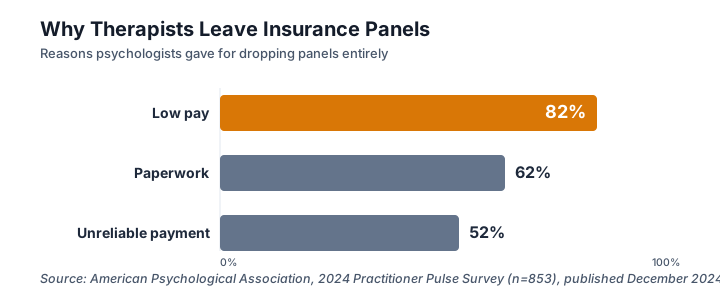
Because the math stopped working. When the APA asked psychologists who had left why they left, the answers stacked up like this (APA, December 2024):
- 82% said low pay. The rate insurers pay per session often doesn’t cover the cost of running a practice.
- 62% said paperwork. Pre-approval forms and audits eat hours nobody pays for.
- 52% said unreliable payment. Checks arrive late, and insurers sometimes demand money back after paying.
How low is the pay? Per Heard’s 2025 Financial State of Private Practice report, covered by Behavioral Health Business in April 2025, the average private-pay session is $159, while the average insurance payment is $111. That is 36% less for the same hour. Heard is a bookkeeping company for therapists, so read it as an industry survey, not a government count. It still matches what therapists say out loud every day.
Now picture that $111 from the therapist’s chair. It has to cover the session, plus the unpaid time after it: the note, the claim, the phone call when the claim bounces. It also has to cover rent, software, and their own health insurance. Therapists keep reaching the same conclusion. The card pays like a coupon, and the coupon comes with homework.
And the plans aren’t short on money. RTI International studied claims (the bills plans process) inside commercial health plans and found something blunt. On average, insurers paid medical clinicians 22% more for office visits than they paid mental health clinicians inside the very same plans. At the higher end of the pay range, the gap reached 48% (April 2024). Same plan, same member, but a different rate depending on whether you treat a knee or a mind.
RTI also named the tool. In-network pay, the study says, is “a key lever that health plans use to encourage provider in-network participation.” In plain words, the rate is a dial, and the insurer’s hand is on it. I broke down the therapist-side math over on our VibeCheck.luxury blog in why commercial insurers pay therapists so little, and I’ve traced the business model behind the dial here before. The short version: a thin panel is cheap.
Aetna’s July 15 cut shows how the machine runs
The dial still turns down, even in 2026.
On May 20, 2026, therapists who see Aetna members through a platform called Alma got a notice, first reported by Behavioral Health Business (May 2026). Starting July 15, 2026, two things change:
- A long therapy session (53 minutes or more, billing code 90837) gets paid the same as a shorter one (37 to 52 minutes, code 90834). The extra time becomes free labor.
- Therapists who hold doctorates get paid at master’s-level rates for certain visit types. The extra years of training stop showing up on the check.
Alma told its own therapists: “We disagree with these changes.”
If your therapist takes Aetna through Alma, this lands on them in days. Some will absorb it quietly. Others will run the APA math and leave the panel, which moves the cliff one step closer to you.
Notice what’s missing from this section. No adjectives, and no villain speech. A number, a source, and a date can carry the whole argument. Every cut like this hands more therapists the exact math problem the APA documented, and we already know how a third of psychologists solved it.
What happens to access when the panels empty out?
People go hunting outside their plan, or they stop hunting.
The best data comes from RTI International, which studied claims covering more than 22 million people a year, from 2019 through 2021, in all 50 states (April 2024). People with commercial insurance went out-of-network 3.5 times more often for mental health care than for medical care. For psychiatrists, it was 8.9 times more often. For psychologists, 10.6 times.
Out-of-network means your plan pays little or nothing, and the bill lands on you. Now bring back the cash price: about $143 a session. Weekly therapy at that rate runs past $570 a month. Families who can carry that keep getting care. Families who can’t sit on waitlists or quietly stop looking. That quiet stop is the engine behind why “just go to therapy” is broken.
For employers, this explains a lot about why mental health benefits sit unused. The network list your plan hands employees was built before a third of the field stopped billing insurance. People call, strike out, and stop telling you about it. The benefit looks fine on a slide and fails in a phone call.
Underneath the paywall sits a true shortage. The federal government flags places without enough mental health providers as shortage areas. As of December 31, 2025, there were 6,807 of them, and 137.1 million Americans lived inside one. That is about 40% of the country (KFF, using federal HRSA data). In those areas, only about 27.3% of the need for care is met, and closing the gap would take roughly 6,800 more providers.
Stack the two problems and you get the cliff. A real shortage sits on the bottom, and the walk-away from insurance sits on top. Demand keeps climbing anyway, which is the same squeeze already hitting psychiatry.
What would pull therapists back?
Start with the lever the researchers already named. RTI called the in-network rate the key tool plans use to fill a network. So the fix list is short, and none of it is exotic:
- Pay mental health care like medical care. Close that 22% within-plan gap. Parity is already federal law, and states have started fining commercial insurers over it.
- Cut the unpaid paperwork. 62% of the psychologists who left named it.
- Pay on time, and stop clawing money back. 52% named that one.
Employers hold more power here than they think. You are the customer. Ask your plan one question at renewal: what share of our employees’ mental health visits went out-of-network last year? If the honest answer sits anywhere near 3.5 times the medical rate, you’re paying for a card while your people pay for the care.
To the therapists reading this: the data says the quiet part for you. If panel math stopped working for your practice, you’re standing next to a third of your field. That is a policy outcome. Policy outcomes move when the pressure on them gets loud, public, and sourced.
And if you’re the one still hunting for a therapist, hitting voicemail after voicemail: the wall you keep meeting is real, it has a builder, and it has a dial. Dials that get turned down can be turned back up. Now you know whose hand is on this one.
FAQ
Why doesn’t my therapist take insurance? Usually, the pay. In the APA’s 2024 Practitioner Pulse Survey, 82% of psychologists who dropped insurance blamed low rates, 62% blamed paperwork, and 52% blamed late or clawed-back payments. Per Heard’s 2025 practice report, insurance pays about $111 a session, while the average private-pay rate is $159.
How many therapists don’t take insurance? About one in three. The APA found 34% of psychologists accept no insurance at all (December 2024). A separate Health Affairs Scholar study of 175,083 Psychology Today listings found roughly one-third took no insurance, with an average cash rate of $143.26 a session.
Is this a therapist shortage or an insurance problem? Both at once. As of December 31, 2025, 137.1 million Americans, about 40% of the country, live in a federal mental health shortage area, where only about 27.3% of the need for care is met (KFF, using HRSA data). The walk-away from insurance then shrinks the usable supply even further.
What can I do when no in-network therapist has openings? Keep notes on every call: the date, the name, and whether they were full or unreachable. Then ask your plan for a single-case agreement, which pays an out-of-network therapist at in-network rates when the network can’t deliver. People with commercial insurance already go out-of-network 3.5 times more often for mental health care than for medical care (RTI, 2024). Plans know it.
Sources
- American Psychological Association: 2024 Practitioner Pulse Survey press release, December 2024. 34% of psychologists accept no insurance; 82% cite low reimbursement, 62% cite administrative burdens, 52% cite payment reliability. Survey of 853 psychologists, September 2024.
- Health Affairs Scholar: analysis of 175,083 Psychology Today provider listings, September 2024, data through December 31, 2023. About one-third accept no insurance; average cash rate $143.26 per session.
- RTI International: network-access disparities study, April 2024. Out-of-network use 3.5x higher for behavioral health (8.9x for psychiatrists, 10.6x for psychologists); medical clinicians paid 22% more in-network on average within the same commercial plans.
- KFF State Health Facts: Mental Health Care Health Professional Shortage Areas, HRSA data as of December 31, 2025. 137.1 million people in 6,807 shortage areas; about 27.3% of need met; roughly 6,800 more practitioners needed.
- Behavioral Health Business: “Aetna Cuts Rates With Alma-Contracted Therapists”, May 21, 2026. Extended sessions (90837) paid at 90834 rates and doctoral-level providers paid at master’s-level rates, effective July 15, 2026.
- Behavioral Health Business: coverage of Heard’s 2025 Financial State of Private Practice Report, April 7, 2025. Average private-pay rate $159 versus average insurance payment $111.
Disclaimer
This article is for educational and informational purposes only. It does not constitute medical, clinical, legal, or therapeutic advice, and reading it does not create a therapist-client relationship with Matthew Sexton, LCSW or Mental Wealth Solutions, Inc. Although the author is a licensed clinical social worker, the content in this article is not clinical assessment, diagnosis, or treatment.
Insurance participation, reimbursement rates, network rules, survey findings, and shortage-area designations vary by health plan, state, and over time, and may change after this article is published. Nothing here is a substitute for confirming coverage or rate details with a specific plan, your benefits team, or qualified counsel. Plans and circumstances differ, and what is described here may not match your situation.
If you are in immediate emotional crisis, you can reach the 988 Suicide & Crisis Lifeline by calling or texting 988 (US). If you are experiencing domestic violence or are in physical danger, contact the National Domestic Violence Hotline at 1-800-799-7233 or visit thehotline.org. In a life-threatening emergency, call 911.
Frequently asked questions.
- Why doesn't my therapist take insurance?
- Usually, the pay. In the APA's 2024 Practitioner Pulse Survey, 82% of psychologists who dropped insurance blamed low rates, 62% blamed paperwork, and 52% blamed late or clawed-back payments. Per Heard's 2025 practice report, insurance pays about $111 a session, while the average private-pay rate is $159.
- How many therapists don't take insurance?
- About one in three. The APA found 34% of psychologists accept no insurance at all (December 2024). A separate Health Affairs Scholar study of 175,083 Psychology Today listings found roughly one-third took no insurance, with an average cash rate of $143.26 a session.
- Is this a therapist shortage or an insurance problem?
- Both at once. As of December 31, 2025, 137.1 million Americans, about 40% of the country, live in a federal mental health shortage area, where only about 27.3% of the need for care is met (KFF, using HRSA data). The walk-away from insurance then shrinks the usable supply even further.
- What can I do when no in-network therapist has openings?
- Keep notes on every call: the date, the name, and whether they were full or unreachable. Then ask your plan for a single-case agreement, which pays an out-of-network therapist at in-network rates when the network can't deliver. People with commercial insurance already go out-of-network 3.5 times more often for mental health care than for medical care (RTI, 2024).
Want to discuss this for your program?
Book a 30-min conversation. We'll walk you through deployment, the BAA, and what your rollout looks like in production.
Book a 30-min conversation