I have been a clinician long enough to know that the most dangerous policies are not the ones that openly deny care. Those are easy to identify and fight. The dangerous ones are the policies that sound reasonable on paper while creating conditions that quietly destroy the people they claim to serve.
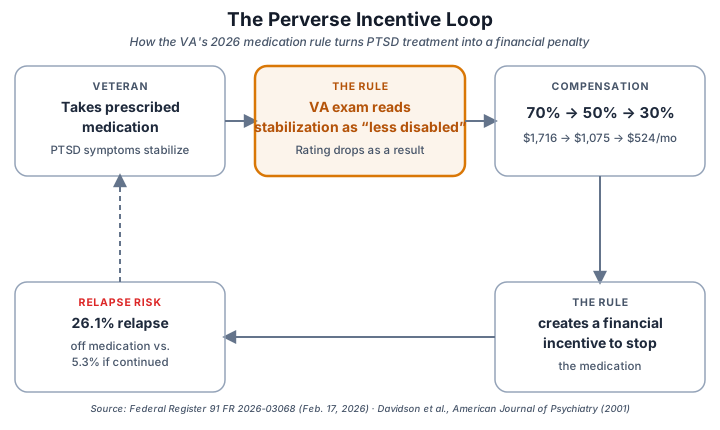
On February 17, 2026, the Department of Veterans Affairs published an interim final rule in the Federal Register — effective immediately, no public comment period — that directed VA examiners to evaluate disability ratings based on how veterans function with medication, rather than on the underlying severity of their condition.1 In plain English: if your PTSD medication is working, you look less disabled during your compensation and pension exam, and your rating drops. Your compensation drops. Your access to other VA benefits drops.
The message to every veteran managing their PTSD with medication was unmistakable: getting better costs you money.
I am not going to dance around this. That is one of the most clinically reckless policy decisions I have seen in my career. And the fact that it was suspended after two weeks of public outrage does not mean the damage is undone. Because the rule is still technically law.2 And because the message it sent to veterans — that compliance with treatment is a financial liability — cannot be unsent.
PTSD Is Managed, Not Cured — And Every Clinician Knows This
The foundational problem with this rule is that it treats PTSD as though medication resolves it. As though a veteran on sertraline who reports fewer nightmares during a C&P exam has been fixed.
That is not how PTSD works. The DSM-5-TR classifies PTSD as a condition that can persist for years to decades after the initial traumatic event.3 It is frequently chronic. The symptoms wax and wane. A veteran can have a good month and a devastating month. Medication stabilizes — it does not eradicate.
The clinical data is unambiguous on this point. A landmark relapse prevention study published in the American Journal of Psychiatry found that veterans who discontinued sertraline after achieving PTSD remission had a relapse rate of 26.1%, compared to just 5.3% for those who continued the medication. Patients who stopped treatment were 6.4 times more likely to relapse.4 Among male veterans specifically, 27.8% of those on placebo relapsed compared to zero percent of those maintained on sertraline.
Let that sink in. The medication is not curing the PTSD. It is holding the line. Remove the medication and the condition surges back in more than one in four patients. And the VA’s rule essentially told veterans: we will rate you as though the line does not need holding.
A 2023 systematic review in BMC Psychiatry examined PTSD recurrence across multiple longitudinal studies and found mean recurrence rates of 24.5% among those who had previously met criteria for PTSD and 25.4% among those classified as recovered.5 One in four. Even among people the clinical literature considers recovered, the condition comes back a quarter of the time. This is not a disease you beat and walk away from. This is a disease you manage for the rest of your life.
Broader meta-analytic evidence across anxiety disorders and PTSD confirms this pattern. A systematic review of 28 relapse prevention trials found that discontinuing antidepressant medication resulted in significantly higher relapse rates, with a summary odds ratio of 3.11 and a hazard ratio of 3.63 for time to relapse.6 The clinical consensus is clear: for patients with chronic PTSD, medication should be maintained for at least one year after symptom stabilization, with regular follow-up to prevent relapse.
The Perverse Incentive: Stop Your Meds or Lose Your Check
Here is where policy collides with human psychology in the worst possible way.
Dr. Charles Garbarino, a physician who served three tours in Iraq, told Stars and Stripes that he worries many veterans will stop taking their medications rather than risk a lower rating — particularly those prescribed drugs for PTSD.7 Kristofer Goldsmith, an Army combat veteran, put it more bluntly: “In the minds of some veterans, it’s worth suffering the full effects of PTSD or another illness, rather than put your family at a financial disadvantage.”7
This is not hypothetical. This is predictable. When you create a system where treatment compliance leads to financial punishment, rational actors — especially those already navigating the cognitive distortions that come with PTSD — will calculate that suffering is cheaper than healing.
A veteran rated at 70% for PTSD receives approximately $1,716 per month in disability compensation. Drop that to 50% and it falls to $1,075. Drop it to 30% and it is $524. These are not abstract numbers. They are rent. They are groceries for children. They are the difference between stability and crisis.
Now imagine telling that veteran: the medication that keeps your nightmares manageable and your hypervigilance below the threshold of daily dysfunction is going to be used as evidence that you are less disabled. That the very thing keeping you alive and functional is the thing that will reduce your financial lifeline.
Any clinician who has worked with this population knows exactly what happens next. The medication goes in the drawer.
17.5 Veterans Per Day — And We Are Adding Risk Factors
According to the VA’s own 2025 National Veteran Suicide Prevention Annual Report, 6,398 veterans died by suicide in 2023 — approximately 17.5 per day.8 The suicide rate among male veterans is nearly 60% higher than non-veteran males. Among female veterans, it is 92% higher.
The VA completed more than 5.3 million suicide risk screenings in 2025 and handled 1.3 million calls, chats, and texts through the Veterans Crisis Line — a 39% increase over the prior year.8 The system is already under extraordinary strain.
Into this environment, someone decided it was appropriate to create a financial incentive for medication non-compliance.
Pain was identified as the most frequent risk factor among veterans who died by suicide from 2021 to 2023.8 PTSD and pain are deeply intertwined — somatic symptoms, hyperarousal, sleep disruption, and the compounding effect of untreated psychological distress on physical health. When a veteran stops their PTSD medication, they do not just lose symptom management for intrusive memories. They lose sleep regulation. They lose the neurochemical buffer against irritability and rage. They lose the capacity to tolerate the physical pain that is already the number one identified risk factor for veteran suicide.
This is not a policy debate. This is a body count waiting to happen.
The Moral Injury of Being Punished by the System That Broke You
There is a concept in the clinical literature that is gaining overdue recognition: moral injury. It occurs when a person experiences, witnesses, or is forced to participate in events that violate their deeply held moral beliefs.9 Unlike PTSD, which is rooted in fear-based trauma responses, moral injury is driven by guilt, shame, betrayal, and existential anger.
Recent VA research published in 2025 found that 44.7% of veterans endorsed potentially morally injurious events during their service. Among those, 45.2% reported witnessing inhumanity, 40.2% were directly affected by others’ transgressions, and 14.0% reported perpetrating transgressive acts they cannot reconcile.10
Here is what the policy literature on moral injury does not adequately address: the moral injury inflicted by the system itself after service ends.
A veteran who served in combat, developed PTSD, sought treatment as the VA encouraged, took their medication as prescribed, showed up for therapy, and did the work of recovery — that veteran was then told by the same system that their recovery would be used as evidence to reduce their benefits. The institution that sent them to war, that created the conditions for their trauma, that built an entire healthcare apparatus ostensibly to help them heal — that institution turned their healing into a liability.
If that is not a morally injurious event, I do not know what qualifies.
The VA’s own National Center for PTSD notes that moral injury can lead to PTSD, depression, substance use disorders, and suicidality.9 The instrument they developed to measure it — the Moral Injury and Distress Scale (MIDS) — assesses the link between morally injurious events and subsequent psychological distress.11 I would argue that a policy which punishes treatment compliance meets every clinical threshold for a potentially morally injurious event. It is a betrayal by an institution the veteran was told to trust.
The Rule Was Suspended — But the Damage Is Not
VA Secretary Doug Collins suspended enforcement of the rule on February 19, 2026, after two weeks of backlash from the VFW, DAV, American Legion, and virtually every major veterans service organization in the country.2 The VFW called it a “dangerous incentive.” The DAV warned it would “undermine the health and wellbeing of our nation’s veterans.” Congressional members from both parties demanded its withdrawal.
But here is what the headlines about the suspension miss: the rule was never formally rescinded. It remains in the Federal Register. It was published as an interim final rule — meaning it took effect immediately, bypassing the standard notice-and-comment rulemaking process. The VA said it would collect public comment going forward but offered no timeline for formal withdrawal.2
This means the rule exists in a regulatory limbo. It is suspended but not dead. Any future administration, any future VA secretary, can reactivate it without new rulemaking. The legal infrastructure for punishing medication compliance is built. It just is not plugged in right now.
And the psychological infrastructure was activated the moment the rule was published. Every veteran who read about it — every veteran whose buddy texted them the Military.com article — absorbed the message. The VA can and will use your treatment against you. That message does not get unsent by a press release about a suspension.
What Needs to Happen — From a Clinical Perspective
The clinical community cannot treat this as resolved because enforcement was paused. Three things need to happen:
First, the rule must be formally rescinded — removed from the Federal Register, not just suspended. As long as it exists in regulatory limbo, it functions as a threat. Veterans and their advocates should submit public comments demanding withdrawal, and Congress should codify the protection through legislation that explicitly prohibits the VA from reducing disability ratings based on the ameliorative effects of medication.
Second, clinicians working with veterans need to proactively address this with their patients. If you treat veterans, bring this up. Ask directly: has this rule changed how you think about your medication? Are you considering stopping or reducing your treatment? The damage from this policy is not theoretical — it is happening in exam rooms and VA waiting rooms right now, in veterans who are quietly doing the math on whether they can afford to keep healing.
Third, the veteran mental health community needs to name what this is. This is not a bureaucratic error. This is not a well-intentioned policy that missed the mark. This is the institutional expression of a belief that disabled veterans cost too much — and that the cheapest way to reduce that cost is to redefine disability downward by counting treatment as cure. That belief needs to be confronted directly, repeatedly, and without diplomatic equivocation.
The Line We Hold
I started this piece talking about the medications that hold the line for veterans with PTSD. Sertraline, paroxetine, the SSRIs and SNRIs that do not cure but stabilize. That keep the nightmares from running the show. That give a veteran enough neurochemical breathing room to stay employed, stay married, stay alive.
The line those medications hold is not just biochemical. It is existential. It is the difference between a veteran who can pick up their kid from school and one who cannot leave the house. Between a veteran who sleeps four hours and one who does not sleep at all. Between a veteran who is here tomorrow and one who is not.
Any policy that threatens that line — that creates even a whisper of incentive to step back from it — is not a regulatory adjustment. It is a betrayal of the people this country promised to take care of.
The rule was suspended. It should be destroyed.
References
Footnotes
-
Department of Veterans Affairs. “Evaluative Rating: Impact of Medication.” Federal Register, 91 FR 2026-03068, February 17, 2026. https://www.federalregister.gov/documents/2026/02/17/2026-03068/evaluative-rating-impact-of-medication ↩
-
Shane III, L. “VA to formally rescind controversial disability ratings rule.” Military Times, February 26, 2026. https://www.militarytimes.com/veterans/2026/02/26/va-to-formally-rescind-controversial-disability-ratings-rule/ ↩ ↩2 ↩3
-
American Psychiatric Association. Diagnostic and Statistical Manual of Mental Disorders, Fifth Edition, Text Revision (DSM-5-TR). Washington, DC: American Psychiatric Publishing, 2022. ↩
-
Davidson, J., Pearlstein, T., Londborg, P., et al. “Efficacy of Sertraline in Preventing Relapse of Posttraumatic Stress Disorder: Results of a 28-Week Double-Blind, Placebo-Controlled Study.” American Journal of Psychiatry, 158(12), 1974-1981, 2001. https://psychiatryonline.org/doi/10.1176/appi.ajp.158.12.1974 ↩
-
Steinert, C., Hofmann, M., Leichsenring, F., & Kruse, J. “Recurrence of post-traumatic stress disorder: systematic review of definitions, prevalence and predictors.” BMC Psychiatry, 24(20), 2024. https://link.springer.com/article/10.1186/s12888-023-05460-x ↩
-
Batelaan, N.M., Bosman, R.C., Muntingh, A., et al. “Risk of relapse after antidepressant discontinuation in anxiety disorders, obsessive-compulsive disorder, and post-traumatic stress disorder: systematic review and meta-analysis of relapse prevention trials.” BMJ, 358, j3927, 2017. https://pmc.ncbi.nlm.nih.gov/articles/PMC5596392/ ↩
-
Keller, J. “Veterans slam new VA rule for determining disability ratings.” Stars and Stripes, February 17, 2026. https://www.stripes.com/veterans/2026-02-17/new-va-rule-disability-ratings-20780685.html ↩ ↩2
-
U.S. Department of Veterans Affairs. 2025 National Veteran Suicide Prevention Annual Report. Washington, DC: Office of Mental Health and Suicide Prevention, 2025. https://www.mentalhealth.va.gov/suicide_prevention/data.asp ↩ ↩2 ↩3
-
National Center for PTSD. “Moral Injury.” U.S. Department of Veterans Affairs. https://www.ptsd.va.gov/professional/treat/cooccurring/moral_injury.asp ↩ ↩2
-
Borges, L.M., et al. “The prevalence of moral distress and moral injury among U.S. veterans.” Journal of Psychiatric Research, 2025. https://www.sciencedirect.com/science/article/pii/S0022395625004297 ↩
-
Health Services Research & Development. “The Moral Injury and Distress Scale (MIDS): First of its Kind.” U.S. Department of Veterans Affairs. https://www.hsrd.research.va.gov/impacts/mids.cfm ↩
Frequently asked questions.
- Can the VA reduce my disability rating if my PTSD medication is working?
- In February 2026, the VA issued an interim final rule that would allow examiners to rate veterans based on how they function with medication rather than the underlying severity of their condition. The rule was suspended after massive backlash from veterans groups, but it has not been formally rescinded and remains technically on the books.
- What happens if a veteran stops taking PTSD medication to preserve their disability rating?
- Stopping PTSD medication abruptly can be medically dangerous. Clinical trials show that veterans who discontinue sertraline after PTSD treatment have a 26% relapse rate compared to 5% for those who continue medication. PTSD is a chronic condition that requires ongoing management, and medication discontinuation increases risk of symptom recurrence, crisis, and suicidality.
- Is PTSD cured by medication?
- No. PTSD is managed, not cured, by medication. SSRIs like sertraline achieve full remission in roughly 42% of patients, and even those who achieve remission face recurrence rates of approximately 25%. The DSM-5-TR recognizes PTSD as a condition that can persist for years to decades after the initial trauma.
- What is the current veteran suicide rate?
- According to the VA's 2025 National Veteran Suicide Prevention Annual Report using 2023 data, 6,398 veterans died by suicide that year — approximately 17.5 per day. The suicide rate among male veterans is nearly 60% higher than non-veteran males, and among female veterans it is 92% higher than non-veteran females.
- What is moral injury and how does it differ from PTSD?
- Moral injury occurs when a person experiences, witnesses, or is forced to participate in events that violate their deeply held moral beliefs. Unlike PTSD, which centers on fear-based responses and hypervigilance, moral injury is driven by guilt, shame, betrayal, and anger. Recent VA research shows 44.7% of veterans endorse potentially morally injurious events, and moral injury frequently co-occurs with PTSD, depression, and substance use disorders.
If this named something you're living with —
You don't have to figure it out from articles. Matthew Sexton, LCSW, NATC sees adults in therapy at his separate private practice (telehealth · NY · ME · DE · FL). Or take this piece to your own therapist — it's written to be shared.
Visit the practice