Narcissism in New York Real Estate: How Antagonistic Personality Styles Fuel Predatory Agents, Brokers, and Landlords
A clinical and investigative look at narcissistic and antagonistic traits in NYC's real estate industry — from predatory agents to deed-theft rings, slumlords, and institutional landlords — with citations and survival tools for New Yorkers.
In December 2024, federal prosecutors in Manhattan unsealed an indictment charging three brothers — including two of the country's most publicized luxury real estate agents — with running a years-long sex trafficking conspiracy inside the high-end New York and Miami circles they had spent a decade marketing themselves to.1 That same year, a Manhattan landlord who had topped the NYC Public Advocate's "Worst Landlords" list for seven consecutive years finally surrendered to a jail cell, sentenced for ignoring hundreds of housing code violations.2
Federal prosecutors and the New York Attorney General sued the country's largest rent-pricing software company, alleging it had coordinated an algorithmic price-fixing cartel across New York, New Jersey, and dozens of other markets.3 Attorney General Letitia James has for years now called the theft of deeds from Black and brown homeowners in Brooklyn, Queens, and the Bronx an "epidemic."4 And the $454 million civil fraud judgment entered in 2024 against one of New York's better-known real estate families is, in the end, one more file in a much larger drawer.5
These are not isolated bad actors. They are a pattern.
By the Numbers — New York's Housing Crisis, 2024
$454M
Civil fraud judgment — real estate fraud trial
200,000+
NYC eviction filings (2024, est.)
$418M
NAR antitrust settlement — buyer-agent commissions
"Epidemic"
AG Letitia James on deed theft targeting Black homeowners in NYC
As an LCSW who spent years in corrections and forensic settings before founding Mental Wealth Solutions, I have been trained to recognize what clinicians call antagonism — the personality domain that the American Psychiatric Association's DSM-5-TR identifies as the core of pathological narcissism and related "Cluster B" disorders.6 Antagonism is not a diagnosis you collect casually. But its features — grandiosity, manipulativeness, deceitfulness, callousness, hostility — describe with uncomfortable precision how certain corners of the New York real estate industry have learned to operate.
This piece is for the tenant who was gaslit out of her rent-stabilized apartment. For the elderly homeowner in Bed-Stuy who signed "paperwork" she did not understand. For the first-time buyer in Astoria who was love-bombed, rushed, and bullied into waiving every contingency. And for the clinicians, attorneys, and social workers who see the mental health wreckage after the deal is done.
I will walk you through what antagonistic personality styles actually look like, how they show up at the micro, mezzo, and macro levels of the New York housing industry, what the last 24 months of prosecutions and investigations reveal, and — because this is a mental health publication — what the psychological cost looks like and how you can protect yourself.
Estimated read time: 24 minutes. 62 citations. For clinical education and consumer protection only — see legal disclaimer at the end.
Part 1: What Clinicians Actually Mean by "Narcissistic" and "Antagonistic"
Before we can responsibly diagnose an industry, we have to define our terms. Popular usage has turned "narcissist" into a slur for any difficult ex or demanding boss. The clinical picture is more precise — and more useful.
Narcissistic Personality Disorder in the DSM-5-TR
The DSM-5-TR defines Narcissistic Personality Disorder (NPD) as a pervasive pattern of grandiosity, need for admiration, and lack of empathy, indicated by at least five of nine criteria, including a sense of entitlement, exploitativeness in relationships, and arrogant behaviors.6 Prevalence estimates in the general U.S. population range from roughly 1% to 6.2% depending on methodology.7 It is more common in men and, importantly, more prevalent in certain high-autonomy, high-reward industries — including sales, finance, law, politics, and real estate.8
The Alternative Model and the Trait Called "Antagonism"
Because the strict categorical diagnosis misses many functional — even highly successful — individuals with narcissistic pathology, the DSM-5-TR's Alternative Model of Personality Disorders (AMPD) supplements the categories with five dimensional trait domains.6 One of those domains is antagonism, which the APA defines as the opposite pole of agreeableness. Its facets are:
- •Manipulativeness — using charm, flattery, or coercion to influence others
- •Deceitfulness — dishonesty, misrepresentation, embellishment of truth
- •Grandiosity — entitlement, self-centeredness
- •Attention-seeking — excessive need for admiration
- •Callousness — indifference to others' suffering
- •Hostility — irritability, rage in response to slights
You do not need a diagnosis to have these traits at elevated levels. And an industry does not need every member to be a diagnosable narcissist to be structurally antagonistic.
The Dark Triad in Business
Personality researchers Delroy Paulhus and Kevin Williams coined the term "Dark Triad" in 2002 to describe the overlap of narcissism, Machiavellianism, and psychopathy — three socially malevolent traits that share callousness and manipulativeness at their core.9 Dark Triad scores are disproportionately elevated in finance, sales, and executive populations.10 Paul Babiak and Robert Hare's Snakes in Suits documented the specific advantages psychopathic and narcissistic traits confer in competitive commission-based industries: charm without empathy, risk tolerance without conscience, and the capacity to perform remorse on demand.11
Why Real Estate Attracts These Traits
Three features of the real estate industry act as what evolutionary psychologists call "niche selection" for antagonistic personalities:
- •Commission-based compensation with minimal base pay. The work rewards closers. Empathy, patience, and deliberation are punished by the pay structure.
- •Enormous asymmetric information. The agent, broker, or lender almost always knows more than the client — about market comps, loan products, inspection issues, and legal rights. Asymmetry is catnip to manipulators.
- •High stakes, low frequency transactions. Most New Yorkers buy a home once or twice in a lifetime and move apartments maybe every 3–5 years. There is no repeat-game discipline. The bad actor can burn a client and still thrive, because that client will not be back.
Add to this an industry with light licensing requirements (77 hours of pre-licensing coursework in New York State for a salesperson license12), fragmented oversight, and a dominant professional association — the National Association of Realtors — recently forced into a $418 million antitrust settlement over commission structures.13 You have built a greenhouse.
Part 2: The Micro Level — Individual Predators in New York
The micro level is where personality pathology meets a human being. One agent. One landlord. One loan officer. One signature.
The Predatory Agent
The warning signs clinicians use to screen for antagonistic traits in interpersonal relationships translate almost one-for-one into transactional red flags:
| Clinical Sign | Real Estate Translation |
|---|---|
| Love-bombing | "You're my favorite client — I'm doing this deal for you, not for me." |
| Isolation | "You don't need your own attorney — my guy handles everything." |
| Manufactured urgency | "Three other offers coming in tonight — sign now." |
| Gaslighting | "I never said the seller concessions included that." |
| Narcissistic rage | Angry texts, shaming, name-calling when you ask a question |
New York has legal guardrails — a mandatory Agency Disclosure Form, a three-day attorney review window, and statutory fiduciary duties — but enforcement relies on the consumer knowing enough to invoke them. Antagonistic agents exploit exactly that gap.
Sometimes the antagonism is not subtle. In December 2024, federal prosecutors in Manhattan unsealed a sweeping indictment against Tal and Oren Alexander — twin brothers who had been profiled for more than a decade as two of the most successful luxury real estate agents in the country, reportedly closing over $1.9 billion in sales in 2022 alone — along with their brother Alon, alleging a years-long sex trafficking and rape conspiracy that prosecutors described using organized-crime-style language.1 The indictment alleges that the brothers used their wealth, their social access, and, in some cases, the properties they represented as part of a pattern of drugging and sexual assault of women dating back more than a decade. The industry press that had celebrated them as closer-celebrities did not, apparently, see the underlying pathology. Many clients and acquaintances who had raised quieter alarms for years did.
"Personality pathology does not hide well in a business that is fundamentally about charm — it hides in plain sight until a federal grand jury names it."
The Slumlord Archetype
Daniel Ohebshalom, whose Washington Heights and Harlem buildings accumulated more than 400 housing code violations, was sentenced to 60 days in jail in March 2024 — a rare criminal consequence for a landlord — after ignoring a court order to make repairs.2 He had appeared on the NYC Public Advocate's "Worst Landlords" list repeatedly since 2017.14
Steve Croman, once called "New York's Bernie Madoff of Landlords," pleaded guilty in 2017 to tax fraud and falsifying business records and served a year on Rikers Island after a NY Attorney General investigation found he had systematically harassed rent-stabilized tenants to force them out so he could deregulate their apartments.15 His playbook — construction noise "weaponized" against sick and elderly tenants, buyouts offered with intimidation — has become a template that investigators still see.
The psychological profile is not random. Clinician and author M.E. Thomas has written about the "useful sociopath" — individuals whose emotional detachment allows them to evict a mother with cancer, kill a lease renewal for a family with a newborn, and sleep eight hours afterward.16 Antagonism at scale requires precisely that kind of blunted affective response to suffering.
Case Files: A New York Slumlord Sampler
The Ohebshalom and Croman cases are not outliers. They are data points in a pattern that the New York Attorney General, the NYC Public Advocate, and investigative journalists have documented for more than a decade.
- •Raphael Toledano controlled roughly 15 East Village apartment buildings before pleading guilty in federal court in 2021 to bank fraud tied to a multi-million-dollar loan secured by rent-stabilized properties he had acquired through a documented campaign of intimidation and buyout pressure against longtime tenants.17 He was sentenced to federal prison; his playbook — aggressive buyouts, construction weaponized against the sick and elderly, misrepresentations to lenders — maps almost verbatim onto the clinical template for predatory antagonism.
- •Isaac Kassirer's Emerald Equity Group assembled an East Harlem portfolio so aggressively, and with such documented disregard for rent-regulated tenants, that the NYC Public Advocate named him the single worst landlord in all of New York City in 2018 — after which the portfolio became the subject of sustained tenant litigation and extensive investigative coverage in The City, Gothamist, and The New York Times.18
- •Zara Realty, a major Queens operator run by the Subraj family, was sued in 2019 by the New York Attorney General for allegedly charging illegal fees, retaliating against tenants, and operating a pattern of housing discrimination against South Asian immigrant tenants; the matter resolved with monetary penalties and reform commitments.19
- •Sugar Hill Capital Partners, a Harlem-focused investor, acquired hundreds of apartments in the neighborhood and was accused by tenants, investigative journalists, and advocacy groups of a systematic effort to push rent-regulated residents out so that units could be flipped to market rate.20
- •Greenbrook Partners, a Brooklyn-focused firm, purchased hundreds of small residential buildings across the borough and became the subject of organized tenant lawsuits alleging rent overcharges, improper deregulation, and retaliatory non-renewals.21
What unites these files is not any single personality. It is a shared operational playbook: buy rent-regulated, squeeze the existing tenants out by any means that avoid the outer bounds of what a court will punish, flip the apartments to market rate, refinance against the new valuation, repeat. The playbook requires every actor in the chain — owner, management company, contractor, lawyer — to remain affectively untouched by the suffering it produces. That is the clinical definition of callousness. It has also been, for roughly a generation, one of the most reliably profitable business models in New York residential real estate.
The Shared Playbook
Buy rent-regulated. Squeeze tenants out. Flip to market rate. Refinance. Repeat.
This playbook requires every actor in the chain — owner, management company, contractor, lawyer — to remain affectively untouched by the suffering it produces. The clinical term for that is callousness. The industry term for it is profit.
The Deed-Theft Operator
In Brooklyn, Queens, and the Bronx, a specific form of real estate predation targets elderly, immigrant, and Black homeowners. New York Attorney General Letitia James has called deed theft "one of the most insidious crimes an individual can commit," and in 2023–2024 her office announced charges in multiple schemes in which homeowners were tricked into signing over their deeds for pennies on the dollar.4
The pattern is consistent: a friendly "investor" identifies a homeowner in distress — behind on taxes, in probate, facing foreclosure — and arrives with gifts, kindness, and urgency. Papers are presented as "foreclosure relief." The homeowner signs. The deed transfers. The family is evicted from a home they had owned for 40 years.
Governor Kathy Hochul signed legislation in November 2023 strengthening New York's deed theft protections — criminalizing the practice, authorizing the AG to prosecute, and allowing courts to void fraudulent deeds.22 It was a direct response to what the AG's office called an epidemic targeting historically redlined neighborhoods.
The Predatory Mortgage Originator
Reverse mortgage abuse — concentrated among elderly homeowners — has been documented by the Consumer Financial Protection Bureau since at least 2012.23 A 2019 USA Today investigation found reverse mortgage foreclosures occurred at disproportionately high rates in predominantly Black neighborhoods in New York and five other cities.24 Post-2008, "stated income" (liar) loans have returned under new branding as "bank statement" and "non-QM" loans, marketed aggressively to the same populations that were devastated in the subprime crisis.25
The Commission Grab: Everyday Agent Misconduct
Not every predatory real estate encounter involves a criminal ring or a federal indictment. Most of them look like a perfectly normal transaction — until they do not.
Dual agency is legal in New York with full written disclosure, but it is structurally designed to disadvantage the consumer. When a single agent — or two agents at the same brokerage — represents both buyer and seller, the fiduciary duty effectively collapses: the agent cannot negotiate aggressively for either side without harming the other.26 The incentive is not neutrality. It is a doubled commission. The disclosure form exists; the power imbalance does not disappear because the form was signed.
"Buying the listing" is a practice so common it has its own industry slang: an agent wins a seller client by inflating their estimate of the home's value at the pitch meeting, locking in an exclusive agreement, and then steadily pressuring the seller to reduce the price once no offers appear at the fantasy number. By that point, the seller is contractually locked in, the clock is running, and the agent's leverage is complete. It is a textbook bait-and-switch.
Pocket listings — marketing a property privately before or instead of listing on the Multiple Listing Service — allow a well-connected agent to control both sides of a deal and collect both commissions while excluding competing buyers who might push the price higher. The National Association of Realtors' "Clear Cooperation Policy," adopted in 2020, was designed to curb the practice; enforcement in New York's luxury tier has been, charitably, inconsistent.26
Kickbacks between agents and recommended vendors — inspectors, attorneys, title companies, contractors — are illegal under the Real Estate Settlement Procedures Act (RESPA, 12 U.S.C. § 2607) and prohibited by New York Real Property Law.27 They are also common enough that the NYS Department of State Division of Licensing Services devotes specific enforcement resources to them. When your agent says "I know a great inspector," the question worth asking is: great for whom?
The unifying thread is not fraud — most of this lives in the gray zone just below criminal liability. It is the exploitation of information asymmetry, applied systematically, by someone who knows the game and a client who is playing it for the first or second time in their life. That is the mezzo structure of antagonism: not necessarily illegal, but reliably at the expense of the person with less power.
Facebook Scams, "Cash Buyers," and the Digital Predator
Not all real estate predation wears a suit. Some of it wears a Facebook ad with a yellow "WE BUY HOUSES" graphic and a phone number that goes to a burner.
"Cash buyer" operations — the flyers stapled to telephone poles in Jamaica and Flatbush, the Facebook and Instagram ads that reach homeowners who've recently searched "foreclosure help" or "how to sell my house fast" — are not uniformly illegal. Some are legitimate investors. A significant and well-documented number are not. The Federal Trade Commission and multiple state attorneys general have pursued operations specifically targeting elderly, low-income, and financially distressed homeowners with below-market offers delivered under manufactured urgency — repeated texts, door-knock visits, emotional appeals, and contract language designed to obscure what the seller was signing away.28
Assignment contract schemes are a close cousin: a wholesaler secures a property under contract at a dramatically below-market price by convincing a distressed seller it is fair, then sells ("assigns") that contract to a flipper for a markup before the transaction closes. The original homeowner collects the lowball number. The wholesaler collects the spread without ever owning anything. The whole mechanism depends on the seller not knowing the actual value of what they had.
Fake rental listings on Facebook Marketplace and Craigslist are, in terms of sheer volume, probably the most common real estate fraud in New York City today. The script is consistent: a real apartment's photos and address are scraped from StreetEasy or Zillow and reposted at a below-market rent designed to generate immediate responses. When a prospective tenant reaches out, the "landlord" — often operating remotely — requests a security deposit and first month's rent via Zelle, CashApp, or wire transfer before any showing. The money transfers. The apartment was never available. The FBI's New York Field Office, NYPD's Financial Crimes Unit, and the NYC Department of Consumer and Worker Protection have each published repeated consumer alerts documenting this pattern.29
Foreclosure rescue scams follow a template the CFPB has described as "eerily consistent": identify a homeowner behind on their mortgage through public record searches or targeted social media ads, charge a large upfront fee to "negotiate" with the lender on their behalf, deliver nothing of value, sometimes have the homeowner sign documents they do not understand, and leave the family in a materially worse position than before they answered the ad.30 In New York, these operations run Facebook and Instagram campaigns specifically targeting ZIP codes with elevated foreclosure filing rates — the same ZIP codes, not coincidentally, that were redlined in the 1930s and devastated by subprime lending in 2005–2008.
The clinical thread running through all of it is what therapists call predatory grooming — a process of manufacturing false trust, identifying and exploiting emotional vulnerability, and engineering a situation in which the target consents without understanding what they are consenting to. The channel changes (newspaper classifieds → telephone poles → Facebook → Instagram DMs), but the psychological mechanism is identical, and the personality features doing the driving are the same ones clinicians find on the high-antagonism end of the trait spectrum: manipulativeness, deceitfulness, callousness, and an untroubled ability to sleep after a transaction goes through.
Part 3: The Mezzo Level — Firms, Operations, and Organizational Culture
Mezzo — in social work's ecological model — is the meso layer of family, organization, and community. In real estate, it is the brokerage, the property management company, the LLC, and the regional operation.
Brokerage Culture as Trait Amplifier
When a firm's top producers are celebrated for aggression — "closers" plastered on internal leaderboards — the culture selects for antagonistic traits and teaches them to everyone else. Organizational psychology research on "toxic top performers" shows that a single high-antagonism producer in a sales team costs the organization roughly 2x what that person generates, in turnover, legal liability, and client loss.31 Firms that ignore this math — because the commissions are intoxicating — do not accidentally develop predatory cultures. They select for them.
The Attorney-Broker-Agent Triangle: Conflicts, Referral Fees, and Disclosure Failures
The real estate attorney in a New York transaction is supposed to be one of the independent checks on a process riddled with conflicts. In practice, the same financial relationships that compromise agents and brokers at the commission level also run through the legal community supposed to protect consumers from them.
The Referral Fee Economy
The Real Estate Settlement Procedures Act (RESPA, 12 U.S.C. § 2607) explicitly prohibits kickbacks and unearned fee-splitting between settlement service providers — a category that includes real estate agents, brokers, attorneys, title companies, mortgage lenders, and home inspectors.27 No person may give or receive any fee, kickback, or thing of value in connection with a referral of settlement service business. The prohibition is clear on paper. The enforcement gap is substantial in practice.
Referral arrangements between attorneys and agents are common enough that the Consumer Financial Protection Bureau devotes ongoing resources to RESPA enforcement specifically targeting them.32 The arrangements are designed to obscure the quid pro quo: an attorney places a title insurance company's advertising in their office; an agent's brokerage reciprocally refers clients to specific attorneys whose offices return the favor at elevated rates; a mortgage broker, title company, and agent operate as an informal closed network, each passing the next client through the loop while the consumer believes they are receiving independent recommendations. The financial consideration flows — just not through a check made out to "kickback."
The "Preferred Attorney" Problem
Many large brokerages in New York maintain lists of "recommended" or "preferred" attorneys — presented to buyers and sellers as a convenience, a curated list of vetted professionals. The clinical question is the same one a therapist asks about any recommendation from someone with a financial stake in the outcome: vetted by whom, and toward what end?
The attorney a brokerage recommends may be excellent. They may also be excellent precisely because they do not cause problems for the brokerage — they do not aggressively negotiate on the buyer's behalf, do not raise uncomfortable questions about disclosed conditions, and do not slow down closings that the brokerage needs to close to earn its commission. The selection filter is not quality of legal representation. It is compatibility with brokerage interests. These are not the same thing, and in an adversarial transaction, they are often the opposite.
New York's Rules of Professional Conduct prohibit attorneys from sharing legal fees with non-lawyers (Rule 5.4) and require that attorneys avoid conflicts of interest between their clients' interests and any third-party financial relationships (Rules 1.7 and 1.8).33 An attorney who generates business primarily through brokerage referrals, and who knows that aggressive client advocacy will cost them those referrals, has precisely the structural conflict these Rules are designed to prevent. Disclosure requirements alone do not neutralize it.
The Lender's Attorney and the Closing Table
A specific form of this conflict is institutionalized enough in New York mortgage closings to barely register as unusual: the attorney who appears at closing whose fee is technically paid by the borrower but whose ongoing business relationship runs to the title company or lender. In New York, every borrower is entitled to retain independent counsel and request a three-day attorney review period — but many first-time buyers and immigrant homeowners do not know they have these rights. The closing proceeds with one attorney and interests that are not aligned.
What Disclosure Actually Looks Like — and Doesn't
New York Real Property Law §443 requires agents to provide an Agency Disclosure Form explaining whose interests they represent. The form is required; its comprehension is not tested. In a closing room where documents arrive in stacks, where the attorney has financial incentives that run toward the same brokerage that generated the business, and where the client has been through eight weeks of a high-pressure transaction, "full disclosure" on paper does not approximate informed consent in practice.
The antagonistic personality structure exploits exactly this gap. A form signed under manufactured urgency is not a disclosure. It is a liability shield.
When the Conflict Becomes Personal: Sexual and Romantic Relationships
The conflict-of-interest analysis above assumes purely financial entanglements. Real estate transactions also produce a less-discussed category of undisclosed conflict: personal, romantic, and sexual relationships between attorneys, agents, and brokers — and between those professionals and their clients. New York's ethics rules address part of this. The clinical literature addresses the rest.
Conflict of Interest Matrix — NY Rules of Professional Conduct
New York's Rules of Professional Conduct address one side of this directly. Rule 1.8(j) prohibits an attorney from having sexual relations with a client unless a consensual sexual relationship existed between them before the attorney-client relationship began.33 The prohibition exists because the power imbalance inherent in the attorney-client relationship — the attorney holds informational authority, manages documents the client may not fully understand, and is trusted with decisions of enormous financial consequence — makes consent structurally compromised in ways that cannot be resolved by mutual willingness. An attorney who begins a sexual relationship with a client during an active real estate transaction violates this rule regardless of whether the client initiates it.
The ethics rules do not, however, explicitly address the inverse: a personal or romantic relationship between an attorney and the opposing agent or broker in the same transaction — the seller's agent when the attorney represents the buyer, for instance. Such a relationship is a conflict of interest under Rules 1.7 and 1.8 that requires disclosure to the client and, if the conflict is material, written informed consent before the attorney can continue.33 Undisclosed, it is a violation. It is also, in practice, rarely disclosed, because the professional consequences of disclosure (losing the client's trust, potentially the representation) create strong incentives for concealment.
On the agent side, neither the National Association of Realtors' Code of Ethics nor New York's licensing regulations explicitly prohibit sexual relationships between agents and clients. The absence of an explicit prohibition does not make the conduct ethical or harmless. What clinical and legal practitioners observe, and what elder financial abuse investigators document, is a specific predatory pattern — one that is worth mapping in detail.
The Predatory Relationship Pattern — Dark Triad Targeting of Vulnerable Homeowners
New York's Adult Protective Services, the Office of the Attorney General's Investor Protection Bureau, and elder law practitioners have each documented this pattern as a form of financial elder abuse — one that is underreported precisely because the victim often does not recognize the relationship as predatory until the transaction is complete and the professional has moved on.
Institutional Landlords and the Kushner Playbook
ProPublica's 2017–2019 investigations into Kushner Companies documented a pattern of aggressive tenant harassment, deceptive construction tactics, and systemic disregard for rent-regulated tenants' legal protections.34 A $3.25 million settlement with the New York Attorney General in 2021 resolved allegations that Kushner Companies had submitted false documents to the NYC Department of Buildings to conceal construction in rent-regulated buildings.35
The point is not that any single principal "is a narcissist." The point is that the operational playbook itself is antagonistic — construction-as-harassment, paperwork-as-weapon, fines absorbed as a cost of doing business. The organization behaves as a personality.
The Hedge-Fund Landlord
Between 2011 and 2013, the federal government — through Fannie Mae's bulk-sale program and the "REO-to-Rental" initiative — allowed private equity firms and hedge funds to purchase tens of thousands of foreclosed single-family homes at steep discounts and convert them into institutional rental portfolios.36 The stated rationale was market stabilization. The practical result was the birth of a new American landlord class.
Blackstone Group's Invitation Homes, now publicly traded and spun off, became the largest owner of single-family rental homes in the United States, managing more than 80,000 properties nationwide.37 A joint ProPublica and Reveal (Center for Investigative Reporting) investigation found that institutional single-family landlords filed eviction proceedings against tenants at roughly twice the rate of smaller owner-operators, aggressively pursued small fees that compounded into eviction triggers, and operated a customer-service apparatus tenants described in terms ordinarily reserved for cable companies — except with one's home as the hostage.38 Pretium Partners' Progress Residential, American Homes 4 Rent, Starwood Capital, Cerberus Capital Management, and Angelo Gordon each run similarly structured portfolios; several touch the New York metropolitan market directly, through apartment holdings and ownership of rental homes across the outer boroughs, Long Island, and the Hudson Valley.
The concentration matters clinically. When an individual landlord chooses to evict a family, there is at least the possibility of human reflection — a meeting, a conversation, a second thought, sometimes mercy. When a portfolio manager in another state signs off on an eviction through a spreadsheet, there is not. The defining feature of antagonism is not malice — it is affective distance. Institutional landlordism industrializes that distance. It does not require any single person in the chain to be cruel. It requires only that no one in the chain be permitted to feel anything.
RealPage and the Algorithm as Collective Antagonist
In August 2024, the U.S. Department of Justice, joined by the attorneys general of New York and seven other states, sued the rent-pricing software company RealPage, alleging its YieldStar product enabled landlords to coordinate rent increases across the country, including in New York City.3 The DOJ's complaint alleges the software ingested competitors' nonpublic pricing data and fed back synchronized "recommendations" — functionally a cartel mediated by code.
This is the mezzo level evolving. When individual landlords collude, we call it price-fixing. When an algorithm does it on their behalf, we have — until the DOJ's case — called it software. What remains constant is the callousness.
The Eviction Mill
Princeton's Eviction Lab has documented that New York, like most major U.S. metros, has a short list of landlord-attorney firms responsible for a disproportionate share of eviction filings.39 Matthew Desmond's Pulitzer Prize–winning Evicted showed how mass-eviction operations function as logistical systems — a courtroom assembly line designed to extract value from tenants and discard them.40 Housing Court in the Bronx routinely processes hundreds of cases a day; the typical tenant appears without counsel.41
Figure 1 — The Scale of the Problem (NYC, most recent available data)
NYC Eviction Filings, by Year (approx.)
2019 ████████████████████████████ 231,000
2020 █████ 30,000 (COVID moratoria)
2021 ████ 23,000
2022 █████████████ 120,000
2023 ███████████████████ 170,000
2024 ████████████████████████ 200,000+
(source: NYC OCA / Eviction Lab)[^23][^25]
A returning tide of filings after pandemic-era moratoria lapsed and emergency rental assistance expired.
Fair Housing Failures: Racial Steering, Discrimination, and the Broker Accountability Gap
The most documented and legally actionable form of antagonism in the New York residential real estate industry is not the individual rogue agent. It is the systematic racial steering practiced openly enough that an undercover investigation could capture it across dozens of firms in a single region.
Long Island: The Industry's Open Secret
In November 2019, Newsday published "Long Island Divided" — an undercover investigation three years in the making that tested 93 agents across Nassau and Suffolk counties using Black, white, Hispanic, and Asian testers posing as comparable homebuyers.42 The findings were damaging: reporters found evidence of racial steering — directing buyers toward or away from communities based on their race — in roughly 40 percent of tests involving Black testers. White buyers were shown more listings, offered more detailed guidance, and steered toward more desirable areas. Black buyers with identical financial profiles were shown fewer options, subjected to additional financial scrutiny not applied to their white counterparts, and effectively redirected away from predominantly white communities.
The investigation covered agents operating under the banners of virtually every major residential brokerage in the region — national franchise names among them. The pattern was not outlier behavior. It was, the evidence suggested, the informal operating protocol of an industry shaped by generations of legally enforced housing segregation that had, in many corners, never actually updated its practices after segregation became illegal. Long Island's racial geography is itself a product of deliberate exclusionary policy. Levittown — the archetypal postwar American suburb — included explicit racial restrictions in its original deeds. Federal highway and mortgage policy reinforced the segregation for decades. Agents educated in that environment transmitted the behavioral norms through mentorship, brokerage culture, and an enforcement regime too thin to interrupt the pattern.
Westchester County: A Government Forced to Reckon with Its Own Complicity
In 2009, Westchester County entered into a federal consent decree with the U.S. Department of Housing and Urban Development and the Department of Justice to settle an investigation finding that the county had failed to affirmatively further fair housing despite receiving more than $52 million in federal community development funds.43 The settlement required Westchester to develop 750 units of affordable housing in predominantly white municipalities, dismantle exclusionary zoning practices, and pay $62.5 million — at the time one of the most significant fair housing settlements involving a local government in U.S. history.
The real estate industry operating in Westchester's exclusionary geography had a ready-built landscape to enforce, and enforce it agents did. Federal monitors found noncompliance for more than a decade after the initial settlement, in a pattern that mirrors the enforcement dynamic across the New York housing market more broadly: legal obligation acknowledged, behavioral change deferred.
New York City: Local Fair Housing Enforcement — and Its Limits
The New York City Commission on Human Rights maintains one of the most expansive local fair housing enforcement mandates in the country, covering not only the protected classes in federal law but also source of income, lawful occupation, and citizenship status.44 It receives thousands of housing discrimination complaints annually. The gap between complaint volume and consequential enforcement is structural — a resource and jurisdictional constraint that advocacy organizations including the National Fair Housing Alliance have documented through paired testing showing discrimination rates well above what official complaint data would suggest.44
Major Brokerages and the Accountability Gap
The NAR's March 2024 antitrust settlement restructured buyer-agent commission practices industry-wide but left untouched the fair housing compliance infrastructure inside major franchise brokerages.13 Franchise models — including Keller Williams, RE/MAX, Coldwell Banker, Compass, and others operating extensively in the New York metropolitan area — generate revenue from franchisee fees while maintaining deliberate structural distance from what individual agents do in individual transactions. When a franchisee engages in steering, the franchisor's liability exposure is designed to be minimal. Accountability terminates at the franchise boundary.
New York State's Department of State Division of Licensing Services — the agency that regulates the state's roughly 115,000 licensed real estate professionals — has faced persistent criticism from fair housing advocates for the volume of complaints it receives versus the rate of consequential license action.45 The gap is structural: the regulatory body that issues licenses is also the body that sets conduct standards, in close consultation with the industry's own trade associations.
The NFHA's paired testing methodology — in which testers with identical financial profiles but different racial identities contact the same agents and compare their treatment — has repeatedly documented discrimination at national franchise offices and independent brokerages across the New York region.44 The rates documented through testing consistently exceed what official complaint data reflects. Most steering is never reported.
"Steering is not always conscious. Clinical research on implicit bias shows that discriminatory behavior can be fully consistent with a person's explicit values and self-image — people sincerely believe they are not discriminating while the behavioral pattern demonstrates that they are. When discrimination also happens to be financially rewarding, the motivated reasoning required to sustain it is reinforced by every successful transaction."
The agent who steers a Black buyer away from a high-value listing in a predominantly white neighborhood — because they anticipate seller resistance, or want to protect their relationship with the listing — is engaging in conduct that benefits their commission, sustains a relationship, and causes documented harm to the buyer they misdirected. At scale, within a brokerage culture that does not audit its agents' behavioral patterns or take internal enforcement action when those patterns emerge, the individual agent's motivated reasoning compounds into an organizational practice — even without anyone in the firm explicitly adopting one.
Part 4: The Mental Health Cost — What Housing Predation Actually Does to People
I am a psychotherapist. I run this practice because I believe mental health cannot be treated in isolation from the systems that damage it — and housing is the most consequential of those systems. Everything above this line describes what predatory actors do. This section describes what it does to the people it is done to.
Real estate transactions are among the most stressful life events human beings experience under entirely normal conditions. Researchers rank a home purchase or move alongside bereavement, divorce, and serious illness on standard stress inventories.46 When those transactions involve manipulation, coercion, fraud, or systemic displacement — when the stress is not merely circumstantial but inflicted — the psychological consequences compound in ways that clinical research is only recently beginning to fully document.
Housing Instability and the ACEs Framework
The original Adverse Childhood Experiences (ACE) study, published in 1998 by Felitti and colleagues in the American Journal of Preventive Medicine, established that childhood adversity — abuse, neglect, household dysfunction — is a foundational driver of adult disease, mental illness, and shortened lifespan.47 Housing instability is an ACE. Eviction is an ACE. Growing up in a family whose apartment was harassed away by a landlord, whose home was lost to a predatory mortgage, whose deed was stolen — that is an ACE. The children in those families carry the wound forward in their cortisol levels, their attachment patterns, and their own relationship to housing long after the apartment door has closed behind them.
Research on children and housing instability is direct: residential instability in early childhood is associated with elevated rates of developmental delay, behavioral problems, depression, academic disruption, and reduced likelihood of completing secondary education.48 These effects do not resolve when a new apartment is found. They compound.
Financial Trauma as a Clinical Construct
The clinical community has been slow to name financial trauma as a discrete presenting concern, but the neurobiological case for doing so is strong. Threat to financial security — the prospect of losing one's home, being unable to pay rent, having been defrauded of a family's savings — activates the same hypothalamic-pituitary-adrenal (HPA) axis stress cascade as physical danger.49 The amygdala does not distinguish a predatory mortgage from a predatory person. Both trigger threat appraisal, cortisol elevation, and attentional narrowing onto survival.
Chronic financial threat produces what researchers increasingly describe as financial hypervigilance: avoidance of bank statements and mail, physical anxiety responses to envelopes, intrusive rumination centered on specific contracts or signatures, and a global inhibition of future planning. The sufferer cannot imagine next year because their nervous system is still processing what happened at the closing table. They present in therapy as depressed, scattered, or "not themselves" — and the link to a real estate event that occurred 18 months ago goes unasked and unnamed.
Shame, Self-Blame, and the Psychology of Scam Victimization
One of the most consistent findings across studies of financial fraud victimization is how effectively it generates shame in targets — and how durably that shame persists long after the fraud is over.50 Victims of real estate scams, predatory lending, fake rental listings, and deed theft frequently internalize the exploitation as personal failure: I should have read the contract more carefully. I was greedy. I was naive. I should have known.
This shame is not accidental. It is, in many cases, deliberately cultivated. Antagonistic actors across every level of real estate predation use techniques that researchers recognize as accountability inversion — the subtle, consistent framing of transactions so that the target feels responsible for the outcome. The agent who manufactured urgency while the buyer waived the inspection contingency will later say: You made that choice. The deed-theft operator will say: You signed the document. The Facebook rental scammer has already blocked the number. The shame lands on the person who was deceived, not on the person who designed the deception.
"You were manipulated by someone who made a study of your vulnerabilities and exploited them under carefully engineered conditions. That is not a reflection of your intelligence. It is a reflection of their pathology."
— Clinical intervention for financial fraud victimization
Eviction as an Independent Clinical Event
Research published in the American Journal of Public Health has documented that eviction is an independent risk factor for suicide, depression, substance use disorders, and adverse pediatric outcomes — even after researchers control for poverty and prior mental health status.51 Being evicted makes people sick in ways that being poor alone does not. The loss of a home is not merely a material loss; it is the loss of the physical container of a life — the place where children sleep, where medications are kept, where the door can be locked.
Matthew Desmond's Evicted, which documented housing court in Milwaukee and won the Pulitzer Prize in 2017, showed something that practitioners in New York Housing Court already know: the experience of losing one's home in a legal proceeding — often alone, often without counsel, often in under ten minutes — is a traumatic event in the clinical sense of the word.40 New York processes hundreds of eviction cases a day in some boroughs. Each one is a person.
Predatory Real Estate as Complex Trauma
When a tenant is systematically gaslit by a landlord over months or years — the construction noise that starts at 7am on weekdays, the heat that goes out, the maintenance requests that are never answered, the subtle and not-so-subtle communications that you are not wanted here — the resulting psychological presentation frequently meets criteria for Complex PTSD: prolonged, interpersonal, inescapable trauma that produces affective dysregulation, negative self-concept, disturbances in relational trust, and features beyond the classic PTSD triad of re-experiencing, avoidance, and hyperarousal.52
I have seen this presentation in my practice. Many New York clinicians have, even if they have not named it as housing-related. The client who cannot make eye contact when discussing their lease. The client who panics when they receive certified mail. The client who describes a landlord with the same dissociation and shame-inflected precision with which survivors of other forms of interpersonal abuse describe their abusers. Housing is not background. Housing is the container of the self.
The Compounded Burden on Black and Brown New Yorkers
Housing predation does not distribute evenly, and neither does its psychological toll. Black and Latino homeowners and renters in New York City face predatory targeting at disproportionate rates — in deed theft rings,4 in subprime and predatory lending,53 in discriminatory rental practices,19 and in the foreclosure concentration that stripped generational wealth from neighborhoods that had only recently acquired it.
The research on race-based housing discrimination and psychological harm is direct: discrimination experiences are associated with elevated rates of depression, anxiety, hypertension, and trauma symptoms, above and beyond the material harm of the discrimination itself.54 When the family home that was fraudulently signed away represented forty years of equity accumulation — often the only intergenerational asset a family possessed — the loss is not only financial. It is an identity wound, a community wound, and what clinical literature on racial trauma calls cultural bereavement: grief not for a person but for a place that held a lineage.54
What the Clinical Picture Actually Looks Like
Clients who have been through predatory real estate experiences most commonly present with:
The clinical response mirrors that for other forms of interpersonal trauma: validate without minimizing, psychoeducate specifically about manipulation tactics (naming the mechanism reduces shame), rebuild agency incrementally, and — critically — refer for legal remedy where one exists. Therapy does not replace an attorney, a housing court advocate, or a complaint to the AG. But it is often the only space where the full human cost of what happened gets to be named.
Part 5: Pulling It Together — The Clinical Picture and the Organizations Fighting Back
Parts 2, 3, and 4 documented what predatory housing actors do and what it costs the people they do it to. This section does two things: names the specific mental health conditions the research connects to housing predation, and catalogs the organizations in New York and nationally that are working — with real results — to change the environment that produces them.
The Diagnostic Map: What Predatory Housing Actually Generates
Not every person who experiences housing predation develops a diagnosable mental health condition. But the population-level and clinical data make clear that certain forms of housing trauma generate predictable downstream psychiatric presentations. What follows is not a diagnostic algorithm — that requires evaluation by a licensed clinician — but a clinical map of what the research shows.
Post-Traumatic Stress Disorder (PTSD) The DSM-5-TR requires that a traumatic event involve actual or threatened death, serious injury, or sexual violence — and clinicians sometimes hesitate to apply the diagnosis to housing events.6 But forced displacement, deed theft, and sustained landlord harassment have each been documented as events that produce the full PTSD symptom cluster: intrusive re-experiencing (flashbacks to the signing, nightmares about eviction notices), avoidance of reminders (refusing to engage with paperwork, avoiding certain neighborhoods), negative alterations in cognition and mood (shame, self-blame, persistent hopelessness), and hyperarousal (hypervigilance to mail, startling at door knocks). When the index event meets clinical threshold, PTSD is the correct frame — not "stress" and not "adjustment."
Complex PTSD (ICD-11) Where PTSD maps most cleanly to single-incident trauma, Complex PTSD — formally recognized in the ICD-11 and increasingly adopted by U.S. clinicians — captures the sequelae of prolonged, interpersonal, inescapable harm.52 The tenant who was harassed by a landlord for 18 months is not a single-incident survivor. Neither is the homeowner who spent two years trying to understand what happened to her deed, or the family that lived through a multi-year predatory mortgage unraveling. Complex PTSD adds three disturbance domains beyond the PTSD core: affect dysregulation, negative self-concept ("I am broken, worthless, a failure"), and disturbances in relationships. All three appear in housing-related presentations. Many NY clinicians see this picture every week and call it something else because they never asked about housing.
Major Depressive Disorder Loss of a home — particularly a home that held decades of family history, a rent-stabilized apartment that had been someone's anchor in the city, or a family property passed down generationally — produces a grief response that, when it meets duration and severity criteria, is Major Depressive Disorder.6 The specific features: hopelessness about housing security (catastrophic, often realistic), anhedonia, social withdrawal, and a distinctive inability to imagine a stable future because the last stable foundation was taken.
Generalized Anxiety Disorder and Chronic Stress Presentation Housing instability as an ongoing condition — not knowing month to month whether a lease will be renewed, whether a landlord will find a pretext for eviction, whether this month's rent will trigger a notice — maintains a chronic threat-activation state consistent with GAD criteria: persistent worry, difficulty controlling the worry, muscle tension, sleep disruption, and irritability.6 The important clinical note here is that this is not irrational anxiety; it is accurate threat assessment of a genuinely precarious situation. Clinicians who treat the anxiety without engaging the housing reality are treating smoke without addressing the fire.
Financial Trauma and Money Disorders Psychologists Brad and Ted Klontz developed a taxonomy of money disorders that includes financial PTSD, financial hypervigilance, financial avoidance, and money worship as dysfunctional belief systems with trauma origins.49 Predatory real estate experiences — particularly scam victimization, predatory lending, and eviction — are exactly the kind of financial trauma events that generate these disorders. The client who cannot open their bank statements three years after a foreclosure is not being irrational; they are responding to a learned association between financial engagement and devastating loss.
Prolonged Grief Disorder The DSM-5-TR added Prolonged Grief Disorder (PGD) in its 2022 revision — a condition in which grief over a significant loss remains intense and impairing more than twelve months after the loss.6 The loss of a family home, particularly under conditions of fraud, theft, or harassment, is a significant loss in the clinical sense. Clinicians working with housing-displaced clients should screen for PGD, particularly in older adults who lost homes they had occupied for decades.
Racial Trauma / Race-Based Traumatic Stress Not a DSM diagnosis — yet — but increasingly recognized in clinical literature as a discrete injury requiring specific clinical attention. Bryant-Davis and Ocampo define racist-incident-based trauma as a stress response to discriminatory encounters that produces PTSD-like symptomatology, including intrusion, avoidance, and hyperarousal.54 When the deed theft targeted a Black homeowner specifically because of neighborhood and vulnerability signals that correlate with race, or when a landlord's harassment pattern demonstrably falls harder on immigrant or minority tenants, the racial dimension of the trauma is not incidental — it is the wound. Ignoring it is a clinical error.
A Summary Diagnostic Table
| Housing Predation Type | Primary Clinical Presentations |
|---|---|
| Sustained landlord harassment | Complex PTSD, MDD, GAD |
| Eviction | Acute PTSD, MDD, pediatric ACEs, Prolonged Grief Disorder |
| Deed theft | Grief, Prolonged Grief Disorder, racial trauma |
| Facebook / digital scam | Financial trauma, shame, trust disruption |
| Predatory mortgage / foreclosure | Financial PTSD, MDD, intergenerational grief |
| Agent misconduct (dual agency, etc.) | Anxiety, financial hypervigilance |
| Algorithmic rent-fixing | Chronic stress, GAD, housing insecurity |
| Institutional landlord displacement | Complex PTSD, racial trauma, cultural bereavement |
Organizations Actually Fighting the Antagonistic Housing Environment
The predatory system documented in this article is not going uncontested. What follows is a non-exhaustive list of organizations doing serious, documented work to change the conditions that allow antagonistic real estate actors to thrive.
New York City and State — Direct Tenant Advocacy
- •Metropolitan Council on Housing (metcouncil.net) — New York City's oldest tenant membership organization, running the city's leading tenant hotline and pushing for rent law enforcement since 1959.
- •Housing Justice for All — The statewide coalition of tenant groups that drove the 2019 Housing Stability and Tenant Protection Act through Albany. The most powerful organized tenant voice in recent NY legislative history.
- •Tenants and Neighbors (tenantsandneighbors.org) — Statewide organizing and education for rent-regulated tenants; strong presence in NYC and smaller upstate cities.
- •Make the Road New York (maketheroadny.org) — Immigrant rights and tenant advocacy organization with active housing legal and organizing programs in Queens and Brooklyn.
- •Community Service Society of New York (cssny.org) — Policy advocacy, direct services, and an annual Unheard Third survey documenting low-income New Yorkers' experiences with housing, health, and economic conditions.
- •Association for Neighborhood and Housing Development (ANHD) (anhd.org) — Coalition of 80+ community development organizations across all five boroughs; produces data-driven advocacy on affordable housing policy.
New York — Legal Services and Eviction Defense
- •The Legal Aid Society (legalaidnyc.org) — The cornerstone of civil legal services in NYC, with a housing practice that handles tens of thousands of eviction cases annually.
- •New York Legal Assistance Group (NYLAG) (nylag.org) — Free civil legal services including housing, eviction defense, and predatory lending cases.
- •Right to Counsel NYC Coalition — The advocacy coalition that pushed for and won universal right to counsel in NYC Housing Court; now working to expand and fully fund the program.
- •Housing Court Answers (housinganswers.org) — Court-based assistance helping unrepresented tenants navigate NYC Housing Court.
New York — Homeowner Protection
- •Center for NYC Neighborhoods (cnycn.org) — Specifically focused on preserving homeownership for working- and middle-class New Yorkers; runs the statewide Homeowner Protection Program (HOPP) network.55
- •New York State Attorney General's Homeowner Protection Program (HOPP) — Network of 85+ legal services and housing counseling organizations providing free help to homeowners facing foreclosure, predatory lending, or deed theft.55
- •Neighborhood Housing Services of New York City (nhsnyc.org) — Homeownership counseling, foreclosure prevention, and community lending across all five boroughs.
Research and Policy
- •Furman Center for Real Estate and Urban Policy (NYU) (furmancenter.org) — Produces some of the most rigorous and cited data on NYC housing, affordability, rent stabilization, and displacement. If you are looking for numbers on any NYC housing question, start here.
- •Eviction Lab (Princeton University) (evictionlab.org) — National eviction tracking database and research center; NY data is extensively used by advocates and policymakers.39
- •Urban Institute (urban.org) — National housing policy research with frequent NY-specific work on institutional landlords, racial disparities, and affordable housing finance.
National
- •National Low Income Housing Coalition (NLIHC) (nlihc.org) — Annual The Gap report documenting the shortage of affordable rental homes; leading national voice on housing as a fundamental need.
- •National Fair Housing Alliance (NFHA) (nationalfairhousing.org) — Coordinates fair housing testing and enforcement; handles cases of racial steering, discriminatory lending, and discriminatory landlord practices.
- •National Housing Law Project (nhlp.org) — Legal advocacy on behalf of low-income tenants; publishes guidance on tenant rights and predatory landlord practices nationwide.
Mental Health + Housing Intersection
- •Coalition for the Homeless (coalitionforthehomeless.org) — NYC's leading advocacy and direct-services organization at the housing-mental health intersection; tracks the relationship between housing instability and psychiatric outcomes.
- •CUCS (Center for Urban Community Services) (cucs.org) — Supportive housing and mental health services for formerly homeless New Yorkers; deep expertise in trauma-informed housing support.
- •Project Renewal (projectrenewal.org) — Integrated mental health, substance use, and housing services in NYC.
What This Means for Clinicians in Practice
The organizations listed above are not just advocacy resources. They are clinical referral partners. A therapist treating a client for depression who discovers that the depression is downstream of an illegal eviction has a professional obligation to connect that client with legal remedy — not instead of therapy, but alongside it. The trauma cannot fully resolve while the housing threat is unaddressed, and the legal remedy cannot be accessed without the emotional capacity to pursue it.
Build the referral list before you need it. The Legal Aid Society, NYLAG, Housing Court Answers, HOPP, and Make the Road New York each have intake processes that can move quickly when a housing emergency is live. Knowing these numbers is, at this point, a clinical competency for anyone practicing in New York.
Part 6: The Macro Level — Systems That Enable Antagonism
Macro is the policy and legal infrastructure. It is where individual and organizational antagonism becomes institutionalized.
Regulatory Capture and the Enforcement Gap
New York has stronger consumer and tenant protections on paper than almost any other state — the Housing Stability and Tenant Protection Act of 2019, a universal Right to Counsel in Housing Court, a dedicated Tenant Harassment Prevention Task Force, and an Attorney General with a demonstrated willingness to prosecute landlords, developers, and entire corporate families. And yet violations persist at industrial scale.
The gap between the statute book and the enforcement file is, in large part, the story of how the industry writes the rules that govern it. State real estate commissions are predominantly staffed by industry practitioners. The National Association of Realtors is among the largest lobbying organizations in the United States, consistently outspending nearly every other trade group in a given federal election cycle.56 The political contributions of New York's largest landlord families and real estate trade associations — notably the Real Estate Board of New York — have historically tracked the deregulation priorities of whichever party happens to control Albany at the moment.56 The result is an enforcement regime that reacts, sometimes decisively, sometimes decades late — rather than one that prevents.
For readers trained in mental health, the dynamic is familiar. It is structurally identical to the way an abuser in a family system consolidates informational power, frames every outsider as a threat, and successfully relabels accountability as persecution. The only difference is scale.
The NAR Settlement
In March 2024, the National Association of Realtors agreed to a $418 million settlement and sweeping rule changes in the wake of the Sitzer/Burnett antitrust verdict, which found that NAR's commission-sharing rules had artificially inflated buyer-agent commissions for years.13 New York buyers overpaid for decades under a structure that every actor inside the industry knew was anticompetitive — and that outsiders had been told was "standard."
421-a and the Economics of Luxury Displacement
New York's 421-a tax abatement program — designed to incentivize new construction — has been chronically exploited by developers who meet minimal affordability requirements while reaping decades of tax exemptions.57 The Independent Budget Office has estimated the program costs New York City more than $1.7 billion annually in forgone tax revenue.58 The macro effect: subsidized gentrification that displaces exactly the tenants the city's housing policies claim to protect.
Racial Targeting and the Afterlife of Redlining
Douglas Massey and Jacob Rugh's landmark 2010 study in the American Sociological Review demonstrated that racial segregation was a fundamental cause of the 2008 foreclosure crisis — not incidental to it.53 Their evidence: Black and Latino borrowers received subprime loans at far higher rates than similarly qualified white borrowers, and those loans were concentrated geographically in segregated neighborhoods. New York's deed theft epidemic is the latest chapter of the same story, targeting the same neighborhoods the federal government redlined in the 1930s.
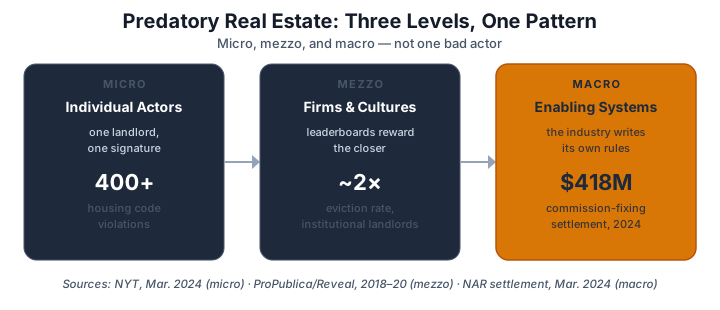
Figure 2 — The Three Levels Summarized
MACRO | Policy, law, regulatory capture, tax abatement abuse,
| antitrust violations, generational racial targeting
| Example: $454M civil fraud judgment, NAR settlement, RealPage DOJ case
------ +---------------------------------------------------------------
MEZZO | Firms, brokerages, LLCs, eviction mills, algorithmic pricing
| Example: Kushner Cos, RealPage, high-volume landlord-attorneys
------ +---------------------------------------------------------------
MICRO | Individual agent, landlord, loan officer, deed-theft operator
| Example: Ohebshalom, Croman, individual wholesaling scams
Antagonism reinforces itself across scales. Individual traits build organizational cultures; organizational cultures capture policy; captured policy shields individual traits.
Part 7: Red Flags — How to Recognize an Antagonistic Real Estate Actor Early
This is not a diagnostic checklist. It is a consumer-protection checklist informed by clinical patterns.
⚠ Red Flag Reference — Consumer Protection
Courtship Stage
- •• Love-bombing and flattery out of proportion to the relationship
- •• Pressure to sign before you have consulted your own attorney
- •• Claims of exclusivity or urgency that cannot be independently verified
- •• Discouragement of outside inspection, appraisal, or legal review
- •• Dismissal of questions with charm or condescension
Mid-Transaction
- •• Shifting terms between conversations and documents
- •• Paperwork presented at inconvenient times (evenings, weekends, closing day)
- •• Requests to sign blank or partially completed forms
- •• Hostility, guilt-tripping, or sudden coldness when you raise concerns
- •• "Handshake" assurances that contradict written terms
Ongoing Tenancy or Ownership
- •• Construction or maintenance "weaponized" against your habitability
- •• Retaliation following any formal complaint
- •• Document requests designed to intimidate rather than inform
- •• Selective enforcement — different rules for different tenants
- •• Any threat of deed theft, buyout pressure, or "cash for keys" without counsel
Part 8: Protecting Yourself in New York
New York has some of the strongest tenant and consumer protections in the country — but they have to be invoked to work. Here is where to start.
- •Always retain an independent real estate attorney for any transaction. In New York, three-day attorney review is standard. Use it. Do not share counsel with the other side.
- •For rent-regulated tenants: confirm your status with DHCR (Division of Housing and Community Renewal). Keep your own records. Understand the Housing Stability and Tenant Protection Act of 2019.59
- •If you are a homeowner approached by a "foreclosure rescue" investor: contact the New York Attorney General's Homeowner Protection Program (HOPP) — a free, statewide network of legal service providers and housing counselors.55
- •If you face eviction: New York City's Right to Counsel guarantees free legal representation for low-income tenants in Housing Court. Do not appear without counsel.60
- •If you believe you are being harassed: the NYC Tenant Protection Act allows civil suits for harassment, including punitive damages.61
- •Document everything. Text messages, emails, written promises, maintenance requests. Photograph conditions with timestamps.
- •If your mental health is suffering: this is an appropriate time to seek therapy. Mental Wealth Solutions and many other NY practices see financial trauma and housing-related stress as legitimate presenting concerns.
Part 9: For Mental Health Professionals
If you practice in New York, I want to invite a small expansion of your clinical frame:
- •Screen for housing instability in intake. A single question — "Is where you live right now secure?" — surfaces a staggering amount of clinical material.
- •Recognize financial trauma as a legitimate diagnostic frame. Many of our clients present with PTSD symptoms whose index trauma is a signature, not a single violent event.
- •Know your referral network. HOPP, tenant advocates, legal aid, housing counselors. Have the numbers before you need them.
- •Advocate upstream. Housing is mental health policy. Silence from the clinical community is itself a political choice.
Recap: What This Article Established
Ten thousand words is a long time to spend with a difficult subject. Here is what we documented and why it matters.
1. This is a clinical phenomenon, not just a business ethics problem. The antagonistic personality traits running through New York's predatory real estate industry — grandiosity, manipulativeness, deceitfulness, callousness, hostility — are the same traits clinical research identifies as the core of Narcissistic Personality Disorder and the DSM-5-TR's antagonism domain. They are overrepresented in commission-based, high-autonomy industries. They are not accidental features of the industry. They are selected for by its structure.
2. The predation operates at every scale simultaneously. Micro: the agent who love-bombs and manufactures urgency; the slumlord who weaponizes construction noise against an elderly tenant; the deed-theft operator who befriends a family in distress; the Facebook "cash buyer" who shows up at the door until the answer is yes; the Alexander brothers, celebrated as industry icons until a federal grand jury named what was underneath. Mezzo: the brokerage that puts the most aggressive closer on the wall; the LLC that absorbs housing court fines as a line item; the hedge fund that processes evictions through a spreadsheet two thousand miles away; the RealPage algorithm that coordinates rent increases without any single human making the decision. Macro: the industry that writes the regulations that govern it; the lobbying infrastructure that keeps the statute book favorable; the generational racial targeting that concentrates extraction in the same neighborhoods it has always targeted.
3. The mental health cost is real, documented, and clinically specific. Housing predation generates PTSD, Complex PTSD, Major Depressive Disorder, Generalized Anxiety Disorder, Financial Trauma, Prolonged Grief Disorder, and Race-Based Traumatic Stress — in documented populations, at documented rates, with documented neurobiological mechanisms. Children carry the ACEs forward into development and behavior. Families carry the grief of lost generational equity for decades. Clients carry the shame into therapy years after the transaction closed, and never connect it to the housing event — because no one asked.
4. The shame belongs to the predator, not the target. Accountability inversion — the systematic framing of predatory transactions so that the victim feels responsible — is a deliberate technique embedded in how these actors operate, not an accidental outcome. The person who was love-bombed into urgency, isolated from independent counsel, and pressured into waiving their rights was not naive. They were manipulated by someone who identified their vulnerabilities and engineered conditions to exploit them. The clinical intervention begins with naming that clearly and repeating it as many times as necessary.
5. The system is being contested, and some of it is changing. The 2024 NAR antitrust settlement restructured buyer-agent commissions for the first time in a generation. The New York AG's deed theft task force is prosecuting rings that operated for years without consequence. The Right to Counsel program is keeping tenants in homes that Housing Court would otherwise have emptied. The organizations documented in Part 5 — Met Council, NYLAG, the Furman Center, NLIHC, the Center for NYC Neighborhoods, the Coalition for the Homeless — are doing work that is measurable. The structural conditions that invite antagonism have not been dismantled. But the arc is being bent, unevenly, by people who refused to accept that predatory housing is simply the price of living in New York.
Mental Wealth Solutions — New York City
Housing-related trauma is real. And it is treatable.
If what you read here named something you have been carrying — a landlord's harassment, a transaction you are still ashamed of, a home you lost and have never been allowed to grieve — you do not have to work through it alone.
Book a Free ConsultationConclusion: The Shame Is Not Yours
In December 2024, two of New York's most publicly celebrated luxury real estate agents were arrested on federal charges. Tal and Oren Alexander had spent years on billboards, in industry press profiles, and across social media as the embodiment of what this business rewards: charm, aggression, the relentless close. The industry that had amplified them spent a weekend in silence before quietly removing the photos.
That arrest will not change New York real estate. It will not stop the deed-theft rings in East New York and Brownsville. It will not slow the hedge fund's next eviction filing, move the algorithm off someone's rent, or unwind the forty years of family equity that walked out of a home in Queens because an elderly woman signed a document she did not understand.
But it was seen. Named. Documented. And being seen is the precondition for anything changing.
That is true at the systemic level and it is equally true at the clinical level.
The tenant who first says out loud, in a therapy room or at a legal aid intake desk — what was done to me was wrong — has started something. The clinician who asks about housing at intake instead of assuming depression is purely intrapsychic has started something. The journalist, the public advocate, the attorney general, the tenant organizing neighbors on their floor for the first time — each of them started something. The research that names eviction as an ACE, financial fraud as a trauma, and rent-price coordination as a harm — that research started something too.
Antagonism is not destiny. The personality traits that drive predatory real estate behavior are real, they are elevated in this industry, and they are reinforced by structures that have been deliberately built. But structures are built by people, and people — under enough organized, documented, sustained pressure — have changed them before in New York. They will change them again.
If any part of this article named something you have been carrying — a landlord's harassment you have not spoken aloud, a transaction you are still ashamed of, a home you lost and have not yet been allowed to grieve — I want you to know that what happened to you was not your failure. And you do not have to work through it alone.
Book a free consultation at Mental Wealth Solutions. Let's talk about what you are facing and what a next step looks like.
Your mental wealth matters. Let's build it together.
Frequently Asked Questions
What is the difference between narcissism and antagonism? Narcissism is a specific personality disorder characterized by grandiosity, need for admiration, and lack of empathy (DSM-5-TR).6 Antagonism is a broader personality trait domain — the opposite of agreeableness — whose facets include manipulativeness, deceitfulness, grandiosity, callousness, and hostility. All narcissistic personalities score high on antagonism, but not everyone high on antagonism is a narcissist.
Are real estate agents more likely to be narcissists? Peer-reviewed research has not surveyed real estate agents directly, but Dark Triad traits — narcissism, Machiavellianism, psychopathy — are elevated in commission-based sales, finance, and executive populations generally.910 Industry structure (commission pay, information asymmetry, low repeat-game discipline) plausibly amplifies the effect in real estate.
What is deed theft and how does it happen in New York? Deed theft is a predatory scheme in which a homeowner — typically elderly, in financial distress, or unfamiliar with English — is induced by fraud or coercion to sign over their property for a fraction of its value. New York criminalized the practice in 2023, and the state Attorney General operates a dedicated task force.422
How do I know if my landlord is legally harassing me? Under the NYC Tenant Protection Act, harassment includes repeated acts intended to force a tenant from a regulated unit — construction abuse, threats, false evictions, service interruptions. You can file a complaint with the NYC Department of Housing Preservation and Development or pursue a private harassment cause of action.61
I think I was defrauded in a real estate transaction. What do I do? Document everything, contact a real estate attorney immediately (not the one from the transaction), and consider filing with the New York Department of State Division of Licensing Services and, if predatory lending is involved, the CFPB. For older adults, the NY AG's Consumer Frauds Bureau has a dedicated elder abuse division.
Legal and Clinical Disclaimer
This article is published for public education and consumer protection. It is not legal advice, medical advice, or a substitute for evaluation by a licensed professional. Nothing here diagnoses any individual, company, or public figure with a mental health condition — clinical diagnoses require direct evaluation by a qualified professional. References to public figures and companies are based on publicly reported legal proceedings, regulatory actions, and investigative journalism cited in the endnotes. If you believe you are a victim of real estate fraud or predatory practices in New York, contact an attorney. If you are in psychological distress, contact 988 (Suicide & Crisis Lifeline) or a licensed mental health professional. Mental Wealth Solutions PLLC is a New York State–registered mental health practice; see mentalwealthsolutions.org for clinical services.
Citations
Footnotes
- •
United States v. Tal Alexander, Oren Alexander, and Alon Alexander, U.S. District Court for the Southern District of New York, indictment unsealed December 11, 2024. See U.S. Department of Justice and SDNY press releases; contemporaneous reporting in The New York Times, Bloomberg, The Real Deal, and The Wall Street Journal. ↩ ↩2
- •
Mihir Zaveri, "A Notorious New York Landlord Heads to Jail," The New York Times, March 26, 2024. See also NYC Public Advocate's Office, "100 Worst Landlords" annual list. ↩ ↩2
- •
United States, State of New York, et al. v. RealPage, Inc., Complaint, U.S. District Court for the Middle District of North Carolina, August 23, 2024. U.S. Department of Justice press release, "Justice Department Sues RealPage for Algorithmic Pricing Scheme that Harms Millions of American Renters." ↩ ↩2
- •
Office of the New York State Attorney General, "Attorney General James Announces Charges Against Deed Theft Ring," press releases 2023–2024. See also NYS AG "Deed Theft Task Force" programmatic announcements. ↩ ↩2 ↩3 ↩4
- •
People of the State of New York v. Donald J. Trump et al., Index No. 452564/2022 (N.Y. Sup. Ct. 2024). Decision & Order After Non-Jury Trial, Justice Arthur Engoron, February 16, 2024. ↩
- •
American Psychiatric Association. Diagnostic and Statistical Manual of Mental Disorders, Fifth Edition, Text Revision (DSM-5-TR). Washington, D.C.: American Psychiatric Publishing, 2022. ↩ ↩2 ↩3 ↩4 ↩5 ↩6 ↩7 ↩8
- •
Stinson FS, et al. "Prevalence, correlates, disability, and comorbidity of DSM-IV narcissistic personality disorder: Results from the Wave 2 National Epidemiologic Survey on Alcohol and Related Conditions." Journal of Clinical Psychiatry. 2008;69(7):1033-1045. ↩
- •
Ronningstam, E. "Pathological Narcissism and Narcissistic Personality Disorder: Recent Research and Clinical Implications." Current Behavioral Neuroscience Reports. 2016;3(1):34-42. ↩
- •
Paulhus, D.L., & Williams, K.M. "The Dark Triad of personality: Narcissism, Machiavellianism, and psychopathy." Journal of Research in Personality. 2002;36(6):556-563. ↩ ↩2
- •
Boddy, C.R. "Corporate Psychopaths, Conflict, Employee Affective Well-Being and Counterproductive Work Behaviour." Journal of Business Ethics. 2014;121(1):107-121. ↩ ↩2
- •
Babiak, P., & Hare, R.D. Snakes in Suits: When Psychopaths Go to Work. New York: HarperCollins, 2006. ↩
- •
New York State Department of State, Division of Licensing Services, "Real Estate Salesperson License Requirements," dos.ny.gov. ↩
- •
Sitzer/Burnett v. National Association of Realtors, U.S. District Court, Western District of Missouri, jury verdict October 31, 2023; NAR settlement announcement, March 15, 2024. ↩ ↩2 ↩3
- •
Office of the New York City Public Advocate, "Worst Landlord Watchlist," annual 2017–2024 editions. ↩
- •
Office of the New York State Attorney General, "A.G. Schneiderman Announces Indictment of Notorious NYC Landlord Steven Croman," 2016; plea and sentencing 2017. ↩
- •
Thomas, M.E. Confessions of a Sociopath: A Life Spent Hiding in Plain Sight. New York: Crown, 2013. ↩
- •
United States v. Raphael Toledano, Southern District of New York, guilty plea 2021. Contemporaneous coverage in The New York Times, New York Magazine, Curbed, and The Real Deal. ↩
- •
Office of the New York City Public Advocate, 2018–2019 Worst Landlord Watchlist (Isaac Kassirer / Emerald Equity Group); see also investigative reporting by The City, Gothamist, and The New York Times, 2019–2022. ↩
- •
Office of the New York State Attorney General, "Attorney General James Announces Lawsuit Against Zara Realty for Deceptive and Illegal Practices," 2019 (and subsequent consent decree materials). ↩ ↩2
- •
Tenant-association litigation and regulatory complaints involving Sugar Hill Capital Partners, 2021–2024; investigative coverage in The City and The New York Times. ↩
- •
Tenant coalition litigation involving Greenbrook Partners, Kings County Housing Court and associated proceedings, 2022–2024; coverage in Brooklyn Eagle, The City, and NY1 News. ↩
- •
New York State Senate Bill S6577/A6656, signed by Governor Kathy Hochul, November 14, 2023. Press release, "Governor Hochul Signs Legislation to Strengthen Protections Against Deed Theft." ↩ ↩2
- •
Consumer Financial Protection Bureau. Reverse Mortgages: Report to Congress. June 2012; updated reports 2017, 2021. ↩
- •
Nick Penzenstadler and Jeff Kelly Lowenstein, "Seniors were sold a risk-free retirement with reverse mortgages. Now they face foreclosure." USA Today, June 11, 2019. ↩
- •
Consumer Financial Protection Bureau, "Non-QM Lending and the Return of Stated Income," industry monitoring reports 2022–2024. ↩
- •
National Association of Realtors, "Clear Cooperation Policy," adopted November 2019, effective January 1, 2020 (NAR Policy Statement 8.0). On dual agency research generally, see Hsieh, C. & Moretti, E. (2003). "Can free entry be inefficient? Fixed commissions and social waste in the real estate industry." Journal of Political Economy 111(5):1076-1122; see also NYS Department of State, Agency Disclosure requirements under New York Real Property Law §443. ↩ ↩2
- •
Real Estate Settlement Procedures Act (RESPA), 12 U.S.C. § 2607 (anti-kickback and referral fee prohibitions); New York Real Property Law §442-d; Consumer Financial Protection Bureau RESPA enforcement actions. ↩ ↩2
- •
Federal Trade Commission enforcement actions against predatory "cash buyer" and foreclosure rescue operations; FTC Consumer Alerts, "Scams Targeting Homeowners" series. See also NYS Attorney General consumer fraud bulletins on distressed property solicitations. ↩
- •
FBI New York Field Office consumer alerts on rental listing fraud; NYC Department of Consumer and Worker Protection, "Apartment Rental Scams" warnings (multiple years); NYPD Financial Crimes Unit public advisories. ↩
- •
Consumer Financial Protection Bureau, "Foreclosure Relief Scams," consumerfinance.gov; CFPB enforcement actions against foreclosure rescue operators. See also HUD-approved housing counselor network warnings. ↩
- •
Housman, M., & Minor, D. "Toxic Workers." Harvard Business School Working Paper 16-057, 2015. ↩
- •
Consumer Financial Protection Bureau, RESPA enforcement actions and guidance, consumerfinance.gov/compliance/supervision-examinations/respa/. See also CFPB Supervisory Highlights (multiple issues, 2016–2024) documenting kickback and referral fee arrangements between settlement service providers in residential real estate transactions. ↩
- •
New York Rules of Professional Conduct, Rule 1.7 (Conflict of Interest: Current Clients), Rule 1.8 (Conflict of Interest: Current Clients — Specific Rules including sexual relations with clients, subsection (j)), Rule 5.4 (Professional Independence of a Lawyer — fee-sharing prohibition with non-lawyers). Published by the New York State Unified Court System, 22 NYCRR Part 1200. ↩ ↩2 ↩3
- •
Alec MacGillis, "Kushner Companies Filed False Paperwork With City." ProPublica, March 18, 2018, and follow-up reporting. ↩
- •
Office of the New York State Attorney General, "Attorney General James Secures $3.25 Million From Kushner Companies For Deceiving Tenants And Rent Regulators," settlement announcement, 2021. ↩
- •
U.S. Department of Housing and Urban Development and Federal Housing Finance Agency, "REO-to-Rental" and Fannie Mae Bulk Sale Program materials, 2012–2013. ↩
- •
Invitation Homes, Inc., most recent SEC Form 10-K filing and investor disclosures. ↩
- •
Aaron Glantz et al., "When Wall Street Is Your Landlord," Reveal (Center for Investigative Reporting) in partnership with ProPublica, 2018–2020 investigative series. ↩
- •
Eviction Lab, Princeton University. evictionlab.org. New York City eviction filing data, 2017–2024. ↩ ↩2
- •
Desmond, M. Evicted: Poverty and Profit in the American City. New York: Crown, 2016. Pulitzer Prize for General Nonfiction, 2017. ↩ ↩2
- •
New York State Office of Court Administration, Housing Court filings data; NYC Right to Counsel Coalition annual reports. ↩
- •
Joye Brown, Ann Choi, David M. Schwartz, and colleagues. "Long Island Divided." Newsday, November 17, 2019. Three-year undercover investigation testing 93 Long Island real estate agents in Nassau and Suffolk counties; documented racial steering against Black, Hispanic, and Asian testers. newsday.com/long-island/long-island-divided. ↩
- •
United States v. County of Westchester, Case No. 06-cv-2860 (S.D.N.Y.), consent decree entered January 2009. U.S. Department of Housing and Urban Development press release, "Westchester County, N.Y., Agrees to Landmark Consent Decree to Resolve Claims of Housing Discrimination," January 7, 2009. Federal court-appointed Monitor reports, 2009–2022. ↩
- •
National Fair Housing Alliance (NFHA). Fair Housing Trends Report, annual editions 2019–2024. ↩ ↩2 ↩3
- •
New York State Department of State, Division of Licensing Services, Annual Enforcement Reports 2021–2023; complaint and disciplinary data for licensed real estate professionals. dos.ny.gov/licensing. ↩
- •
Holmes, T.H. & Rahe, R.H. (1967). "The Social Readjustment Rating Scale." Journal of Psychosomatic Research, 11(2), 213-218. ↩
- •
Felitti, V.J., et al. (1998). "Relationship of childhood abuse and household dysfunction to many of the leading causes of death in adults: The Adverse Childhood Experiences (ACE) Study." American Journal of Preventive Medicine, 14(4), 245-258. ↩
- •
Cutts, D.B., et al. (2011). "US housing insecurity and the health of very young children." American Journal of Public Health, 101(8), 1508-1514. ↩
- •
Marjanovic, Z., et al. (2012). "The cognitively-mediated coping model of fraud victimization." Psychology, Public Policy, and Law, 18(1), 66-104. See also the broader literature on HPA axis activation in response to financial threat. ↩ ↩2
- •
AARP Foundation, Fraud Victim Survey (multiple years); Kircheimer, S. Scam-Proof Your Life (2006); academic literature on shame and self-attribution in financial fraud victimization. ↩
- •
Fowler KA, et al. "Increase in Suicides Associated with Home Eviction and Foreclosure During the US Housing Crisis." American Journal of Public Health. 2015;105(2):311-316. See also Desmond M, Kimbro RT. "Eviction's Fallout: Housing, Hardship, and Health." Social Forces. 2015;94(1):295-324. ↩
- •
World Health Organization. International Classification of Diseases, 11th Revision (ICD-11). Complex PTSD criteria, 2018; Herman, J.L. Trauma and Recovery. 1992, rev. 2015. ↩ ↩2
- •
Rugh, J.S., & Massey, D.S. "Racial Segregation and the American Foreclosure Crisis." American Sociological Review. 2010;75(5):629-651. ↩ ↩2
- •
Bryant-Davis, T. & Ocampo, C. (2005). "Racist-incident-based trauma." The Counseling Psychologist, 33(4), 479-500. Carter, R.T. (2007). "Racism and Psychological and Emotional Injury: Recognizing and Assessing Race-Based Traumatic Stress." The Counseling Psychologist, 35(1), 13-105. ↩ ↩2 ↩3
- •
New York State Homeowner Protection Program (HOPP), administered through the Office of the Attorney General and authorized local partners. ↩ ↩2 ↩3
- •
OpenSecrets.org, National Association of Realtors lobbying and political contributions, multi-cycle data; New York State Board of Elections filings for Real Estate Board of New York and related PACs. ↩ ↩2
- •
Citizens Budget Commission, "The 421-a Tax Exemption: A Cost to New York City," analyses 2015–2022. ↩
- •
New York City Independent Budget Office, "Estimated Revenue Loss from the 421-a Tax Abatement," fiscal year reports. ↩
- •
New York State Housing Stability and Tenant Protection Act of 2019 (S6458/A8281). ↩
- •
New York City Administrative Code §26-1301 et seq. ("Universal Access to Legal Services"), the NYC Right to Counsel law, effective 2017. ↩
- •
New York City Administrative Code §27-2004 et seq., "Harassment of Tenants" provisions; see NYC HPD guidance. ↩ ↩2