Narcissistic abuse is a pattern of psychological and emotional manipulation that systematically erodes a person’s ability to trust their own perception, their own needs, and in many cases their own memory of what happened to them. It is rarely loud. It is almost never a single incident. It is a structural feature of a relationship that uses charm, intermittent reward, and reality distortion to produce an exhausted, hypervigilant, and confused partner. The questions below are the ones survivors ask most often once the fog starts to lift.
What Is Narcissistic Abuse?
Narcissistic abuse is a pattern of psychological and emotional manipulation that leaves you questioning your own reality. It doesn’t look like what most people imagine abuse looks like. There’s rarely shouting. Often, there’s charm. What defines it is the systematic erosion of your sense of self — through gaslighting, intermittent reinforcement, and the slow replacement of your perceptions with someone else’s narrative.
It’s not about one bad argument or one difficult person. It’s about a pattern that recurs, escalates subtly, and leaves you feeling like the problem.
Clinically, the term does not require that the other person carry a formal diagnosis of Narcissistic Personality Disorder. Judith Herman’s work on complex trauma (Herman, 1992) describes how prolonged, repeated interpersonal harm produces a predictable set of sequelae — hypervigilance, disrupted self-concept, difficulty trusting one’s own perception — whether or not the harm-doer meets criteria for any particular disorder. The point of the label “narcissistic abuse” is not to diagnose the other person. It is to name a pattern the survivor has been living inside without words for it.
How Is It Different From a High-Conflict Relationship?
High-conflict relationships can be painful and corrosive without being abusive. What distinguishes narcissistic abuse is not the volume of conflict. It is the direction of the distortion.
In an ordinary high-conflict relationship, both people generally agree on what happened, even when they disagree about who was at fault. In a narcissistically abusive relationship, the history itself is contested. Events are rewritten in real time. A conversation the survivor remembers having one way is reported back as having happened another way, with the survivor as the aggressor. Over months and years, this produces what Robert Stolorow has described as the erosion of a stable “sense of being” — the basic feeling that one’s experience is one’s own (Stolorow, 2007).
Some markers that tend to distinguish the two:
- In ordinary conflict, repair is possible. In narcissistic abuse, apologies are used to end the conversation, not to acknowledge harm.
- In ordinary conflict, both people feel bad after a fight. In narcissistic abuse, one person feels bad and the other feels justified.
- In ordinary conflict, you leave the room still knowing what you think. In narcissistic abuse, you leave the room no longer sure what you think.
- In ordinary conflict, the relationship has range. In narcissistic abuse, the relationship oscillates between idealization and withdrawal, and the middle is gone.
Why Didn’t I See It Sooner?
This is the question survivors ask with the most shame, and it has the clearest clinical answer. The abuse did not start at the level it ended at. It started inside a period of idealization — what some clinicians call the “love bombing” phase — in which the other person was attentive, attuned, and intensely focused on the survivor. Attachment forms during this phase, and it forms fast. The nervous system encodes the early attunement as a template for what the relationship is.
When the pattern changes, the nervous system does not immediately update. It treats the new, harmful behavior as a deviation from the “real” relationship, and it waits for the earlier version to come back. This is how attachment works under conditions of intermittent reinforcement, a dynamic originally described in operant conditioning research (Skinner, 1953) and later extended into the relational context by Dutton and Painter in their foundational work on traumatic bonding (Dutton & Painter, 1993).
You also did not see it because you were not looking for it. Most people do not enter relationships scanning for structured manipulation. That is a baseline assumption that most relationships are what they appear to be. In the cases where it is not, the assumption itself is used against you. The shame survivors carry about “missing the signs” is usually misplaced. You were reading the relationship the way a reasonable person reads any relationship. That is not the flaw.
Can a Narcissist Change?
The honest clinical answer has two layers.
First: yes, in theory, any human capable of self-reflection and willing to do the work can change. There are documented cases of people with narcissistic traits who, through long-term psychotherapy and a significant internal reckoning, developed more stable empathy and less defensive relating. These cases exist. They are rare, and they share a feature that almost never appears in the relationships survivors ask this question about: the person sought help on their own, without the pressure of losing a relationship, and stayed in treatment for years.
Second: change under the pressure of an ultimatum is not what usually happens. Patrick Carnes’s work on betrayal bonds (Carnes, 1997) describes a recurring pattern in which the harm-doer improves briefly during periods of relationship threat — a phase sometimes called “hoovering” — and then returns to baseline once the relationship is secure again. This is not evidence of change. It is evidence of a pattern that includes temporary improvement as part of its structure.
The question survivors are usually asking underneath “can they change” is: is it safe to hope? The clinically honest answer is that hope is not the problem. Staying in a harmful relationship on the basis of hope is the problem.
Why Does No Contact Feel Impossible?
Because in the early weeks, it is supposed to. No contact feels impossible because the survivor’s nervous system is in withdrawal from an intermittent reinforcement schedule, and withdrawal is a physiological event, not a mindset.
Variable reinforcement schedules (Skinner, 1953) produce the most persistent behavioral patterns of any reinforcement schedule and are remarkably resistant to extinction. Helen Fisher’s work on the neurochemistry of romantic attachment (Fisher, 2004; Fisher et al., 2010) shows that dopaminergic reward circuitry is activated not only by reward itself but by the anticipation of reward, and most intensely when the reward is uncertain. When you cut contact, you are not just leaving a person. You are depriving a dopaminergic reward system of the unpredictable input it was trained on. The system does not go quietly.
What this produces in the early weeks:
- Intrusive memories, usually of the best moments rather than the worst.
- A physical craving indistinguishable from longing.
- A sudden urge to “just check” social media or old messages.
- The reappearance of hope that the relationship could have been different.
Every one of these is a withdrawal symptom. None of them is evidence that you should return. The S.T.O.I.C.K. method is one framework for working with these body-state urges when they arise, because the work of no contact is nervous-system work, not willpower work. Breaking contact is not about being strong. It is about staying out long enough for the reward anticipation system to extinguish.
Am I the Narcissist?
The fact that you are asking this question is, by itself, the strongest single piece of evidence that you are not. People with narcissistic traits, as a rule, do not wonder in good faith whether they are the problem. They wonder whether other people are the problem.
There is a more specific clinical reason this question shows up so often among survivors. Gaslighting produces uncertainty about one’s own reality. Over time, the survivor internalizes the other person’s framing — that they are too sensitive, too reactive, too needy, too much — and begins to inspect themselves for the traits they have been accused of. This is not evidence of narcissism. It is evidence of the kind of reality distortion Herman (1992) described as central to complex trauma. The survivor’s self-inspection is a residue of the abuse, not a revelation about their character.
If you are concerned about a specific pattern in yourself, that concern is best worked through with a clinician who can hold the nuance, not resolved through internet quizzes. But the reflexive, anxious, recurring “what if I’m the narcissist” question is almost always a symptom of the damage, not a diagnosis of it.
Do I Have C-PTSD?
Complex post-traumatic stress disorder — C-PTSD — is the diagnostic framework that most closely describes the aftermath of prolonged interpersonal abuse. It was proposed by Judith Herman (1992) to capture what standard PTSD missed: the way chronic, inescapable harm produces symptoms that go beyond intrusive memories and hyperarousal and into the structure of a person’s self-concept, relationships, and emotional regulation.
The hallmarks Herman described include disturbances in affect regulation (feeling flooded or numb with no middle setting), disturbances in self-perception (pervasive shame, feeling permanently damaged), disturbances in relating to others (difficulty trusting, oscillation between over-closeness and distance), and a distorted perception of the harm-doer that persists long after the relationship ends. Bessel van der Kolk’s The Body Keeps the Score (2014) adds the physiological layer: chronic interpersonal stress keeps the nervous system locked in hypervigilance and encodes bodily states as long-term features of daily life. Stephen Porges’s polyvagal theory (Porges, 2011) clarifies that these are not character traits but autonomic states, and that they can shift when the nervous system has repeated experiences of actual safety.
Only a qualified clinician can actually assess for C-PTSD. But if you read that list and a large number of those items feel familiar, what you are feeling is not weakness and it is not permanent. It is a trauma response, and it is one that nervous systems are capable of recovering from.
How Long Does Recovery Take?
Longer than anyone wants, and shorter than survivors fear in the early weeks. Individual timelines vary widely, and nothing in this section is a promise. What clinical observation across trauma recovery work does suggest is a rough arc.
- Weeks 1 to 4 (acute withdrawal): intrusive longing, physical craving, frequent urges to break no contact. The hardest phase, and the one survivors most often break no contact during.
- Weeks 4 to 12 (fog lifting): sleep starts to improve, the first stretches of genuine relief arrive, and the survivor begins to remember details they had blocked out. Memories return faster than the survivor’s ability to process them.
- Months 3 to 12 (reconstruction): the work shifts from surviving the absence to rebuilding a life inside it. Herman (1992) described this as the reconstruction phase, characterized by a return of ordinary interests and the slow re-emergence of a sense of self that is not organized around managing the other person.
- Beyond a year (integration): the experience becomes part of the survivor’s story rather than the whole story. Waves still arrive, often around anniversaries, but they pass without pulling the survivor under.
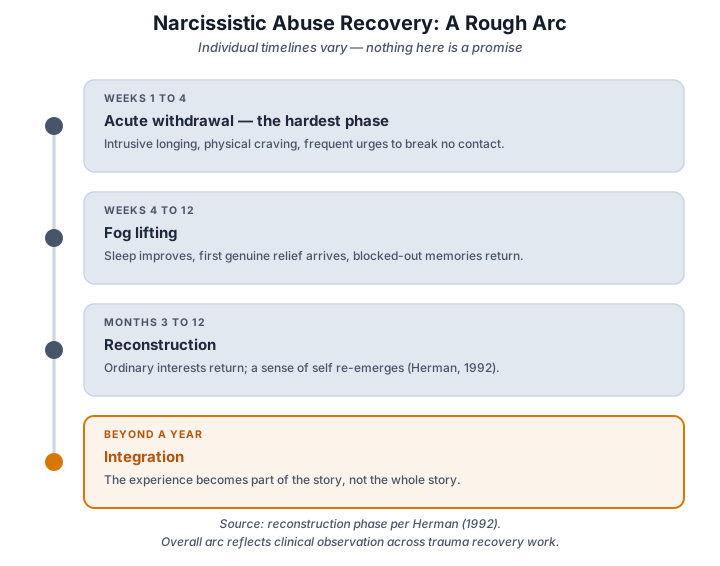
Recovery is not linear. Intermittent contact — even a single text — tends to reset the clock by reactivating the reward anticipation system. Frameworks like R.A.V.E.S. exist because recovery is a nervous system project, not a willpower project.
What Does Real Recovery Actually Look Like?
Recovery isn’t about understanding them. It’s about returning to yourself.
The first phase involves recognizing the pattern for what it is — not a relationship problem, not a communication issue, not something you could have fixed. A pattern. One that was functioning exactly as intended.
The second phase is grieving. Not the person — but the version of the relationship you believed existed. That version was real to you. The loss of it is real. Skipping this part doesn’t work. Kenneth Doka’s concept of “disenfranchised grief” (Doka, 1989) — grief that a person’s social world does not recognize or validate — applies squarely here. Survivors are often told they should feel relief, not grief, and when grief arises anyway they feel there is something wrong with them. There is not. Disenfranchised grief is still grief, and it is often more painful than validated grief precisely because it has to be carried privately.
The third phase is reconstruction. Rebuilding trust in your own perceptions. Reconnecting with your values, your responses, your instincts — the ones that got quieted. This is where therapy does its most important work.
Recovery isn’t linear and it doesn’t have a deadline. But it does happen. The fog clears. Your instincts come back online. You stop explaining yourself to people who were never listening.
Frequently Asked Questions
Can narcissistic abuse happen outside of romantic relationships? Yes. The same pattern can occur in parent-child, sibling, workplace, friendship, and religious community contexts. The dynamics are structurally identical; what changes is the survivor’s ability to leave. Adult children of narcissistic parents often describe a lifelong version of the same fog, with the added difficulty that the attachment was present before they had language for anything.
Does going gray rock work? Gray rock — becoming flat and non-reactive — can reduce the frequency of hostile interactions in situations where no contact is not possible, such as co-parenting. It is a containment tool, not a recovery tool. It reduces supply without healing the underlying nervous system impact, and it should not be confused with the deeper work of recovery.
Is it possible to heal while still in the relationship? In most cases, no. The nervous system cannot recalibrate while the source of dysregulation is still present. Short of separation, things can help — individual therapy, support groups, safety planning — but the deeper recovery work described by Herman (1992) and van der Kolk (2014) depends on repeated experiences of actual safety, which is difficult to manufacture inside an ongoing harmful dynamic.
Why do I keep dreaming about them? Dreams about the former partner, especially in the early months, are part of the nervous system’s processing of encoded material. They do not indicate unresolved love, and they are not a sign to reach out. Van der Kolk (2014) describes how traumatic material is often processed during sleep. The dreams tend to fade as the waking nervous system settles.
Should I tell people what happened? Only when and to whom it feels safe. Narcissistic abuse is often invisible from the outside, and survivors frequently encounter disbelief or social pressure to “work it out” — a form of disenfranchisement (Doka, 1989) that can make disclosure worse than silence. Telling the story is valuable when told to people who can hold it, especially a clinician trained in complex trauma. Telling it to people who cannot hold it is re-injury.
A Note on Recovery
Understanding the pattern does not make the nervous system stop responding to it. Understanding is step one. The rest of the work is physiological, and it happens over time, in safety, with support. If you are in the early weeks and the weight feels like it will never lift, the clinical answer is that it will lift, and the work is to keep the nervous system out of contact long enough to recalibrate.
If you want to do this work with someone who treats narcissistic abuse as physiology rather than weakness, book a free consultation.
Matthew Sexton, LCSW is a licensed clinical social worker who has treated survivors of narcissistic abuse and complex trauma since 2015. He has directed clinical programs across thirteen settings, including substance abuse treatment, forensic assertive community treatment, and disaster case management. He founded Mental Wealth Solutions to help survivors rebuild their nervous system, reclaim their sovereignty, and do the real work of recovery in a setting that respects the physiological reality of what they have been through.
Disclaimer
This article is for educational and informational purposes only. It does not constitute medical, clinical, legal, or therapeutic advice, and reading it does not create a therapist-client relationship with Matthew Sexton, LCSW or Mental Wealth Solutions, Inc.. Although the author is a licensed clinical social worker, the content in this article is not clinical assessment, diagnosis, or treatment.
The patterns, concepts, and recovery frameworks described here reflect clinical research and general observations across trauma recovery work. Individual experiences vary, and what is described here may not match every reader’s situation. If you are working through narcissistic abuse, complex trauma, or a trauma bond, please consult a licensed mental health professional who can assess your specific circumstances.
If you are in immediate emotional crisis, you can reach the 988 Suicide & Crisis Lifeline by calling or texting 988 (US). If you are experiencing domestic violence or are in physical danger, contact the National Domestic Violence Hotline at 1-800-799-7233 or visit thehotline.org. In a life-threatening emergency, call 911.
References
Carnes, P. (1997). The Betrayal Bond: Breaking Free of Exploitive Relationships. Health Communications.
Doka, K. J. (1989). Disenfranchised Grief: Recognizing Hidden Sorrow. Lexington Books.
Dutton, D. G., & Painter, S. (1993). Emotional attachments in abusive relationships: A test of traumatic bonding theory. Violence and Victims, 8(2), 105–120.
Fisher, H. (2004). Why We Love: The Nature and Chemistry of Romantic Love. Henry Holt.
Fisher, H. E., Brown, L. L., Aron, A., Strong, G., & Mashek, D. (2010). Reward, addiction, and emotion regulation systems associated with rejection in love. Journal of Neurophysiology, 104(1), 51–60.
Herman, J. L. (1992). Trauma and Recovery: The Aftermath of Violence. Basic Books.
Porges, S. W. (2011). The Polyvagal Theory: Neurophysiological Foundations of Emotions, Attachment, Communication, and Self-Regulation. W. W. Norton.
Skinner, B. F. (1953). Science and Human Behavior. Macmillan.
Stolorow, R. D. (2007). Trauma and Human Existence: Autobiographical, Psychoanalytic, and Philosophical Reflections. Routledge.
van der Kolk, B. A. (2014). The Body Keeps the Score: Brain, Mind, and Body in the Healing of Trauma. Viking.
If this named something you're living with —
You don't have to figure it out from articles. Matthew Sexton, LCSW, NATC sees adults in therapy at his separate private practice (telehealth · NY · ME · DE · FL). Or take this piece to your own therapist — it's written to be shared.
Visit the practice