A vulnerable narcissist has the same core as every other narcissist: entitlement, a constant need for validation, and real difficulty caring how you feel. The delivery is what differs. Instead of swagger you get fragility, wounded silence, and a running story in which they are always the one being harmed. Narcissistic personality disorder has a lifetime prevalence of about 6.2% of U.S. adults, according to the National Epidemiologic Survey on Alcohol and Related Conditions, which interviewed 34,653 people (Stinson et al., 2008). The trait pattern is broader than the diagnosis, and the quiet version of it is the one almost nobody teaches you to recognize.
Two presentations, one core
Researchers have described this split since at least 1991, when psychologist Paul Wink published “Two Faces of Narcissism.” Grandiose narcissism is the face everyone knows: bold, dominant, charming, thick-skinned, hungry for the spotlight. Vulnerable narcissism, sometimes called covert or hypersensitive narcissism, looks nearly opposite. Anxious. Easily wounded. Withdrawn, resentful, and preoccupied with how unfairly life has treated them.
The surfaces differ. The center is shared: a rigid sense of specialness, entitlement to other people’s time and emotional energy, and a limited capacity for genuine reciprocity. Where the grandiose narcissist demands admiration outright, the vulnerable narcissist extracts care through displays of suffering.
Watch what the suffering does, because this is the most useful distinction in the whole literature. Real vulnerability involves risk: openness to feedback, a willingness to be changed by what another person sees. The vulnerable narcissist’s version demands a response from you and refuses any influence from you.
The engine underneath
The Canadian Psychological Association’s fact sheet on narcissism (2025) puts it plainly: vulnerability can be understood as primary narcissism. Internalized shame, low self-worth, and difficulty processing criticism sit at the core of all narcissistic behavior, including the grandiose kind. The CPA also notes that people with clinical narcissism oscillate between grandiose and vulnerable states, which is part of why there are no officially recognized subtypes.
If you have lived with someone like this, you already know the oscillation. Entitled and superior in the morning. Collapsed into self-pity by dinner, convinced everyone is against them. That whiplash is not two different people. It is one person cycling between two defenses of the same fragile self-image.
The research that reframed vulnerable narcissism
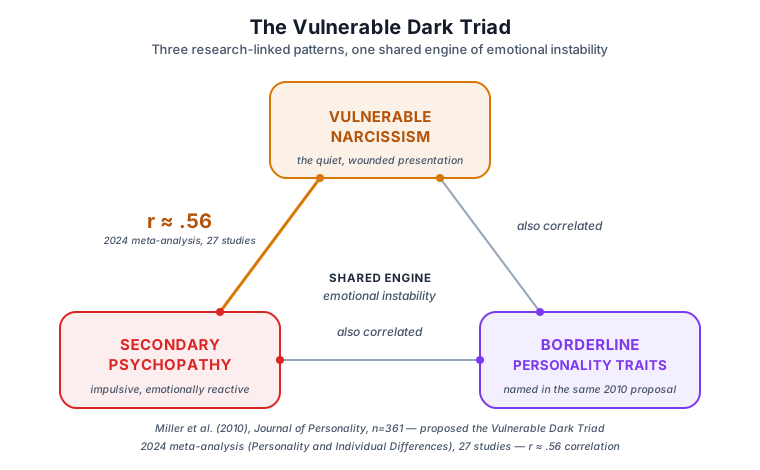
In 2010, personality researcher Joshua Miller and colleagues proposed the “Vulnerable Dark Triad”: vulnerable narcissism, secondary psychopathy (the impulsive, emotionally reactive variant), and borderline personality traits, studied together in a sample of 361 adults (Journal of Personality, 2010). The proposal was that these three patterns share an engine of emotional instability, the way the classic Dark Triad shares callousness.
The proposal held up. A 2024 meta-analysis in Personality and Individual Differences pooled 27 studies and found all three traits significantly intercorrelated, with vulnerable narcissism and secondary psychopathy correlating at roughly .56, a large overlap by personality-research standards. In plain terms, the quiet, wounded presentation sits statistically closer to the reactive variant of psychopathy than most people would guess.
One more finding deserves plain language. A study of 740 Italian adults (Journal of Personality Disorders, 2014) measured moral disengagement: the mental habit of rationalizing harm you have caused, with thoughts like “they brought it on themselves” or “it wasn’t that bad.” Moral disengagement tracked with vulnerable narcissism and with both variants of psychopathy. It showed no link to grandiose narcissism. The presentation built around being hurt carries the same self-excusing machinery researchers find in psychopathy, and that helps explain why the apologies feel hollow. By the time one reaches you, the harm has often already been explained away internally.
The empathy question
A meta-analytic review covering 32,200 participants looked at both kinds of empathy: cognitive, meaning the ability to read what you feel, and affective, meaning the capacity to feel it with you (Urbonaviciute & Hepper, 2020). Grandiose narcissism’s deficit showed up mainly on the affective side; on behavioral tasks, grandiose individuals could still read emotions about as well as anyone. Vulnerable narcissism was associated with lower self-reported empathy on both sides.
In practice: the grandiose narcissist can often read you accurately and simply does not feel the cost of using what they see. The vulnerable narcissist tends to struggle with the reading too.
A 2025 study helps explain why. Researchers tested 220 adults and found that alexithymia, the difficulty identifying and describing your own emotions, helped account for the link between vulnerable narcissism and reduced affective empathy (Bond & Lutz-Zois, Journal of Aggression, Maltreatment & Trauma, 2025). A person who cannot read their own internal states has no reference point for yours.
If someone close to you chronically says “I don’t know why I did that” or “I can’t explain what I’m feeling,” that may be literally true. It is also not a defense. Their not-knowing does not make your hurt less real, and it does not transfer the job of managing their inner life to you.
One more verified finding belongs here. Dickinson and Pincus (2003) found that people with vulnerable narcissism report high interpersonal distress, and that most describe fearful or preoccupied attachment styles. The distress you see is usually genuine. It is organized around threats to a fragile self-image rather than around the wellbeing of the relationship.
What the pattern looks like up close
Partners, adult children, and close friends of vulnerable narcissists describe a remarkably consistent cluster.
Chronic victimhood. In their telling, every conflict is something that happened to them. Every ex was toxic, every boss was threatened by them, every old friend eventually betrayed them. When someone’s entire history has one blameless protagonist and a full cast of villains, pay attention to the casting.
Extraction without asking. The vulnerable narcissist rarely makes direct demands. Guilt, sighs, wounded withdrawal, and sacrifices nobody requested (carefully remembered, frequently mentioned) do the asking instead. You end up doing enormous amounts of caretaking that no one ever asked for out loud.
Punishment by withdrawal. After a perceived slight comes the silent treatment, the cold distance, the sudden unavailability. You learn to pursue, apologize, and re-earn warmth you did nothing to lose.
A ledger of grievances. A long, detailed memory of every wrong ever done to them, kept ready. In conflict, the ledger comes out, the blame resets, and the original topic disappears.
Hidden entitlement. It looks less like demanding the best table at a restaurant and more like an unspoken expectation that you will manage their moods, anticipate their needs, and absorb their distress indefinitely, without reciprocation. When you fall short, the response is wounded collapse rather than rage, and it lands as punishment all the same.
Outsized reactions to small slights. A delayed text. A lukewarm response to their news. An evening you spent with friends. The hurt these trigger is real to them, which is exactly what makes it hard to challenge without feeling cruel.
The view from inside the relationship
From outside, none of this looks like much. From inside, people describe the same experiences again and again.
You track their mood before you share your own news. The relationship has quietly reorganized so that their feelings are the weather and yours are a private matter.
Conversations about problems end with their suffering. You raise a concern. Forty minutes later you are the one apologizing, and the concern never got discussed. This is a maneuver, practiced until it is automatic, even if nobody involved would call it a strategy.
You feel worse and cannot point to why. Nothing is overtly cruel. It is a look, a pause, a forgotten commitment, coldness arriving right after you expressed a need. People in these relationships often say they walk on eggshells but cannot name the rule they are afraid of breaking.
Your needs read as attacks. A boundary is received as abandonment. Dissatisfaction is received as betrayal. Over time you learn to suppress your needs before they surface, and you may stop noticing you have them.
Partners of grandiose narcissists often describe fear of explosive anger. Partners of vulnerable narcissists describe something quieter: constant vigilance oriented around the other person’s fragility. You self-censor to prevent a collapse, and to avoid the guilt that follows one. If you have felt that and doubted yourself for feeling it, the research in this article is on your side. The pattern is real, it is described in the clinical literature, and other people have lived exactly this.
Why even professionals miss it
The reasons this presentation slips past clinicians are structural, and worth naming as clinical observations rather than statistics.
The symptoms overlap heavily with depression, anxiety, and complex trauma: low self-esteem, interpersonal sensitivity, emotional dysregulation, chronic emptiness. Clinicians are trained to attune to suffering, and this presentation supplies suffering convincingly. The natural pull is toward sympathy and protection, which quietly confirms the client’s self-concept as a blameless victim of other people’s failings.
Therapy itself can become another arena for validation. The client may enter voluntarily, speak the language of self-improvement, and describe their patterns with impressive clarity while continuing to enact them unchanged outside the session. Insight that never turns into changed behavior mostly upgrades the vocabulary.
Couples therapy carries a specific risk. After years of this dynamic, the other partner has often developed reactive behaviors: withdrawal, irritability, emotional flatness. In the room, that partner can look like the problem. If this happened to you in couples work, you are not the first, and it does not mean your read on the relationship was wrong.
What the research means if you love one
Practically, the findings above translate into a few hard but useful expectations.
The insight moment you are waiting for may not come. The alexithymia research matters here. You cannot will another adult into emotional literacy, any more than you can will someone into better eyesight.
The victimhood is structural. It functions as a threat-detection system calibrated to protect the self-image, and every interaction gets filtered through it. Waiting for the day they finally notice the pattern usually means waiting through more of the pattern.
The hollow apology is hollow for a reason. Genuinely owning harm requires holding “I did something wrong” without the self fragmenting. The moral-disengagement research suggests this is precisely the capacity that is compromised.
The feelings are real and the accountability is absent, at the same time. You are not imagining either half. The tears are genuine. The change never comes. Both can be true of the same person, and the research says they routinely are.
A word about origins. Vulnerable narcissism is widely understood to grow out of early environments heavy on shame and thin on steady affirmation, which fits the CPA’s framing of internalized shame as the core. Many people in these relationships hold real compassion for that history. Compassion for the origin does not obligate you to absorb the adult behavior. Understanding a cause and excusing an effect are different acts.
What helps
Name the pattern precisely. That is what an article like this is for. Naming a pattern is not the same as diagnosing a person; only a licensed clinician who has evaluated someone can do that, and the label matters far less than how the relationship treats you. (If the person in your life leads with helpfulness instead of woundedness, the related pattern is communal narcissism.)
Get outside reality-testing. This dynamic survives on isolation and on the gap between the public persona and your private experience. One trusted friend, one support group, or one therapist who hears the specifics can break the sealed loop of self-doubt.
Consider individual therapy with someone who understands antagonistic relational patterns. The purpose is to name what happened accurately and rebuild the parts of you that years of managing another person’s inner weather wore down. That work is standard, it is unglamorous, and it does not require you to have made any decision about the relationship first.
FAQ
Is “vulnerable narcissist” an official diagnosis? No. The DSM-5-TR recognizes narcissistic personality disorder. Grandiose and vulnerable narcissism are research-described presentations, and the Canadian Psychological Association notes that people tend to oscillate between them rather than belonging to a fixed subtype. The description is useful for making sense of your experience. Diagnosis belongs to a licensed clinician who has evaluated the actual person.
Can the same person be grandiose one day and vulnerable the next? Yes. Oscillation between grandiose and vulnerable states is well documented, and the Canadian Psychological Association’s 2025 fact sheet treats it as expected rather than exceptional. Superiority when things go well, collapse and blame when they do not, sometimes within a single conversation.
Do I need to have left the relationship to start therapy? No. You can start therapy while you are still in the relationship, still unsure, or still years away from any decision. A good therapist helps you see clearly and stay safe at whatever point you are standing. If you are in physical danger, safety planning comes first: the National Domestic Violence Hotline at 1-800-799-7233 is available around the clock.
Is every sensitive, easily hurt person a vulnerable narcissist? No. Sensitivity to criticism is common and human. The pattern described here requires the rest of the machinery: entitlement, missing reciprocity, chronic victimhood, and harm that never gets owned. If someone is sensitive and also curious about your experience, able to apologize and able to change, that is just a sensitive person.
Sources
- Stinson, F. S., et al. (2008). Prevalence, correlates, disability, and comorbidity of DSM-IV narcissistic personality disorder: Wave 2 NESARC. Journal of Clinical Psychiatry, 69(7). https://www.psychiatrist.com/jcp/prevalence-correlates-disability-comorbidity-dsm-iv-narcissistic-personality-disorder-wave-2-nesarc/. Supports the lifetime NPD prevalence of about 6.2% among U.S. adults, from interviews with 34,653 people.
- Miller, J. D., et al. (2010). Searching for a Vulnerable Dark Triad. Journal of Personality, 78(5). https://onlinelibrary.wiley.com/doi/abs/10.1111/j.1467-6494.2010.00660.x. Supports the Vulnerable Dark Triad proposal and the 361-participant sample.
- Unveiling the fragile façade: A scoping review and meta-analysis of the Vulnerable Dark Triad (2024). Personality and Individual Differences. https://www.sciencedirect.com/science/article/pii/S0191886924001193. Supports the 27-study pooled analysis, the intercorrelation of all three traits, and the roughly .56 correlation between vulnerable narcissism and secondary psychopathy.
- Fossati, A., Pincus, A. L., Borroni, S., Munteanu, A. F., & Maffei, C. (2014). Are pathological narcissism and psychopathy different constructs or different names for the same thing? Journal of Personality Disorders, 28. https://guilfordjournals.com/doi/10.1521/pedi_2014_28_127. Supports the 740-adult sample and the finding that moral disengagement related to narcissistic vulnerability and both psychopathy variants, with no link to narcissistic grandiosity.
- Urbonaviciute, G., & Hepper, E. G. (2020). When is narcissism associated with low empathy? A meta-analytic review. Journal of Research in Personality. https://www.sciencedirect.com/science/article/abs/pii/S0092656620301252. Supports the 32,200-participant scope and the cognitive/affective empathy findings for grandiose and vulnerable narcissism.
- Bond, E. A., & Lutz-Zois, C. J. (2025). Alexithymia as a mediator of the relationship between the Vulnerable Dark Triad and empathy. Journal of Aggression, Maltreatment & Trauma, 34(5). https://www.tandfonline.com/doi/abs/10.1080/10926771.2025.2494108. Supports the 220-participant sample and the finding that alexithymia mediated the link between vulnerable narcissism and reduced affective empathy.
- Canadian Psychological Association (2025). Psychology Works Fact Sheet: Narcissism. https://cpa.ca/psychology-works-fact-sheet-narcissism/. Supports the vulnerability-as-primary-narcissism framing, the shame core, and grandiose–vulnerable oscillation.
- Dickinson, K. A., & Pincus, A. L. (2003). Interpersonal analysis of grandiose and vulnerable narcissism. Journal of Personality Disorders, 17. https://pure.psu.edu/en/publications/interpersonal-analysis-of-grandiose-and-vulnerable-narcissism/. Supports the high interpersonal distress and fearful/preoccupied attachment findings.
- Wink, P. (1991). Two faces of narcissism. Journal of Personality and Social Psychology, 61(4), 590–597. Framework reference for the grandiose/vulnerable distinction; no figures drawn from it.
Figures current as of July 2026.
Disclaimer
This article is for educational and informational purposes only. It does not constitute medical, clinical, legal, or therapeutic advice, and reading it does not create a therapist-client relationship with Matthew Sexton, LCSW or Mental Wealth Solutions, Inc. Although the author is a licensed clinical social worker, the content in this article is not clinical assessment, diagnosis, or treatment.
The patterns, concepts, and frameworks described here reflect published research and general clinical observations. Individual experiences vary, and what is described here may not match every reader’s situation. If you are working through the concerns described in this article, please consult a licensed mental health professional who can assess your specific circumstances.
If you are in immediate emotional crisis, you can reach the 988 Suicide & Crisis Lifeline by calling or texting 988 (US). If you are experiencing domestic violence or are in physical danger, contact the National Domestic Violence Hotline at 1-800-799-7233 or visit thehotline.org. In a life-threatening emergency, call 911.
Frequently asked questions.
- Is "vulnerable narcissist" an official diagnosis?
- No. The DSM-5-TR recognizes narcissistic personality disorder. Grandiose and vulnerable narcissism are research-described presentations, and the Canadian Psychological Association notes that people tend to oscillate between them rather than belonging to a fixed subtype. The description is useful for making sense of your experience. Diagnosis belongs to a licensed clinician who has evaluated the actual person.
- Can the same person be grandiose one day and vulnerable the next?
- Yes. Oscillation between grandiose and vulnerable states is well documented, and the Canadian Psychological Association's 2025 fact sheet treats it as expected rather than exceptional. Superiority when things go well, collapse and blame when they do not, sometimes within a single conversation.
- Do I need to have left the relationship to start therapy?
- No. You can start therapy while you are still in the relationship, still unsure, or still years away from any decision. A good therapist helps you see clearly and stay safe at whatever point you are standing. If you are in physical danger, safety planning comes first: the National Domestic Violence Hotline at 1-800-799-7233 is available around the clock.
- Is every sensitive, easily hurt person a vulnerable narcissist?
- No. Sensitivity to criticism is common and human. The pattern described here requires the rest of the machinery: entitlement, missing reciprocity, chronic victimhood, and harm that never gets owned. If someone is sensitive and also curious about your experience, able to apologize and able to change, that is just a sensitive person.
If this named something you're living with —
You don't have to figure it out from articles. Matthew Sexton, LCSW, NATC sees adults in therapy at his separate private practice (telehealth · NY · ME · DE · FL). Or take this piece to your own therapist — it's written to be shared.
Visit the practice