SDOH Inpatient Rollback: CMS's Outpatient Mandate Gap
Fewer than 20% of ESRD patients ever reach transplant evaluation (UNOS) — CMS's SDOH rollback just widened the inpatient-outpatient gap they fall through.
From the earlier archive. This article’s original writing is retained and has not been fact-checked as part of our current review. Product references may reflect an earlier version; see current solutions for today’s status.
Imagine a patient — 54 years old, end-stage renal disease, three times a week at dialysis. He had emergency surgery two months ago for a vascular complication. He was in the hospital for six days.
During those six days, no one screened him for food insecurity. No one asked about his living situation. The discharge planner spent eleven minutes with him, confirmed his dialysis schedule, and sent him home with a printed sheet of phone numbers.
When he showed up at his outpatient dialysis center the following week, his primary social worker — seeing him for the first time since the hospitalization — started over. New SDOH screen. New housing assessment. New transportation form.
She didn’t know he’d been in the hospital. The hospital social work team never reached out. There was no shared record, no warm handoff, no protocol. Just a patient who had spent six days in an acute care setting where his social risk factors were invisible, now sitting across from a clinician doing catch-up work that should have started weeks earlier.
This is not an edge case. This is the default.
And as of CMS’s FY2026 final rule, it just became federal policy.
What CMS Changed on SDOH — and What It Didn’t
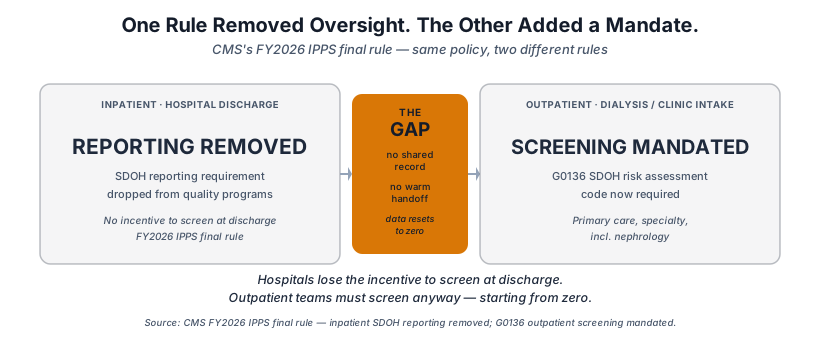
In the FY2026 inpatient prospective payment system (IPPS) final rule, CMS removed SDOH-related reporting requirements from inpatient quality programs, citing administrative burden reduction for acute care hospitals and skilled nursing facilities. At the same time, CMS expanded outpatient SDOH screening requirements — most notably through the G0136 SDOH risk assessment code, which is now mandatory for qualifying outpatient encounters across primary care and specialty settings including nephrology.
Taken in isolation, either decision is defensible. Inpatient quality reporting has real administrative overhead, and reducing it for hospitals operating on thin margins has logic. Expanding outpatient screening is aligned with the evidence base: social determinants predict readmissions, mortality, and care utilization as reliably as many clinical variables.
But the two decisions together create something neither alone would have produced: a structural gap in accountability at the exact point in the care continuum where high-risk patients are most vulnerable.
Hospitals no longer have a quality incentive to screen for SDOH at discharge. Outpatient providers are now required to screen — but they receive no upstream data from the inpatient setting to build on. The gap between hospital discharge and dialysis center intake is now an accountability void.
Why ESRD Patients Can’t Afford That Void
The ESRD population moves through care settings in a way that most patient populations don’t. A kidney patient doesn’t stay in one lane. Over the course of their illness, they may cycle through:
- Inpatient acute care — for vascular access complications, infections, hospitalizations
- Discharge planning — often brief, under-resourced, and disconnected from outpatient teams
- Outpatient dialysis — three times weekly, the most consistent touchpoint in the care system
- Nephrology clinic visits — periodic, usually focused on clinical parameters
- Transplant evaluation — if they get there at all
According to UNOS data, fewer than 20% of ESRD patients are ever evaluated for transplant, and among those who are, social and logistical barriers — housing instability, lack of transportation, absence of a caregiver for the perioperative period — account for a significant proportion of deferrals and denials.
SDOH isn’t a peripheral concern in this population. It is often the primary variable determining whether a patient ever makes it through the transplant evaluation pipeline.
CMS now requires screening at the outpatient bookends of this pathway. It has eliminated the quality incentive to screen in the inpatient middle — the acute care hospitalizations and skilled nursing stays where social vulnerability often becomes most visible.
The result is that dialysis social workers and transplant social work teams are now expected to detect social risk factors that hospitals have no accountability for reporting. Every team starts from zero. Every transition is a data reset.
Social Workers Are Now the Bridge — Without the Infrastructure
I spent thirteen years in clinical social work across settings that included transplant coordination, behavioral health, and ACT teams working with high-acuity populations. One pattern repeated across all of them: when a policy gap existed in the system, clinical social workers filled it — not because it was in their job description, but because someone had to.
The CMS rollback doesn’t eliminate the clinical need for SDOH identification in inpatient settings. It eliminates the institutional accountability for doing it. That work doesn’t disappear. It gets deferred to the next clinician in line.
In transplant and dialysis settings, that’s already a stretched position. The average dialysis center social worker carries a caseload of 80 to 120 patients according to CMSA data. They are managing pre-ESRD education, mental health support, insurance navigation, and transplant readiness assessments simultaneously. They are not resourced to do retrospective SDOH detective work on patients who passed through a hospital without a screening flag.
What this policy shift creates — without anyone necessarily intending it — is a system where the most consistently underfunded clinical position in nephrology care now carries the full burden of social risk identification for a population that cycles through five different care settings.
Documentation theater doesn’t help those patients. A G0136 code billed at outpatient intake doesn’t capture the food insecurity that went unaddressed during a six-day hospitalization. It doesn’t restore the connection to a home health aide that lapsed during recovery. It doesn’t flag the housing instability that developed after a surgery-related work absence.
Screening without continuity is not care coordination. It’s a compliance checkbox.
What Integrated Programs Can Actually Do
This policy gap doesn’t require a federal fix to address at the program level. Healthcare systems and dialysis organizations that take seriously their role in ESRD outcomes can build internal continuity protocols that the mandate doesn’t require but the patient needs.
Build a structured SDOH handoff between inpatient discharge and dialysis intake. This doesn’t have to be a technology project. A templated secure message, a structured phone handoff between social workers, or a shared care coordination note in a common EHR all serve the same function: when a patient leaves the hospital, the outpatient team knows what happened. What was screened, what was found, what was deferred, and what the patient said.
Standardize pre-referral SDOH screening at the dialysis center level. The referral to transplant evaluation should not be the first time a patient’s SDOH profile is documented comprehensively. Dialysis social workers have more sustained contact with patients than any other provider in the care continuum. Use that relationship. Build a formal pre-referral SDOH assessment into the workflow before the referral letter goes out — not as a prerequisite to exclude patients, but as a foundation for identifying barriers that the transplant team can help address.
Design for care continuity, not compliance documentation. The SDOH data collected for quality reporting and the SDOH data that actually serves the care team often look different. Quality measures want checkboxes. Care teams need context. If your SDOH screening tools are built around the audit trail rather than the clinical story, they will not generate the information that closes gaps.
Advocate for upstream accountability. Clinical leaders have a platform to push back on inpatient policy changes that shift burden without shifting resources. Hospital system leadership, medical directors at dialysis organizations, and ACO governance structures all have the ability to maintain internal SDOH quality standards even when CMS doesn’t require them. Voluntary inpatient screening that connects to a downstream handoff protocol is more valuable than a mandated outpatient screen that starts cold.
The Systems Argument CMS Hasn’t Made Yet
The evidence on SDOH screening is not the problem. The evidence is robust and continues to grow. Social determinants predict readmission rates, emergency utilization, medication adherence, and surgical outcomes. CMS knows this — it’s why the outpatient mandate exists.
The gap in the federal framework is the assumption that screening location equals care location. Inpatient providers see patients at peak vulnerability. Outpatient providers see them consistently over time. Neither setting, acting alone, has full visibility into the patient’s social risk trajectory.
What the evidence actually supports is not screening mandates in isolated settings — it’s care coordination infrastructure that allows SDOH data to move with the patient. Integrated programs. Shared records. Formal handoff protocols. Warm transitions that don’t require the next clinician to start from scratch.
That’s not the policy CMS built. It’s the policy the evidence calls for. And until it exists at a federal level, healthcare organizations, dialysis centers, and transplant programs that serve ESRD patients will need to build it themselves.
The tools are available. The clinical justification is overwhelming. What’s missing is the organizational will to treat SDOH continuity as a structural priority rather than a compliance checkbox.
What This Means for Transplant Social Work Specifically
The dialysis-to-transplant referral gap has always been an SDOH problem wearing clinical clothing. Patients who don’t get referred for transplant evaluation are disproportionately those with housing instability, inadequate social support, transportation barriers, and histories of system distrust — all factors that show up on SDOH screens and then disappear from the clinical record if there’s no handoff protocol to carry them forward.
TransplantCheck was built around a direct response to this observation. The platform automates SDOH screening at the point of dialysis, before the referral goes out, and generates a structured risk profile that travels with the patient into the evaluation process. It doesn’t replace the clinical relationship between a social worker and their patient. It ensures that the SDOH work done at the dialysis center doesn’t evaporate when the referral letter is sent.
That’s not a technology solution to a policy problem. It’s a clinical infrastructure tool for an accountability gap that policy created and left unfilled.
If your program is trying to figure out how to maintain SDOH continuity in a post-rollback environment — without adding burden to already-stretched social work staff — it’s worth a conversation.
Learn more at transplantcheck.org or reach out directly through Mental Wealth Solutions.
Matthew Sexton, LCSW, is the founder of Mental Wealth Solutions, Inc. and has thirteen years of clinical experience in behavioral health, transplant social work, and care coordination for high-acuity populations. He writes about healthcare access, SDOH policy, and the systems that support — or fail — underserved patients.