VA Disability Rating Drops When Your Medication Works
A 2026 VA interim rule allows medication effectiveness to lower disability ratings — veterans managing PTSD or TBI through treatment now risk losing compensation.
From the earlier archive. This article’s original writing is retained and has not been fact-checked as part of our current review. Product references may reflect an earlier version; see current solutions for today’s status.
There is a particular cruelty in a system that punishes you for getting better.
A veteran I know — I’ll call him David — spent three years doing everything right. He showed up for every therapy appointment. He took his medication consistently. He learned his triggers, built routines, and slowly, painfully, rebuilt a life that chronic PTSD had nearly dismantled. His sleep improved. His relationships stabilized. He held a job.
Then his VA disability rating came up for review.
The examiner noted his functioning was stable. His medication was effective. His symptom scores were down. And based on the new framework taking shape under the 2026 VA interim rule, his rating was reduced — because the way he manages his illness was being credited against the severity of the illness itself.
David didn’t get better. David learned to compensate. That’s not the same thing.
What the 2026 VA Disability Rating Rule Actually Changed
The VA’s 2026 interim rule on disability ratings formalized something that had been creeping into evaluation practices for years: the use of medication effectiveness and treatment response as evidence of reduced functional impairment.
Under the revised rating framework, veterans are increasingly assessed on how they function with their current treatment regimen — not on the underlying severity of their condition. This shift affects evaluations across several domains the VA now scrutinizes more granularly:
- Occupational functioning — Can you hold a job?
- Social functioning — Can you maintain relationships?
- Sleep quality — Are you sleeping through the night?
- Mood regulation — Are your emotional responses within a “normal” range?
- Cognitive performance — Can you concentrate and make decisions?
When medication and therapy are working, a veteran may appear to function within normal limits on each of these domains. What the rating doesn’t capture is what it costs them to do that. What breaks down when the structure slips. What 2 AM looks like. What happens when a medication stops working or access to care is disrupted.
The rule is framed as precision. What it produces is a system that rates the effort of managing a serious condition as evidence that the condition is less serious.
Why This Is a Systems Failure, Not a Clinical Win
Let me be direct about what is happening here: the VA has restructured disability compensation so that the behavioral and pharmacological management of a mental health condition can be used to argue that the condition has been resolved — or substantially mitigated — even when it has not.
This is not a clinical success story. It is a documentation crisis.
There are at least three structural failures embedded in this approach:
1. It confuses compensation with recovery.
Compensation is the veteran who can hold a job because they’ve rigorously avoided triggers, taken medication twice daily, maintained a rigid sleep schedule, and made thousands of micro-adjustments that no one without their condition would need to make. Recovery would be if those adjustments were no longer necessary.
They are not the same state. Rating them the same way is a category error with real financial consequences.
2. It incentivizes concealment over treatment.
If a veteran knows that functioning well on medication will reduce their rating, they have a rational financial incentive to either avoid treatment or underperform in evaluations. This is not a hypothetical — it is a predictable behavioral response to a poorly designed system.
We should not be building a disability system that creates disincentives for treatment engagement. That is a public health failure layered on top of a justice failure.
3. It ignores the episodic and context-dependent nature of PTSD and related conditions.
PTSD, TBI sequelae, major depression, and anxiety disorders do not present uniformly across time and context. A veteran who functions adequately in a controlled, structured environment — or on a good week — may be severely impaired in high-stimulus situations, during stressors, or when routine is disrupted.
A single snapshot evaluation, taken during a period of relative stability, is not an accurate measure of functional impairment. It is a measure of that day. The rating system is increasingly treating it as a measure of the condition.
What Clinicians Must Document Now
For every social worker, therapist, case manager, and VA-adjacent clinician working with veteran populations: your documentation is now the last line of defense.
The rating system will read your notes. Adjusters will look for evidence of stability, positive response to treatment, and functional adequacy. If your notes read like a success narrative without context, you may inadvertently contribute to a rating reduction for a client who is still substantially impaired.
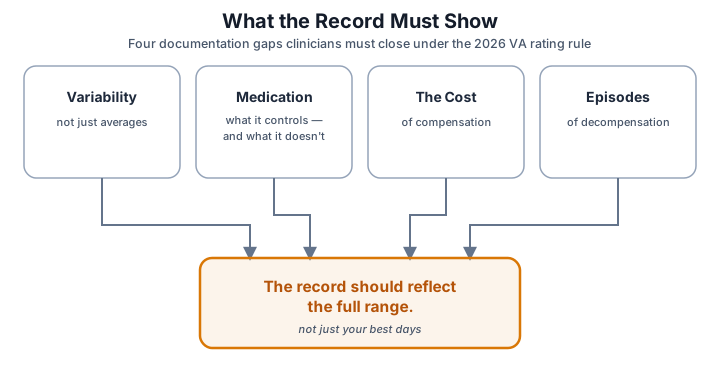
Here is what the documentation must now capture:
Document functional variability, not just averages.
If your client functions well in session but struggles outside of it, document that. “Client presented as calm and organized during session but reported significant difficulty managing work demands when supervisory structure was reduced” is far more accurate — and protective — than “client was calm and cooperative.”
Capture what medication controls and what it doesn’t.
Medication may be managing the acute symptom presentation while leaving underlying vulnerabilities intact. “Medication has reduced nightmares from nightly to 2-3x/week, but client continues to report hypervigilance in public settings that prevents sustained employment” directly addresses the medication-effectiveness clause.
Document the cost of compensation.
If your client is holding a job, document what it requires. Sleep hygiene protocols. Avoidance strategies. Social isolation to manage energy. The meticulous routines that, if disrupted, would result in decompensation. These are not signs of recovery — they are evidence of ongoing functional impairment managed through effort and structure.
Document episodes of decompensation.
When your client has a bad week, a crisis, a relapse of symptoms — document it explicitly. Ratings based on best-case functioning are not accurate. The record should reflect the full range.
Use standardized functional impairment measures.
Tools like the PCL-5, the WHODAS 2.0, and the GAF are insufficient on their own, but they create a documented baseline. Consider adding tools that measure functional variability over time, not just symptom severity at a point in time. The VHA’s own frameworks for functional impairment documentation provide language that is aligned with how the rating system operates.
What Veterans Need to Know About Their Rights
If you are a veteran in active treatment and you are concerned about an upcoming rating review, there are several things you should know:
You have the right to request a C&P (Compensation and Pension) examination that accounts for functional variability. If an evaluation was conducted during a period of unusual stability, you can provide supplemental documentation from your treatment providers that reflects the full picture.
Your treatment records are evidence. Every therapy note, medication adjustment log, and crisis call is part of your clinical record. Request copies. Understand what they say. Make sure they reflect the full scope of your functioning — not just your best days.
Veterans Service Organizations (VSOs) can review your rating decision. Organizations like the DAV, VFW, and American Legion have accredited claims agents who understand how ratings are calculated and can identify errors in the application of the new criteria.
The 2026 rule is being contested. Veteran advocacy organizations and several VSOs are actively challenging aspects of the interim rule. Staying informed about the legal landscape matters — a ruling that changes the standard could affect claims currently in process.
“Stable” is not the same as “recovered.” If a rater or examiner frames your improved functioning as evidence that your condition has resolved, you have the right to challenge that characterization. Your clinician can provide a letter explicitly differentiating between managed symptoms and resolved impairment.
The Larger Problem: Systems That Punish Self-Advocacy
What David’s case — and thousands like it — exposes is a deeper structural failure in how the United States conceptualizes disability and treatment.
We have built a system where accessing care, following treatment recommendations, and managing a condition diligently can result in financial penalty. The most responsible veterans — the ones doing the work, taking the medications, showing up for therapy — face the greatest risk of rating reduction under this framework. The least engaged, by contrast, may maintain or increase their ratings simply because their unmanaged symptoms are more visible.
This is backwards.
From a clinical social work perspective, the goal of disability compensation was never to reward suffering. It was to recognize that certain conditions create ongoing barriers to the kind of functioning that allows financial independence — and to bridge that gap. When treatment helps a veteran function better, that is not evidence that the gap has closed. It is often evidence that the gap requires ongoing effort and resources to bridge.
A system that removes the bridge when someone is using it successfully has not understood its own purpose.
The 2026 rule, as written, does not distinguish between a veteran who has fully recovered functional capacity and a veteran who is working extraordinarily hard to maintain adequate functioning despite an ongoing impairment. Both present as “functioning.” Only one has closed the gap.
The Documentation System Needs to Change Too
Clinicians cannot carry this alone. The solution is not only better individual documentation — it is standardized, systematic, functional screening that produces documentation-ready output aligned with how the VA actually calculates ratings.
That means tools that capture:
- Functional variability over time (not just point-in-time snapshots)
- Occupational, social, cognitive, and behavioral domains as the VA defines them
- The gap between best-case and typical functioning
- The conditions and structures required to maintain current functioning levels
When screening is standardized and output is structured, it becomes part of the clinical record in a way that is legible to the rating system — not just to the treatment team.
This is the clinical documentation problem that VeteranCheck was built to address: standardized PTSD and TBI functional impairment screening, structured for documentation, designed for the veteran population.
What Has to Change
The 2026 interim rule should not stand as written.
The medication-effectiveness clause needs a counterbalancing requirement: if medication is credited as reducing impairment, then the rating evaluation must also document what happens when that medication is unavailable, discontinued, or insufficient — and what functional impairment remains in those conditions.
Evaluations should capture functional variability, not just current state. A single C&P exam conducted on a veteran’s best day is not a valid basis for rating a chronic condition.
The system should be measuring the severity of the underlying condition and the ongoing effort required to manage it — not crediting the management as evidence that the condition is gone.
Until those changes happen, clinicians bear responsibility for documentation that tells the complete story. Veterans bear responsibility for advocating for evaluations that reflect their full experience.
And policymakers bear responsibility for a rule that punishes recovery.
Matthew Sexton is a Licensed Clinical Social Worker with experience in substance abuse treatment, forensic case management, disaster case management, and community behavioral health. He is the founder of Mental Wealth Solutions and the creator of VeteranCheck, a standardized PTSD and TBI screening platform for veteran-serving organizations.
If your organization works with veterans and needs documentation-ready functional impairment screening, VeteranCheck provides standardized tools aligned with VA functional rating domains.