Missing a narcissistic partner after leaving is one of the most predictable — and least-discussed — experiences in narcissistic abuse recovery. It is not a sign of weakness, unresolved love, or poor judgment. It is the physiological signature of a trauma bond: an attachment formed through intermittent reinforcement that the nervous system cannot override through understanding alone. Survivors often feel ashamed of the missing, believing it contradicts what they know about the relationship. It does not. Knowing how the abuse worked and still feeling the pull of absence are two separate systems in the brain, and they do not have to agree.
The Paradox of Missing a Narcissist Who Harmed You
Missing an abuser is not a contradiction. It is one of the most predictable things that happens after narcissistic abuse, and one of the least talked about, because people feel ashamed of it.
Knowing what happened. Knowing how it affected you. And still missing them. That is not confusion or weakness. That is what a trauma bond looks like from the inside.
Dutton and Painter’s (1993) foundational work on traumatic bonding, published in Violence and Victims, documented exactly this paradox: attachment in abusive relationships can strengthen, rather than weaken, under conditions of intermittent harm. Judith Herman, in Trauma and Recovery (1992), framed the same phenomenon as a defining feature of complex post-traumatic stress — the way captivity-like dynamics produce bonds that survivors later cannot reconcile with their own memory of what happened. Recognizing the missing as a symptom of trauma bonding, rather than as evidence of unfinished love, is often the first clinical turning point in recovery.
Understanding Trauma Bonds: Why Intermittent Reinforcement Is So Powerful
Trauma bonds do not form because of naivety or poor judgment. They form through intermittent reinforcement — the unpredictable alternation between warmth and withdrawal, connection and rejection, presence and absence. This pattern creates stronger attachment than consistent kindness does. That is not intuitive, but it is well-documented in behavioral and attachment research.
Variable reinforcement schedules were originally described in operant conditioning research (Skinner, 1953) and have been consistently shown to produce the most persistent behavioral patterns — more persistent than continuous reinforcement, and remarkably resistant to extinction. In human relationships, the same principle applies: unpredictable warmth creates stronger anticipatory attachment than reliable warmth. The brain learns to wait for the reward window, not to give up when it is absent.
What this produces in practice:
- Predictable kindness produces steady, low-arousal attachment.
- Intermittent kindness produces anticipatory, high-arousal attachment.
- Unpredictable reward activates dopamine circuits more powerfully than reliable reward.
- The nervous system learns to treat the reward window as precious precisely because it is rare.
Helen Fisher’s work on the neurochemistry of romantic attachment, including brain imaging of people in various stages of love and rejection (Fisher, 2004; Fisher et al., 2010, Journal of Neurophysiology), shows that dopaminergic reward circuitry is activated not only by reward itself but by the anticipation of reward — and most intensely when the reward is uncertain. Applied to an abusive relationship, this means that the unpredictable nature of the “good moments” is not a bug in the trauma bond. It is the mechanism.
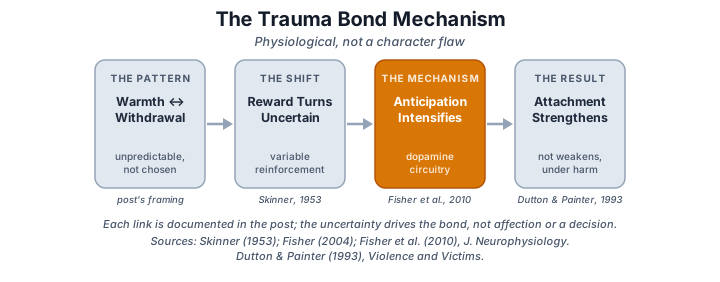
This is why survivors often describe their narcissistic relationship as the most intense connection they have ever felt. That intensity was real. It was also pathological in the precise clinical sense — the intensity came from the uncertainty, not from the love.
The Neurochemistry of the Missing
When something good happened in the relationship, the relief was enormous. That relief is what survivors miss. Not the person — the neurochemical event. The hope. The brief window where everything felt like it could be okay.
The brain learns to anticipate that window. It learns to wait for it, even when it stops coming. That is the bond. It is physiological, not a character flaw.
Bessel van der Kolk, in The Body Keeps the Score (2014), describes how chronic interpersonal stress keeps the nervous system locked in hypervigilance, and how brief moments of perceived safety inside that stress release outsized surges of relief-related neurochemistry. Those surges get encoded with the intensity usually reserved for survival experiences. They become what the brain later craves — not because it wants to return to the relationship, but because it wants to return to the relief.
Stephen Porges’s polyvagal theory (Porges, 2011, The Polyvagal Theory) adds another layer. The ventral vagal branch of the nervous system — the branch responsible for social engagement, connection, and felt safety — is activated by moments of reciprocal warmth. When those moments are rare and embedded inside a larger pattern of threat, the ventral vagal response becomes tightly linked to the specific person who produced it. The nervous system does not easily separate “the feeling of safety” from “the person I felt it with,” even when that person was also the source of the threat. This is why the missing is so often described as a physical ache rather than a mental thought. It is happening in the body. The S.T.O.I.C.K. method is one framework for working with that physiological response when it arises.
What Survivors Are Actually Mourning
There is a version of the relationship that exists only in memory — the version from the beginning, or from the good moments scattered through the hard ones. That version felt real because it was real to the person experiencing it.
Grieving that version is legitimate. There is no need to justify mourning something that also caused harm. Both things can be true simultaneously.
The distinction that matters most in recovery: survivors are not missing who the person was. They are mourning who they believed that person to be. That is a different kind of loss — and one that deserves proper attention, because bypassing it does not work.
Kenneth Doka’s concept of “disenfranchised grief” (Doka, 1989) describes grief that a person’s social world does not recognize or validate. Grieving the end of a relationship with someone who also harmed you falls squarely into this category. Survivors are often told they should feel relief, not grief, and when grief arises anyway they feel there is something wrong with them. There is not. Disenfranchised grief is still grief. It is often more painful than validated grief precisely because it has to be carried privately.
Herman’s work on complex trauma recovery (Herman, 1992) emphasizes that the grieving phase of recovery involves mourning two distinct losses: the believed version of the other person, and the self that existed inside the belief. Both are real losses. Neither is undone by knowing the relationship was harmful. In fact, the intellectual knowledge of harm often intensifies the grief, because the survivor is also mourning a story they needed to be true.
Why This Is Physiological, Not a Character Flaw
The nervous system forms bonds under conditions of threat. This is not a design flaw. It is a survival mechanism — one that served humans in contexts where attachment to a protector, even an inconsistent one, improved the odds of survival. In modern intimate-partner contexts, that same mechanism can produce devastating trauma bonds, but the underlying wiring is not a sign that something is broken in the survivor. It is a sign that the wiring worked exactly as designed, in a context it was never meant to operate in.
Porges and van der Kolk both emphasize that cognitive understanding alone does not undo a physiologically encoded attachment. Herman puts it plainly: understanding is not the same as feeling, and recovery requires the nervous system to have its own experience of safety, repeatedly, over time, before the bond loosens. This is why survivors cannot simply think their way out of the missing. The missing is not a thought. It is a body state.
Patrick Carnes, in The Betrayal Bond (1997), writes specifically about the power of these bonds in the context of betrayal and abuse, and emphasizes that the shame survivors often feel about missing their abuser is itself part of what keeps the bond active. Shame isolates. Isolation re-activates the nervous system’s search for the one person it associates with relief, even when that person was also the threat. Breaking that loop begins with naming the physiology out loud: this is a trauma bond, not a character flaw, and it will weaken as the nervous system recovers. Frameworks like R.A.V.E.S. exist because recovery is a nervous system project, not a willpower project.
How the Missing Fades
The missing fades. Not because caring stops, but because the nervous system returns to baseline. As hypervigilance settles, as the daily work of managing someone else’s emotional state ends, as ordinary life starts to feel safe again — the pull weakens.
The progression looks something like this: the missing becomes less frequent, then becomes a thought rather than a physical ache, then arrives occasionally and leaves without pulling someone under.
Clinical observation across trauma recovery work suggests a rough arc, though individual timelines vary widely:
- Weeks 1 to 4: Intense physical craving and intrusive longing. This is the withdrawal phase. The nervous system is searching for the reward window that no longer exists. This is the hardest and most destabilizing phase, and the phase during which survivors most often break no contact.
- Weeks 4 to 12: Episodes become less continuous. Long stretches of relief, punctuated by sharp waves. The waves feel like they come out of nowhere, but they are usually triggered by sensory cues — smells, songs, dates, places.
- Months 3 to 12: The missing shifts from a body state to a thought state. Survivors report that it becomes something they think about rather than something they feel in the chest.
- Beyond a year: Most survivors describe occasional waves, often around anniversaries or unexpected triggers, but the waves no longer pull them under. Life continues through them.
These are observations, not guarantees. Recovery is not linear, and intermittent contact — even a single text — tends to reset the clock by reactivating the reward anticipation system. This is the clinical basis for strict no contact: not punishment of the other person, but protection of the survivor’s nervous system during the phase when it is most vulnerable to reinforcement.
That is not indifference. That is what getting better actually looks like.
Frequently Asked Questions
Is missing my narcissistic ex a sign I still love them? No. The missing is a physiological withdrawal response from a trauma bond, not an indicator of unresolved love. The brain is searching for the relief-reward pattern it was conditioned to anticipate, not for the person as they actually were. Most survivors report that as the missing fades, what they are left with is not love but a clearer, quieter assessment of what actually happened.
How long does it take to stop missing a narcissistic partner? Individual timelines vary, but many survivors report significant reduction in the intensity of the missing within three to twelve months of maintaining strict no contact. Intermittent contact — including social media checking, mutual-friend updates, or brief exchanges — tends to reset the clock by reactivating the reward anticipation system. Time alone does not heal a trauma bond; time plus no contact does.
Will I ever stop missing them completely? For most survivors, the intensity fades substantially and the missing eventually becomes a thought rather than a body state. Occasional waves are normal even years later and do not indicate incomplete recovery. The goal is not to never feel anything about the relationship. The goal is for those feelings to arrive and pass without pulling you under.
Why does no contact help even though I miss them more at first? In the short term, no contact intensifies the missing because the nervous system is in withdrawal. In the longer term, no contact is the only condition under which the trauma bond can weaken, because any contact reactivates the intermittent reinforcement pattern that maintains the bond. The short-term discomfort is the price of long-term recovery, not evidence that no contact is the wrong approach.
Is missing them worse after leaving than it was during the relationship? Often, yes, in the early weeks. This is withdrawal, not regret. During the relationship, the nervous system still had access to intermittent reward. After leaving, that access is gone, and the brain registers the absence acutely. This phase is expected and temporary.
A Note on Recovery
Understanding the physiology does not make the missing stop. It makes the missing bearable. Recovery from narcissistic abuse is not an intellectual exercise. It is a nervous system project that happens over time, in safety, with support. If you are in the early weeks of this and the missing feels like it will never end, the clinical answer is that it will end, that the timeline is not your fault, and that the work is to keep the nervous system out of contact long enough to recalibrate.
If you want to do this work with someone who treats the missing as physiology rather than weakness, book a free consultation.
Matthew Sexton, LCSW is a licensed clinical social worker who has treated survivors of narcissistic abuse and complex trauma since 2015. He has directed clinical programs across thirteen settings, including substance abuse treatment, forensic assertive community treatment, and disaster case management. He founded Mental Wealth Solutions to help survivors rebuild their nervous system, reclaim their sovereignty, and do the real work of recovery in a setting that respects the physiological reality of what they have been through.
Disclaimer
This article is for educational and informational purposes only. It does not constitute medical, clinical, legal, or therapeutic advice, and reading it does not create a therapist-client relationship with Matthew Sexton, LCSW or Mental Wealth Solutions, Inc.. Although the author is a licensed clinical social worker, the content in this article is not clinical assessment, diagnosis, or treatment.
The patterns, concepts, and recovery frameworks described here reflect clinical research and general observations across trauma recovery work. Individual experiences vary, and what is described here may not match every reader’s situation. If you are working through narcissistic abuse, complex trauma, or a trauma bond, please consult a licensed mental health professional who can assess your specific circumstances.
If you are in immediate emotional crisis, you can reach the 988 Suicide & Crisis Lifeline by calling or texting 988 (US). If you are experiencing domestic violence or are in physical danger, contact the National Domestic Violence Hotline at 1-800-799-7233 or visit thehotline.org. In a life-threatening emergency, call 911.
References
Carnes, P. (1997). The Betrayal Bond: Breaking Free of Exploitive Relationships. Health Communications.
Doka, K. J. (1989). Disenfranchised Grief: Recognizing Hidden Sorrow. Lexington Books.
Dutton, D. G., & Painter, S. (1993). Emotional attachments in abusive relationships: A test of traumatic bonding theory. Violence and Victims, 8(2), 105–120.
Fisher, H. (2004). Why We Love: The Nature and Chemistry of Romantic Love. Henry Holt.
Fisher, H. E., Brown, L. L., Aron, A., Strong, G., & Mashek, D. (2010). Reward, addiction, and emotion regulation systems associated with rejection in love. Journal of Neurophysiology, 104(1), 51–60.
Herman, J. L. (1992). Trauma and Recovery: The Aftermath of Violence. Basic Books.
Porges, S. W. (2011). The Polyvagal Theory: Neurophysiological Foundations of Emotions, Attachment, Communication, and Self-Regulation. W. W. Norton.
Skinner, B. F. (1953). Science and Human Behavior. Macmillan.
van der Kolk, B. A. (2014). The Body Keeps the Score: Brain, Mind, and Body in the Healing of Trauma. Viking.
If this named something you're living with —
You don't have to figure it out from articles. Matthew Sexton, LCSW, NATC sees adults in therapy at his separate private practice (telehealth · NY · ME · DE · FL). Or take this piece to your own therapist — it's written to be shared.
Visit the practice