I’ve spent most of my clinical career working with people the system wasn’t built for. Veterans with treatment-resistant PTSD who’ve cycled through every SSRI on the formulary. Patients who show up to their fourth therapist already knowing the CBT worksheets by heart. People who aren’t failing treatment — treatment is failing them.
So when I see Congress advancing legislation to fund psychedelic-assisted therapy at VA hospitals, I don’t dismiss it. I also don’t celebrate prematurely. I pay attention — because this is the kind of policy shift that could fundamentally change how we treat the veterans who need it most.
What’s Actually Happening in Congress
The Innovative Therapies Centers of Excellence Act, introduced by Senator Gallego out of Arizona, would designate at least five VA medical centers as psychedelic therapy centers of excellence. These wouldn’t be fringe research labs. They’d be fully integrated clinical sites within the VA system, staffed and funded to deliver psychedelic-assisted therapy as a treatment modality for veterans with PTSD, treatment-resistant depression, and substance use disorders.
This isn’t one lone bill sitting in committee. The VA has already funded its first psychedelic-assisted therapy study. Louisiana’s Senate Bill 43 passed committee on March 25 with zero opposition — zero — after veterans testified about their own experiences with psilocybin and MDMA-assisted therapy. Massachusetts advanced multiple psychedelic therapy bills on March 18. The momentum is bipartisan and accelerating.
Why Psychedelic Therapy for Veterans Matters Clinically
Let me be direct about the clinical reality. We have roughly 600,000 post-9/11 veterans with PTSD. Somewhere between 30 and 50 percent of them don’t respond adequately to first-line treatments — SSRIs, prolonged exposure, CPT. These aren’t people who didn’t try hard enough. These are people whose neurobiological trauma responses are resistant to the tools we currently have.
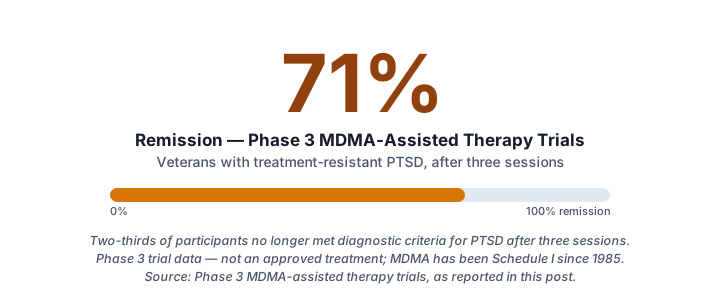
The Phase 3 MDMA-assisted therapy trials showed remission rates around 71 percent for treatment-resistant PTSD. Not improvement. Remission. Two-thirds of participants no longer met diagnostic criteria for PTSD after three sessions. If any pharmaceutical achieved those numbers, it would be the biggest mental health breakthrough in decades. The difference is that this one comes with a molecule that’s been Schedule I since 1985.
Psilocybin research is earlier-stage but equally promising. Johns Hopkins and NYU have published data showing significant reductions in depression and existential distress, with effects lasting months after a single dose. The VA’s decision to fund its own study signals that the institutional resistance is cracking.
The Clinical Social Work Perspective
Here’s where I think most of the public conversation misses the mark. Psychedelic-assisted therapy isn’t someone taking mushrooms and having a spiritual experience. It’s a structured clinical protocol. Typically three phases: preparation sessions with a trained therapist, the dosing session itself with clinical oversight, and integration sessions afterward where the real therapeutic work happens.
That integration phase? That’s social work. That’s sitting with someone as they process the trauma that surfaced during their session. That’s helping them rebuild relationships, navigate VA benefits, address the housing instability or substance use that co-occurs with their PTSD. The molecule opens the door. The clinician walks through it with them.
This is why I care about screening infrastructure. When psychedelic-assisted therapy becomes available at VA centers — and the legislative trajectory suggests it will — clinicians will need tools to identify which veterans are appropriate candidates. Not everyone with PTSD is. Patients with active psychosis, certain cardiac conditions, or specific medication interactions need to be screened out. Patients with complex trauma histories need to be matched with providers who can handle what surfaces.
That’s exactly the kind of clinical triage that VeteranCheck was built to support. We screen across ten SDOH domains — mental health, substance use, housing, social support, cognitive function — and use AI-powered referral facilitation to match veterans with appropriate services. As psychedelic-assisted therapy enters the VA formulary, screening tools that can assess readiness and contraindications become essential, not optional.
What the States Are Telling Us
The state-level movement is arguably more telling than the federal bills. Louisiana passing a psychedelic therapy bill with zero opposition tells you something about where the political winds are blowing. This isn’t coastal liberal policy. This is a conservative Southern state saying, “Our veterans testified. We listened.”
Massachusetts is advancing multiple bills simultaneously. Oregon already has a regulated psilocybin services program. Colorado legalized regulated access in 2022. The state experimentation is generating the safety data and operational frameworks that federal agencies need before they’ll commit.
For clinicians, the practical implication is this: psychedelic-assisted therapy is not a question of if but when. The clinical workforce needs to prepare now — training programs, supervision structures, integration therapy competencies, and the screening infrastructure to support safe implementation.
The Uncomfortable Middle Ground
I want to be honest about something. There’s a tension in this space between the people who think psychedelics will save everyone and the people who think they’re dangerous nonsense. The clinical reality is neither.
Psychedelic-assisted therapy is a powerful tool with genuine risks. Bad trips happen. Psychological destabilization happens, especially in patients with undiagnosed psychotic spectrum disorders. The therapeutic container matters enormously — set, setting, the therapeutic alliance, the quality of integration work. Poorly implemented psychedelic therapy could cause real harm.
And yet. The status quo is also causing harm. Every veteran who cycles through their fifth medication without relief. Every veteran who drops out of CPT because the exposure work is too destabilizing without adequate support. Every veteran who dies by suicide while waiting for a treatment that actually works. The risk of doing nothing is not zero.
The responsible clinical position is to support expanded access within rigorous clinical frameworks while advocating for the screening, training, and integration infrastructure that makes it safe. That’s the unsexy middle ground. That’s where social workers live.
The Workforce Gap No One’s Talking About
Here’s what keeps me up at night about this. We don’t have enough trained psychedelic-assisted therapy providers. Not even close. The number of clinicians who have completed MAPS-method MDMA therapy training or equivalent psilocybin protocols is measured in the hundreds. The number of veterans who could benefit is measured in the hundreds of thousands.
Clinical social workers are uniquely positioned to fill this gap — and I don’t say that because I am one. I say it because the competencies required for psychedelic integration therapy align almost perfectly with advanced clinical social work training. Trauma-informed care. Systems navigation. Crisis intervention. Cultural humility. The ability to sit with someone in acute psychological distress without reaching for a prescription pad.
The licensing and training infrastructure needs to scale before the legislative infrastructure outpaces it. State boards of social work need to develop supervision and continuing education requirements for psychedelic-assisted therapy. Universities need to integrate these modalities into MSW programs. And VA-affiliated training programs need to start building the pipeline now, not after the centers of excellence are operational and understaffed.
This is a workforce development problem as much as it is a policy problem. And workforce development is slow. The time to start was yesterday.
What Happens Next
If the Innovative Therapies Centers of Excellence Act passes, we’ll see at least five VA hospitals stand up psychedelic therapy programs. The VA’s existing research funding will expand. Training pipelines for psychedelic-assisted therapy providers — including clinical social workers — will need to scale rapidly.
At the community level, veterans who can’t access VA centers will need pathways to state-regulated programs. That means care coordination. That means someone helping a veteran in rural West Texas understand that Oregon has a regulated psilocybin program and what it would take to access it. That means the kind of referral facilitation infrastructure that I’ve spent the last year building.
I built VeteranCheck because I watched too many veterans fall through the cracks of a system that screens for problems but doesn’t close the loop on solutions. As psychedelic-assisted therapy enters the clinical mainstream, the gap between identifying a veteran who could benefit and actually getting them into treatment will determine whether this breakthrough reaches the people who need it or stays locked in academic centers.
The legislation is moving. The science is strong. The clinical workforce needs to catch up.
If you’re a clinician working with veterans, start paying attention to this space now. Learn the protocols. Understand the contraindications. Think about how your current practice could integrate psychedelic-assisted therapy referrals — even if you never administer a session yourself. The veterans in your caseload who haven’t responded to conventional treatment deserve to know that new options are coming.
And if you’re a veteran reading this — know that the system is changing. Slowly, imperfectly, but genuinely. People are fighting for you in committee rooms and on senate floors. The science backs them up. The clinical community is catching up.
That’s the work ahead.
Matthew Sexton is a Licensed Clinical Social Worker and the founder of Mental Wealth Solutions. He builds AI-powered screening and referral facilitation tools for healthcare — including VeteranCheck, which screens veterans across 10 SDOH domains and connects them with services. Follow him on X @MattSextonLCSW.
Want to discuss this for your program?
Book a 30-min conversation. We'll walk you through deployment, the BAA, and what your rollout looks like in production.
Book a 30-min conversation