Dependent Personality Disorder in Care Settings
A 2020 study found patients with high dependency traits show lower rates of independent care behavior — even when equally motivated. Here's what clinicians miss.
From the earlier archive. This article’s original writing is retained and has not been fact-checked as part of our current review. Product references may reflect an earlier version; see current solutions for today’s status.
This is Part 3 in the Personality Types Explained series. Start with Part 1: Schizoid PD and Part 2: Schizotypal PD.
A woman in her mid-fifties has been on the transplant waitlist for two years. Her chart is clean. She shows up to every appointment. She says yes to everything — yes to the medication adjustment, yes to the referral to the nutritionist, yes to the suggestion that she might want to connect with a social worker. She is, by every metric the system has, a compliant patient.
She also hasn’t scheduled her own follow-up in fourteen months. She stopped going to dialysis for three weeks last fall because the nurse at the center seemed rushed and she didn’t want to be a bother. She never told anyone about either of these things because no one asked in a way that felt safe to answer.
The system didn’t miss her because she was hiding. It missed her because she was too easy to overlook.
That’s Dependent Personality Disorder in a medical setting.
What Dependent Personality Disorder Actually Is
Dependent Personality Disorder (DPD) is a Cluster C condition in the DSM-5-TR — the “anxious and fearful” cluster, which also includes Avoidant PD and Obsessive-Compulsive PD. It’s characterized by a pervasive and excessive need to be taken care of, leading to submissive and clinging behavior and fears of separation.
The diagnostic criteria include at least five of the following:
- Difficulty making everyday decisions without excessive advice or reassurance from others
- Needs others to assume responsibility for most major areas of their life
- Difficulty expressing disagreement out of fear of loss of support or approval
- Difficulty initiating projects or doing things independently
- Goes to excessive lengths to obtain nurturance and support, including doing things that are unpleasant
- Feels uncomfortable or helpless when alone due to exaggerated fears of being unable to care for themselves
- Urgently seeks another relationship when a close relationship ends
- Is unrealistically preoccupied with fears of being left to care for themselves
The operative word throughout is fear. Not incapacity. Not laziness. Not manipulation. This is anxiety organized around dependence — a deep dread of being left without support, of making the wrong call, of doing something that causes someone to withdraw.
What makes DPD particularly hard to spot in care settings is that its surface presentation looks like cooperation. These patients agree. They nod. They say thank you. They are — by the visible metrics of clinical interaction — exactly who we hope our patients will be.
But compliance and engagement are not the same thing.
The Compliance Illusion
Medical systems are built to reward assertive patients. The squeaky wheel gets the referral. The patient who asks questions, follows up, advocates for themselves, calls the office back — that’s the patient the system is designed for.
Dependent PD patients present a mirror image. They are maximally agreeable at the point of contact and minimally self-directed outside of it.
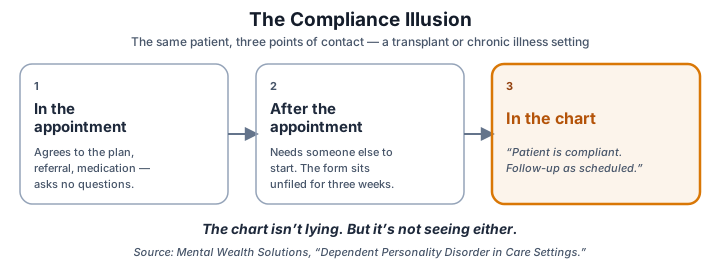
Here’s how the pattern actually plays out in a transplant or chronic illness setting:
In the appointment: Patient agrees to the treatment plan, the referral, the dietary change, the medication titration. Nods. Says yes. Doesn’t ask questions — not because they understand everything, but because asking questions might seem like being difficult.
After the appointment: Patient needs someone to initiate the next step. The form that needs to be submitted sits in their car for three weeks because filling it out alone felt too uncertain. The specialist’s office number is written on a card in their wallet. They haven’t called because they don’t know if it’s the right time to call, and they don’t want to call at the wrong time.
In the chart: “Patient is compliant. Follow-up as scheduled.”
The chart isn’t lying. But it’s not seeing either.
Research on chronic illness engagement consistently identifies a gap between expressed willingness and completed behavior — but the clinical literature rarely links this gap to personality structure. A 2020 study in Patient Education and Counseling (van Dulmen et al.) found that patients with high dependency traits had significantly lower rates of independent care behavior (self-monitoring, scheduling, self-advocacy) even when they reported high levels of motivation and intention. They wanted to do the right thing. They needed someone to set it in motion with them.
This is not a failure of intelligence, character, or commitment. It is a structural feature of how they navigate the world.
Why Clinicians Miss It
There are two professional instincts that work against catching this pattern.
First: We like agreeable patients. After a day of hostile intakes and cancelled appointments and patients who have every reason not to trust the system, the person who says yes and says thank you and seems to appreciate you — that person is a relief. The clinical heuristic that something might be wrong when a patient is too agreeable doesn’t get much airtime in training.
Second: Our frameworks assume self-advocacy capacity. Patient activation models, shared decision-making protocols, motivational interviewing — these tools are designed for people who can, with support, move toward autonomous action. They work well with avoidant patients, ambivalent patients, under-informed patients. They work poorly with patients whose core anxiety is organized around self-initiation itself.
Telling a patient with Dependent PD to “take ownership of your care” is like telling someone with a broken leg to “push through the discomfort.” It’s not wrong in principle. It just has nothing to do with the actual clinical picture.
What Actually Works
The evidence-based approach for DPD in clinical settings is not autonomy training. It is structured support.
This means:
Warm handoffs, not referrals. The difference between “here’s the number for the nutritionist” and “I’m going to connect you with Maria, who’s going to call you Thursday at 2pm” is the difference between a referral that gets followed and one that doesn’t. Dependent PD patients need someone to initiate the bridge. They can cross it. They just can’t build it alone.
Decision scaffolding. Instead of “what do you want to do?” — which creates a decision vacuum — use structured prompts: “Here are the two options. Most people in your situation choose [A]. Does that feel right to you, or do you want to go over [B] first?” You’re not removing their agency. You’re giving their agency something to grab onto.
Explicit permission to ask questions. It sounds small. It isn’t. “I want you to call us if anything feels confusing, even if it seems small — there are no dumb questions here” is not a throwaway line for this patient. It restructures the implicit permission field they’re operating in.
Proactive check-ins, not self-reported follow-up. If your care model depends on the patient calling you, you have already lost Dependent PD patients. A system that reaches out — text reminders, navigator calls, structured check-in prompts — doesn’t require self-initiation. It removes the most significant barrier.
For individual readers who recognize this pattern in themselves: knowing this about yourself is not a life sentence. It’s a map. You can name it to providers: “I have a hard time asking questions in appointments — can you walk me through the steps out loud?” You can build a support system that does initiation with you, not instead of you. The goal isn’t independence for its own sake. It’s building conditions where you can engage.
The Organizational Takeaway
If you run a clinic, a transplant center, a behavioral health program, or any care setting with a high-risk chronic illness population — your most vulnerable patients may be your most cooperative patients.
The ones who never push back. Who agree to everything. Who you could go three months without flagging for a care coordination touchpoint because they seem fine.
Run the question backward: Which of my patients has not self-initiated a contact in the last 90 days? Not because they haven’t needed care — because needing care and reaching out for it are two entirely different things for a portion of your caseload.
Building structured navigation into your outreach workflow — proactive contact, scaffolded decision support, warm handoffs — isn’t just good practice for complex cases. It’s the entire clinical model for a population that is currently invisible in your data because they’ve never complained loudly enough to appear.
Matthew Sexton is a Licensed Clinical Social Worker with 13 years of experience across community mental health, substance use treatment, forensic settings, and healthcare navigation. He is the founder of Mental Wealth Solutions, Inc.
If you work with transplant patients or chronic illness populations and want to see what structured patient navigation looks like in practice, TransplantCheck is built around exactly this model — proactive outreach, decision scaffolding, and navigation workflows designed for the patients your current system is missing.