I had a patient once — I will call her Maria — who had been managing a chronic condition for six years. She had insurance. She had a specialist she trusted. She knew exactly what she needed to do to stay stable.
And she was still declining.
When I finally asked her directly what was getting in the way, she paused for a long moment. Then she said: “I just can’t keep up with the bills. So sometimes I just don’t go.”
Maria was not non-compliant. She was financially exhausted. And no one on her care team had asked her about money.
There is a clinical term for what she was experiencing. It is called financial toxicity — and it is one of the most underdiagnosed barriers to chronic illness management in the American healthcare system.
What Financial Toxicity Actually Means
The term was coined in oncology, where researchers noticed that the financial devastation of cancer treatment was producing measurable psychological and behavioral consequences — independent of the cancer itself. Patients who were otherwise responding to treatment were developing anxiety disorders, depressive episodes, and treatment non-adherence because of the cost of staying alive.
That dynamic is not limited to cancer. It shows up in every major chronic illness category: kidney disease, cardiovascular conditions, diabetes, autoimmune disorders, respiratory disease. Any condition that requires sustained, ongoing management carries financial weight — and when that weight becomes unbearable, it starts affecting clinical decisions.
Medical debt is now the leading cause of personal bankruptcy in the United States. The majority of people who file involve people who had health insurance at the time of their illness. This is not about being uninsured. This is about the gap between what insurance covers and what care actually costs — in copays, deductibles, medications, specialist fees, transportation, lost wages, and the thousand small expenses that do not appear on any explanation of benefits.
That gap is where financial toxicity lives.
The Mental Health Connection Is Not Incidental
When a chronic illness patient is facing mounting medical debt, they are not just stressed. They are activating a psychological stress response that directly undermines the biological management of their condition.
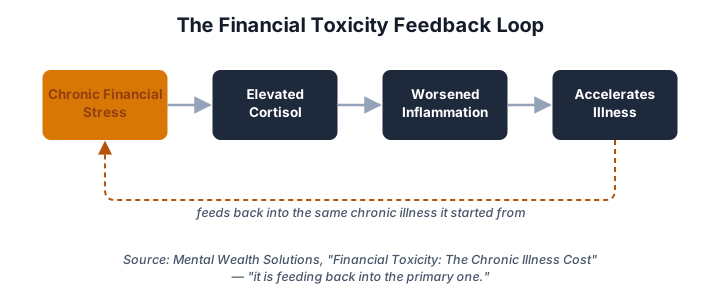
Chronic financial stress elevates cortisol. Elevated cortisol worsens inflammation. Worsened inflammation accelerates the very conditions they are trying to manage. The financial toxicity is not a side problem — it is feeding back into the primary one.
Beyond the physiological loop, there are behavioral consequences that clinicians see every day:
Treatment non-adherence. When medications cost more than rent, patients ration doses, skip refills, or discontinue treatment without telling their provider. The National Alliance on Mental Illness estimates that cost is among the most commonly cited reasons people discontinue psychiatric medications. The pattern is identical in chronic medical illness.
Appointment avoidance. A $40 copay sounds manageable until you have four specialist appointments in a month and no paid sick leave. Patients start triaging their own care — deciding which appointments to skip based on money, not medical priority.
Care avoidance. Some patients stop calling their providers at all because they cannot face another bill. They manage crises at home, delay until a condition worsens, and present to emergency departments — the most expensive and least therapeutic setting — when they can no longer hold it together.
Mental health deterioration. Research published in JAMA consistently links financial hardship in chronic illness to significantly elevated rates of depression and anxiety. These are not coincidental comorbidities. They are predictable consequences of a system that treats the disease without treating the person carrying it.
What You Can Do If This Is You
First: name it. Financial toxicity is real, it is documented, and it is not a personal failing. You are not bad at managing money. You are managing a system that was not designed to make it easy.
Talk to your medical team about cost. I know this feels uncomfortable. Do it anyway. Most providers have social workers, case managers, or patient navigators who know about assistance programs, copay support, pharmaceutical patient assistance programs, and local resources. But they will only connect you to these resources if they know you need them. Your doctor cannot read your bank account.
Request a financial counselor at your hospital or clinic. Many health systems have patient financial counselors — separate from billing — whose job is to help you navigate costs before they become crises. Ask for one before your next appointment.
Look at disease-specific organizations. Every major chronic illness category has nonprofit organizations that provide financial assistance, medication access programs, and navigation support. The American Kidney Fund, the American Heart Association, the National Multiple Sclerosis Society — these organizations exist partly because the system routinely fails the people it is supposed to serve.
Do not skip doses without telling someone. If cost is making you consider skipping or rationing medication, call your prescriber’s office and say exactly that. There are almost always lower-cost alternatives, samples, or assistance programs — but only if your provider knows the barrier exists.
Address the mental health piece directly. Financial stress and chronic illness form a feedback loop. Breaking the loop means addressing both simultaneously. If you are experiencing anxiety or depression in the context of managing your illness and its costs, that is a treatable clinical presentation — not a character flaw.
What Organizations Need to Do Differently
If you are a healthcare administrator, employer, or organizational leader, hear this: financial toxicity is not your patient’s problem to solve alone. It is a systems problem, and systems can be changed.
Healthcare organizations need to embed financial screening into chronic illness management workflows. Asking “How are you managing the financial side of your care?” should be as standard as asking about medication adherence. Because they are not separate questions.
Employers are often the overlooked stakeholders in chronic illness management. When an employee is managing a chronic condition, the financial burden frequently affects their work — through absenteeism, presenteeism, delayed care, and mental health deterioration. Robust EAP benefits that include financial counseling, flexible scheduling for medical appointments, and supplemental insurance options are not just employee perks. They are retention and productivity investments.
Health plans need to stop designing benefits structures that punish consistent care. High-deductible plans with poor chronic disease management benefits are a false economy. The downstream costs of deferred care — hospitalizations, emergency visits, accelerated disease progression — far exceed what preventive coverage costs.
The point is not that everyone needs to spend more money. The point is that the current system distributes financial pain in ways that predictably produce worse health outcomes — and that is a design choice, not an inevitability.
The Thing Maria Needed
Maria did not need more willpower. She did not need a better attitude about her health. She needed someone to ask the right question — and then she needed to be connected to resources that existed but that no one had ever told her about.
After we identified the financial barriers, we connected her with a patient navigator at her specialty clinic, a pharmaceutical assistance program for one of her medications, and a disease-specific nonprofit that helped cover travel costs for appointments. None of these required more money from Maria. They required someone to ask.
That is the micro-empowerment piece: one honest conversation, with the right information, at the right time — it changes the trajectory of care.
If you are navigating a chronic illness and hitting financial walls, Mental Wealth Solutions works with patients and care teams to identify resources, address the mental health impact of chronic disease management, and build care strategies that are actually sustainable.
Frequently asked questions.
- What is financial toxicity in chronic illness?
- Financial toxicity is a clinical term originally from oncology that describes the financial harm — and the downstream mental, emotional, and behavioral consequences — caused by the cost of managing a serious illness. It includes direct costs like copays and medications, and indirect costs like missed work, transportation, and caregiving.
- How does financial stress affect chronic illness outcomes?
- Research consistently shows that financial stress leads to treatment non-adherence, increased anxiety and depression, delayed care-seeking, and worse clinical outcomes. Patients who can't afford medications skip doses. Patients who can't afford copays skip appointments. The financial burden becomes a clinical barrier.
- What can employers do to support employees with chronic illness?
- Employers can expand EAP benefits to include financial counseling, offer flexible scheduling for medical appointments, provide supplemental insurance options, and train managers to recognize when employees may be struggling with treatment-related financial strain.
If this named something you're living with —
You don't have to figure it out from articles. Matthew Sexton, LCSW, NATC sees adults in therapy at his separate private practice (telehealth · NY · ME · DE · FL). Or take this piece to your own therapist — it's written to be shared.
Visit the practice