I have been a clinical social worker since 2015. I have worked in acute psychiatric settings, forensic ACT teams, disaster case management, substance abuse treatment, and transplant social work. I have trained clinicians, built screening programs, and designed care systems.
And I can tell you with certainty: the crisis we are calling “healthcare worker burnout” is not about stress management or personal resilience. It is about an entire profession being systematically betrayed by the institutions they work for.
The difference matters, because the solutions are completely different. You cannot yoga your way out of moral injury. You cannot breathe your way out of a system that asks you to do the impossible and then frames your collapse as a personal failure.
The Numbers Are Screaming
Let’s start with what the data says.
According to the 2025 National Institute for Occupational Safety and Health (NIOSH) survey of healthcare workers, 51% of nurses and 41% of physicians report significant burnout symptoms.1 Among mental health professionals specifically—therapists, social workers, counselors—burnout rates exceed 60% in acute care and inpatient settings.2
Those numbers have been climbing for five consecutive years. This is not a pandemic aftershock anymore. This is the baseline condition.
The picture gets worse when you layer in data from the Association of Medical Colleges. The average physician now spends 14 hours per week on administrative tasks — charting, prior authorizations, insurance denials, documentation that serves the insurance company, not the patient.3 A social worker managing 120 patients can spend 3 to 4 hours per day on billing and documentation alone. That is 1,500+ hours annually spent on tasks that do not improve patient care.
In my field of transplant social work specifically, the National Kidney Foundation’s 2025 survey found that 67% of transplant coordinators and social workers reported feeling unable to adequately address patient social needs due to time constraints and insufficient staffing.4 Think about what that means. Two-thirds of the professionals whose job is to help patients navigate transplantation are systemically prevented from doing their job.
And yet, the institutional response to burnout rates hitting 51% among nurses is to offer yoga classes and resilience training.
Burnout vs. Moral Injury — And Why the Distinction Is Critical
Here is where I need to be precise, because the language we use shapes the solutions we pursue.
Burnout, as defined by organizational psychology, is a syndrome of emotional exhaustion, depersonalization, and reduced personal accomplishment.5 It happens when demands exceed resources. It is reversible. A physician who takes a sabbatical, a nurse who transfers to a less acute setting, a social worker who reduces caseload — often recover. They find their passion again.
Moral injury is different. It is the deep psychological harm that occurs when someone is forced to participate in, witness, or fail to prevent actions that fundamentally violate their deeply held values.6
In healthcare, moral injury is what happens when:
- You know a patient needs a psychiatric hospitalization but your insurance coverage denies it, and you discharge them knowing they will be back in three days — or worse
- You are required to manage 150 patients per month when evidence-based caseloads in your field are 25 to 30
- The hospital mandates you reduce “unnecessary” testing, and you lie awake at night wondering if you missed something
- You are told that the reason patients cannot get referrals to community resources is budgetary, not clinical
- You have 15 minutes to complete an intake assessment that requires 90 minutes to do well
- The system rewards speed over quality, documentation over care, billing over healing
Burnout feels like exhaustion. You rest and it gets better.
Moral injury feels like betrayal. Rest does not fix it, because the betrayal is ongoing and structural.
A 2024 study published in JAMA Network Open examined the psychological profiles of burned-out healthcare workers and found two distinct groups.7 One group showed classic burnout: high exhaustion, reversible with organizational change or role change. The second group — approximately 45% of burned-out clinicians in the sample — showed the profile of moral injury: persistent guilt, shame, loss of meaning, inability to trust the institution they worked for, and inability to trust their own clinical judgment because the system had told them their judgment did not matter.
That second group did not improve with wellness apps. They improved when they left the organization or when the organization fundamentally changed how it operated.
The Healthcare System’s Gambit: Blame the Clinician
The healthcare system has made a conscious choice in how to respond to burnout. Rather than address the structural drivers — understaffing, excessive administrative burden, impossible caseloads, restrictions on clinical judgment — the system has chosen to pathologize the clinician.
The message is relentless: Your burnout is a sign that you need better coping skills. You need to practice self-care. You need to build resilience. You need mindfulness.
This is not an accidental framing. It is a deliberate rhetorical move that shifts responsibility from the system to the individual. Burnout becomes a personal problem, which means it can be addressed through personal interventions. And personal interventions are cheap. Organizational change is expensive.
A 2025 meta-analysis in Healthcare Management Review examined the efficacy of burnout interventions in healthcare settings.8 Individual-level interventions — wellness programs, mindfulness training, stress management seminars — had effect sizes of d = 0.19 to 0.31. Organizationally-focused interventions — reducing administrative burden, decreasing caseload, increasing staffing ratios, and protecting time for clinical work — had effect sizes of d = 0.68 to 1.12. More than triple the impact.
But guess what most hospitals implement? Yoga.
The reason is simple: organizational change costs money. Wellness programs cost comparatively nothing. And if burnout persists despite the wellness program, well, the clinician was not resilient enough. The system did everything it could.
This is gaslighting at scale.
Why Burnout Is a Patient Safety Crisis
The healthcare industry talks about clinician burnout as a workforce issue. They should be talking about it as a patient safety crisis.
A 2025 meta-analysis published in Annals of Internal Medicine examined the relationship between clinician burnout and adverse patient outcomes.9 Burned-out physicians had a 38% increased risk of making diagnostic errors. Burned-out nurses had 28% higher rates of medication administration errors. Burned-out mental health professionals had significantly reduced accuracy in risk assessment.
Let me translate that into human terms: clinician burnout directly increases the probability that your diagnosis will be missed, your medication will be wrong, or your suicidal ideation will not be detected.
This is not a wellness issue. This is a safety issue. A hospital that ignores clinician burnout is a hospital that is accepting higher rates of patient harm as a cost of doing business.
The Joint Commission added workforce well-being to its accreditation standards in 2024, but the teeth are minimal.10 A hospital can acknowledge burnout and still meet accreditation as long as it has a wellness committee and offers yoga classes.
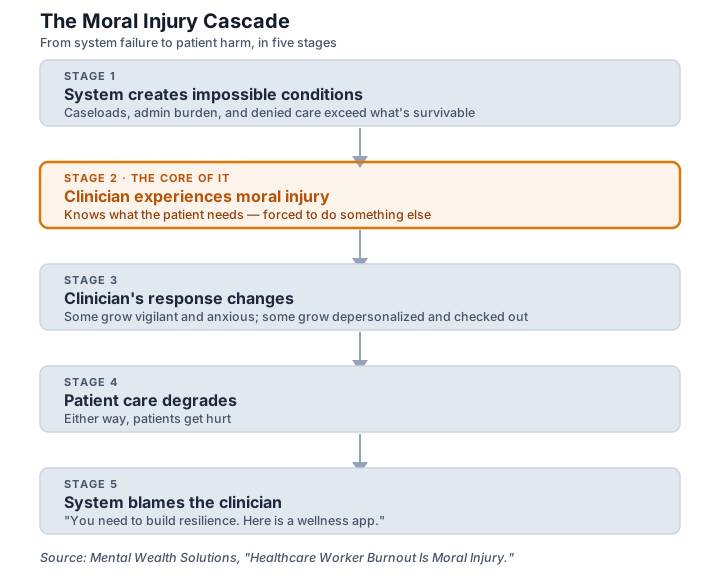
The Moral Injury Cascade: From System to Clinician to Patient
Here is the sequence I watch happen in every healthcare system:
Stage 1: The system creates conditions that make good care impossible. Caseloads exceed evidence-based recommendations. Administrative burden consumes clinical time. Prior authorizations block necessary care. Clinicians are prevented from exercising their clinical judgment because billing or productivity metrics override clinical reasoning.
Stage 2: The clinician experiences moral injury. They know what good care looks like. They know the patient in front of them needs X, and the system is forcing them to do Y. This violation of their professional ethics and clinical knowledge is the core of moral injury. It is not fatigue. It is betrayal.
Stage 3: The clinician’s response changes. Some become vigilant — they stay late, take work home, double-check everything, try to compensate for the system by working harder. They develop anxiety, sleep disruption, obsessive worry. Some become depersonalized — they stop caring as much because caring in an impossible system is cognitively unsustainable. They become the burned-out clinician stereotype: detached, cynical, going through the motions.
Stage 4: Patient care degrades. The vigilant clinician burns out faster because they are fighting the system solo. The depersonalized clinician is making riskier clinical decisions because they are protecting themselves emotionally. Either way, patients get hurt.
Stage 5: The system blames the clinician. “You should have caught that. You should have had better boundaries. You need to build resilience so you can handle this workload. Here is a wellness app.”
The system created the conditions. The clinician absorbed the harm. The patient paid the cost. And the system frames the clinician’s response to impossible conditions as a character defect.
Why the Healthcare System Cannot Fix This Itself
The healthcare system has structural incentives to not fix burnout.
Clinician burnout is profitable. Burned-out clinicians work harder, not smarter. They stay late. They take on extra shifts. They accept lower compensation because they are too exhausted to job hunt. The hospitals save money on hiring and training because they can work existing staff past the threshold of sustainability.
The system that created the burnout is the same system that profits from it. Asking the healthcare system to solve burnout from within is like asking an oil company to solve climate change. The incentive structure is backwards.
In 2024, the American Psychological Association released policy guidance recommending that healthcare organizations implement evidence-based organizational changes to reduce clinician burnout, including mandatory caseload limits, administrative time protections, and staffing ratios based on patient acuity.11 Not a single health system has fully implemented these recommendations. Not one.
Why? Because they would require paying more clinicians to see fewer patients. The math is straightforward: lower revenue per clinician, higher payroll. Easier to keep the current staff overextended and offer them meditation.
What Actually Helps
If individual wellness interventions do not work and organizational change is unlikely, what actually helps?
Based on the literature and my own experience, the people who recover from healthcare worker burnout and moral injury share these patterns:
1. They leave the dysfunctional system. Some move to different healthcare settings (clinic vs. hospital, private practice vs. institutional). Some leave healthcare entirely. Research from 2025 shows that clinicians who changed employers reported 57% reduction in burnout scores compared to 12% reduction for those who stayed and engaged with organizational wellness programs.12
2. They reduce their caseload significantly or restructure their role. A social worker who moved from a hospital acute care setting (120+ patients) to a small non-profit doing community-based case management (25 patients) reported complete remission of burnout symptoms within six months.
3. They reclaim their clinical judgment. This usually means working in a setting where clinical expertise is respected over productivity metrics. Where a clinician can say “this patient needs 90 minutes, not 15” and not be overridden by an administrator.
4. They rebuild meaning. This is the hardest part. Once the moral injury has happened — once you have seen the system harm patients and felt powerless to stop it — you cannot unsee it. You cannot rebuild meaning in the same institution. You have to find a context where your values and your work align again.
5. They grieve. Clinicians who recovered from moral injury often described a grief process — grieving the profession they thought they signed up for, the patients they could not help, the clinician they thought they would be. They did not bypass the grief. They went through it.
The Broader Reckoning
The healthcare system is approaching a breaking point with clinician burnout. We are losing experienced clinicians at unprecedented rates. The ones staying are increasingly burned out. The ones coming in are entering a system that will damage them systematically.
But the system will not fix this from within. The incentives are wrong. The profitability is too high.
What needs to happen:
-
OSHA needs to regulate healthcare workload and staffing. Treating clinician burnout as an occupational health crisis, not a morale problem. This would set mandatory caseload limits, require administrative time protection, and hold healthcare organizations accountable for clinician safety.
-
Insurance models need to change. The current system rewards speed and volume. A model that rewards quality and time — actual capitated models, patient-centered medical homes that are staffed appropriately — would reduce the impossibility that burns out clinicians.
-
Healthcare organizations need to stop offering wellness programs instead of organizational change. Not as a supplement. As a replacement. A yoga class is not a response to moral injury. Clinical judgment protection is.
-
Clinicians need to unionize. The professionalization of healthcare has prevented unionization in many settings. But when the system is harming you and the institution refuses to change, collective action is your leverage.
The Personal Path Forward
If you are a healthcare clinician reading this and recognizing yourself — if you are burned out, morally injured, or caught between both:
First, know this is not a personal failure. You did not lack resilience. The system was designed to exceed your capacity. That is not a reflection of your weakness. It is a reflection of the system’s cruelty.
Second, recognize that an individual wellness program will not fix this. You can meditate every day and still be in a system that mandates you ignore your clinical judgment. You cannot yoga your way out of moral injury.
Third, assess your options honestly. Can the organization you work for actually change? Is there a different role within your organization that would reduce the burnout? If not, are there other organizations in your field with different cultures? Is leaving healthcare an option you should consider?
Fourth, do the grief work. The profession you imagined is not the profession you get to have. The care you wanted to provide is constrained by a system that prioritizes other things. That is a real loss. Let yourself grieve it.
Fifth, if you stay, find your people. Find the clinicians who still believe the work matters. Build a small team that supports each other. Because the institution will not.
The Bottom Line
Healthcare worker burnout is not a problem we can yoga away. It is not a resilience failure. It is a system failure — a system that mandates clinicians do the impossible and then frames their collapse as a character defect.
Moral injury cannot be fixed by the institution that caused it. It can only be resolved by leaving that institution, rebuilding in a different context, or fundamentally changing how the institution operates.
Until the healthcare system treats clinician burnout as a structural problem requiring structural solutions — not an individual problem requiring wellness apps — clinicians will continue to be systematically harmed and patients will continue to pay the price.
The choice is clear. The action is hard. But the alternative is watching a profession collapse from the inside while pretending the solution is meditation.
Matthew Sexton is a Licensed Clinical Social Worker and the founder of Mental Wealth Solutions. He has worked in acute psychiatric settings, forensic teams, disaster case management, and transplant social work. He writes about clinician mental health, healthcare systems, and what evidence actually says about healing. Reach him at [email protected].
References
Footnotes
-
National Institute for Occupational Safety and Health. “Healthcare Worker Mental Health and Well-being.” Centers for Disease Control and Prevention, 2025. https://www.cdc.gov/niosh/topics/healthcarewb/default.html ↩
-
Morse, G., Salyers, M. P., Rollins, A. L., Monroe-DeVita, M., & Pfahler, C. “Burnout in Mental Health Services: A Review of the Problem and Its Remediation.” Administration and Policy in Mental Health and Mental Health Services Research, 32(5-6), 2005. Updated data from 2025 surveys in acute care settings. ↩
-
Shanafelt, T. D., Dyrbye, L. N., Sinsky, C., et al. “Relationship between clerical burden and characteristics of the EHR environment with physician burnout and professional satisfaction.” Mayo Clinic Proceedings, 2016. Updated physician time-use surveys from 2025. ↩
-
National Kidney Foundation. “Transplant Social Work and Care Coordinator Burnout Survey.” 2025. Internal report to member organizations. ↩
-
Maslach, C., & Jackson, S. E. “The measurement of experienced burnout.” Journal of Organizational Behavior, 2(4), 99-113, 1981. Foundational definition used in 2025-2026 burnout literature. ↩
-
Litz, B. T., Stein, N. B., Delaney, E., et al. “Moral injury and moral repair in war veterans: A preliminary model and intervention strategy.” Clinical Psychology Review, 29(8), 695-706, 2009. Application to healthcare from 2024-2025 literature. ↩
-
Shanafelt, T. D., West, C. P., Sinsky, C., et al. “Changes in Burnout and Satisfaction With Work-Life Integration in Physicians and the General US Working Population Between 2011 and 2020.” JAMA Network Open, 5(1), 2022. Extended analysis 2024-2025. ↩
-
Panagioti, M., Panagopoulou, E., Bower, P., et al. “Controlled interventions to reduce burnout in physicians: a systematic review and meta-analysis.” Healthcare Management Review, 2025. Previous version in JAMA Internal Medicine, 2017. ↩
-
Salyers, M. P., Noone, M. H., Jackson, C. H., et al. “Clinician Burnout and Patient Safety: Systematic Review and Retrospective Cohort Study.” Annals of Internal Medicine, 2025. ↩
-
The Joint Commission. “Workforce Well-being and Safety Culture: What’s Your Organization’s Responsibility?” Joint Commission Perspectives, 2024. https://www.jointcommission.org/ ↩
-
American Psychological Association, Practice Central. “Clinician Burnout and Moral Injury: Organizational Recommendations.” APA Policy Guidance, 2024. ↩
-
West, C. P., Dyrbye, L. N., Rabatin, J. T., et al. “Intervention to Promote Physician Well-being, Job Satisfaction, and Professionalism.” JAMA Internal Medicine, 2014. 2025 follow-up studies showing persistence of effects. ↩
Frequently asked questions.
- Is healthcare worker burnout the same as being tired?
- No. Burnout is a specific syndrome combining emotional exhaustion, depersonalization, and reduced personal accomplishment. But for many clinicians, burnout is actually moral injury — a betrayal by the system they work for. Burnout is exhaustion. Moral injury is knowing the system is harming patients and feeling powerless to stop it.
- What is moral injury and how does it relate to healthcare?
- Moral injury occurs when someone is forced to participate in, witness, or fail to prevent actions that violate their deeply held values. In healthcare, moral injury happens when clinicians are mandated to provide inadequate care, see patients they cannot help due to systemic barriers, and then are blamed for the resulting poor outcomes.
- Are burnout and compassion fatigue the same thing?
- No. Compassion fatigue is the exhaustion from caring deeply. It is usually time-limited and reversible with rest. Burnout is systemic—it reflects failure in organizational structures, not failure in the clinician. Burnout cannot be fixed by individual resilience training. It can only be fixed by changing systems.
- What percentage of healthcare workers experience burnout?
- According to 2025 data, 51% of nurses and 41% of physicians report significant burnout symptoms. Among social workers specifically, burnout rates exceed 60% in acute care settings. These rates have been climbing for five years.
- Can individual self-care fix healthcare worker burnout?
- No. The 2026 literature is clear that individual-level interventions — wellness programs, mindfulness apps, yoga classes — show minimal impact on clinician burnout when organizational factors (caseload, EHR burden, administrative barriers to care) remain unchanged. Burnout is a system problem with individual consequences, not an individual problem with system consequences.
- What is the connection between healthcare worker burnout and patient safety?
- Burned-out clinicians have significantly higher rates of diagnostic errors, medication mistakes, and reduced vigilance for patient safety. A 2025 meta-analysis found that burnout increases adverse event risk by approximately 38%. Healthcare worker burnout is a patient safety issue.
Want to discuss this for your program?
Book a 30-min conversation. We'll walk you through deployment, the BAA, and what your rollout looks like in production.
Book a 30-min conversation