Your employer is paying for therapy sessions, financial counseling, legal consultations, and more — right now. It’s already in your benefits package. And statistically, there’s about a 95% chance you’ve never touched it.
That’s not a knock on you. It’s a system design problem.
Employee Assistance Programs (EAPs) are one of the most underutilized benefits in the American workforce. According to the Employee Assistance Professionals Association, average EAP utilization sits between 3% and 6% annually — despite the fact that these programs are provided at zero cost to employees. SAMHSA reports that untreated mental health conditions cost employers an estimated $100 billion per year in lost productivity, absenteeism, and turnover.
That’s a massive gap between what’s available and what people are actually using. And it’s not because employees don’t need support — it’s because nobody ever clearly explained what an EAP actually does or how to use it without feeling like you’re sending a red flag to your manager.
Let’s fix that.
What an EAP Actually Covers
Most people think EAPs are limited to a couple of therapy sessions for “stress.” The reality is much broader.
Depending on your employer’s plan, an EAP typically includes:
- Mental health counseling — usually 3–8 free sessions per issue per year with a licensed clinician
- Financial counseling — help with debt, budgeting, bankruptcy, financial crisis
- Legal consultation — initial consultations on family law, landlord disputes, estate planning, and more
- Substance use support — assessment, referrals, short-term counseling
- Work-life resources — childcare referrals, elder care support, caregiver resources
- Crisis intervention — 24/7 phone access to a licensed counselor
- Grief and loss support — bereavement counseling after a death or major loss
Some EAPs also include coaching, nutrition counseling, and online mental health tools. The specific offering depends on your employer’s contract, but the baseline is almost always more than most employees realize.
Why People Don’t Use It (And Why Those Fears Usually Aren’t Founded)
Fear #1: My employer will know I used it.
This is the big one. And it’s understandable — nobody wants their manager to know they’re struggling.
Here’s the reality: your employer does not receive information about individual usage. EAP providers are legally required to maintain confidentiality. What your employer sees — if anything — is aggregate utilization data like “47 employees used the EAP this quarter.” They do not see your name, your diagnosis, or what you talked about.
The exception is when there’s a mandatory referral — say, a workplace accident that triggers a required EAP visit. In those cases, the EAP may confirm attendance to HR (not content). But for voluntary use, you are protected.
Fear #2: The therapists are bad.
Some are great. Some aren’t. That’s true of every system, including private practice.
The legitimate limitation is that EAP sessions are often capped — 6 sessions isn’t enough for deep trauma work or chronic conditions. But for situational stress, work transitions, relationship conflict, grief, or anxiety that’s getting in the way of functioning, 6 focused sessions with a skilled clinician can make a real difference. Think of it as a bridge — not necessarily the whole road.
If you need longer-term support, a good EAP counselor will help you transition to longer-term care and navigate your insurance benefits to make that affordable.
Fear #3: I don’t know how to access it.
This is where most programs lose people. The access point is often buried in a benefits PDF you got during onboarding and never opened again.
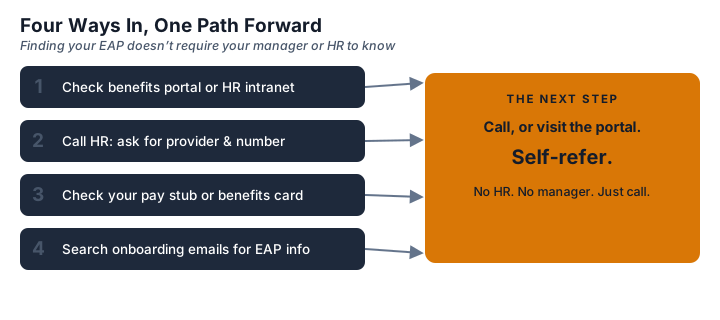
Here’s how to find it:
- Check your benefits portal or HR intranet — look for “EAP” or “Employee Assistance”
- Call HR and ask directly: “What’s our EAP provider and the number to call?”
- Check your pay stub or benefits card — EAP contact info is sometimes printed there
- Search your inbox for onboarding emails — most employers send this info and it’s searchable
Once you have the number, you call it — or visit the web portal — and self-refer. You don’t go through HR. You don’t tell your manager. You just call.
How to Get the Most Out of EAP Sessions
If you’re going to use the benefit, use it intentionally.
Be specific when you call. When you contact the EAP, the intake person will ask what you’re looking for. You don’t have to know the clinical name for what you’re experiencing. “Work stress that’s affecting my sleep and home life” is a complete and valid reason. “I’m going through a divorce and I need some support” is more than enough. The more specific you can be, the better they can match you with the right clinician.
Ask about session limits upfront. Know how many sessions you have before you start. If you’re approved for 6 and you use 2 before the clinician understands your situation, that’s not ideal. Good EAP clinicians work within the model — they’re used to it — but it helps to come in knowing the structure.
Treat it like a real intake, not a test. Some people downplay what they’re going through in an EAP call because they feel like they need to prove they’re “sick enough” to deserve support. You don’t. EAPs exist for exactly the kind of thing most people don’t talk about — the functioning-but-struggling zone that doesn’t make it to HR or a hospital but is absolutely eroding your quality of life.
Ask about what else is covered. If you call for mental health support, also ask: “What else does my EAP cover?” You may be leaving financial or legal consultation on the table that could directly reduce the stressors driving your mental health concerns in the first place.
What Organizations Are Getting Wrong
If you’re an HR leader, benefits manager, or executive reading this, the utilization data is telling you something important: your employees aren’t using what you’re paying for.
The reasons are almost never “they don’t need it.” The reasons are:
-
Awareness is too passive. A benefits PDF during onboarding and an annual reminder email are not a communication strategy. Employees need to hear about the EAP at the moment they need it — during stressful seasons, after major org changes, after layoffs, before and after performance review cycles.
-
Managers don’t know how to refer. When a manager notices someone struggling, they often don’t say anything because they don’t know what’s appropriate to offer. Training managers to say “We have an EAP — completely confidential — here’s the number” is a five-minute conversation that could change someone’s year.
-
Stigma is embedded in culture. If leadership never acknowledges that mental health support exists, employees read that as: this isn’t something you do here. Normalizing EAP use from the top down — even just “I’ve used the EAP before and found it helpful” from a leader — removes the stigma in ways that no poster in the break room can.
-
The access experience is friction-heavy. A 1-800 number with a 20-minute hold time is a barrier to entry. Work with your EAP vendor to streamline access. Ask them for their time-to-first-appointment data. If it’s more than 5 business days, that’s a problem worth solving.
The return on solving this is real. Research published in the Journal of Occupational and Environmental Medicine found that organizations with higher EAP utilization show measurable reductions in absenteeism, presenteeism, and healthcare cost inflation. The program is already paid for. Getting people to use it is the work.
The Bottom Line
Your EAP exists because your employer knows that people need support sometimes — and that supporting them is good business. It’s confidential. It’s free. And it’s almost certainly offering more than you think.
If you’re in the struggling-but-functioning zone right now, that’s exactly what this benefit is for. You don’t need to be in crisis to call. You don’t need to explain yourself to your HR department. You just need the number.
If you’re in a leadership role and your utilization is under 5%, that’s not a benefit working for you — that’s a resource sitting unclaimed while your people manage alone.
Either way, the first step is the same: make the call.
Matthew Sexton is a Licensed Clinical Social Worker and the founder of Mental Wealth Solutions, where he helps individuals, organizations, and healthcare systems build sustainable approaches to mental health and chronic illness support. For tools built specifically for complex care navigation, explore TransplantCheck and VeteranCheck.
If this named something you're living with —
You don't have to figure it out from articles. Matthew Sexton, LCSW, NATC sees adults in therapy at his separate private practice (telehealth · NY · ME · DE · FL). Or take this piece to your own therapist — it's written to be shared.
Visit the practice