In February 2026, the FDA granted Breakthrough Device Designation to Nephrodite’s implantable artificial kidney — a surgically placed, continuous dialysis system that could fundamentally change what ESRD treatment looks like. The device, called “Holly,” is a filter about the size of a AA battery that sits in your pelvis, connected directly to your blood vessels, running 24/7 to do what your kidneys no longer can.
When I read that news, my first thought wasn’t “this is coming soon.” It was “this is real, it’s coming, and it’s going to take years.”
I’m an LCSW who’s worked in clinical social work since 2015 — substance abuse programs, forensic ACT teams, disaster case management, grant-funded programs. For the past few years, I’ve been building TransplantCheck, a screening and referral tool for transplant patients. That work has given me a front-row seat to what kidney disease actually looks like in America right now: 90,000 people on the kidney transplant waitlist, thousands of them stuck there because nobody screened them for barriers that could be fixed, nobody helped them navigate the system, nobody connected them to resources that exist but stay invisible.
So yes, an implantable kidney is incredible. But it’s also 5-10 years away from patient access. And right now, in 2026, the patients who need help aren’t waiting for 2031. They’re waiting today. They’re on dialysis three times a week, missing work, missing their kids’ school events. They’re managing diabetes and hypertension on top of kidney failure. They’re trying to stay off a waitlist they don’t know how to get on.
Let me break down what’s actually happening with this device, why it matters, and — more importantly — what you need to know about the landscape right now.
What Is an Implantable Artificial Kidney?
Holly is a wearable or implantable continuous filtration device. Imagine a dialysis machine — the one that’s the size of a washing machine, that you sit next to for 4-5 hours, three times a week — and then imagine shrinking it down, putting it inside your body, and never having to go back to dialysis again.
Here’s how it works: The device sits in your pelvis, surgically placed. Two small tubes connect it to blood vessels — one to bring blood in, one to send it back out. It filters your blood continuously, 24 hours a day, just like a real kidney would. The filtered waste goes to your bladder, where it exits as urine, the same way it would if your kidneys were working.
The science behind it is solid. Instead of the stop-start rhythm of three weekly dialysis sessions, your body gets constant, gentle filtration. No fluid overload between treatments. No “dialysis week” where you feel good for 24 hours and then get worse as you gain weight and toxins build up. No spending 15+ hours a week in a dialysis chair.
The clinical advantages are enormous: better blood pressure control, fewer medication adjustments, no more diet restriction around potassium and phosphorus, no more fluid restriction. Your hematocrit stays more stable. Your vascular access — that precious fistula or graft — doesn’t take the beating that dialysis demands. Your quality of life isn’t measured in hours between treatment sessions.
For someone on dialysis, this is the device you dream about at 3 AM when you can’t sleep because you drank too much water.
Why This Breakthrough Matters
FDA Breakthrough Device Designation is significant. It means the FDA looked at the evidence and said, “This device addresses an unmet medical need and shows promise compared to existing treatments.” It fast-tracks the approval process. It signals that the agency believes this technology could materially improve patient outcomes.
That’s not hype. ESRD is brutal. It kills faster than most cancers. The five-year survival rate for dialysis patients is around 35-40% — worse than many solid-organ cancers. Kidney transplant is the gold standard, with a five-year survival rate around 80-90%, but that requires a donor and the willingness to take immunosuppressants forever. An implantable artificial kidney would be the third option, and for many patients, it could be the best option.
The waitlist is long and getting longer. Over 90,000 people are waiting for a kidney right now. The average wait time is 3-5 years. Some people wait 10+ years and never get called. Every year, thousands of people die on dialysis waiting for a kidney that never comes.
An implantable kidney doesn’t solve the shortage. But it changes the equation. It means patients who can’t get a deceased donor kidney and don’t have a living donor don’t have to choose between dialysis and death. It means we might be able to move toward a world where dialysis is temporary — while you wait for a transplant or while your new kidney is being established — rather than a life sentence.
That’s the promise.
The Clinical Reality: Years Away, Not Months
Here’s where I have to be direct, because this is where the news gets simplified into something that sounds more immediate than it is.
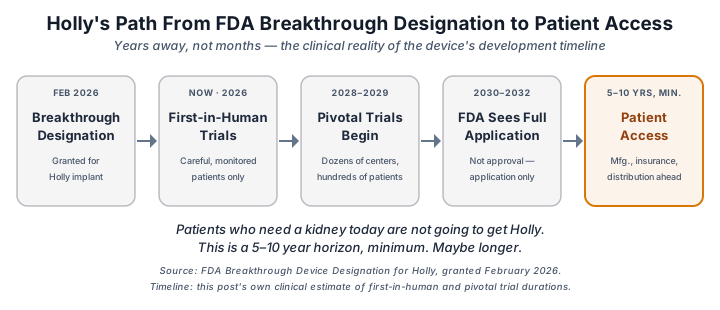
Holly is in the first-in-human trials phase. That means they’re just now starting to put it in actual patients — carefully selected, heavily monitored patients in research settings. This is not “available now for anyone who needs it.” This is “we have evidence it works in animals and computational models; now let’s see if it works in humans.”
First-in-human trials typically run 2-3 years. That gets us to 2028-2029. Then there are larger pivotal trials, where you take the device into dozens of centers and hundreds of patients, to build the safety and efficacy data that the FDA wants. That’s another 2-3 years. So we’re looking at 2030-2032 before the FDA is likely to see a full approval application.
Then there’s manufacturing scale-up, insurance coverage negotiation, reimbursement rates, distribution logistics. A device that sophisticated doesn’t just appear in every dialysis center. There will be specialized centers. There will be a waitlist for the device itself, just like there’s a waitlist for donor kidneys.
So realistically? Patients who need a kidney today are not going to get Holly. Patients who go on dialysis next year might not get Holly by the time they’re eligible for transplant. This is a 5-10 year horizon, minimum. Maybe longer.
And that’s assuming the trials go smoothly, the device performs as expected, and there are no complications that force a redesign.
I’m not being pessimistic. I’m being clinical. I’ve worked in healthcare long enough to know that “FDA Breakthrough Designation” doesn’t mean “patients can access this next year.” It means “this is genuinely promising, and we’re going to move it through the approval process faster than usual.” Faster is still years.
The Present Crisis: 90,000 Patients Can’t Wait for 2031
While Nephrodite is running trials on an implantable kidney, 90,000 real people are on a transplant waitlist right now. Over 5,000 of them will die this year waiting for a kidney that doesn’t come.
That’s not because there’s a shortage of kidneys that are good enough. It’s because thousands of potential living donors exist but never get identified. It’s because patients don’t know how to ask family members. It’s because their doctors never screened them for barriers — things like unstable housing, food insecurity, untreated depression, untreated addiction, lack of transportation, unstable insurance.
Social determinants of health — what I call SDOH — matter more for transplant outcomes than any single clinical factor. A patient with well-controlled blood sugar and blood pressure is still going to struggle with a transplant if they can’t afford their medications or don’t have stable housing. A patient with perfect lab values still can’t take immunosuppressants if they’re experiencing homelessness or food insecurity.
I built TransplantCheck because I was tired of watching patients get screened for transplant eligibility by someone who checked their creatinine and ejection fraction and said “you’re good to go” — without ever asking whether they had stable housing, reliable transportation, food security, mental health support, or a social network to help them manage a transplant.
Here’s what actually kills transplants: missing medications because you’re working two jobs and forgot to refill. Rejecting a kidney because untreated depression meant you stopped taking your immunosuppressants. Losing a transplant because you experienced a housing crisis and spent three weeks in your car without refrigeration for your meds. Not making it to your follow-up appointment because you don’t have transportation.
None of that is novel. We’ve known for decades that SDOH matters for transplant outcomes. But screening for it, addressing it, connecting patients to resources — that’s the unsexy work that doesn’t get FDA breakthroughs. That’s case management, social work, systems navigation. That’s fixing problems that exist today for patients who can’t wait for 2031.
What Transplant Patients Actually Need Right Now
The Holly device is incredible. I hope it works. I hope it gets approved. I hope it transforms the lives of thousands of patients. But I’m not going to tell a patient on dialysis today that their solution is an FDA Breakthrough Designation.
What they actually need is:
Someone to screen them comprehensively — not just clinically, but for the SDOH barriers that predict transplant failure. Housing stability. Food security. Transportation. Mental health. Substance use. Social support. Insurance. Job stability. Each of these is fixable, if someone identifies it.
Someone to help navigate the system — Transplant is complex. You need a nephrologist, you need a transplant surgeon, you need a transplant center, you need to get on the waitlist, you need a living donor (maybe), you need insurance coverage, you need mental health clearance, you need infectious disease clearance, you need financial counseling. It’s a maze. Most patients have no idea where to start.
Someone to connect them to resources — If you’re food insecure, there are programs. If you’re unhoused, there are services. If you’re struggling with addiction, there’s treatment. If you’re depressed, there’s therapy. Most of these programs exist. Most patients don’t know about them, and most transplant centers aren’t equipped to connect them.
Someone to follow up — Screening once and then disappearing doesn’t work. Patients need ongoing support, especially once they’re transplanted. That’s where the work actually happens.
This is why I built TransplantCheck. It’s not sexy. It doesn’t get FDA breakthroughs. But it works. It identifies patients who can be transitioned from dialysis to transplant. It screens for the barriers that predict failure. It connects patients to resources. It bridges the gap between clinical eligibility and actual success.
The Future Is Both/And, Not Either/Or
Here’s what I believe: We need both the implantable artificial kidney AND the tools and systems that help patients navigate transplant right now.
The implantable kidney is going to be transformative, eventually. Patients who get one are going to have dramatically better quality of life, better health outcomes, longer survival. The device is worth the investment, the trials, the years of work. I want it to succeed.
But it doesn’t help the 90,000 people on the waitlist in 2026.
The unsexy work — screening patients for SDOH barriers, helping them navigate transplant, connecting them to resources, supporting them post-transplant — that’s what helps them now. That’s what we can do today. That’s what closes the gap between clinical eligibility and actual transplant access.
Both matter. And we can do both. We can invest in breakthrough innovation while also investing in the systems work that’s needed right now.
What’s Next for Patients
If you or someone you know has ESRD and is considering transplant, here’s what I’d recommend:
Get screened comprehensively — Don’t just sit with your nephrologist and talk about your creatinine. Talk about housing, food security, transportation, mental health, substance use, social support, insurance, job stability. These are the things that actually predict whether you’ll succeed with a transplant.
Start exploring living donors early — Family, friends, coworkers. You’d be surprised how many people are willing to be tested. But they have to know you need them, and they have to understand the process. Don’t wait.
Connect with your transplant team and social work — If your transplant center has a social worker, use them. Use a case manager. Use any resource that exists. The goal is to get you transplanted, not to keep you on dialysis.
Stay in the loop on Holly — Follow the trials. Understand where the device is in development. If you’re a good candidate and you’re interested in being part of a trial, talk to your transplant team about it. But don’t bet your current treatment plan on a device that’s years away.
Use tools like TransplantCheck — Whether it’s ours or someone else’s, use screening tools that help you understand your SDOH barriers and what you need to succeed. Transplant isn’t just about clinical numbers. It’s about your whole life.
The implantable artificial kidney is coming. But it’s not here yet. Right now, your job is to get yourself ready — clinically, psychologically, socially — for the transplant that’s available today, or to optimize your dialysis while you wait.
The future is incredible. But we also have to live in the present.
Where to Go from Here
If you want to learn more about TransplantCheck or about the work we’re doing in SDOH screening and transplant facilitation, visit transplantcheck.org. If you’re looking for clinical social work or want to learn more about mental health support for ESRD patients, visit mentalwealthsolutions.org.
The implantable artificial kidney is real. It’s coming. And while we wait for it, we can do the work that matters right now — helping patients understand their barriers, navigate the system, and get the transplant they need.
That’s the work I’m committed to. That’s the work that’s saving lives today.
If this named something you're living with —
You don't have to figure it out from articles. Matthew Sexton, LCSW, NATC sees adults in therapy at his separate private practice (telehealth · NY · ME · DE · FL). Or take this piece to your own therapist — it's written to be shared.
Visit the practice