Narcissistic mirroring is the practice of reflecting a person’s identity, values, and interests back at them so precisely that the target feels seen at a depth they have never experienced. It is not the same as the natural, co-regulated mirroring that develops between two people who genuinely connect over time. Narcissistic mirroring is directed, rapid, and built from material extracted from the target rather than offered by the mirror. The reason it feels intoxicating — and the reason its withdrawal feels like a physiological hangover — is that the brain responds to feeling perfectly understood with the same neurochemistry it releases around alcohol, novelty, and high-stakes reward. Understanding this is the beginning of recovery.
What Is Mirroring, Clinically?
Mirroring is the practice of reflecting someone’s identity, values, and interests back at them to create the illusion of deep compatibility. It is not the same as the natural mirroring that happens between people who genuinely connect — where shared values and mannerisms develop organically over time. Narcissistic mirroring is deliberate, and it is aimed at one thing: getting the target to feel seen so completely that every defense comes down.
In the early stages of the relationship, it often feels like finding someone who finally understands — someone who likes the same things, holds the same values, finishes sentences. That feeling is not imagined. It is manufactured.
Clinically, mirroring is a subset of what the literature on narcissistic abuse calls idealization — the opening phase of the idealize-devalue-discard cycle first described in clinical observations of pathological narcissism and elaborated in the trauma literature (Herman, 1992). It is one of the primary mechanisms by which a trauma bond begins to form. Kernberg’s work on pathological narcissism frames the behavior as an externalization of a grandiose false self that requires a constant supply of validation and admiration (Kernberg, 1975). The mirror is not built to connect. It is built to extract.
The extraction is quiet. Most survivors do not notice it happening. The other person asks thoughtful questions, pays unusually close attention to the answers, and then — weeks later — begins to repeat those answers back as their own preferences, their own opinions, their own identity. The target does not hear this as mimicry. They hear it as compatibility.
The Vodka-Martini Analogy
Vodka on the rocks and a martini are not the same drink. They share a base ingredient, but the presentation is completely different, and the experience of drinking them is nothing alike.
Narcissistic mirroring works the same way. The connection felt real because it was built from real material — the target’s actual values, genuine interests, authentic way of engaging with the world. It was sourced from the target. The compatibility was not fabricated from nothing; it was constructed from the survivor’s own reflection.
That is what makes it so hard to name and so hard to leave. The target was not falling for a fiction. The target was falling for a carefully curated version of the self, handed back as a relationship.
The clinical distinction matters. A genuine connection involves two separate nervous systems gradually syncing through repeated experiences of mutual attunement — what Schore and Siegel describe as the right-brain-to-right-brain regulation that builds secure attachment over time (Schore, 2003; Siegel, 1999). That process is slow by design. The slowness is protective. It gives both parties time to test whether the other person’s internal state is consistent, responsive, and genuinely their own.
Mirroring bypasses that process entirely. It produces the felt experience of attunement without the underlying regulation. It is the social equivalent of a drink that tastes like a signature cocktail but is actually straight alcohol.
Why Feeling Perfectly Understood Is Intoxicating
Survivors often describe the early phase of a narcissistic relationship as “the best I have ever felt,” “unreal,” or “like a drug.” That language is not metaphor. It is phenomenology.
Helen Fisher’s brain imaging research on romantic attachment documents that the early, high-intensity phase of romantic love activates the same dopaminergic reward circuitry implicated in substance reward — the ventral tegmental area, the caudate nucleus, and the nucleus accumbens (Fisher, 2004; Fisher et al., 2010, Journal of Neurophysiology). These are not the systems that produce warm contentment. They are the systems that produce craving. When someone mirrors a target effectively, they are engineering a direct hit on the reward circuitry responsible for pursuit, anticipation, and the urge to secure more of the stimulus.
Stephen Porges’s polyvagal framework adds the second layer. The ventral vagal branch of the nervous system — the branch responsible for social engagement, felt safety, and co-regulation — is activated by moments of reciprocal warmth and mutual gaze (Porges, 2011). Normally, ventral vagal activation is slow to build and steady in character. When a skilled mirror produces it artificially and at high intensity, the nervous system registers the other person as a source of exceptional safety, at a magnitude that is usually reserved for primary attachment figures. The S.T.O.I.C.K. method names this as a nervous-system event rather than a character event, which is the beginning of being able to work with it.
What makes the combination pharmacologically potent is the overlap. Dopaminergic craving plus ventral vagal safety-signaling plus the novelty of a new partner is, to the brain, indistinguishable from a substance that produces euphoria, connection, and anticipatory hunger all at once. Survivors are not exaggerating when they say the feeling was like a drug. It was behaving like one in their nervous system.
How Mirroring Differs From Genuine Attunement
Genuine attunement has a slow, two-directional character that mirroring lacks. Four clinical markers help separate them:
- Pace. Genuine attunement builds over months and years and is punctuated by ordinary mismatches and repairs. Mirroring produces the felt sense of deep knowing within days or weeks.
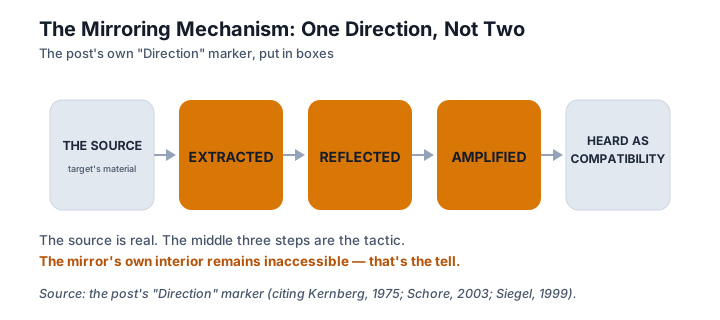
- Direction. Genuine attunement moves in both directions — each person is altered by the other. Mirroring moves in one direction: the target’s material is extracted, reflected, and amplified, while the mirror’s own interior remains inaccessible.
- Durability. Genuine attunement persists through disagreement and distance. Mirroring collapses the moment the target challenges the reflection, because there is no underlying self to generate a stable counter-position.
- Texture. Genuine attunement feels grounding and steady. Mirroring feels electrified, urgent, and slightly unreal. Many survivors later describe “something felt off from the beginning” — that felt-sense of unreality was accurate data.
The earlier survivors can name the texture difference, the sooner the intoxication becomes recognizable as intoxication. This is not easy work. Naming the unreality while inside it requires the target to distrust what feels like the most powerful connection of their life. Most people cannot do that alone.
How to Spot Mirroring Before the Bond Forms
The signs tend to emerge over time, not all at once:
- Their personality is unusually fluid. What they love, believe, and value seems to shift depending on who they are with. There is no stable core that persists across contexts.
- The early connection felt accelerated. Deep intimacy in weeks rather than months. An intensity of understanding that seemed almost uncanny. These are not always red flags in isolation, but in retrospect, many survivors describe the idealization phase as moving faster than any healthy relationship they had before.
- When the target changed, so did the mirror. If the target evolved an opinion, adjusted an interest, or shifted a value, the other person often followed, seamlessly, without acknowledging the change.
- Confrontation revealed a blank wall. When the mirroring stopped and the target tried to access the real person underneath, there was an absence where a self should have been.
- The mirror’s history does not hold up. Stories about past relationships, hobbies, and values subtly contradict each other across conversations, because they were assembled to fit each audience rather than lived.
- Praise arrived before being earned. Unusually intense admiration in the first weeks is a reliable early signal. Genuine admiration develops through exposure. Love-bombing arrives pre-formed, because it is designed to move fast enough to bypass scrutiny (Dutton & Painter, 1993).
None of these markers are diagnostic in isolation. A person with an unusual personality, a fast-moving romance, or a confusing history is not automatically a narcissistic abuser. The cluster matters. So does the internal signal. If the relationship feels too good too fast, that feeling is worth taking seriously, even when the surface evidence does not yet justify concern.
Why the Withdrawal Feels Like a Hangover
When the mirroring stops — during devaluation, during a silent treatment, or after the relationship ends — the nervous system experiences something closer to withdrawal than to heartbreak. This is not a metaphor. The same dopaminergic circuitry that was hyperactivated by mirroring begins firing in the absence of its stimulus, producing the physical symptoms of craving: intrusive thoughts, agitation, somatic unrest, impaired sleep, and the felt sense that something is deeply wrong until the stimulus returns (Fisher et al., 2010).
Skinner’s operant work on intermittent reinforcement explains why the withdrawal is so much more punishing than a clean break would be (Skinner, 1953). During devaluation, the mirror does not disappear. It flickers — warm one moment, withdrawn the next — which is the exact reinforcement schedule most resistant to extinction. The brain does not learn to let go. It learns to wait harder for the next flicker of reflection. This is the mechanism behind the trauma bond described by Dutton and Painter (1993), and it is why leaving tends to feel worse before it feels better.
Van der Kolk documents in The Body Keeps the Score (2014) that chronic interpersonal stress of this kind produces measurable changes in autonomic regulation, interoception, and sleep architecture. The somatic component of the withdrawal is not imagined. The body is doing what the body does in the absence of a stimulus it was trained to anticipate. Patrick Carnes frames the entire pattern in The Betrayal Bond (1997) as a neurobiological form of attachment, not a failure of judgment — the reframe most survivors need first.
Knowing intellectually that the missing is withdrawal does not stop the withdrawal. It makes it bearable, because it tells the survivor that the body is not broken, that the craving is not evidence of unresolved love, and that relief is not a matter of willpower. R.A.V.E.S. exists because recovery is a nervous system project, not a willpower project.
What Recovery From Mirroring Looks Like
Recovery is less about forgetting the mirrored version of the relationship and more about gradually building a relationship with the actual self that was being reflected. Three components tend to show up across survivors’ recovery arcs:
- Naming the false self out loud. The phrase that tends to land: the connection was real to me because it was built from me. Saying this out loud, repeatedly, to someone safe, is often the first time the relationship stops feeling like a referendum on the survivor’s judgment and starts feeling like a description of a specific clinical pattern.
- Rebuilding the interoceptive signal. Survivors of mirroring often lose access to their own preferences, because those preferences were absorbed and reflected for so long that they began to feel shared rather than owned. Recovery involves relearning what is actually preferred, which requires quiet, time, and the absence of the mirror.
- Protecting against re-contact. Because intermittent contact reactivates the dopaminergic pattern, strict no contact is usually recommended during the withdrawal phase (Carnes, 1997; Herman, 1992). This is not punishment of the other person. It is protection of a recovering nervous system.
Herman’s framing of complex trauma recovery is useful here. She describes recovery as a staged process that moves from safety, through remembrance and mourning, to reconnection (Herman, 1992). Survivors of mirroring tend to need a long stretch in the first stage — establishing physiological safety — before the remembrance and mourning phases become tolerable. Skipping ahead does not work. Pressuring a survivor to “just get over it” before the nervous system has stabilized tends to reinforce the shame that keeps the bond alive.
Recognizing mirroring does not undo the connection. It contextualizes it. What the survivor experienced was real to them. The loss is real. Understanding that the source of that connection was the survivor’s own reflection — not a genuine person who saw them — is one of the more disorienting parts of recovery.
It is also, eventually, one of the more freeing.
Frequently Asked Questions
Is mirroring always a sign of narcissistic abuse? No. Mild, mutual mirroring is a normal feature of bonding between any two people who are getting to know each other — it is how rapport is built. Narcissistic mirroring is distinguished by its pace, its one-directionality, its fragility under confrontation, and the absence of a stable self underneath. The clinical pattern is not the presence of mirroring behavior; it is the presence of mirroring behavior without any accompanying interior.
How fast does narcissistic mirroring usually move? Survivors commonly describe feeling understood at a depth they had never experienced before within the first two to six weeks. The speed is not incidental. It is a functional part of the tactic, because it produces an attachment strong enough to override the target’s critical faculties before those faculties have time to notice anomalies. When a new connection feels uncannily deep in the first month, pace alone is worth taking seriously.
Why do I still miss someone who was mirroring me? Because the neurochemistry that mirroring produced was real, and your nervous system was conditioned to anticipate it. The missing is withdrawal from the chemical event, not from the person as they actually were. Most survivors report that as the withdrawal fades, what they are left with is not love but a clearer, quieter assessment of what was actually happening in the relationship.
Can someone who mirrors ever change? Clinically, change of this magnitude requires sustained, self-directed treatment for a personality-level pattern, which is uncommon. Most survivors will not see that kind of change, and making recovery dependent on whether the other person changes keeps the survivor’s nervous system tethered to the bond. Recovery works best when it is treated as the survivor’s project, independent of what the other person does.
What should I do if I suspect I am being mirrored right now? Slow down. The pace of the relationship is the first and most reliable intervention. Introduce ordinary, low-stakes friction — different opinions, small disagreements, a week of reduced contact — and observe the response. A person with a stable self tolerates friction. A mirror tends to escalate, destabilize, or punish. If the friction produces threat rather than dialogue, that is useful data. A licensed clinician experienced in narcissistic abuse recovery can help you interpret what you are seeing without pressure to decide anything right away.
A Note on Recovery
Understanding the physiology of mirroring does not make the missing stop. It makes the missing bearable. Recovery from narcissistic abuse is not an intellectual exercise. It is a nervous system project that happens over time, in safety, with support. If you are in the early weeks of this and the withdrawal feels like it will never end, the clinical answer is that it will end, that the timeline is not your fault, and that the work is to keep the nervous system out of contact long enough to recalibrate.
If you want to do this work with someone who treats mirroring as physiology rather than weakness, book a free consultation.
Matthew Sexton, LCSW is a licensed clinical social worker who has treated survivors of narcissistic abuse and complex trauma since 2015. He has directed clinical programs across thirteen settings, including substance abuse treatment, forensic assertive community treatment, and disaster case management. He founded Mental Wealth Solutions to help survivors rebuild their nervous system, reclaim their sovereignty, and do the real work of recovery in a setting that respects the physiological reality of what they have been through.
Disclaimer
This article is for educational and informational purposes only. It does not constitute medical, clinical, legal, or therapeutic advice, and reading it does not create a therapist-client relationship with Matthew Sexton, LCSW or Mental Wealth Solutions, Inc.. Although the author is a licensed clinical social worker, the content in this article is not clinical assessment, diagnosis, or treatment.
The patterns, concepts, and recovery frameworks described here reflect clinical research and general observations across trauma recovery work. Individual experiences vary, and what is described here may not match every reader’s situation. If you are working through narcissistic abuse, complex trauma, or a trauma bond, please consult a licensed mental health professional who can assess your specific circumstances.
If you are in immediate emotional crisis, you can reach the 988 Suicide & Crisis Lifeline by calling or texting 988 (US). If you are experiencing domestic violence or are in physical danger, contact the National Domestic Violence Hotline at 1-800-799-7233 or visit thehotline.org. In a life-threatening emergency, call 911.
References
Carnes, P. (1997). The Betrayal Bond: Breaking Free of Exploitive Relationships. Health Communications.
Dutton, D. G., & Painter, S. (1993). Emotional attachments in abusive relationships: A test of traumatic bonding theory. Violence and Victims, 8(2), 105–120.
Fisher, H. (2004). Why We Love: The Nature and Chemistry of Romantic Love. Henry Holt.
Fisher, H. E., Brown, L. L., Aron, A., Strong, G., & Mashek, D. (2010). Reward, addiction, and emotion regulation systems associated with rejection in love. Journal of Neurophysiology, 104(1), 51–60.
Herman, J. L. (1992). Trauma and Recovery: The Aftermath of Violence — From Domestic Abuse to Political Terror. Basic Books.
Kernberg, O. F. (1975). Borderline Conditions and Pathological Narcissism. Jason Aronson.
Porges, S. W. (2011). The Polyvagal Theory: Neurophysiological Foundations of Emotions, Attachment, Communication, and Self-Regulation. W. W. Norton.
Schore, A. N. (2003). Affect Regulation and the Repair of the Self. W. W. Norton.
Siegel, D. J. (1999). The Developing Mind: How Relationships and the Brain Interact to Shape Who We Are. Guilford Press.
Skinner, B. F. (1953). Science and Human Behavior. Macmillan.
van der Kolk, B. A. (2014). The Body Keeps the Score: Brain, Mind, and Body in the Healing of Trauma. Viking.
van der Kolk, B. A. (2014). The Body Keeps the Score: Brain, Mind, and Body in the Healing of Trauma. Viking.
If this named something you're living with —
You don't have to figure it out from articles. Matthew Sexton, LCSW, NATC sees adults in therapy at his separate private practice (telehealth · NY · ME · DE · FL). Or take this piece to your own therapist — it's written to be shared.
Visit the practice