Nobody’s Calling Her a Narcissist
What Kristi Noem Teaches Us About Female Antagonistic Personality Patterns
A note before we start: This article does not diagnose anyone. We are not doctors to Kristi Noem. We have never treated her. We have never met her. What we are doing is looking at public behavior — things she said, did, wrote in her own books, and did on camera — and comparing those behaviors to patterns that are well-studied in personality research. This is the same thing your therapist does when they help you spot patterns in someone you’re dealing with. We name the behavior. We don’t name the person.
That said — the behaviors are very clear. And nobody is saying the word.
The Word Nobody Wants to Say
When a man in power lies to people’s faces, cheats on his wife, uses his position to help his family, spends other people’s money on himself, and brags about hurting animals — we have a word for that.
We call him a narcissist.
But when a woman does all of those same things? We call her “controversial.” We call her “polarizing.” We say she “stirs up drama.” We say she “made some bad choices.”
We don’t say the word.
And that’s a problem. Because if you can’t name the pattern, you can’t protect yourself from it. Not in politics. Not in your family. Not in your relationship.
Kristi Noem’s public record is one of the clearest examples of narcissistic behavior patterns we’ve seen in American politics in recent years. And the fact that almost nobody in the media is using that word — while they’d use it for a man in five seconds — tells you everything about the blind spot we’re going to talk about today.
Why We Miss Narcissism in Women: What the Research Says
This isn’t opinion. This is peer-reviewed science.
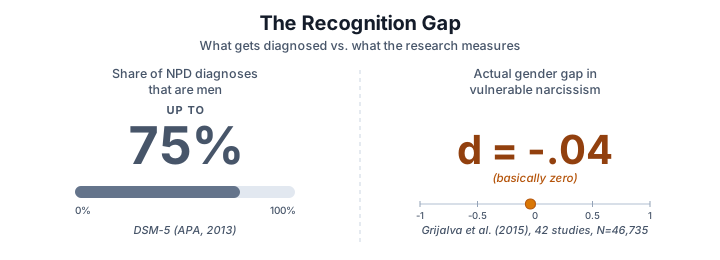
The DSM-5 — the book that mental health professionals use to diagnose personality disorders — says that up to 75% of people diagnosed with Narcissistic Personality Disorder are men (American Psychiatric Association, 2013).
That sounds like narcissism is mostly a male thing. But the research says something different. The research says we’re just not catching it in women.
Here’s what the studies found:
The diagnostic tools are biased toward men. A 2022 study by Green, MacLean, and Charles published in Psychological Reports found that the way we measure narcissism is built around traits that look like traditional male behavior — things like being bossy, taking charge, and acting entitled in obvious ways. The study found that “existing inventories of NPD may be biased toward interpreting adaptive masculine behaviours as being an indication of maladaptive narcissistic disorder.” In plain English: the tests are designed to catch men. Women who show narcissism differently slip right through.
Women with narcissistic traits get misdiagnosed. A 2023 study published in Frontiers in Psychology by Green and colleagues tested 108 clinicians. They gave the clinicians fake patient profiles. When the fake patient was a woman showing vulnerable narcissism — things like needing constant reassurance, being hypersensitive to criticism, and manipulating through emotions — clinicians were “significantly more likely to attribute a BPD [borderline personality disorder] diagnosis in female patients, compared to male patients.” Same exact symptoms. Different label — just because she was a woman.
Men and women score the same on vulnerable narcissism. A major meta-analysis by Grijalva and colleagues (2015) — published in the Psychological Bulletin and covering 470,846 participants across 355 studies — found that while men scored slightly higher on narcissism overall (d = .26), driven by entitlement and authority, there was virtually no gender difference in vulnerable narcissism. Across the 42 studies that measured that subtype, covering 46,735 participants, the effect size was d = -.04. That’s basically zero.
Women who act “feminine” still show narcissistic traits. A study by Klonsky and colleagues (2002) found that women who behaved in traditionally feminine ways — nurturing, appearance-focused, emotionally expressive — actually showed more narcissistic features, not fewer. Narcissism in women doesn’t always look like a loud boss at a boardroom table. Sometimes it looks like someone reshaping their entire face to please a powerful man. Sometimes it looks like someone using their children as props. Sometimes it looks like someone crying on cue when they get caught.
The newer diagnostic systems are starting to fix this. A 2025 study by Green and colleagues in the British Journal of Clinical Psychology found that the ICD-11’s new dimensional approach to personality disorders was less affected by gender bias than the old DSM categories. That’s progress. But most therapists in the United States are still using the DSM-5. Which means women with narcissistic patterns are still being missed — or being told they have something else entirely.
Let’s put all of this in one sentence: Women can be narcissists. The research says so. The tools we use just weren’t built to catch them.
Now let’s look at one of the clearest public examples of what these patterns look like in real life.
The Grandiose–Vulnerable Oscillation Pattern
GRANDIOSE MODE (activated when they hold positional power):
- Uses position for personal gain
- Treats rules as beneath them
- Bragging reframed as “honesty”
- Contempt toward subordinates
VULNERABLE MODE (activated when seeking approval from above):
- Reshapes identity to match patron
- Loyalty displays as supply-seeking
- Plays victim when exposed
- Physical transformation for approval
THE TOGGLE: Narcissistic injury triggers the switch — dismissal → victimhood → blame shift → rage.
The Case Study: Kristi Noem’s Public Behavioral Record
Again — we are not diagnosing this woman. We are looking at public behavior. Things she did on camera. Things she wrote in books she published for money. Things that were investigated by state legislators, reported by journalists, and confirmed by court records.
Let’s go through the patterns.
Pattern 1: The Identity That Changes to Match the Person in Power
One of the strongest signs of narcissistic behavior is when someone’s whole identity shifts to match whoever is above them. Not in a normal “I respect my boss” kind of way. In a way where they seem to become a different person.
Kristi Noem’s political career started in the South Dakota state legislature in 2006. She was a farm woman. Jeans and boots. Natural hair. No frills. The media called her “the Palin of the Plains” — a nod to Sarah Palin, who was the biggest female Republican star at the time.
When the Tea Party wave hit, Noem rode it to Congress. When Trump came along, she was one of the first governors to endorse him. She sent National Guard troops to the Texas border — eight separate times. She gave him a replica of Mount Rushmore with his face carved onto it next to Abraham Lincoln.
And then came the physical change.
Media outlets have widely documented a dramatic change in Noem’s appearance over the past several years. Multiple board-certified plastic surgeons have publicly analyzed before-and-after photos, noting what they believe are signs of extensive cosmetic procedures. The New York Times called it “the Trumpification of Kristi Noem.” Others have called it “Mar-a-Lago face” — a term for the specific cosmetic look common among women in Trump’s inner circle.
Now — there is nothing wrong with cosmetic procedures. People can do whatever they want with their own bodies. That’s not the point.
The point is the pattern. When someone rebuilds their physical appearance to match what the person above them rewards — when the identity, the look, the language, the politics, the aesthetic all shift to mirror one specific authority figure — that’s not personal growth. That’s identity calibration to a supply source. It’s one of the most well-documented behaviors in vulnerable narcissism research.
Pattern 2: Using Power for Personal and Family Gain
In 2020, Noem’s daughter Kassidy Peters applied for a real estate appraiser license in South Dakota. The state’s appraiser certification program recommended denying her application. She hadn’t met the requirements.
What happened next was investigated by the South Dakota state legislature.
Noem called a meeting at the governor’s mansion. She brought her daughter, the state Labor Secretary, and the woman who ran the appraiser program — a 30-year state employee named Sherry Bren. According to the legislative committee’s findings, Bren said she “felt intimidated” at the meeting. The committee found that “this meeting was unique” — the Labor Secretary confirmed she had never seen a governor pull a trainee into a meeting like that before.
Ten days later, Peters got a special agreement that gave her another path to certification.
A week after that, Bren — the program director who had denied the license — was pushed out of her job. The state paid her $200,000 to settle an age discrimination complaint.
A legislative panel later found that Peters “received preferential treatment.” The South Dakota Government Accountability Board found that Noem may have “engaged in misconduct.”
Noem called the investigation a witch hunt.
Peters eventually gave up the license and closed her business. In a letter, she said the scrutiny had “done irreparable damage” to her career.
Let’s be clear about what happened here. A person in power used the machinery of government to benefit a family member. When the person who said “no” was pressured and pushed out. When caught, the person in power denied everything and framed the investigation as an attack.
If a man did this, we’d say it without blinking: that’s narcissistic entitlement.
Pattern 3: Cruelty Reframed as Strength
In 2024, Noem published a memoir called No Going Back. In the book, she describes killing her 14-month-old dog, Cricket. The dog was a wirehaired pointer being trained for hunting. Noem wrote that Cricket was “untrainable” and had an “aggressive personality.” After the dog killed a neighbor’s chickens and snapped at Noem, she took Cricket to a gravel pit and shot her.
She wrote: “I hated that dog.”
After shooting the dog, Noem walked to the same gravel pit and killed a family goat. She described the goat as “nasty and mean.” She shot the goat once. It didn’t die. She had to walk back to the truck to get another shell. Then she went back and shot the goat again.
She put this story in a book she was selling. She framed it as proof of leadership. She wrote that leaders have to make “difficult, messy, ugly” decisions that other people avoid.
When the public reaction was overwhelmingly negative — across both political parties — she responded in stages.
First: grandiose dismissal. “We love animals, but tough decisions like this happen all the time on a farm.”
Second: marketing pivot. “If you want more real, honest, and politically INcorrect stories that’ll have the media gasping, preorder ‘No Going Back.’” She posted this with a link to buy the book.
Third: legalistic defense. She cited a South Dakota law that allows killing dogs who attack livestock.
Fourth: victim framing. In a separate controversy, she used a line she returns to often: “these old, tired attacks on conservative women are based on a falsehood that we can’t achieve anything without a man’s help.”
This is the oscillation pattern in real time. Grandiose → marketing → legal → victim. Four steps. Each one a different tool to protect the same self-image.
The dog story isn’t really about a dog. It’s about what personality researchers call instrumental empathy failure — the inability to model how other people will feel about your actions, combined with the belief that your perspective is the only one that matters. Animal behavior experts pointed out she could have rehomed the dog, used different training methods, or taken Cricket to a shelter. She didn’t consider any of those options because, in her framing, the dog was a problem to be eliminated, not a living being with other possibilities.
The bragging about it afterward is the narcissistic signature. It’s not just that she did it. It’s that she thought it would make her look strong.
Pattern 4: Infidelity and the Antagonistic Relationship Pattern
Now we get to the part nobody wants to talk about.
Multiple news outlets have reported since 2021 that Noem has been in a romantic relationship with political operative Corey Lewandowski. Both are married to other people. Noem has denied the reports each time. But in September 2025, New York magazine reported that the relationship was ongoing and that Lewandowski was functioning as Noem’s “de facto chief of staff” at DHS — an unpaid advisory role she created for him.
Then, in early 2026, a separate story broke. Axios reported that Noem’s husband Bryon had been sending money to online sex workers — reportedly $25,000 — and engaging in behavior that tabloids covered in detail.
Here’s why this matters from a personality research standpoint.
The research on narcissism and infidelity is robust. A 2014 study by McNulty and Widman published in Archives of Sexual Behavior studied 123 newlywed couples and found that sexual narcissism was positively associated with infidelity — even after controlling for relationship satisfaction and global narcissism. The key drivers were sexual entitlement and low sexual empathy.
A 2023 study by Gewirtz-Meydan and colleagues published in the Journal of Family Psychology found something even more specific: grandiose women were more likely than men to feel they “deserved” a sexual relationship outside their marriage. The researchers called this an attitude of entitlement toward infidelity that was specific to grandiose narcissism in women.
Research published in PLOS ONE (2020) found that narcissism was a direct predictor of intentions toward infidelity, and that insecure attachment styles — especially dismissive and fearful attachment — made the link even stronger.
And a 2024 study in the International Journal of Environmental Research and Public Health by Besser and colleagues found that antagonistic narcissism was associated with negative relationship dynamics even in low-threat situations, meaning the person doesn’t need a major crisis to start devaluing their partner.
Let’s map this to what we see.
Noem reportedly maintained a long-term extramarital relationship with a man she then installed in an official role at her federal agency. Meanwhile, her husband was reportedly paying sex workers. This is not a family going through a rough patch. This is a relationship system that looks like what researchers call parallel narcissistic supply structures — where both partners are seeking validation and stimulation outside the marriage, but the marriage itself continues because it serves a public function.
In antagonistic personality dynamics, the marriage often isn’t about love or partnership. It’s about image. It’s a prop. It exists because dissolving it would threaten the public persona.
You’ve seen this pattern before. Maybe not in politics. Maybe in your own family. Maybe in your own relationship.
The partner who cheats but stays. Who keeps the family photo on the desk. Who plays the role in public and lives a different life in private. Who gets furious — not about being caught, but about the threat to the image of being caught.
That’s the pattern. And it doesn’t care about gender.
Pattern 5: The “Doer” Myth — Force Without Competence
Noem branded herself as a “doer.” Someone who makes hard choices and acts fast while other people dither. The dog story was supposed to prove it. Her leadership at DHS was supposed to prove it.
Her actual record proved the opposite.
At DHS, she required personal approval on FEMA expenses over $100,000 — which bottlenecked disaster relief for Hurricane Helene victims. She cycled through three acting FEMA administrators. The agency lost roughly a third of its permanent workforce during her tenure. She feuded with the heads of CBP and ICE — the agencies she was supposed to be leading.
In Minneapolis, a DHS enforcement surge she oversaw led to the fatal shootings of two U.S. citizens by federal agents. Noem immediately called both victims “domestic terrorists” — before any investigation had started. Video evidence appeared to contradict her claims. She was eventually removed from leading operations in Minnesota, and Border Czar Tom Homan was sent to take over.
She oversaw a $220 million advertising campaign that prominently featured herself. When Congress questioned the spending, she told the Senate that Trump had personally approved the campaign. The White House immediately denied it. Within 48 hours, she was fired.
An adviser who spoke with Trump told Axios: “She had no goodwill on Capitol Hill. She mismanaged FEMA. She didn’t show up to hearings. She was disrespectful. No one liked her.”
This is what narcissistic leadership actually looks like in practice. It’s not strength. It’s force without competence. It’s making fast decisions that create bigger problems. It’s micromanaging to feel in control while the actual mission falls apart. It’s prioritizing personal image over institutional function. And when it all collapses, it’s blaming the people around you — or the person above you — because the possibility of personal failure doesn’t exist inside the narcissistic framework.
The “doer” brand was always marketing. The results were always chaos.
Why This Matters for Your Life
You probably don’t work at the Department of Homeland Security. You probably don’t know Kristi Noem. So why does any of this matter?
Because you know someone like this.
Maybe it’s a mother who reshapes herself around every new man in her life — different personality, different look, different priorities — while her children watch and wonder who she really is.
Maybe it’s a partner who acts one way in public and another way behind closed doors. Who keeps the image perfect while the relationship rots.
Maybe it’s a boss who takes credit when things go right and blames everyone else when things go wrong. Who micromanages not because they care about quality but because they need to feel in control.
Maybe it’s a friend who kills the metaphorical dog — cuts people off brutally, without warning, without remorse — and then reframes the cruelty as “setting boundaries” or “being real.”
The research tells us these patterns exist at the same rates in women as in men — especially the vulnerable kind. But our culture is set up to miss them. We diagnose women with borderline when they’re actually narcissistic. We call them “dramatic” instead of manipulative. We say they’re “difficult” instead of antagonistic. We feel sorry for them when they cry — even when the tears are a tool.
The pattern is the pattern. Gender doesn’t change it. Gender just changes whether we name it.
What You Can Do
Learn the pattern, not the label. You don’t need to diagnose anyone. You need to recognize the behavioral cycle: grandiose when they’re in power, vulnerable when they’re seeking approval, and a rapid switch between the two when their self-image is threatened.
Watch the oscillation. The single biggest tell of the grandiose-vulnerable hybrid is the speed of the switch. Dismissal to victimhood in the same conversation. Cruelty to tears in the same hour. If you’re getting whiplash, you’re probably in the presence of this pattern.
Track behavior over time, not individual moments. Anyone can have a bad day. Anyone can snap at someone or make a selfish choice. The pattern becomes clear over months and years. The question isn’t “did they do something narcissistic?” The question is “is this who they are across time and situations?”
Stop making excuses based on gender. “She’s just emotional” is not an explanation. “She’s going through a lot” is not an explanation — not when the behavior is consistent, strategic, and harmful. Hold women to the same behavioral standards you’d hold men to. That’s not sexism. That’s respect.
Protect your own mental wealth. If you’re in a relationship or family system with someone who shows these patterns, the most important thing you can do is stop trying to fix them and start building your own clarity. You can’t change the pattern. You can only decide whether you keep standing in front of it.
Key Takeaways
-
Narcissistic behavior patterns exist at similar rates in men and women — especially the vulnerable subtype. The DSM-5’s 75% male diagnostic rate reflects measurement bias, not reality (Green et al., 2022; Grijalva et al., 2015).
-
Women with narcissistic traits are routinely misdiagnosed with borderline, dependent, or histrionic personality disorders because the diagnostic tools were built around male presentation (Green et al., 2023; Anderson et al., 2001).
-
The grandiose-vulnerable hybrid is one of the most common — and most missed — narcissistic presentations. It shows up as someone who dominates downward but appeases upward, switching between the two modes rapidly when their self-image is threatened.
-
Infidelity is a well-documented feature of narcissistic personality patterns, driven by sexual entitlement, low empathy, and a view of relationships as sources of supply rather than genuine partnership (McNulty & Widman, 2014; Gewirtz-Meydan et al., 2023).
-
Narcissistic leadership looks like force, not competence. Fast decisions that create chaos. Micromanagement driven by ego. Personal branding masquerading as institutional mission. And total inability to accept responsibility when it fails.
References
American Psychiatric Association. (2013). Diagnostic and statistical manual of mental disorders (5th ed.). American Psychiatric Publishing.
Anderson, K. G., Sankis, L. M., & Widiger, T. A. (2001). Pathology versus statistical infrequency: Potential sources of gender bias in personality disorder criteria. The Journal of Nervous and Mental Disease, 189(10), 661–668.
Besser, A., et al. (2024). Fragile egos and broken hearts: Narcissistic and borderline personality traits predict reactions to potential infidelity. International Journal of Environmental Research and Public Health, 21(10), 1272.
Campbell, W. K., Foster, C. A., & Finkel, E. J. (2002). Does self-love lead to love for others? A story of narcissistic game playing. Journal of Personality and Social Psychology, 83(2), 340–354.
Euler, S., et al. (2018). Grandiose and vulnerable narcissism in borderline personality disorder. Psychopathology, 51(2), 110–121.
Foster, J. D., Shrira, I., & Campbell, W. K. (2006). Theoretical models of narcissism, sexuality, and relationship commitment. Journal of Social and Personal Relationships, 23(3), 367–386.
Gewirtz-Meydan, A., et al. (2023). Narcissism and attitudes toward infidelity among couples. Journal of Family Psychology, 37(5), 697–707.
Green, A., MacLean, R., & Charles, K. (2022). Female narcissism: Assessment, aetiology, and behavioural manifestations. Psychological Reports, 125(6), 2833–2864.
Green, A., et al. (2023). Clinician perception of pathological narcissism in females: A vignette-based study. Frontiers in Psychology, 14, 1090746.
Green, A., et al. (2025). Gender bias in assessing narcissistic personality: Exploring the utility of the ICD-11 dimensional model. British Journal of Clinical Psychology, 64(1), 118–133.
Grijalva, E., et al. (2015). Gender differences in narcissism: A meta-analytic review. Psychological Bulletin, 141(2), 261–310.
Hoertel, N., et al. (2018). A comprehensive model of predictors of narcissistic personality disorder. Journal of Clinical Psychiatry, 79(1).
Klonsky, E. D., Oltmanns, T. F., & Turkheimer, E. (2002). Gender role and personality disorders. Journal of Personality Disorders, 16(5), 464–476.
McNulty, J. K., & Widman, L. (2014). Sexual narcissism and infidelity in early marriage. Archives of Sexual Behavior, 43(7), 1315–1325.
Widman, L., & McNulty, J. K. (2010). Sexual narcissism and the perpetration of sexual aggression. Archives of Sexual Behavior, 39(4), 926–939.
Disclaimer
This article is for educational purposes only. It does not constitute a clinical diagnosis of any individual, including Kristi Noem. The author, Matthew Sexton, LCSW, has no clinical relationship with any public figure discussed in this article.
All behavioral observations are based on publicly available information — including published memoirs, sworn congressional testimony, legislative investigation reports, court records, and reporting by major news organizations including the Associated Press, CNN, NBC News, NPR, the New York Times, the Washington Post, Axios, and Britannica.
The personality constructs discussed (grandiose narcissism, vulnerable narcissism, antagonistic personality traits, Dark Triad) are well-established in peer-reviewed psychological research. Citations are provided throughout and in the references section. The application of these constructs to public behavior does not constitute a formal diagnosis under the DSM-5 or any other diagnostic framework.
This article is consistent with the Goldwater Rule (Section 7.3 of the American Psychiatric Association’s Principles of Medical Ethics), which prohibits psychiatrists from diagnosing public figures without a formal examination. The author is a licensed clinical social worker, not a psychiatrist, and is not offering a diagnosis — only an educational analysis of publicly observable behavioral patterns through the lens of established personality research.
If you or someone you know is struggling with relationship patterns related to narcissistic behavior, please seek support from a licensed mental health professional.
Mental Wealth Solutions, Inc. provides behavioral health services and educational content about personality patterns, attachment, and recovery. Learn more at mentalwealthsolutions.org.
© 2026 Mental Wealth Solutions, Inc. All rights reserved.
If this named something you're living with —
You don't have to figure it out from articles. Matthew Sexton, LCSW, NATC sees adults in therapy at his separate private practice (telehealth · NY · ME · DE · FL). Or take this piece to your own therapist — it's written to be shared.
Visit the practice