You’re in a pediatrician’s office, or a primary care visit, and before the doctor comes in, you fill out a questionnaire. Did you run out of food in the last month? Do you have stable housing? Do you have trouble paying utilities?
You answer honestly. The doctor acknowledges it. Says something like, “We’re going to connect you with some resources.” You nod. You leave.
A week passes. A month. Nothing.
This is not an unusual experience. It is, statistically, one of the most common failures in American healthcare right now. And if it happened to you, it was not a personal oversight or a one-time mistake. It is a systemic design gap that the healthcare industry created by rushing the screening without building the infrastructure to act on what it finds.
The Promise of SDOH Screening
Social determinants of health — SDOH — is the term clinicians and policymakers use to describe the non-medical factors that drive health outcomes. Where you live. What you eat. Whether you can afford to heat your home or get to your appointment. Whether you’re safe in your relationship.
Research has made the case clearly: SDOH accounts for 30–55% of health outcomes, according to the World Health Organization. The CDC estimates that social and economic factors contribute to as much as 80% of premature deaths in the United States. These numbers reframed how healthcare systems think about what’s causing disease — and created an urgency to screen.
The response has been broad and genuine. CMS now incentivizes SDOH screening across Medicare and Medicaid programs. Epic and other major EHR vendors built standardized tools directly into clinical workflows. Federally Qualified Health Centers are required to screen for social needs. In pediatric settings, the American Academy of Pediatrics recommends routine SDOH screening at every well-child visit.
A 2024 study found that approximately 67% of pediatric clinics now conduct some form of SDOH screening. That is real progress. The healthcare system identified a gap and moved to fill it.
And then it stopped there.
What Happens After the Question Is Asked
Here is where the system breaks.
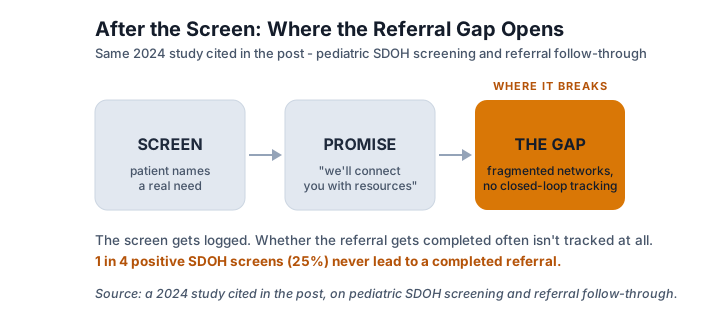
That same body of research found that 25% of positive SDOH screens — cases where a patient identified a real, concrete social need — led to unresolved referrals. One in four people who raised their hand got lost in the gap between the question and the answer.
That number is almost certainly an undercount. It captures only the cases that were tracked well enough to identify as unresolved. It doesn’t account for referrals that were completed on paper but never followed through in practice — a phone number handed over, a flyer left in an exam room, a community organization called once with no callback.
Matthew Sexton, LCSW, has seen this failure from inside clinic systems. “The screening gets done because it’s mandated or incentivized. The referral network to back it up often doesn’t exist at the same scale. What you get is a clinical workflow that generates data without generating outcomes.”
The causes of this gap are not mysterious. They are structural, behavioral, and resource-based — and they repeat across every type of healthcare setting.
1. Referral networks are fragmented and outdated. Most clinical systems maintain lists of community resources — food pantries, housing programs, legal aid, utility assistance — but these lists are notoriously difficult to keep current. Organizations close. Programs run out of funding. Phone numbers change. A social worker or medical assistant who makes three referral calls and reaches voicemail twice is not failing. They’re hitting a capacity ceiling the system doesn’t acknowledge.
2. There’s no closed-loop accountability. In most settings, completing the referral means handing the patient a phone number or submitting a note in the EHR. Whether the patient called, whether the resource had availability, whether the need was actually met — none of that is routinely tracked. The screen is recorded. The outcome is not.
3. Patients face friction at every step. Even when a referral is made to a legitimate, available resource, patients often run into barriers: transportation, language access, documentation requirements, eligibility criteria, or simply the cognitive and emotional load of being sick while also being asked to navigate a social services system that was not designed for people who are managing illness. The referral doesn’t account for any of this.
4. Clinical staff are not trained or resourced for referral coordination. SDOH screening is increasingly built into the medical visit. But a fifteen-minute primary care appointment is not designed to include case management. Most clinics don’t have dedicated social workers. The task of connecting a patient to community resources often falls to whoever has a few minutes — and those minutes rarely exist.
What This Means If You’re the Patient
If you answered honestly on that intake form and never heard back, here is what I want you to know:
You were not forgotten because your need wasn’t real or wasn’t serious. You were not forgotten because the system didn’t care. You were caught in the space between a system that had learned to ask the right question and hadn’t yet built the infrastructure to follow through on the answer.
That distinction matters because the default interpretation — that nothing happened because nothing was available, or because your situation wasn’t worth following up on — is not accurate. And that interpretation can lead people to stop asking for help.
Here is what you can do right now:
Ask specifically at your next visit. Rather than waiting for the referral to materialize, ask your provider or the front desk: “I flagged food insecurity on my last intake form. Did a referral get sent somewhere? Who should I follow up with?” Making it explicit creates a named task someone has to respond to.
Look for 211. In most of the United States, dialing 2-1-1 connects you to a local resource database staffed by trained coordinators who can help navigate social services in real time. It is free, confidential, and more current than most clinic resource lists.
Ask about a social work referral. If you are dealing with housing instability, food insecurity, a chronic illness, or a combination, you may qualify for case management services through your health plan, your Federally Qualified Health Center, or a hospital-based social work program. You can ask directly — you don’t have to wait to be referred.
Track your own referrals. If you’re given a contact or a phone number, write it down along with the date and the name of the person who gave it to you. If you call and get voicemail, leave a message and note the date. If you don’t hear back in a week, call again. This should not be your job. But until the system builds better infrastructure, documentation is the most reliable protection you have.
What This Means If You’re Building the Infrastructure
For health system leaders, clinic administrators, care coordinators, and policymakers reading this — the screening push was right. The data matters. The clinical documentation of social need is the first step toward being able to respond to it.
But screening without follow-through infrastructure doesn’t just fail patients. It erodes the therapeutic relationship. When a patient answers a vulnerable question and nothing comes of it, they learn not to answer that question next time. Every unresolved referral is a lesson the system teaches people about whether it can be trusted with the truth.
The path forward requires closed-loop accountability — not just documenting that a referral was made, but tracking whether the need was met. It requires sustained investment in referral network maintenance, not just point-in-time database builds. It requires pairing SDOH screening with social work staffing at a ratio that makes follow-through realistic.
It also requires honesty with patients at the point of care. If the system cannot reliably follow through on a referral within a defined window, clinical staff should say so — “We’re going to try to connect you, but I want you to also have this number in case you don’t hear from us.” That is not a failure of care. It is an honest handoff.
The Bottom Line
Healthcare has made real progress on asking the right questions. The next phase of that progress is building systems that can actually answer them.
If you’ve been stuck in the gap between a screen and a referral that never materialized, your next step doesn’t have to wait for the system to catch up. There are tools designed specifically to reduce that friction — to meet you where you are, when you need support, without requiring you to navigate a referral queue that may or may not have space for you.
VibeCheck.luxury was built for exactly that moment — low friction, no 1-800 number, no intake paperwork, no waiting for a call back. A starting point that takes fifteen minutes, not fifteen weeks.
Because the question your doctor asked deserves an answer. And so do you.
Matthew Sexton, LCSW, is a licensed clinical social worker and the founder of Mental Wealth Solutions, a health technology company building tools to close the gap between clinical care and the communities it serves.
Want to discuss this for your program?
Book a 30-min conversation. We'll walk you through deployment, the BAA, and what your rollout looks like in production.
Book a 30-min conversation