Too Many Clicks: The Tax Your EMR Charges Every Session
An ER doctor clicks 4,000 times a shift; outpatient clinicians spend 16+ minutes in the EHR per encounter. The click tax is a design choice, not a clinician failure.
From the earlier archive. This article’s original writing is retained and has not been fact-checked as part of our current review. Product references may reflect an earlier version; see current solutions for today’s status.
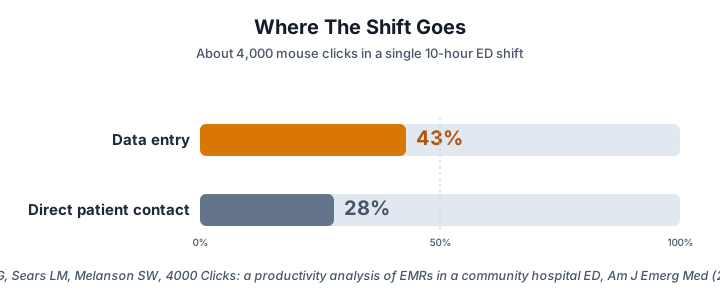
An emergency physician registers about 4,000 mouse clicks in a single shift, and in that same study clinicians spent more of their time on data entry (43%) than in direct contact with patients (28%). Outpatient clinicians average more than 16 minutes in the EHR per encounter, most of it on documentation and chart review. Every one of those clicks is a small tax on attention, and therapists pay it on top of work that is already emotionally heavy. The cause is not slow clinicians. It is software that turns a clinical note into a click-trail for the audit. The fix is fewer clicks by design — and AI that drafts the note, so the most click-heavy task in the day collapses into a review and a signature.
I am a licensed clinical social worker. I have done the clicks. This is a piece about where the click tax comes from, what it actually costs, and what “fewer clicks” should mean.
Why does my EHR require so many clicks?
The click count is not an accident, and it is not a measure of how fast you work. It is a direct consequence of who the software was built for. Most behavioral-health systems are designed around what the payer and the compliance auditor need to see, and the cleanest way to capture that is to make the clinician click through every field, pop-up, and attestation. The click trail becomes the audit trail. The clinician becomes the data-entry mechanism that produces it.
That is why the most common complaint about these tools is not that they are missing a feature. It is that they were obviously designed by people who never did the job. A simple, routine task — a note done a dozen times a day — should not require navigating three screens and dismissing four pop-ups. When it does, the friction is not incidental. It is the product working as designed, for a customer who is not the clinician.
The click tax, measured
The research on this is blunt. The “4,000 clicks” analysis of emergency physicians found that data entry consumed 43% of their time, while direct patient contact got 28%.1 The ratio is the story: the tool meant to support care was taking more of the clinician’s day than the care itself.
The outpatient picture is the same shape at a different scale. A descriptive study of roughly 100 million encounters across more than 150,000 physicians found an average of 16 minutes and 14 seconds in the EHR per encounter, with chart review (33%), documentation (24%), and order entry (17%) accounting for most of it.2 Sixteen minutes per encounter, across a full caseload, is hours a week — and for behavioral-health clinicians, much of it lands after the last session, in the after-hours charting that drives burnout.
The click is the unit of that tax. Most of the time is not spent thinking; it is spent operating the machine.
What “fewer clicks” actually means
“Fewer clicks” is not a cosmetic goal. It is the difference between a tool that disappears into the work and one that sits on top of it demanding to be managed. Three things have to change.
The routine has to be cheap. The tasks done a dozen times a day should take one or two interactions, not a dozen. Every mandatory field that does not earn its place is a tax levied on the clinician for the system’s convenience. A clinician-first tool removes them by default and asks only for what the clinical work actually requires.
The note has to come from the session, not the form. The single most click-heavy task is writing the note. If the note is drafted from a consented session record and the clinician edits and signs it, the click count for documentation collapses — not because the clinician is doing less clinical work, but because they are no longer assembling a page by hand. Studies of ambient AI scribes report real reductions in documentation time and after-hours charting when this is done well.3
The interface has to respect attention. Fewer pop-ups, fewer forced navigations, fewer interruptions between the clinician and the thing they are trying to record. Attention is the scarce resource in a therapy practice. Software that spends it carelessly is taking it from the room.
The clinician is not the problem
It is worth saying this directly, because the click tax is usually framed as a clinician-resilience issue — learn the shortcuts, get faster, push through. That framing asks the clinician to absorb a design failure through effort, and it is exactly how good clinicians end up describing their burnout in terms of administrative load rather than clinical work.
The honest version is the opposite. The clinician is not slow. The tool is expensive. A system that charges 4,000 clicks and 16 minutes per encounter for the privilege of documenting care is not a tool the clinician failed to master. It is a tool that was built to bill, and the clicks are what it costs.
The call
So here is the call, said plainly. The EMR that wins the next decade of private practice is the one that treats a clinician’s clicks and minutes as the scarce, expensive things they are — and spends almost none of them. The note will draft itself from the session. The routine will cost one tap. The clinician will get the 16 minutes back, every encounter, and put them where they belong: in the room, or in the rest of a life. The tool that does that is coming, and it is being built by someone who counted the clicks too.
Sources: 1. Hill RG, Sears LM, Melanson SW. 4000 Clicks: a productivity analysis of electronic medical records in a community hospital ED. American Journal of Emergency Medicine (2013). 2. Physician Time Spent Using the Electronic Health Record During Outpatient Encounters. Annals of Internal Medicine (2020), M18-3684. 3. Tierney AA, et al. Use of Ambient AI Scribes to Reduce Administrative Burden and Professional Burnout. JAMA Network Open (2025).
Frequently asked questions
- How many clicks does an EHR take?
- A widely cited productivity study found emergency physicians register about 4,000 mouse clicks during a single 10-hour shift, and that data entry consumed 43% of their time versus 28% in direct patient contact. A larger outpatient study found physicians spend more than 16 minutes in the EHR per encounter, with documentation and chart review accounting for most of it. The click burden is a design choice, not a measure of clinician slowness.
- Why does my EHR require so many clicks?
- Because most systems were built so the click trail doubles as the audit trail. Every mandatory field, pop-up, and attestation exists to satisfy billing and compliance, not to help the clinician write. Routine tasks get buried under navigation, which is why clinicians so often say these tools were designed by people who never did the job.
- Can AI reduce EHR clicks for therapists?
- Yes, when it is scoped to documentation. AI that drafts the clinical note from a consented session record turns writing into reviewing and signing, which collapses the click count for the most click-heavy task. Studies of ambient AI scribes report meaningful reductions in documentation time and after-hours charting. The clinician still edits and signs every note.