
The standard therapy session runs 53 minutes. That is not a clinical recommendation. It is a scheduling artifact — the time that is left over after everything the system requires gets accounted for. 62% of psychologists who left or never joined insurance networks cited administrative issues, including prior authorizations and audits, as the barrier, according to the APA’s 2024 Practitioner Pulse Survey. The session wasn’t designed for the patient. It was designed for the paperwork.
Quick answer: Mental health practice sustainability is in crisis because the system that pays for therapy was built around billing, documentation, and compliance — not around delivering care. The 53-minute hour is the most visible symptom. The attrition of clinicians from the workforce is the one that will cost us the most.
The hour that isn’t actually an hour
Here is something that almost never gets said plainly: the 50- or 53-minute session isn’t what any therapist would design if they were starting fresh. It is what you get when a 60-minute window has to absorb a progress note, a billing code, a prior-auth check, and whatever your electronic health record demands before you see the next person. We call it the “therapy hour.” We should call it the therapy remainder.
I have been doing this long enough to know that nobody enters clinical social work to fill out forms. The pull is the room — the patient, the relationship, the work that actually changes something. But the system layered on top of that room has its own appetite, and it is relentless.
The Tebra 2025 Physician Burnout Survey, drawing from 219 private-practice providers across six specialties, found that mental health clinicians report the highest rate of mental fatigue of any specialty surveyed — 77%. Documentation and charting tied as the number one stated driver of burnout, cited by 23% as their primary complaint. Not the clinical complexity. Not the emotional weight. The paperwork.
That is a system-design problem. It is worth naming it that way.
Where the workforce is actually going
The math on who is left to do this work is not reassuring. 137 million Americans — 40% of the U.S. population — currently live in a Mental Health Professional Shortage Area, according to the HRSA Bureau of Health Workforce’s 2025 Behavioral Health Workforce report. That number increased by 15 million people — a 12.3% jump — in a single year, between December 2024 and December 2025. The country is not running out of people who need mental health care. It is running out of people willing to provide it under current conditions.
HRSA projects shortfalls of roughly 99,840 psychologists and 99,780 mental health counselors by 2038 under baseline assumptions. Those projections do not assume anything gets worse. They assume things stay roughly the same. Given what the data shows about burnout and attrition, “staying the same” is probably the optimistic scenario.
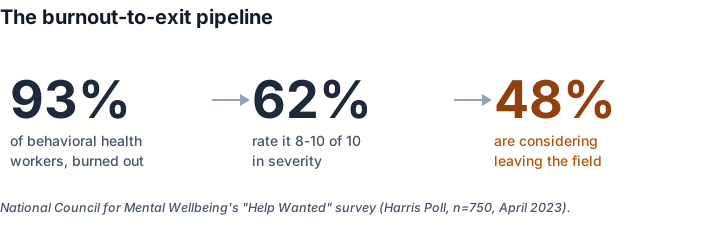
The National Council for Mental Wellbeing’s “Help Wanted” survey, conducted by Harris Poll across 750 behavioral health workers, put a number on what that attrition looks like from the inside: 93% report experiencing burnout, 62% rate it between 8 and 10 out of 10 in severity, and 48% are actively considering leaving for other employment. Nearly half. Not burned out and still showing up. Burned out and halfway out the door.
This is the burnout-to-exit pipeline. It does not end at burnout. It ends at a waiting list that never gets shorter.
What mental health system design is actually optimized for
Let’s be clear about who designed this. The administrative burden on mental health clinicians was not created by accident. It was created by commercial insurance infrastructure built to manage cost and risk. Prior authorization, step therapy requirements, mandatory audit trails, billing code specificity — these are all mechanisms that serve the insurer’s operational needs. Some of them also serve legitimate clinical purposes. But most of them were not designed with the clinician’s time, or the patient’s access, as the primary constraint.
The result is a system where getting paid for the work requires generating documentation that looks almost nothing like clinical thinking. A progress note written for the medical record and a progress note written to survive an insurance audit are different documents. Clinicians who accept insurance quickly learn to write the second one. That is not dishonesty — it is compliance with a system that requires a certain kind of language to release funds. But it is time. And it is cognitive load. And it is one more reason the door to private-pay-only practice, or out-of-network only, or leaving the field entirely, starts to look like a reasonable door to walk through.
62% of psychologists who left or never joined insurance networks cited administrative issues — prior authorizations, billing requirements, and audit demands — as the primary barrier, per the APA’s 2024 Practitioner Pulse Survey. That number is the clearest evidence we have that the burden is not a minor inconvenience. It is actively determining who stays in the system and who doesn’t.
The access problem hiding inside the workforce problem
Most people reading shortage-area statistics think the problem is geography. Not enough rural providers, not enough coverage in underserved zip codes. That is true, and it is the more visible version of the problem. But there is a second layer that doesn’t show up on maps.
When clinicians leave insurance panels, they don’t disappear. They keep practicing, often in the same building, on the same block. They just become inaccessible to anyone whose only option is insurance. The workforce shortage in shortage areas is partly a geographic problem. The shortage inside insured networks is largely an administrative-burden problem dressed up as a capacity problem.
The distinction matters because the fixes are different. Geographic shortage requires training more people and routing them differently. Network attrition requires fixing the conditions that push clinicians off panels in the first place. We keep trying to solve the second problem with the tools for the first one — more training programs, more loan forgiveness, more incentives to enter the field — while the back door stays open.
We need fewer people leaving, not just more people entering.
Can technology fix this, and what would “fix” even mean?
Technology is being positioned as the answer to administrative burden right now, and there is real evidence it helps. SimplePractice’s 2025 State of Private Practice Report, drawn from data across more than 245,000 clinicians on its platform, found that clinicians who adopted AI note-taking saved an average of 5 hours per week on documentation. AI adoption on the platform went from essentially zero to 10.2% of all clinicians in a single year. That is a meaningful shift.
The APA’s 2025 Practitioner Pulse Survey, fielded across 1,742 respondents, found that 42% of psychologists now say AI can help reduce administrative burden — up from 33% a year earlier. Recognition is growing that the documentation load is unsustainable and that tools exist to reduce it.
Five hours a week is not nothing. For a full-time clinician carrying a 25-client caseload, that is roughly the equivalent of the documentation time for four or five sessions returned to actual clinical work. Or to the rest of a human life. The burnout literature is consistent: time pressure and documentation load predict exit. Anything that meaningfully reduces those two variables should reduce exit.
But here is what technology cannot do on its own. It cannot redesign the underlying requirements that create the documentation burden in the first place. A faster way to write a prior authorization letter is better than a slower way. It is not the same as a world where prior authorization does not eat the first 20 minutes of every Monday morning. AI can optimize the output of a broken workflow. It cannot make the workflow less broken.
The structural argument has to be made separately. The system was not designed by accident, and it will not change by accident either.
FAQ
Why is the standard therapy session 53 minutes instead of a full hour? The 53-minute session isn’t a clinical recommendation — it’s what remains after the system takes its share. Progress notes, billing codes, prior authorization paperwork, and the audit trail commercial insurers require for reimbursement all pull from that hour. The session length reflects administrative need, not what clinicians or patients would choose if they were designing care from scratch.
What is the mental health workforce shortage and how bad is it in 2026? 137 million Americans — 40% of the U.S. population — live in a Mental Health Professional Shortage Area, and that number grew by 15 million in a single year, per HRSA’s 2025 Behavioral Health Workforce report. HRSA projects shortfalls of roughly 99,840 psychologists and 99,780 mental health counselors by 2038. The primary driver is not a lack of people who want to do this work. It is an attrition problem built on administrative overload.
What is driving therapist burnout in 2026? 93% of behavioral health workers report burnout, with 62% rating it 8 to 10 out of 10, per the National Council for Mental Wellbeing’s “Help Wanted” survey. Mental health clinicians report the highest mental fatigue rate of any specialty surveyed — 77% — and documentation or charting tied as the number one burnout driver, per the Tebra 2025 Physician Burnout Survey. For many clinicians, the paperwork has become the job.
Can technology actually fix the administrative burden on therapists? It can take a real bite out of it. SimplePractice’s 2025 State of Private Practice Report found AI note-taking adopters saved an average of 5 hours a week on documentation, with adoption rising from 0% to 10.2% of all clinicians in one year. The APA’s 2025 Practitioner Pulse Survey found 42% of psychologists say AI can help reduce administrative burden. Tools can buy back time. Redesigning the underlying system that generates the burden is a different, larger project.
Sources
APA 2024 Practitioner Pulse Survey, https://www.apa.org/pubs/reports/practitioner/2024 — 62% of psychologists who left or never joined insurance networks cited administrative barriers. APA 2025 Practitioner Pulse Survey (n=1,742), https://www.apa.org/pubs/reports/practitioner/2025 — 42% of psychologists say AI can reduce administrative burden, up from 33% in 2024. National Council for Mental Wellbeing, “Help Wanted” survey (n=750, Harris Poll, April 2023), https://www.thenationalcouncil.org/news/help-wanted/ — 93% burnout rate, 62% severity 8-10/10, 48% considering leaving. HRSA Bureau of Health Workforce, State of the Behavioral Health Workforce 2025, https://bhw.hrsa.gov/sites/default/files/bureau-health-workforce/data-research/Behavioral-Health-Workforce-Brief-2025.pdf — 137 million Americans in shortage areas, 15M increase in one year, projections of ~99,840 psychologist and ~99,780 counselor shortfall by 2038. Tebra 2025 Physician Burnout Survey (n=219 private-practice providers), https://www.tebra.com/theintake/practice-operations/mental-health-therapist-burnout — 77% mental fatigue in mental health specialty, documentation as primary burnout driver. SimplePractice 2025 State of Private Practice Report (245,000+ clinicians), https://www.businesswire.com/news/home/20260513758800/en/SimplePractice-Releases-First-of-Its-Kind-Report-on-Independent-Mental-Health-Practice — AI note-taking adopters saved 5 hrs/week; AI adoption rose from 0% to 10.2% in one year. Figures current as of June 2026.
Disclaimer
This article is for educational and informational purposes only. It does not constitute medical, clinical, legal, or therapeutic advice, and reading it does not create a therapist-client relationship with Matthew Sexton, LCSW or Mental Wealth Solutions, Inc. Although the author is a licensed clinical social worker, the content in this article is not clinical assessment, diagnosis, or treatment.
The workforce statistics, survey data, and systemic patterns described here reflect published research and are accurate as of their stated publication dates. Individual practice circumstances, insurance panel relationships, technology tools, and market conditions vary significantly and may change after this article is published. Nothing here constitutes advice about how to structure your clinical practice, what technology to adopt, or how to navigate insurer relationships. For decisions about your specific practice situation, consult relevant professional associations, your licensing board, and qualified legal or financial counsel as appropriate.
If you are in immediate emotional crisis, you can reach the 988 Suicide & Crisis Lifeline by calling or texting 988 (US). If you are experiencing domestic violence or are in physical danger, contact the National Domestic Violence Hotline at 1-800-799-7233 or visit thehotline.org. In a life-threatening emergency, call 911.
Frequently asked questions.
- Why is the standard therapy session 53 minutes instead of a full hour?
- The 53-minute session isn't a clinical recommendation — it's what's left after the system takes its cut. The remaining time goes to progress notes, billing codes, prior authorization paperwork, and the audit trail that commercial insurers require for reimbursement. The session length was shaped by administrative need, not by what clinicians or patients would design if they were starting from scratch.
- What is the mental health workforce shortage and how bad is it in 2026?
- 137 million Americans — 40% of the U.S. population — live in a Mental Health Professional Shortage Area, and that number grew by 15 million in a single year, according to HRSA's 2025 Behavioral Health Workforce report. HRSA projects a shortfall of roughly 99,840 psychologists and 99,780 mental health counselors by 2038. The primary cause is not a lack of people who want to do this work. It is an attrition problem driven by administrative burden.
- What is driving therapist burnout in 2026?
- 93% of behavioral health workers report burnout, with 62% rating it 8 to 10 out of 10, according to the National Council for Mental Wellbeing's 'Help Wanted' survey. Mental health clinicians report the highest rate of mental fatigue of any specialty surveyed — 77% — and documentation or charting tied as the number one burnout driver, per the Tebra 2025 Physician Burnout Survey. The paperwork is not a side effect of the job. For many clinicians, it has become the job.
- Can technology actually fix the administrative burden on therapists?
- It can take a meaningful bite out of it. SimplePractice's 2025 State of Private Practice Report, drawn from 245,000+ clinicians, found that AI note-taking adopters saved an average of 5 hours a week on documentation. The APA's 2025 Practitioner Pulse Survey found 42% of psychologists now say AI can help reduce administrative burden, up from 33% in 2024. Tools can buy back time. What they can't do on their own is redesign the underlying system that keeps generating the burden in the first place.
Want to discuss this for your program?
Book a 30-min conversation. We'll walk you through deployment, the BAA, and what your rollout looks like in production.
Book a 30-min conversation