
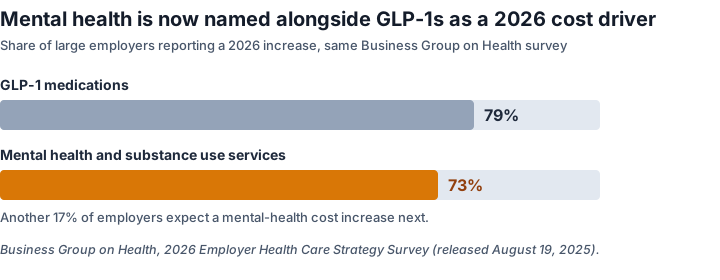
In the 2026 employer health-cost surveys, mental health stopped being a wellness footnote and turned into a named cost driver. Business Group on Health, in its August 2025 strategy survey of large employers, found 73% had seen an increase in mental health and substance use services over the prior year, with another 17% expecting one — and it now lists mental health among the conditions driving employer costs, next to cancer and GLP-1 weight-loss drugs. Cancer is still number one, for the fourth year running. But mental health has arrived in a conversation it used to sit outside of.
Most benefits leaders are reading that arrival as a threat. A new cost showed up, so the instinct is to contain it. That instinct is going to cost them more than the spending ever would, because the number is being read backwards.
Quick answer: Mental health became a 2026 employer cost driver not because people suddenly got sicker, but because care that was always owed is finally being used. When utilization climbs off a floor of 3-6%, a chunk of that “cost increase” is the access gap closing. Treating it as a leak to plug rations the one category where more spending tends to buy back productivity.
What the 2026 numbers actually say
Start with the trend everyone’s quoting. Large employers are projecting health-cost increases clustered around 9% for 2026 — the third straight year near double digits. Business Group on Health puts the median at 9%, dropping to 7.6% after plan-design changes. Aon projects 9.5%, with costs topping $17,000 per employee. Mercer lands at 6.5%, which sounds milder until you read the footnote: it’s Mercer’s biggest projected jump in 15 years, and it would be closer to 9% if employers weren’t already cutting to hold it down.
Inside that total, two categories keep getting named. One is GLP-1s: 79% of employers in the Business Group survey reported an uptick in use of those drugs. The other is behavioral health — that 73% figure. For the first time in a long time, “mental health” is appearing in the same paragraph as cancer and specialty pharmacy, which are the categories CFOs have learned to take seriously. That’s the shift. Mental health used to be the thing you funded for goodwill. Now it’s the thing showing up in the actuarial deck.
The reflex when a category lands in that deck is to manage it down. Tighter networks, more utilization review, a higher bar for what gets approved. That reflex is correct for some line items. It is exactly wrong for this one.
The mental health cost driver is the access gap surfacing, not demand spiking
Here’s what a rising behavioral-health line usually means, and it isn’t that your workforce got sicker this fiscal year.
For decades, the defining feature of workplace mental health was that the people who needed care never reached it. Employee Assistance Programs — the default corporate mental health benefit — run at roughly 3 to 6 percent annual utilization in the U.S. I’ve written about why that 3% number is so stubborn, so I won’t relitigate it here. The short version: the benefit isn’t unwanted, it’s unreachable, and most of the money allocated to it sits untouched.
The reach problem isn’t a mystery to the people living it either. In the 2025 NAMI/Ipsos Workplace Mental Health Poll, only about 53% of employees said they knew how to access mental health care through their employer-sponsored insurance, and more than a quarter didn’t know whether their employer offered mental health benefits at all. Half the workforce, standing in front of a benefit they’re entitled to, unsure where the door is.
So when behavioral-health utilization finally rises, the first question shouldn’t be “how do we stop this?” It should be “is this the gap closing?” A workforce that was always carrying this load — depression, anxiety, substance use, the grief and burnout nobody filed a claim for — starting to actually use the coverage looks identical, on a spreadsheet, to a workforce getting sicker. The two are nearly impossible to tell apart from the cost line alone. But they call for opposite responses. One you ration. The other you were supposed to be paying for all along.
Read it as pure demand, and you tighten the network and raise the bar, and the utilization number goes back down, and someone reports that as a win. What actually happened is that people stopped reaching care. The cost didn’t leave. It moved — into absence, into presenteeism, into the resignation you’ll backfill next quarter.
Why rationing this particular line costs more
Cutting a cost only saves money if the cost goes away. With behavioral health, it relocates, and it tends to relocate somewhere more expensive.
Untreated mental health doesn’t sit quietly. It shows up as presenteeism — people at their desks but operating at a fraction of capacity — which is consistently the largest and least-visible piece of the bill. Deloitte’s 2024 UK analysis put the cost of poor mental health to employers there at £51 billion a year, with presenteeism the single biggest driver at roughly £24 billion. That’s a UK figure in pounds, not a U.S. number, so don’t import it literally. But the shape of it travels: the expensive part of untreated mental illness was never the therapy claim. It’s the work that quietly doesn’t get done, and the people who quietly leave.
This is the part the suppress-the-cost reflex misses. Trim the behavioral-health benefit and the line item on the health plan goes down. The cost it was offsetting — disengagement, turnover, the manager covering for a team that’s running on empty — goes up, in budgets that don’t show up in the benefits review. You don’t save the money. You move it somewhere harder to see and harder to fix, and you pay a margin for the privilege.
There’s a structural piece here too, and it’s worth naming because it’s not the employer’s fault. Part of why mental health care is hard to reach even when it’s “covered” is that commercial insurers have paid mental-health clinicians less than the medical and surgical providers in the same plans — a within-plan disparity that regulators in several states moved against in 2026. I’ve covered that machinery in The Business of Being Unwell. For a benefits buyer, the practical fallout is simple: pay a therapist a fraction of what you pay a physician, and many of them stop taking the plan, which is how a network looks full on paper and empty when an employee calls down the list. So the employer buys coverage in good faith, and the access still isn’t there. Rationing on top of that doesn’t fix the gap. It deepens it.
What reading the number right looks like
The employers handling 2026 well aren’t spending recklessly. They’re refusing to mistake an access signal for a leak, and they’re putting money where the reach was missing.
They treat rising utilization as progress to direct, not a fire to put out. When the behavioral-health line moves, the useful question is who’s now reaching care and whether they’re getting better — not how to push the number back down. Behavioral-health access ranks among the top health-program priorities in the 2026 Mercer survey, with a large share of employers focused on making that care easier to get rather than harder. That’s the tell of an organization reading the trend correctly.
They cut the steps between distress and care. Most of what suppresses utilization isn’t unwillingness, it’s friction — the portal, the phone tree, the directory of indistinguishable names, the three-week wait. Default people into the benefit instead of asking them to opt in. Put the entry point where they already are. Every step removed is a measurable lift in follow-through, and it costs far less than the turnover it prevents.
They measure reach and outcomes, not spend. Stop reporting how much went into the benefit. Report what share of eligible employees actually used it, how fast they got a first appointment, and whether they came back. Those numbers tell you whether the money turned into care or just into the appearance of it.
They build access, they don’t ration it. This is the whole posture. A mental-health cost line that’s rising off a 3% floor is, more often than not, a system finally working for people it used to leave outside. The move is to widen that door, watch the productivity and retention numbers it buys back, and stop confusing a benefit nobody could reach with a benefit nobody needed.
Mental health earned its place in the cost deck the hard way — by being real, and expensive, and ignored long enough that it stopped being ignorable. The employers who win the 2026 version of this aren’t the ones who get the line item back down. They’re the ones who understand what the line item is telling them, and spend the next year making it easier to reach, not harder.
FAQ
Is mental health really one of the top cost drivers for employers in 2026? It’s now named among them. In the Business Group on Health 2026 survey (released August 2025), 73% of large employers reported an increase in mental health and substance use services in the past year and another 17% expect one, and the group lists mental health alongside cancer — still the number-one cost condition for the fourth straight year — and GLP-1 medications. Mental health has moved from a wellness line item to a named cost driver, even if it hasn’t displaced cancer at the top.
How much are employer health costs rising in 2026? Around 9%, depending on the survey. Business Group on Health projects a 9% median increase (7.6% after plan changes), Aon projects 9.5% with costs topping $17,000 per employee, and Mercer projects 6.5% — its largest in 15 years, closer to 9% before mitigation. Behavioral health is one of the categories rising inside that total.
Why is the rise in mental health spending not necessarily bad news? Because for years the real problem was that people who needed care never reached it. U.S. EAPs run at roughly 3-6% utilization, and in the 2025 NAMI/Ipsos poll only about 53% of employees said they knew how to access mental health care through their employer’s insurance. When utilization climbs off that floor, some of the “cost increase” is the access gap closing — people getting care they were always entitled to but couldn’t navigate to.
What should employers do as mental health spending rises? Read the number as an access signal, not a leak to plug. The employers handling it well are expanding and de-frictioning access rather than rationing it — behavioral-health access ranks among the top priorities in the 2026 Mercer survey. Cutting steps between a distressed employee and care, measuring how many eligible people reach a first appointment, and tracking outcomes beat trimming the benefit, which only pushes the cost into absence and turnover.
Sources
Business Group on Health, 2026 Employer Health Care Strategy Survey (released August 19, 2025) — 9% median cost increase (7.6% after plan changes); 73% of employers reported an increase in mental health/substance use services with 17% anticipating one; cancer the top cost-driving condition for the fourth straight year; mental health named among cost drivers; 79% reported a GLP-1 uptick. Survey of 121 large employers covering 11.6M lives.
Aon, U.S. Employer Health Care Costs Expected to Rise 9.5 Percent in 2026 (September 10, 2025) — 9.5% projected increase; costs topping $17,000 per employee.
Mercer, Employers are bracing for the highest health benefit cost increase in 15 years (September 4, 2025) — 6.5% projected per-employee increase, largest in 15 years (~9% before plan changes); behavioral-health access among top program priorities.
NAMI / Ipsos, 2025 Workplace Mental Health Poll, reported via HR Dive, More than 1 in 4 workers don’t know if they have mental healthcare benefits (February 28, 2025) — about 53% of employees know how to access mental health care through employer insurance; more than a quarter unsure whether the benefit exists.
Deloitte UK, Poor mental health costs UK employers £51 billion a year (May 17, 2024) — £51 billion annual cost to UK employers; presenteeism the largest driver (~£24 billion). UK figure, not U.S.
Mental Wealth Solutions: Why Your EAP Has a 3% Utilization Problem and The Business of Being Unwell. Figures current as of June 2026.
Disclaimer
This article is for educational and informational purposes only. It does not constitute medical, clinical, legal, or therapeutic advice, and reading it does not create a therapist-client relationship with Matthew Sexton, LCSW or Mental Wealth Solutions, Inc.. Although the author is a licensed clinical social worker, the content in this article is not clinical assessment, diagnosis, or treatment.
Employer health-cost projections, benefit utilization rates, survey findings, and the design of any specific health plan or Employee Assistance Program vary by employer, plan, industry, and over time, and may change after this article is published. Nothing here is a substitute for confirming the details of a particular benefit or cost trend with your benefits consultant, plan administrator, or qualified counsel. Organizations and circumstances differ, and what is described here may not match your situation.
If you are in immediate emotional crisis, you can reach the 988 Suicide & Crisis Lifeline by calling or texting 988 (US). If you are experiencing domestic violence or are in physical danger, contact the National Domestic Violence Hotline at 1-800-799-7233 or visit thehotline.org. In a life-threatening emergency, call 911.
Frequently asked questions.
- Is mental health really one of the top cost drivers for employers in 2026?
- It's now named among them. In the Business Group on Health 2026 Employer Health Care Strategy Survey (released August 2025), 73% of large employers reported an increase in mental health and substance use services in the past year and another 17% expect one, and the group lists mental health among the conditions driving costs alongside cancer — still the number-one cost condition for the fourth straight year — and GLP-1 medications. So mental health has moved from a wellness line item to a named cost driver, even if it hasn't displaced cancer at the top.
- How much are employer health costs rising in 2026?
- Around 9%, depending on whose survey you read. Business Group on Health projects a 9% median increase for 2026 (7.6% after plan-design changes), Aon projects 9.5% and costs topping $17,000 per employee, and Mercer projects a 6.5% rise — its largest in 15 years, and closer to 9% before employers cut to manage it. Behavioral health is one of the categories rising inside that total.
- Why is the rise in mental health spending not necessarily bad news?
- Because for years the problem was that people who needed care never reached it. U.S. Employee Assistance Programs run at roughly 3-6% utilization, and in the 2025 NAMI/Ipsos workplace poll only about 53% of employees said they knew how to access mental health care through their employer's insurance. When utilization finally climbs, some of that 'cost increase' is the access gap closing — people getting care they were always entitled to but couldn't navigate to.
- What should employers do as mental health spending rises?
- Read the number as an access signal, not a leak to plug. The employers handling this well are expanding and de-frictioning access rather than rationing it: behavioral health access ranks among the top program priorities in the 2026 Mercer survey. Cutting steps between a distressed employee and care, measuring how many eligible people actually reach a first appointment, and tracking outcomes beat trimming the benefit, which only pushes the cost into absence and turnover.
Want to discuss this for your program?
Book a 30-min conversation. We'll walk you through deployment, the BAA, and what your rollout looks like in production.
Book a 30-min conversation