In June 2026, Behavioral Health Business published a breakdown of something that has been building quietly for several years: payers — the insurance companies that decide what mental health care you can access — are now launching their own behavioral health services, stepping directly into the role of provider. One entity. Two sides of the transaction. No structural separation between who decides what care you need and who profits from delivering it.
Quick answer: When your insurance company also employs your therapist, the insurer controls both the referral decision and the care delivery. That is not a coordination model. It is a conflict of interest. Cigna’s Evernorth Behavioral Care Group has grown from 1,000 to more than 5,000 clinicians since 2024 and is targeting 15,000 by end of 2026. UnitedHealth’s Optum acquired Refresh Mental Health’s 300-plus outpatient centers in 2022, giving it a national direct-care footprint. These companies now sit simultaneously at the gatekeeper desk and the treatment table.
What Vertical Integration Actually Means Here
The term sounds abstract. The mechanics are not.
In a traditional arrangement, an insurance company pays for care delivered by independent providers. The insurer’s financial interest is in minimizing cost; the independent clinician’s interest is in delivering adequate care. Those interests conflict — but they conflict from separate positions. That tension has always been imperfect, but it at least meant a third party was making the clinical call.
Vertical integration collapses that. When a payer acquires or builds a care delivery arm, a single corporate parent now has a financial stake in both the utilization decision (how much care a member needs) and the revenue from delivering that care. The question “should this member see a therapist?” is no longer evaluated at arm’s length. It is evaluated by an entity that benefits from the answer in both directions: steering members in-house generates revenue; denying or shortening care reduces cost. Both outcomes flow back to the same balance sheet.
Georgetown University’s Center on Health Insurance Reforms has documented that vertically integrated corporate health structures enable “self-dealing” — referring patients to affiliated providers or affiliated care settings not because it serves the patient, but because it serves the parent company. When this happens in primary care or specialty medicine, it is a known problem. When it happens in behavioral health — a field where the care relationship itself is the therapeutic mechanism — the stakes are different.
The Specific Players, With Sourced Facts
UnitedHealth Group / Optum. Optum employs more than 90,000 physicians across service lines. In 2022, Optum acquired Refresh Mental Health from private equity firm Kelso & Co. — a network of more than 300 outpatient mental health, substance abuse, and eating disorder centers across 37 states. That acquisition gave UnitedHealthcare’s insurance arm a direct-care footprint in behavioral health at national scale. A Health Affairs analysis found that Optum clinicians are paid on average 17% more by UnitedHealthcare than other providers in the same plan, with that premium rising to 61% in markets where UnitedHealthcare holds 25% or higher market share (Behavioral Health Business, January 2026).
In November 2025, Optum reversed course in New Jersey: it laid off 572 employees, ceased all behavioral health services in the state effective November 30, 2025, and canceled all patient appointments — sending members who had been depending on Optum’s in-house care scrambling to find new providers (Behavioral Health Business, November 2025). The New Jersey closure illustrates what happens when the payer-provider is also the one making the business case for maintaining services: when the economics shift, the care disappears.
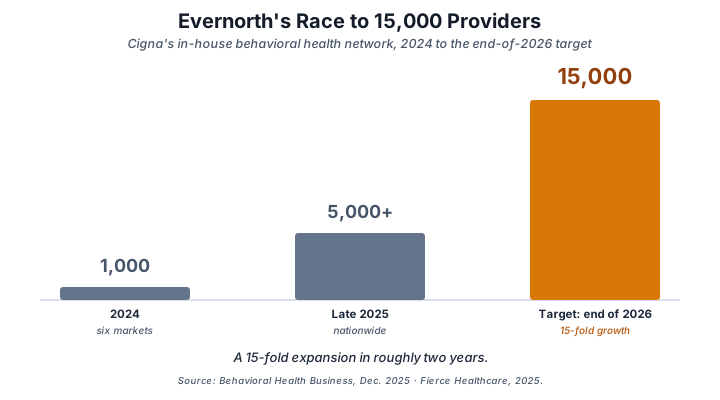
Cigna / Evernorth. Cigna’s health services subsidiary Evernorth launched its Behavioral Care Group in 2024. By late 2025, it had grown from 1,000 providers in six markets to more than 5,000 providers nationwide, with virtual and in-person appointments available. Evernorth’s plan is to reach 15,000 providers by end of 2026 — a 15-fold expansion in roughly two years (Behavioral Health Business, December 2025; Fierce Healthcare, 2025). Evernorth describes its model as using its “relationships with health plans” to identify members experiencing depression, anxiety, or trauma and route them to care within the group. The care group is Cigna’s subsidiary. The health plan is also Cigna’s subsidiary.
Elevance Health / Carelon. Elevance (formerly Anthem) operates Carelon, its health services enterprise, which includes specialty behavioral health services delivered to Elevance’s own members and sold to third-party payers. The structure is the same: insurer and care provider under one parent.
These are not edge cases. They are three of the five largest commercial insurers in the country.
The Gatekeeper Problem
The conflict of interest in payer-owned behavioral health is most acute at the authorization desk.
Prior authorization in behavioral health already functions as a mechanism for limiting access. When I was directing behavioral health programs — including substance abuse programs, a forensic assertive community treatment team, and disaster case management — I watched authorization decisions operate on financial logic dressed in clinical language. That is the tension that prior auth has always created between payer and independent provider.
Now remove the independent provider from the equation. When the payer’s own clinicians are delivering the care, the calculus changes. The question of “how many sessions does this member need?” is now answered by an entity with a direct financial stake in the result — one that benefits from longer courses of care through revenue, and benefits from shorter ones through cost reduction. The clinical determination and the financial incentive live in the same corporate structure.
Behavioral Health Business’s June 2026 analysis framed the core question directly: whether payer-owned care becomes “a gateway to the broader behavioral health ecosystem or evolves into vertically integrated care models that reshape referral patterns and competition across the industry.” The structural incentive is already pointing in one direction.
What This Means for Patients
Members steered to a payer’s in-house care group are not being referred to the best available care. They are being referred to the care their insurer happens to own.
That distinction matters. Independent clinicians carry their own caseloads, maintain their own therapeutic alliances, operate under independent professional obligations, and have no financial stake in their employer’s insurance underwriting decisions. Clinicians employed by a payer-owned group do not have that separation. Their employer writes the prior auth decisions and signs their paychecks.
The practical risk is access restriction framed as care navigation. Evernorth’s model explicitly uses payer data to identify members and route them into its own care group. That routing decision is made by the same entity that controls coverage determinations. A member referred to Evernorth Behavioral Care Group has not received an independent recommendation. They have been directed by their insurer to a provider their insurer owns.
Aetna — owned by CVS Health, itself a major payvider — cut reimbursement rates to independent therapists by 30 to 40 percent in 2025, according to the American Economic Liberties Project, making it functionally untenable for independent clinicians using platforms like Alma to continue accepting Aetna insurance. The pressure on independent therapists through reimbursement cuts, combined with simultaneous investment in in-house capacity, is not coincidence. It is a market architecture that favors the insurer’s own clinical infrastructure over the independent workforce that has historically delivered most outpatient behavioral health care.
What This Means for Independent Clinicians
I have watched the administrative weight on independent clinicians compound steadily: reimbursement rates falling, credentialing requirements tightening, prior auth burdens escalating, documentation requirements growing. Those pressures have always been tied to payer leverage. What is different now is the direction that leverage is pointing.
When a payer also employs therapists directly, independent clinicians are not just competing against each other for referrals. They are competing against their own insurance partners. The payer who decides whether to credential them, whether to approve their treatment plans, and at what rate to reimburse them is also the entity that benefits financially when patients are steered toward its in-house providers instead.
Research on physician vertical integration published in the Proceedings of the National Academy of Sciences in 2024 found that physician-hospital integration produces roughly a 10% increase in referrals to higher-cost facilities affiliated with the parent organization, with counterfactual modeling showing total spending increases of $315 million if primary care were fully integrated. The behavioral health referral dynamic is structurally analogous.
Georgetown University’s Center on Health Insurance Reforms has noted that regulators frequently miss how corporate structures “make it difficult for independent competitors to survive in the market.” Independent behavioral health clinicians are the workforce delivering the majority of outpatient mental health care in this country. They are not an interest group to be managed. They are the infrastructure.
The Legislative Signal
Congress noticed. Senators Elizabeth Warren and Josh Hawley introduced the bipartisan Break Up Big Medicine Act (S.3822, 119th Congress, 2025) — legislation that would prohibit companies from simultaneously owning health plans and provider organizations accepting Medicare payments. The bill was introduced because vertical integration creates structural conflicts of interest that let integrated corporate health giants route patients to their own affiliates while avoiding external accountability.
The Psychotherapy Action Network joined the Break Up Big Medicine coalition in 2025, explicitly naming how insurance conglomerates use structural market power to cut independent therapist reimbursement while building competing in-house capacity.
As of June 2026, the legislation has not passed. The consolidation trend it is responding to continues.
The Question That Does Not Have a Good Answer Yet
Here is what the payer-owned behavioral health model has not answered: who decides whether a member needs mental health care, when the entity making that determination also profits from the outcome?
It is not an abstract question. It is the ethical foundation of the entire care relationship.
We built VibeCheck.luxury on a specific conviction: the clinician holds that determination. Not the insurance company, not the employer, and not the corporate parent of whichever therapy group the insurer happens to own. The clinician signs off. The AI handles the administrative overhead. The patient gets a therapist whose professional obligation is to them — not to an underwriting division two floors up.
That is not a political position. It is what the conflict-of-interest problem actually requires.
FAQ
What does it mean when an insurance company is also a behavioral health provider? It means the same corporate parent controls both whether you can access mental health care (through prior authorization and network decisions) and the care you receive (through its employed therapists). This creates a structural conflict of interest: the entity that profits from limiting care also profits from delivering it. Behavioral Health Business described this in June 2026 as the “payvider” model reshaping referral patterns and competition across behavioral health.
Which insurance companies are building in-house behavioral health services? As of mid-2026: UnitedHealth Group through Optum, which acquired Refresh Mental Health’s 300-plus clinic network in 2022; Cigna through Evernorth’s Behavioral Care Group, which grew from 1,000 to 5,000 clinicians since 2024 and is targeting 15,000 by end of 2026; and Elevance Health through its Carelon behavioral health division. CVS Health’s Aetna is also part of this pattern through CVS’s broader health services ownership structure.
Does being referred to an insurer’s in-house therapist hurt me as a patient? It may limit your choices without disclosing that limitation. When your insurer’s care navigation routes you to a therapist employed by its subsidiary, that is not a clinically neutral referral. The recommendation is made by an entity with a financial stake in where you land. Independent therapists operate outside that corporate structure and have no financial incentive tied to the insurer’s utilization decisions or cost targets.
What is being done about payer-provider conflicts of interest in behavioral health? In 2025, Senators Warren and Hawley introduced the bipartisan Break Up Big Medicine Act (S.3822, 119th Congress), which would prohibit companies from simultaneously owning health plans and provider organizations. The Psychotherapy Action Network joined that campaign explicitly citing mental health. As of June 2026, the legislation has not passed, and vertical integration continues. Several state attorneys general have examined network adequacy, but structural conflict-of-interest regulation at the federal level remains limited.
Sources
- The Winners and Losers When Payers Launch In-House Behavioral Health Services — Behavioral Health Business, June 18, 2026
- Evernorth Plans to Triple Behavioral Health Provider Count, Expand to All 50 States in 2026 — Behavioral Health Business, December 17, 2025
- Evernorth Expands Behavioral Care Group to 5,000 Providers Nationwide — Fierce Healthcare, 2025
- Optum to Lay Off 572 in New Jersey, Cease Behavioral Health Services in the State — Behavioral Health Business, November 5, 2025
- Why the Payvider Model Is Growing in Behavioral Health — Behavioral Health Business, November 26, 2025
- UnitedHealth Reinvigorates Value-Based Care Strategy with Optum at the Core — Behavioral Health Business, January 27, 2026
- Vertical Integration in Health Care: Implications for Consumers, Employers, and Clinicians — Georgetown University Center on Health Insurance Reforms, 2024
- Big Medicine Cuts Therapist Pay, Worsens Mental Health Access Crisis — American Economic Liberties Project, 2025
- How the Move in Congress to Banish Payvider Groups Will Impact Behavioral Health — Behavioral Health Business, September 22, 2025
- The Effects of Physician Vertical Integration on Referral Patterns, Patient Welfare, and Market Dynamics — PMC / National Library of Medicine, 2024
Disclaimer
Disclaimer
This article is for educational and informational purposes only. It does not constitute medical, clinical, legal, or therapeutic advice, and reading it does not create a therapist-client relationship with Matthew Sexton, LCSW or Mental Wealth Solutions, Inc. Although the author is a licensed clinical social worker, the content in this article is not clinical assessment, diagnosis, or treatment.
The business strategies, market dynamics, and conflict-of-interest concerns described here reflect publicly available reporting, regulatory filings, and general analysis as of the publication date. Conditions in the insurance market change quickly. For questions about your specific health plan’s behavioral health coverage and provider network, contact your plan directly or consult a licensed benefits consultant.
If you are in immediate emotional crisis, you can reach the 988 Suicide & Crisis Lifeline by calling or texting 988 (US). If you are experiencing domestic violence or are in physical danger, contact the National Domestic Violence Hotline at 1-800-799-7233 or visit thehotline.org. In a life-threatening emergency, call 911.
If you're the therapist here.
Your clients get 4 sessions a month. The other 26 days they're on their own. VibeCheck.luxury is the between-session companion that carries those days back to you — clients check in daily, and you walk in already knowing what kind of week it was. Built by Matthew Sexton, LCSW, NATC.